信用债收益率

Search documents
信用:谁在推动市场下行?
NORTHEAST SECURITIES· 2026-03-09 06:11
1. Report Industry Investment Rating No relevant content provided. 2. Core Viewpoints of the Report - Affected by the monetary policy statements during the Two Sessions, long - term interest rates such as 10Y/30Y slightly increased, but ordinary credit bonds saw a decline in yields across all maturities due to buying pressure, with the spreads of ordinary credit bonds over 4Y slightly compressed. After a continuous decline, the secondary and perpetual bonds showed little change this week, and the credit spreads slightly widened [1][10]. - Fund companies are the main buyers of non - financial credit bonds with maturities within 5 years, and other types of funds are the main buyers of ultra - long - term credit bonds with maturities over 5 years. The buying intensity of both is at a high level in recent years. The current situation of banks, insurance, securities firms, and wealth management products is relatively normal. The buying of 3 - 5Y ordinary credit bonds by fund companies is mainly driven by the position - building of amortized - cost bond funds, and it is speculated that wealth management products are still the main buying force among other institutions [2][12]. - Currently, the yield quantiles of credit bonds are at a relatively low level in history, especially for ordinary credit bonds with maturities of 2 years and less, whose yields are at an absolute historical low. There is still room for the yields and spreads of medium - and long - term credit bonds to decline, but it may be difficult to compress the term spreads as the term spreads of medium - and long - term credit bonds are still at a high level, and the term spreads of credit bonds are difficult to move independently from those of treasury bonds [3][19][24]. - It is recommended to seek certainty in short - term bonds. In the current situation of loose capital interest rates, it is advisable to look for coupon income in credit bonds with a maturity of about 2 years. For secondary and perpetual bonds, although the price ratio has recovered recently, it is still necessary to wait appropriately. The reasonable price ratio range of 5 - year AAA - secondary bonds to 5Y AAA medium - term notes in March is 10 - 20bp. For ultra - long - term credit bonds, although they have performed strongly, more caution is needed due to high interest rate uncertainty [4][31][34]. 3. Summary According to Relevant Catalogs 3.1 Who is Driving the Market to Heat Up? - **Market Performance**: Affected by the tight - leaning monetary policy statements during the Two Sessions, long - term interest rates such as 10Y/30Y slightly increased. Ordinary credit bonds saw a decline in yields across all maturities due to buying pressure, with the spreads of ordinary credit bonds over 4Y slightly compressed. After a continuous decline, the secondary and perpetual bonds showed little change this week, and the credit spreads slightly widened [1][10]. - **Buying Forces**: Fund companies are the main buyers of non - financial credit bonds with maturities within 5 years, and other types of funds are the main buyers of ultra - long - term credit bonds with maturities over 5 years. The buying intensity of both is at a high level in recent years. The buying of 3 - 5Y ordinary credit bonds by fund companies is mainly driven by the position - building of amortized - cost bond funds. Other institutions are buying ordinary credit bonds in an above - seasonal manner, and it is speculated that wealth management products are still the main buying force [2][12][13]. - **Pricing Ability**: By comparing institutional buying and corresponding interest rate trends, it can be seen that funds still have strong marginal pricing ability, while the net buying of other institutions has a relatively weaker impact on credit bond pricing [17]. 3.2 Can the Medium - and Long - Term End Continue to Decline? - **Yield Quantiles**: Currently, the yield quantiles of credit bonds are at a relatively low level in history, especially for ordinary credit bonds with maturities of 2 years and less, whose yields are at an absolute historical low. The yield quantiles of medium - and long - term credit bonds are slightly higher due to the significantly higher medium - and long - term interest rates compared to 2025 [19][20]. - **Term Spreads**: The term spread quantiles of medium - and long - term credit bonds are significantly higher than the yield quantiles. There is still room for the term spreads of 10Y/1Y AAA medium - term notes to decline. However, it may be difficult to further compress the term spreads as the term spreads of medium - and long - term credit bonds are still at a high level, and the term spreads of credit bonds are difficult to move independently from those of treasury bonds [21][22][24]. 3.3 How to Participate? - **Short - Term Bonds**: It is recommended to seek certainty in short - term bonds. In the current situation of loose capital interest rates, which are likely to remain so in the future, the certainty of the short - end is still high. It is advisable to look for coupon income in credit bonds with a maturity of about 2 years [31]. - **Secondary and Perpetual Bonds**: After being driven by fixed - income plus funds earlier, the price ratio of secondary and perpetual bonds has recovered recently, but it is still necessary to wait appropriately. The reasonable price ratio range of 5 - year AAA - secondary bonds to 5Y AAA medium - term notes in March is 10 - 20bp [31]. - **Ultra - Long - Term Credit Bonds**: Although ultra - long - term credit bonds have performed strongly, more caution is needed due to high interest rate uncertainty. The trading volume of ultra - long - term credit bonds has increased again this week, banks' net selling has slightly increased, credit spreads are hovering at the bottom, and the yield curve has touched the lower limit of 2 - standard - deviation again, all indicating bearish signals [34].
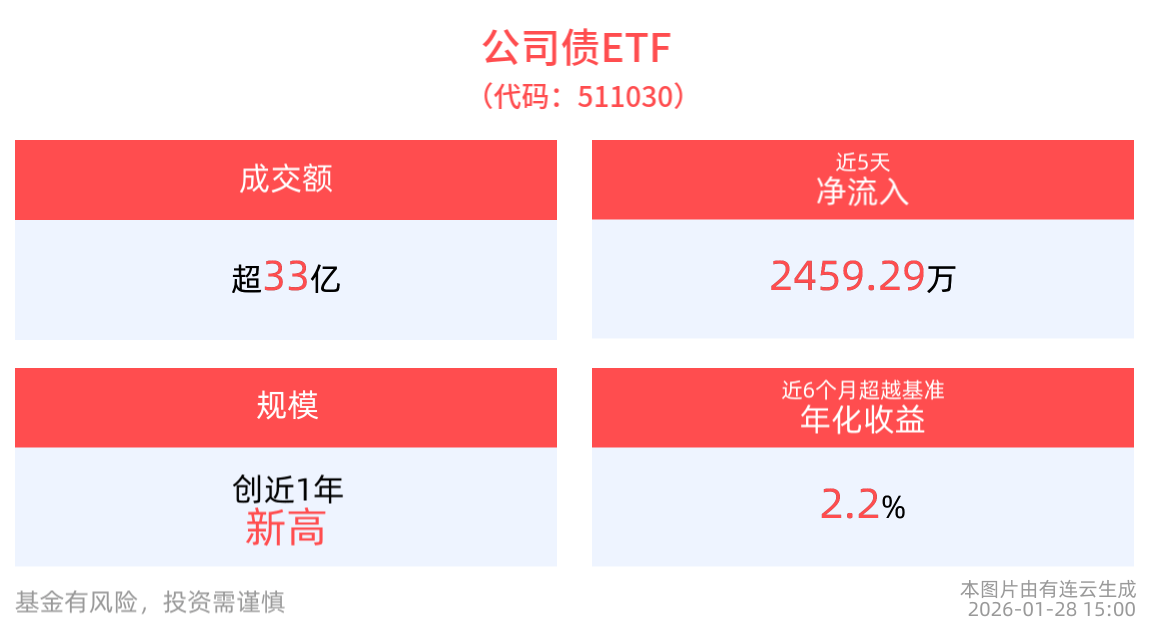
成交额超33亿元,公司债ETF(511030)近5个交易日净流入2459.29万元
Sou Hu Cai Jing· 2026-01-29 01:42
Group 1 - The yield on credit bonds showed mixed results, with most secondary market yields for major banks rising, particularly the 10Y yield increasing by 0.31 basis points and the 7Y yield rising by 1.15 basis points [1] - In the corporate bond market, the majority of yields decreased, with notable declines such as the 25 Kunming Transportation CP001 down by 9.15 basis points and the 24 Xijiang MTN001 down by 4.7 basis points [2] - The company bond ETF (511030) is currently priced at 106.88 yuan, reflecting a 1.49% increase over the past year, with a trading volume of 33.74 billion yuan and a turnover rate of 9.88% [4] Group 2 - The company bond ETF has reached a new high in scale at 341.79 billion yuan, with a recent inflow of 24.59 million yuan over the last five trading days [4] - The tracking error for the company bond ETF this year is 0.007%, closely following the China Bond - Medium to High Grade Corporate Bond Spread Factor Index [5] - The management fee for the company bond ETF is set at 0.15%, while the custody fee is 0.05% [4]

信用债周报:成交规模下降,收益率上行-20251209
BOHAI SECURITIES· 2025-12-09 11:32
1. Report Industry Investment Rating No relevant information provided. 2. Core Viewpoints of the Report - In the current period (December 1 - 7, 2025), most of the issuance guidance rates announced by the National Association of Financial Market Institutional Investors declined, with an overall change range of -6 BP to 2 BP. The issuance scale of credit bonds decreased month - on - month. The issuance amount of enterprise bonds increased, while that of other varieties decreased. The net financing of credit bonds decreased month - on - month, with the net financing of enterprise bonds and commercial paper increasing, and that of other varieties decreasing. The net financing of enterprise bonds was negative, while that of other varieties was positive [2][13][60]. - In the secondary market, the trading amount of credit bonds decreased month - on - month. The trading amounts of private placement notes and commercial paper increased, while those of other varieties decreased. The yields of credit bonds all increased in the current period. The credit spreads of medium - and short - term notes, enterprise bonds, and urban investment bonds were differentiated, generally showing a widening at the short end and a narrowing at the medium - and long - ends [2][17][60]. - From the perspective of absolute returns, insufficient supply and relatively strong allocation demand will drive the credit bond market to continue its recovery. Although fluctuations and adjustments are inevitable under the influence of multiple factors, the conditions for a full - scale bear market in the credit bond market are still insufficient. In the long run, yields are still in a downward channel, and the strategy of increasing positions during adjustments is still feasible. Currently, the cost - effectiveness of most varieties for allocation has decreased, and caution is needed when chasing high prices. The coupon strategy can be moderately optimistic in the current allocation thinking, and the trading thinking should remain optimistic. When selecting bonds, the focus should be on the trend of interest - rate bonds while paying attention to the coupon value of individual bonds. From the perspective of relative returns, although the compression space of credit spreads at all tenors is insufficient at present, the probability of a one - sided correction in the short term is also low. Therefore, investors can still achieve the coupon strategy through credit - quality downgrading and extending the duration according to their own capital characteristics, but they need to pay attention to the rhythm during allocation [2][60]. - The central and local governments have been continuously optimizing real estate policies. The support policies have been continuously strengthened, actively releasing rigid and improving housing demand, which has played a positive role in promoting the stabilization of the real estate market. Although the real estate market is still in the transition period between the old and new models, with the effectiveness of various policies to stabilize the property market, the real estate market is moving towards stabilization. In the future, policies to promote the high - quality development of the real estate market are expected. For real estate bonds, the sales recovery process will have a significant impact on bond valuations. As the market shows signs of stabilization, funds with higher risk appetite can consider early layout, especially focusing on enterprises with outstanding performance in new financing and sales recovery. The focus of allocation should still be on central and state - owned enterprises with stable historical valuations and excellent performance, as well as high - quality private - enterprise bonds with strong guarantees. Investors can extend the duration to increase returns and also appropriately play the trading opportunities brought by the valuation repair of bonds of undervalued real - estate enterprises [3][61]. - For urban investment bonds, under the principle of coordinating development and security, the probability of default of urban investment bonds is very low, and they can still be a key allocation variety of credit bonds. Under the strict supervision of promoting the clearance of local financing platforms in an orderly and effective manner, the reform and transformation of financing platforms are accelerating. Attention should be paid to the reform and transformation opportunities of "entity - type" financing platforms. From the perspective of coupon income, investors can be appropriately active. The allocation strategy can give priority to credit - quality downgrading at the medium - and short - ends, and the trading strategy can still choose to extend the duration of medium - and high - grade bonds [4][61][62]. 3. Summary According to Relevant Catalogs 3.1 Primary Market Situation 3.1.1 Issuance and Maturity Scale - In the current period (December 1 - 7, 2025), a total of 291 credit bonds, including enterprise bonds, corporate bonds, medium - term notes, commercial paper, and private placement notes, were issued, with an issuance amount of 232.914 billion yuan, a month - on - month decrease of 32.35%. The net financing of credit bonds was 54.159 billion yuan, a month - on - month decrease of 6.974 billion yuan [13]. - By variety, 1 enterprise bond was issued, with an issuance amount of 1 billion yuan and a net financing of - 3.292 billion yuan, a month - on - month increase of 3.854 billion yuan. 110 corporate bonds were issued, with an issuance amount of 75.694 billion yuan, a month - on - month decrease of 6.20%, and a net financing of 17.749 billion yuan, a month - on - month decrease of 8.128 billion yuan. 78 medium - term notes were issued, with an issuance amount of 61.583 billion yuan, a month - on - month decrease of 62.30%, and a net financing of 14.611 billion yuan, a month - on - month decrease of 81.694 billion yuan. 80 commercial papers were issued, with an issuance amount of 82.462 billion yuan, a month - on - month decrease of 1.88%, and a net financing of 24.686 billion yuan, a month - on - month increase of 23.237 billion yuan. 22 private placement notes were issued, with an issuance amount of 12.175 billion yuan, a month - on - month decrease of 24.73%, and a net financing of 405 million yuan, a month - on - month decrease of 709 million yuan [13]. 3.1.2 Issuance Interest Rates - Most of the issuance guidance rates announced by the National Association of Financial Market Institutional Investors declined, with an overall change range of -6 BP to 2 BP. By tenor, the interest rate of 1 - year varieties changed from -6 BP to 1 BP, that of 3 - year varieties changed from -5 BP to 2 BP, that of 5 - year varieties changed from -5 BP to 0 BP, and that of 7 - year varieties changed from -3 BP to 0 BP. By rating, the interest rate of key AAA - rated and AAA - rated varieties changed from -2 BP to 2 BP, that of AA + - rated varieties changed from -1 BP to 0 BP, that of AA - rated varieties changed from -3 BP to -2 BP, and that of AA - - rated varieties changed from -6 BP to -3 BP [15]. 3.2 Secondary Market Situation 3.2.1 Market Trading Volume - In the current period (December 1 - 7, 2025), the total trading amount of credit bonds was 817.532 billion yuan, a month - on - month decrease of 7.60%. The trading amounts of enterprise bonds, corporate bonds, medium - term notes, commercial paper, and private placement notes were 17.007 billion yuan, 317.964 billion yuan, 281.89 billion yuan, 144.869 billion yuan, and 55.802 billion yuan respectively. The trading amount of credit bonds decreased month - on - month. The trading amounts of private placement notes and commercial paper increased, while those of other varieties decreased [17]. 3.2.2 Credit Spreads - For medium - and short - term notes, the credit spreads of each variety were differentiated. Specifically, the credit spreads of 1 - year and 5 - year notes widened, while those of 3 - year and 7 - year notes narrowed [20]. - For enterprise bonds, the credit spreads of each variety were differentiated. Specifically, the 1 - year credit spread widened; among the 3 - year bonds, the credit spread of AA + - rated varieties widened, while those of other varieties narrowed; among the 5 - year bonds, the credit spreads of AAA - rated and AA - - rated varieties narrowed, while those of AA + - rated and AA - rated varieties widened; the 7 - year credit spread narrowed [27]. - For urban investment bonds, the credit spreads of each variety were differentiated. Specifically, the 1 - year credit spread widened; among the 3 - year bonds, the credit spread of AA - - rated varieties widened, while those of other varieties narrowed; among the 5 - year bonds, the credit spread of AA + - rated varieties widened, while those of other varieties narrowed; the 7 - year credit spread narrowed [36]. 3.2.3 Term Spreads and Rating Spreads - For AA + medium - and short - term notes: In terms of term spreads, the 3Y - 1Y spread narrowed by 0.26 BP, the 5Y - 3Y spread widened by 2.87 BP, and the 7Y - 3Y spread widened by 1.94 BP. Currently, the 3Y - 1Y spread is at a relatively low historical level, at the 32.1% quantile, the 5Y - 3Y spread is at a relatively low historical level, at the 23.6% quantile, and the 7Y - 3Y spread is at a relatively low historical level, at the 29.0% quantile. In terms of rating spreads, the (AA - )-(AAA) spread of 3 - year medium - and short - term notes narrowed by 2.00 BP, the (AA)-(AAA) spread narrowed by 1.00 BP, and the (AA + )-(AAA) spread narrowed by 1.00 BP. Currently, the (AA - )-(AAA) spread is at a historical low, at the 0.0% quantile, the (AA)-(AAA) spread is at a historical low, at the 3.7% quantile, and the (AA + )-(AAA) spread is at a low level, at the 1.0% quantile [44]. - For AA + enterprise bonds: In terms of term spreads, the 3Y - 1Y spread widened by 2.92 BP, the 5Y - 3Y spread widened by 1.28 BP, and the 7Y - 3Y spread narrowed by 2.23 BP. Currently, the 3Y - 1Y spread is at a relatively low historical level, at the 31.7% quantile, the 5Y - 3Y spread is at a relatively low historical level, at the 26.5% quantile, and the 7Y - 3Y spread is at a relatively low historical level, at the 28.2% quantile. In terms of rating spreads, the (AA - )-(AAA) spread of 3 - year enterprise bonds narrowed by 1.00 BP, the (AA)-(AAA) spread remained the same as the previous period, and the (AA + )-(AAA) spread widened by 2.00 BP. Currently, the (AA - )-(AAA) spread is at a historical low, at the 0.7% quantile, the (AA)-(AAA) spread is at a historical low, at the 6.1% quantile, and the (AA + )-(AAA) spread is at a historical low, at the 1.5% quantile [50]. - For AA + urban investment bonds: In terms of term spreads, the 3Y - 1Y spread narrowed by 0.99 BP, the 5Y - 3Y spread widened by 1.12 BP, and the 7Y - 3Y spread narrowed by 0.73 BP. Currently, the 3Y - 1Y spread is at a relatively low historical level, at the 36.2% quantile, the 5Y - 3Y spread is at a relatively low historical level, at the 24.4% quantile, and the 7Y - 3Y spread is at a relatively low historical level, at the 30.1% quantile. In terms of rating spreads, the (AA - )-(AAA) spread of 3 - year urban investment bonds widened by 1.99 BP, the (AA)-(AAA) spread widened by 0.99 BP, and the (AA + )-(AAA) spread narrowed by 0.01 BP. Currently, the (AA - )-(AAA) spread is at a historical low, at the 10.1% quantile, the (AA)-(AAA) spread is at a historical low, at the 5.4% quantile, and the (AA + )-(AAA) spread is at a historical low, at the 0.8% quantile [53]. 3.3 Credit Rating Adjustment and Default Bond Statistics 3.3.1 Credit Rating Adjustment Statistics - According to iFinD statistics, there were no company rating (including outlook) adjustments in the current period (December 1 - 7, 2025) [58]. 3.3.2 Default and Extended - Maturity Bond Statistics - In terms of bond defaults, according to iFinD statistics, there were no credit bond defaults in the current period (December 1 - 7, 2025). - In terms of bond extensions, according to iFinD statistics, there were no credit bond extensions in the current period (December 1 - 7, 2025) [59]. 3.4 Investment Views - The views are consistent with the core viewpoints of the report, including the analysis of the primary and secondary markets of credit bonds, the judgment of the credit bond market from the perspectives of absolute and relative returns, the analysis of the real estate market and real estate bonds, and the analysis of urban investment bonds [60][61][62].
信用周报20251207:2026年信用债供给怎么看?-20251208
Western Securities· 2025-12-08 08:23
1. Report Industry Investment Rating No industry investment rating is provided in the report. 2. Core Views of the Report - In 2026, the overall supply of credit bonds is expected to increase, with a total net financing of 3.13 trillion yuan, up 330.5 billion yuan from 2025. Industrial bonds will be the main contributor, with a net financing of 2.5 trillion yuan [1][9]. - The regulatory tightening on urban investment platforms will continue in 2026, and the net financing of urban investment bonds is expected to shrink further to -416.3 billion yuan. The net financing of non - bank institutional bonds is expected to increase to 44.29 billion yuan. The net financing of commercial bank financial bonds is expected to be close to 2025, at 24.43 billion yuan, and the net financing of bank secondary and perpetual bonds may drop to 36.44 billion yuan [1][10][19]. - In the week of 2025/12/1 - 12/5, the yields of credit bonds increased across the board. Non - financial credit bonds performed better than financial bonds, and among financial bonds, 10 - year brokerage sub - bonds performed best. Looking ahead, credit bonds may show a volatile trend, and a coupon strategy is recommended [2][24]. 3. Summary by Relevant Catalogs 3.1 2026 Credit Bond Supply Estimation - Overall, in 2026, driven by the growth of industrial bond net financing, the supply of credit bonds is expected to increase. Industrial bonds are the main contributor to supply, with a net financing of 2.5 trillion yuan, an increase of 468.6 billion yuan from 2025 [9][15]. - Urban investment bonds: Due to continued strict supervision, the net financing is expected to shrink to -416.3 billion yuan, a decrease of 212.4 billion yuan from 2025 [10]. - Non - bank institutional bonds: With the expected recovery of the equity market, the full implementation of the I9 standard, and high refinancing pressure, the net financing is expected to reach 44.29 billion yuan, an increase of 11.97 billion yuan from 2025 [10]. - Commercial bank financial bonds: Under the policy guidance of淡化 "scale concept", the net financing is expected to be 24.43 billion yuan, close to 2025 [19]. - Bank secondary and perpetual bonds: Affected by factors such as state - owned bank capital injection, debt replacement, and the substitution of TLAC bonds, the net financing is expected to be 36.44 billion yuan, a decrease of 46.3 billion yuan from 2025 [19]. 3.2 Credit Bond Yield Overview - In the week of 2025/12/1 - 12/5, credit bond yields increased across the board. Non - financial credit bonds outperformed financial bonds, and among financial bonds, 10 - year brokerage sub - bonds performed best [24]. - Urban investment bonds generally showed a feature that the longer the duration, the greater the increase in yield. The 10 - year bonds had the largest average increase of 7bp [24]. - Industrial bonds: High - rating and short - duration bonds had a significantly lower average increase in yield than other types of bonds [24]. - Financial bonds: The increase in yield was generally greater than that of general credit bonds of the same term, and short - duration bonds had a smaller increase than medium - and long - duration bonds [25]. 3.3 Primary Market 3.3.1 Issuance Volume - In the week of December 1 - 5, 2025, the issuance scale of credit bonds decreased both month - on - month and year - on - year. The net financing decreased month - on - month and increased year - on - year. The net financing of urban investment bonds, industrial bonds, and financial bonds decreased by 4 billion yuan, 74.2 billion yuan, and 37.9 billion yuan respectively month - on - month [35]. 3.3.2 Issuance Cost - The average issuance interest rate of credit bonds increased. The average issuance interest rate of urban investment bonds decreased by 1.4bp month - on - month, while that of industrial and financial bonds increased by 15.8bp and 4.6bp respectively [41]. 3.3.3 Issuance Term - The average issuance term of credit bonds decreased month - on - month. The average issuance terms of urban investment bonds, industrial bonds, and financial bonds decreased by 0.13 years, 0.02 years, and 0.19 years respectively [45]. 3.3.4 Cancellation of Issuance - In the week of December 1 - 5, 2025, the number of credit bond cancellations increased month - on - month, while the scale decreased. Nine bonds were cancelled, an increase of 2 from the previous week, and the total cancellation scale was 3.738 billion yuan, a decrease of 0.479 billion yuan [47]. 3.4 Secondary Market 3.4.1 Trading Volume - The trading volume of all types of credit bonds decreased compared with the previous week, and the trading volume of industrial bonds decreased by more than 50 billion yuan [53]. - In terms of remaining term, the trading terms of urban investment and industrial bonds extended, while the trading term of bank secondary capital bonds shortened [53]. 3.4.2 Trading Liquidity - This week, the turnover rates of industrial and financial bonds decreased, while that of urban investment bonds remained flat. Among different terms, the turnover rates of different types of bonds showed different trends [56]. 3.4.3 Spread Tracking - This week, the spreads of urban investment bonds narrowed for most bond types, except for 1 - year, 10 - year, and 5 - year AA + and AA(2) bonds. The spreads of bank secondary and perpetual bonds widened across the board, and the spreads of brokerage sub - bonds mostly widened, while those of insurance sub - bonds widened across the board [64][70][72]. 3.5 Weekly Hot Bonds Overview - Based on qeubee's bond liquidity scores, the top 20 urban investment bonds, industrial bonds, and financial bonds in terms of liquidity are selected for investors' reference [74]. 3.6 Credit Rating Adjustment Review - According to domestic rating agencies, this week, the debt rating of 1 bond was upgraded, and there was no downgrade of debt ratings [80].
信用分析周报:关注税收新规后的信用价值提升-20250803
Hua Yuan Zheng Quan· 2025-08-03 12:52
1. Report Industry Investment Rating - No specific industry investment rating is provided in the report. 2. Core Viewpoints of the Report - The credit bond market has recovered after last week's adjustment caused by the "anti - involution" trend. On August 1st, under the influence of the tax new policy, the cost - performance of credit bonds has been passively improved. It is recommended to continue to pay attention to long - duration sinking urban investment bonds, capital bonds, and insurance sub - debt. Specifically, long - duration capital bonds of Minsheng Bank, Bohai Bank, and Hengfeng Bank are strongly recommended. There is an optimistic view on urban investment dim sum bonds and US dollar bonds, and opportunities in capital bonds of Tianjin Bank, Beibu Gulf Bank, and China Property Insurance are worth attention [3][45]. 3. Summary by Directory 3.1 Weekly Market Overview - **Primary Market**: This week, the issuance volume, repayment volume, and net financing of traditional credit bonds decreased significantly compared with last week. The net financing of asset - backed securities decreased by 46.5 billion yuan compared with last week. The weighted average issuance interest rates of industrial bonds and urban investment bonds increased, while the issuance cost of financial bonds decreased to varying degrees [1][8][20]. - **Secondary Market**: The trading volume of credit bonds decreased by 73.8 billion yuan compared with last week. In terms of turnover rate, the turnover rate of credit bonds showed mixed trends compared with last week, and the turnover rate of asset - backed securities rebounded. The yields of most credit bonds with different maturities and ratings decreased, except that the yield of AAA + credit bonds over 10 years increased slightly. Overall, the credit spreads of different industries and ratings fluctuated, with a maximum amplitude of no more than 5BP [2][25][31]. - **Negative Public Opinions**: A total of 58 bond implicit ratings were downgraded this week. Among them, 38 bond implicit ratings of Financial Street Holding Co., Ltd. were downgraded. The "21 Meibi 01" bond issued by Xi'an Qujiang Meibi Lake Investment and Construction Co., Ltd. was placed on the watch list. The entity rating of Guizhou Huaxi Rural Commercial Bank Co., Ltd. was downgraded, and the rating of its "21 Huaxi Rural Commercial Secondary 01" bond was also downgraded. The entity rating of Guiyang Baiyun Industrial Development Investment Co., Ltd. was downgraded, and the rating of its "19 Baiyun Industrial Investment Bond 01" bond was downgraded. The "19 Contemporary 01" bond issued by Contemporary Energy - Saving Real Estate Co., Ltd. was extended [2][42]. 3.2 Primary Market - **Net Financing Scale**: The net financing of credit bonds (excluding asset - backed securities) was 100.6 billion yuan this week, a decrease of 286.1 billion yuan compared with last week. The net financing of asset - backed securities was - 12.4 billion yuan, a decrease of 46.5 billion yuan compared with last week. By product type, the net financing of urban investment bonds, industrial bonds, and financial bonds decreased compared with last week [8]. - **Issuance Cost**: The weighted average issuance interest rates of industrial bonds and urban investment bonds increased. Specifically, the issuance interest rates of AA, AA +, and AAA urban investment bonds increased by 10BP, 13BP, and 10BP respectively compared with last week, and those of AA, AA +, and AAA industrial bonds increased by 12BP, 14BP, and 14BP respectively. The issuance interest rate of AA + financial bonds decreased by 25BP, and that of AAA financial bonds decreased slightly by 4BP [20]. 3.3 Secondary Market - **Trading Volume**: The trading volume of credit bonds (excluding asset - backed securities) decreased by 73.8 billion yuan compared with last week. Among them, the trading volume of urban investment bonds increased by 13.8 billion yuan, the trading volume of industrial bonds decreased by 28.2 billion yuan, and the trading volume of financial bonds decreased by 59.4 billion yuan. The trading volume of asset - backed securities increased by 2.1 billion yuan [21]. - **Turnover Rate**: The turnover rate of credit bonds showed mixed trends compared with last week. The turnover rate of urban investment bonds increased by 0.08 pct, the turnover rate of industrial bonds decreased by 0.17 pct, and the turnover rate of financial bonds decreased by 0.41 pct. The turnover rate of asset - backed securities increased by 0.07 pct [22]. - **Yields**: The yields of most credit bonds with different maturities and ratings decreased, except that the yield of AAA + credit bonds over 10 years increased slightly. For example, the yields of AA, AAA -, and AAA + credit bonds within 1 year decreased by 3BP, 3BP, and 2BP respectively compared with last week [25]. - **Credit Spreads**: Overall, the credit spreads of different industries and ratings fluctuated, with a maximum amplitude of no more than 5BP. The credit spreads of AA banks, AA + mining and non - banking finance, and AAA electrical equipment industries compressed relatively significantly, within the range of 3 - 4BP. The credit spreads of AA + comprehensive and food and beverage industries widened relatively significantly, within the range of 4 - 5BP [31]. - **Urban Investment Bonds**: The credit spreads of urban investment bonds within 1 year compressed slightly, while those of other maturities widened slightly. In terms of regions, most urban investment credit spreads widened [34][35]. - **Industrial Bonds**: The credit spreads of industrial bonds fluctuated slightly within 5BP as a whole, and the spreads of 3 - 5Y industrial bonds were under pressure and adjusted slightly [38]. - **Bank Capital Bonds**: The credit spreads of bank Tier 2 and perpetual bonds performed well, with different maturities and ratings compressing by 2 - 5BP [39]. 3.4 Investment Recommendations - The central bank achieved a net injection of 6.9 billion yuan this week. The DR001 decreased from 1.40% at the close on Monday to 1.25%. The Shanghai Composite Index closed at 3560 points, and the equity market cooled down and corrected. Commodity futures may have corrected synchronously due to the cooling of the "anti - involution" sentiment. It is necessary to continue to pay attention to the development direction of the "anti - involution" market in the future [44]. - The credit spreads of different industries and ratings fluctuated slightly. It is recommended to continue to focus on long - duration sinking urban investment bonds, capital bonds, and insurance sub - debt, and pay attention to relevant investment opportunities [45].
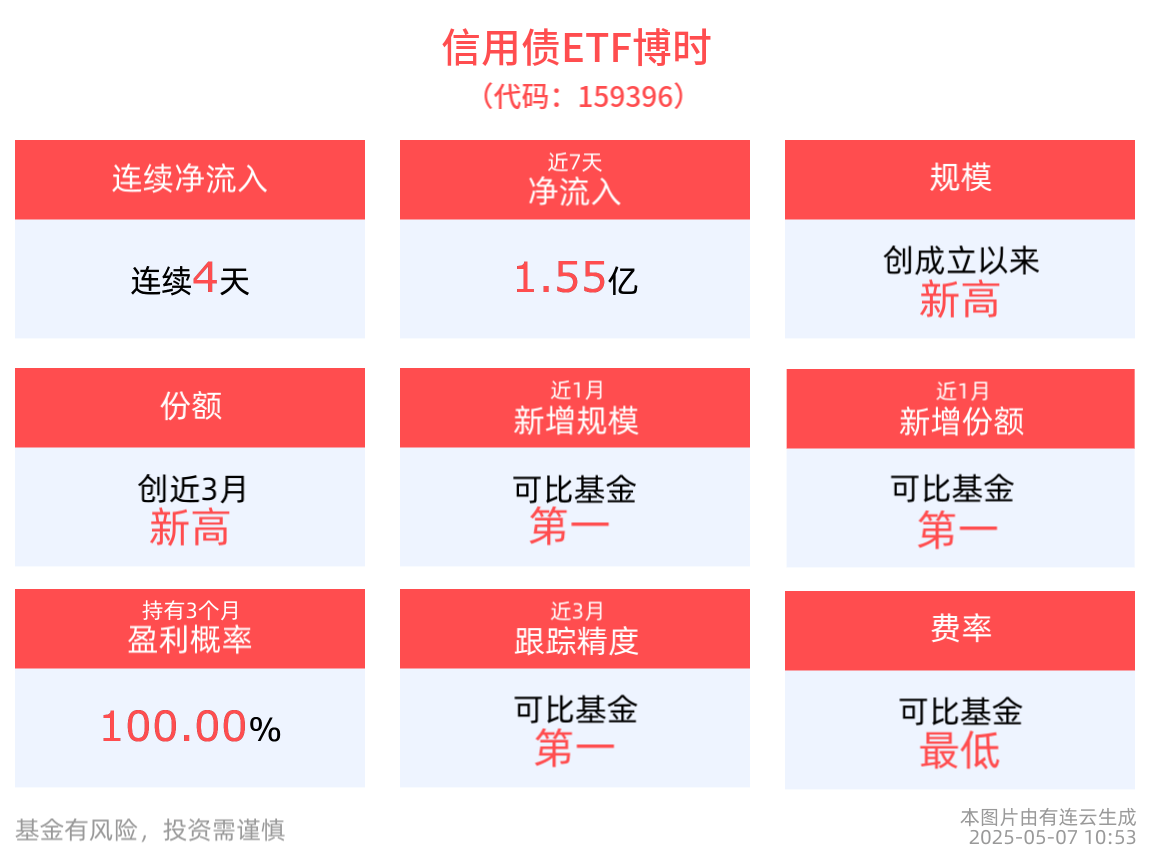
央行重磅释放万亿流动性!信用债ETF博时(159396)盘中飘红,连续4天净流入
Sou Hu Cai Jing· 2025-05-07 03:16
Group 1 - The People's Bank of China announced a 0.5 percentage point reserve requirement ratio cut, providing approximately 1 trillion yuan in long-term liquidity to the market, along with a 0.1 percentage point reduction in policy interest rates [2] - The credit bond ETF from Bosera has seen a recent increase of 0.02%, with a latest price of 100.42 yuan, and a turnover rate of 0.6% during the trading session [2] - The average daily trading volume of the Bosera credit bond ETF over the past month reached 2.165 billion yuan [2] Group 2 - West Securities predicts a significant likelihood of a downward trend in credit bond yields in May, influenced by fundamental and monetary factors [3] - The Bosera credit bond ETF closely tracks the Shenzhen benchmark market-making credit bond index, reflecting the operational characteristics of the Shenzhen credit bond market [3] - The latest scale of the Bosera credit bond ETF reached 5.504 billion yuan, marking a new high since its inception and ranking in the top quarter among comparable funds [3] Group 3 - The Bosera credit bond ETF has experienced continuous net inflows over the past four days, with a maximum single-day net inflow of 100 million yuan, totaling 155 million yuan in net inflows [3] - Since its inception, the Bosera credit bond ETF has recorded a maximum drawdown of 0.89%, with a relative benchmark drawdown of 0.10% [4] - The management fee for the Bosera credit bond ETF is 0.15%, and the custody fee is 0.05%, which are the lowest among comparable funds [4]