
原油制裁

Search documents
油运重磅专家解读-美接管委内原油对贸易格局的影响
2026-01-16 02:53
Summary of Key Points from Conference Call Records Industry Overview - The records focus on the global oil market, particularly the impacts of geopolitical crises and sanctions on oil supply and pricing dynamics, with a specific emphasis on Venezuela, Iran, and Russia [1][2][3]. Core Insights and Arguments - **Venezuela's Oil Production**: Venezuela's oil production is limited and primarily exported to China, resulting in minimal direct impact on the global market. However, the situation in Venezuela has eased the demand for heavy crude from U.S. Gulf Coast refineries, while increasing reliance on Russian ESPO and Basrah blend by Chinese independent refiners, leading to unstable operating rates and increased production costs [1][2][3]. - **Iran's Oil Production**: Iran's oil output exceeds 3 million barrels per day, and any sanctions or disruptions could have a broader impact on global oil prices and supply chains compared to Venezuela. Recent tensions have led to a rapid increase in oil prices and a widening price differential between heavy and light crude [2][3]. - **Impact on Diesel Supply in Europe**: Europe faces challenges in diesel supply due to its reliance on U.S. imports. If Venezuelan crude supply is disrupted, combined with limited access to cheap Ural crude from India, the diesel supply in Europe will become increasingly tight, raising concerns about price differentials and supply security [7][8]. - **Tail Oil Market Dynamics**: The tail oil market accounts for less than 8% of the total market share, but its long-term impact on downstream refining product structures is significant. A decrease in tail oil production could lead to an increase in light naphtha output, thereby reshaping global arbitrage flows [5][6]. - **Transportation Market Effects**: A decline in tail oil production in the U.S. due to reduced Venezuelan crude could increase the outflow of light naphtha to other regions, particularly Asia. Historical data indicates a rise in arbitrage opportunities, which may lead to short-term freight rate fluctuations [6][11]. - **Future of Venezuelan Oil Production**: If Venezuelan oil production recovers to over 1 million barrels per day, the ability of the U.S., China, Russia, and India to absorb this supply remains uncertain. China is unlikely to return to its 2017 import levels, while India prefers discounted Russian crude [12]. Additional Important Insights - **Comparative Analysis of Sanctions**: The sanctions imposed on Venezuela, Iran, and Russia differ significantly. Venezuela's sanctions focus on asset seizures, while Russia's sanctions aim to limit its revenue without causing drastic price fluctuations. Iran faces more stringent sanctions, impacting its market influence [13][19]. - **Long-term Production Outlook**: The outlook for Russian oil production remains bleak due to aging infrastructure, while Iran may increase production before 2025, supported by Chinese purchases and STS transfers, despite facing severe sanctions [14][16]. - **India's Role in Oil Imports**: India currently plays a minor role in global heavy oil imports, primarily relying on discounted Russian and Iranian oil. Its strategy is influenced by geopolitical factors and the need to balance compliance with cost [15][17]. - **Geopolitical Responses**: Middle Eastern oil producers typically do not significantly increase production to fill gaps caused by crises in other regions but may lower sales prices to attract buyers, reflecting a shift in strategy since 2015 [20]. - **Market Volatility**: The volatility in Iranian oil supply has not prompted significant increases in production from Saudi Arabia or Iraq, leading to a shift in European refiners towards Latin American crude sources [21][22]. This summary encapsulates the critical insights and implications for the oil market as discussed in the conference call records, highlighting the interconnectedness of geopolitical events and their impact on global oil supply and pricing.
油气股开盘强势上涨!原油储量世界第一的委内瑞拉,产量为何不到1%
Di Yi Cai Jing· 2026-01-05 02:09
Core Viewpoint - The recent military action by the U.S. against Venezuela, including the capture of President Maduro, is expected to lead to significant investments by U.S. oil companies in Venezuela's oil infrastructure, potentially revitalizing the country's oil production and exports [1] Group 1: Venezuela's Oil Production and Exports - Venezuela has proven oil reserves of approximately 303 billion barrels, accounting for 17% of global reserves, but its daily oil production is currently below 1 million barrels, representing less than 1% of global oil production [2] - Venezuela's oil production has sharply declined from over 2 million barrels per day in 2017 to around 300,000 barrels per day in 2020 due to U.S. sanctions during Trump's presidency [2] - As of November 2025, Venezuela's oil production was 934,000 barrels per day, a month-on-month decrease of 2.3%, while the average production for the year was 916,000 barrels per day, reflecting an annual growth of 8.57% [2] Group 2: Export Dynamics - In November 2025, Venezuela's oil export volume was 653,000 barrels per day, a month-on-month decrease of 16.71%, with an average annual export volume of 728,000 barrels per day, showing a year-on-year increase of 10.7% [3] - The geopolitical instability between the U.S. and Venezuela is likely to support oil prices in the short term, but ongoing developments need to be monitored closely [3] Group 3: Market Conditions and Pricing - The oil market is currently facing macroeconomic conditions that do not favor sustained price increases, with discussions within OPEC+ about gradually restoring production, which could lead to a more balanced global supply-demand scenario [3] - The price of WTI and Brent crude oil has dropped approximately 20% from the beginning of 2025, with WTI falling from $72 per barrel to $56 and Brent from $75 to $60 [4] - Venezuela's oil is primarily heavy and extra-heavy crude, which requires special processing and diluents for transportation and refining, resulting in higher extraction and operational costs compared to conventional light crude oil [3]



印度拒收俄原油后,俄罗斯对中国降价出售?能否影响国内油价?
Sou Hu Cai Jing· 2025-12-26 06:31
Core Viewpoint - The U.S. sanctions against Russian oil have led Indian refineries to withdraw from purchasing, resulting in discounted Russian crude oil, with China emerging as the primary buyer. However, the impact of these low-priced Russian oils on domestic fuel prices remains uncertain [1][3][19]. Group 1: U.S. Sanctions and Indian Response - The U.S. Treasury imposed sanctions on Russian oil companies, including major producers, effective from November 21, leading Indian refiners to halt all Russian oil purchases [1][3]. - Indian companies like Reliance Industries and Bharat Petroleum decided to pause procurement due to compliance with Western sanctions, indicating a lack of autonomy in their purchasing decisions [3][7]. - The share of Russian oil in India's total imports surged from 2% before the Ukraine conflict to over 40% by late 2024, marking a 20-fold increase in just two years [4]. Group 2: China's Role as a Buyer - China has become the largest importer of Russian oil, with imports reaching 108 million tons valued at $62.4 billion in 2024, accounting for 19.6% of China's total crude imports [11]. - Chinese imports of Russian oil occur through pipelines and maritime routes, with significant volumes handled by private refineries in Shandong [13][15]. - Despite the sanctions, China remains cautious, implementing port bans on sanctioned vessels and ensuring compliance with legal frameworks in its procurement [15]. Group 3: Pricing Dynamics and Market Conditions - The average price of Russian oil imported by China in November 2024 was $534 per ton, which is $30 cheaper than Saudi oil, but the price advantage is diminishing compared to previous years [17][21]. - The global oil market is characterized by oversupply, with predictions of non-OPEC+ countries increasing supply by 1.5 million barrels per day in 2025, leading to downward pressure on prices [23]. - Domestic fuel prices in China are determined by a pricing mechanism based on the average international market prices, which means that discounts on Russian oil do not directly influence retail fuel prices [22].

美国在委内瑞拉附近海域扣押油轮 士兵从直升机上速降
Xin Jing Bao· 2025-12-11 02:07
Core Viewpoint - The U.S. has seized a tanker transporting sanctioned crude oil from Venezuela and Iran, highlighting ongoing tensions and enforcement of sanctions against these countries [1] Group 1: U.S. Actions - The U.S. Department of Justice announced the seizure of a tanker linked to transporting sanctioned oil from Venezuela and Iran [1] - The operation involved two helicopters and multiple U.S. Marine Corps and special operations forces [1] - Former President Trump confirmed the seizure of the tanker [1] Group 2: Sanctions and Associations - The seized tanker has been under U.S. Treasury sanctions since 2022 due to its connections with the Iranian Revolutionary Guard and Hezbollah [1] - The tanker is part of broader U.S. efforts to enforce sanctions against entities associated with Iran and Venezuela [1]
俄罗斯原油价格因美制裁临近暴跌 中印买家集体暂停采购
制裁名单· 2025-11-18 01:32
Core Viewpoint - The article highlights the significant impact of sanctions on Russian oil exports, particularly focusing on the widening price discount of Urals crude oil compared to Brent crude, and the resulting financial strain on the Russian economy due to reduced demand and export volumes [1][2][4]. Group 1: Price Dynamics - Urals crude oil prices fell to $36.61 per barrel, with a discount of $23.51 per barrel compared to Brent, marking the largest price gap since March 2023 [1] - The price difference has nearly doubled from the pre-sanction level of $12-13 per barrel, approaching the record of $40 set earlier in 2023 [1] Group 2: Supply and Demand Imbalance - A significant drop in demand has led to approximately 1.4 million barrels per day of Russian oil being stranded at sea, representing one-third of Russia's maritime exports [2] - This situation indicates a new phase of sanctions impacting Russian oil exports, which may further pressure the country's budget revenues [2] Group 3: Impact on Russian Fiscal Health - Major Indian refiners like Reliance Industries and Bharat Petroleum have halted purchases of Russian oil, which previously averaged around 1 million barrels per day [3] - Chinese companies, including Sinopec and PetroChina, have also ceased direct purchases, affecting about 45% of Russia's oil exports to China [3] - Russian fiscal revenues for 2025 have already decreased by over 20%, with Rosneft and Lukoil accounting for 2.2 million barrels per day, or 50% of total exports [4] - The Russian Ministry of Finance anticipates a 30% reduction in export revenues due to sanctions, potentially leading to an annual budget deficit of 5 trillion rubles, equivalent to 2.3% of GDP [4]

十亿桶原油“堵”在海上了!都是制裁惹的祸?
智通财经网· 2025-11-12 11:11
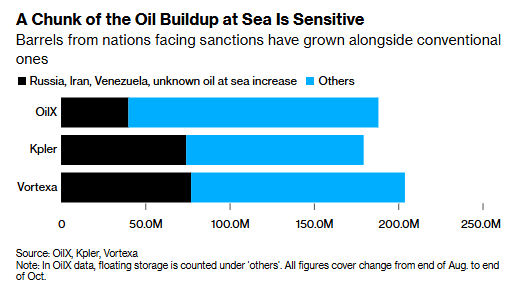
Core Insights - The global oil market is currently facing a backlog of up to 1 billion barrels of crude oil, significantly influenced by sanctions against certain countries, particularly Russia, Iran, and Venezuela [1][4][6] - The increase in offshore oil inventories since late August is primarily attributed to a rise in production from sanctioned countries, which now accounts for approximately 40% of the increase, despite their global production share being lower [1][4] - The backlog poses a threat to the revenues of sanctioned oil-producing countries and could further impact the already anticipated oversupply in the global oil market [1][4] Supply Dynamics - The backlog of crude oil is not permanent, but it indicates challenges in unloading and selling oil from sanctioned countries, particularly Russia, which has seen an increase in maritime oil transport [4][6] - Western sanctions have led to a significant drop in Russian oil tax revenues, with a year-on-year decline of over 24%, and projections suggest that oil and gas revenues will hit their lowest level since the pandemic began in 2020 [6] - In contrast, Iran's oil exports have surged to a seven-year high in October, coinciding with new U.S. sanctions on a major terminal involved in procuring Iranian oil [6] Market Reactions - The increase in oil supply from non-sanctioned countries, particularly Saudi Arabia and the U.S., has contributed to the overall rise in offshore oil inventories [7] - Saudi Arabia has ramped up its oil exports at the fastest rate in two and a half years, recovering market share lost due to previous OPEC+ production cuts [7] - U.S. crude oil exports reached their highest monthly average since July 2024, driven by Asian refiners capitalizing on price differentials [7]
原油日报:卢克石油国际资产面临制裁风险-20251111
Hua Tai Qi Huo· 2025-11-11 03:04
1. Report Industry Investment Rating - No specific industry investment rating is provided in the reports. 2. Report's Core View - Sanctions have led to uncertainties in the oil market, with Luke Oil's international assets at risk of sanctions. The company needs to sell its international assets quickly, but it is difficult to do so in a short time [2]. - Oil prices are expected to be short - term oscillating and bearish, with a medium - term short position recommendation, and a strategy of shorting the monthly spread (buying far - dated contracts and selling near - dated contracts, targeting WTI or Brent) [3]. 3. Summary by Related Catalogs Market News and Important Data - New York Mercantile Exchange's December - delivery light - sweet crude oil futures rose 38 cents to $60.13 per barrel, a 0.64% increase; January - delivery London Brent crude oil futures rose 43 cents to $64.06 per barrel, a 0.68% increase. SC crude oil's main contract closed down 0.04% at 460 yuan per barrel [1]. - Hindustan Petroleum Corporation (HPCL) bought 2 million barrels of WTI crude oil and 2 million barrels of Abu Dhabi Murban crude oil, expected to arrive in January. Mangalore Refinery and Petrochemicals Limited (MRPL) bought 1 million barrels of Basra Medium crude oil for delivery from January 1st to 7th. Both companies have suspended purchasing Russian oil [1]. - The share price of Hungarian refiner Mol rose after Prime Minister Orbán obtained a waiver from US sanctions on Russian oil. Mol's refineries in Hungary and Slovakia continue to rely on Russian crude oil, and the price difference of cheap Russian oil helps expand its refining profit margins and boost Q3 earnings [1]. - During the heating season from this winter to next spring, CNPC has arranged a 3.7% year - on - year increase in natural gas supply resources, accounting for over 60% of the domestic supply. In the first three quarters of this year, CNPC produced 123 billion cubic meters of natural gas (a 4.7% year - on - year increase), imported 80.4 billion cubic meters of natural gas (a 5.7% year - on - year increase), and injected 18.6 billion cubic meters of gas into storage facilities (an 8.8% year - on - year increase) [1]. - Luke Oil has terminated the employment of non - Russian foreign employees at the West Qurna - 2 oil field. Iraq has frozen cash and crude oil payments to Luke Oil and is seeking legal ways to ensure the continued operation of the field [1]. Investment Logic - Although the US has exempted Hungary from Russian energy imports for one year, uncertainties due to sanctions remain. The West Qurna - 2 oil field in Iraq, in which Luke Oil participates, has seen Iraq stop paying cash to the company and cancel three cargoes of equity crude oil originally allocated to it in November. Luke Oil needs to sell its international assets quickly, but it is difficult to do so in a short time, and these assets may still be affected by sanctions [2]. Strategy - Short - term, oil prices are expected to oscillate with a bearish bias; medium - term, a short position is recommended, and short the monthly spread (buy far - dated contracts and sell near - dated contracts, targeting WTI or Brent) [3].
油价在特朗普和普京会晤前微涨
Sou Hu Cai Jing· 2025-08-15 00:26
Core Viewpoint - Oil prices have slightly increased ahead of a meeting between U.S. President Trump and Russian President Putin, with market participants showing caution regarding potential changes in sanctions on Russian oil [1] Group 1: Oil Price Movement - West Texas Intermediate (WTI) crude futures rose by 0.1% to $64.02 per barrel [1] - Brent crude futures increased by 0.2% to $66.95 per barrel [1] Group 2: Market Sentiment - Market participants are cautious ahead of the meeting concerning the Ukraine issue, fearing that the meeting may lead to a relaxation of sanctions on Russian oil [1] - There are concerns that this could result in stricter measures against buyers of Russian oil [1]
原油成品油早报-20250722
Yong An Qi Huo· 2025-07-22 12:51
Industry Investment Rating - Not provided Core Viewpoints - This week, crude oil prices fluctuated within a narrow range, the monthly spreads of the three major crude oil markets declined slightly, and global oil inventories increased slightly. The EU imposed the 18th round of sanctions on Russia, reducing the price cap on Russian oil. Iran may hold nuclear talks with major European powers next week, and whether to resume nuclear talks with the US depends on the US attitude. The supply of Kurdish oil fields was affected by attacks, with about 200,000 barrels per day of production at risk of interruption. Globally, refinery profits strengthened week - on - week, and the product side remained firm. In China, refinery operations were volatile, and after the increase in June, refinery inventories of gasoline and diesel increased significantly, with refinery profits weakening week - on - week, leaving limited room to boost operations further. In the peak season of actual crude oil demand, the escalation of sanctions against Russia and the marginal tightening of Iranian crude oil supply supported the crude oil monthly structure, but the peak - season factors were relatively fully realized, and the recent monthly spreads were in a volatile pattern. The absolute price faces downward pressure in the medium term due to OPEC's accelerated production increase and the impact of US tariff policies on the global economy. Attention should be paid to the evolution of the contradiction between non - OPEC production and the near - term diesel inventory [5]. Summary by Sections 1. Price Data - From July 15 to July 21, 2025, WTI crude oil prices decreased by $0.14, Brent by $0.07, and Dubai by $0.15. The BRENT 1 - 2 month spread decreased by $0.05, and the WTI - BRENT spread decreased by $0.07. Other price differentials also showed various changes [2]. - For domestic and other related products, SC decreased by 19.70, the domestic gasoline - BRT spread increased by 3.00, and the Japanese naphtha - BRT spread decreased by 2.98, etc. [2] 2. Daily News - Traders are evaluating the real impact of the EU's latest sanctions on Russian oil supply, and international oil prices have limited fluctuations. The EU passed the 18th round of sanctions against Russia last Friday, including India's Nayara Energy. The Kremlin said it is immune to Western sanctions. Trump threatened to impose additional sanctions on Russian oil buyers if a peace agreement is not reached within 50 days. The market doubts the effectiveness of the sanctions [2]. - Trump is seeking to impose a 15 - 20% minimum tariff on all EU goods [3]. - The EU sanctioned an Iranian oil tycoon for assisting Russian oil trade. Iran's foreign minister said Iran is willing to talk with the US but not directly for now [3]. 3. Regional Fundamentals - According to the EIA report, in the week of July 11, US crude oil exports increased by 761,000 barrels per day to 3.518 million barrels per day, and domestic crude oil production decreased by 10,000 barrels to 13.375 million barrels per day. The commercial crude oil inventory excluding strategic reserves decreased by 3.859 million barrels to 422 million barrels, a decrease of 0.91%. The US strategic petroleum reserve (SPR) inventory decreased by 300,000 barrels to 402.7 million barrels, a decrease of 0.07%. The import of commercial crude oil excluding strategic reserves was 6.379 million barrels per day, an increase of 366,000 barrels per day compared with the previous week [3][15]. - This week, the operating rate of major refineries in China decreased by 0.26%, and that of Shandong local refineries increased slightly by 1.17%. The output of gasoline decreased while that of diesel increased, the gasoline inventory increased while the diesel inventory decreased. The comprehensive profit of major refineries and local refineries declined week - on - week [4].