地缘局势紧张

Search documents
成品油:今日24时零售限价将遇“三连涨”
Sou Hu Cai Jing· 2026-02-24 02:41
Core Viewpoint - The retail price of refined oil is set to experience a "three consecutive increases" due to rising geopolitical tensions and an increase in the average price of crude oil [1] Group 1: Price Adjustments - As of February 24, 2023, the retail prices for gasoline and diesel will increase by 175 yuan and 170 yuan per ton, respectively [1] - The adjusted prices for 92 gasoline, 95 gasoline, and 0 diesel will rise by 0.14 yuan, 0.15 yuan, and 0.14 yuan per liter, respectively [1] Group 2: Market Outlook - Future geopolitical uncertainties and declining oil inventories suggest that international oil prices may continue to exhibit strong fluctuations [1] - The new pricing cycle for crude oil is expected to start with an increase of 130 yuan per ton, with the next adjustment window set for March 9, 2023, at 24:00 [1]
刚刚!美军,开始撤离!
Xin Lang Cai Jing· 2026-02-23 15:31
Group 1: Military Movements - The U.S. military has begun withdrawing from its largest base in northeastern Syria, with reports confirming that troops are being redeployed to the Iraqi Kurdish region [1][2] - Approximately 1,000 U.S. soldiers are expected to be withdrawn from Syria over the next two months, marking the end of a 10-year military presence [2] Group 2: Geopolitical Tensions - President Trump has indicated a preference for a preliminary strike against Iran in the coming days, with potential for a larger military operation if initial actions do not yield results [4][5] - The U.S. has deployed the "Abraham Lincoln" and "Gerald R. Ford" aircraft carrier strike groups near Iran, heightening regional tensions [5] Group 3: Market Reactions - In response to escalating geopolitical tensions, prices for precious metals such as gold and silver have surged, with gold rising by 1.8% and silver increasing by over 4% as of February 23 [1] - Predictions suggest that any open conflict between the U.S. and Iran could drive oil prices up to $90-$100 per barrel [1]
欧佩克:情绪改善推动油价反弹 经济增长和宽松政策提振油市需求
Xin Hua Cai Jing· 2026-02-13 06:41
Core Viewpoint - OPEC maintains its global oil demand forecast amid geopolitical tensions and supply disruption concerns, which support oil price stability and future market demand [1] Group 1: Oil Price Trends - In January, international oil prices rebounded significantly, ending a downward trend due to geopolitical disturbances in oil-producing regions [2] - OPEC's reference basket price increased by $0.61 per barrel to an average of $62.31 per barrel, while ICE Brent crude futures rose by $3.10 to $64.73 per barrel, and NYMEX WTI crude futures increased by $2.39 to $60.26 per barrel [2] - The report indicates that the market's perception of short-term oil market fundamentals shifted, contributing to the price increase [2] Group 2: Supply and Demand Dynamics - Global refinery throughput remained high at approximately 83.4 million barrels per day in January, despite a slight month-over-month decline, which supported spot market purchasing demand [3] - Strong February loading demand, particularly from European buyers, bolstered crude oil spot prices in the Atlantic Basin [3] - Concerns over supply disruptions and geopolitical tensions have led to a significant increase in net long positions held by hedge funds and other money managers, with a total increase of 144% in net long positions across major crude benchmarks [3] Group 3: Future Demand Outlook - OPEC maintains an optimistic outlook for oil demand growth, projecting an increase of 1.4 million barrels per day in 2026 and 1.3 million barrels per day in 2027, driven by macroeconomic stability and loose monetary policies [4] - The primary growth in oil demand is expected to come from non-OECD countries, with a stable increase of around 1.2 million barrels per day over the next two years [4] - Key drivers of demand growth include strong aviation transport demand, healthy road transport activity, and ongoing industrial, construction, and agricultural activities in non-OECD countries [4] Group 4: Impact of Currency Fluctuations - The report highlights the influence of the US dollar's performance on oil demand, noting a 10.1% decline in the dollar's exchange rate from January to September 2025, followed by a period of relative stability after the Federal Reserve's interest rate cuts [5] - The depreciation of the dollar has reduced the consumption cost of dollar-denominated commodities like oil, providing additional support for global demand [5]

涨了逾一个月,豆油行情未完待续?
Qi Huo Ri Bao· 2026-01-29 23:47
Core Viewpoint - The recent surge in soybean oil futures prices is attributed to multiple factors, including rising biodiesel policy expectations in the U.S. and increasing international crude oil prices, which have collectively driven global oilseed prices higher [2]. Group 1: Price Drivers - The U.S. EPA's proposal to increase the biodiesel quota for 2026 and adjust exemption ratios has positively impacted CBOT soybean oil prices, which have also influenced domestic prices [2]. - Geopolitical tensions have contributed to stronger crude oil prices, providing additional support for the oilseed sector [2]. - The strengthening of palm oil prices has widened the price gap between soybean and palm oil, further driving up soybean oil futures [2]. Group 2: Domestic Demand and Supply - Domestic apparent demand for soybean oil has remained high, with continuous inventory depletion since the fourth quarter of last year, and a low inventory point expected around March-April [2]. - Pre-holiday stocking demand ahead of the Chinese New Year has led to some oil mills experiencing delivery queues into early next month, resulting in a 15% decrease in commercial inventories compared to the previous month [2]. - The ongoing reduction in rapeseed oil imports has led to inventory depletion, causing market demand to shift towards soybean oil, which has further supported price increases [2]. Group 3: Future Outlook - The upward trend in the oilseed sector may not be over, with attention needed on palm oil inventory levels at the end of January and production-demand data in February [3]. - As crushing volumes recover and stocking demands weaken, supply pressures for soybean oil may ease, although global oilseed market conditions and domestic structural support remain [3]. - A more cautious perspective suggests that the price increase potential for soybean oil may be limited, with mid-term downward pressure anticipated [4].


铂或继续偏强运行
Sou Hu Cai Jing· 2026-01-27 23:56
Geopolitical Tensions - The recent tensions surrounding Greenland's sovereignty have strained US-EU relations, with the US initially threatening tariffs on eight European countries before retracting them after negotiations [2] - The geopolitical uncertainty and fluctuating tariff policies have led to increased market volatility, maintaining high levels of risk aversion among investors [2] Economic Indicators - Despite a weakening labor market, the overall recession risk in the US remains low, with the unemployment rate at 4.4% as of December 2025, down 0.1 percentage points from the previous month [3] - The US GDP showed strong growth, with a 4.3% annualized increase in Q3 2025, driven by a 3.5% rise in consumer spending, exceeding market expectations [3] - Inflation is easing, with the core CPI at 2.6% year-on-year in December 2025, the lowest since March 2021, indicating a stable inflation environment [3][4] Federal Reserve Policy - The Federal Reserve has room for potential interest rate cuts, with a 5% probability of a cut in January 2026 and a 30% probability in March 2026, influenced by low employment and inflation data [4] - The pressure from the Trump administration on the Federal Reserve regarding interest rate policies may impact future monetary decisions [4] Platinum Market Dynamics - The global platinum supply has been declining, with total supply at 227.4 tons in 2024, down from 258.4 tons in 2021, primarily driven by mining supply [6] - Demand for platinum remains stable at 258.25 tons in 2024, with significant contributions from the automotive sector, which accounts for 37.4% of total demand [6] - The platinum market has experienced a supply deficit for several consecutive years, with projected deficits of 22 tons in 2023 and 30 tons in 2024, indicating a structural shortage [7] Price Outlook - Short-term macroeconomic factors, including geopolitical tensions and a declining US dollar, are expected to support platinum prices [7] - The expectation of continued liquidity and the potential for platinum to be viewed as an alternative to gold may provide strong price support in the medium to long term [7]
黄金涨价的第一批受害者出现了
商业洞察· 2026-01-27 09:24
Core Insights - The article discusses the impact of soaring gold prices on young couples preparing for marriage, highlighting how traditional customs related to gold have become a financial burden due to market fluctuations [4][6][10] Group 1: Gold Price Surge - In 2025, the global precious metals market experienced an unprecedented bull market, with gold prices rising over 70% and silver soaring more than 170% [4] - By 2026, the upward trend in gold prices showed no signs of slowing, with domestic mainstream gold brands seeing the price of pure gold jewelry exceed 1500 yuan per gram [4] - The surge in gold prices is attributed to multiple underlying factors, including geopolitical tensions, expectations of U.S. Federal Reserve interest rate cuts, and a significant increase in central bank gold purchases [9] Group 2: Impact on Young Couples - Traditional customs surrounding gold, such as the "three golds" in northern China and "five golds" in southern China, have become a heavy economic burden for young couples amid rising gold prices [6][8] - A representative case is highlighted where a couple's planned expenditure on gold jewelry doubled from 30,000 yuan to 60,000 yuan within a year, leading to budget overruns for their wedding [6] - For working-class families in lower-tier cities, the cost of 50 grams of gold can consume nearly a year's savings, while in first-tier cities, the cost can equate to over six months of combined salaries for young couples [6] Group 3: Consumer Behavior and Market Dynamics - Young couples are caught in a mismatch between traditional customs and financial market volatility, leading to passive responses to rising gold prices [7][10] - The article emphasizes the need for rational consumer behavior, suggesting alternatives such as choosing classic designs priced by gram, avoiding one-price traps, and considering second-hand gold to mitigate costs [10] - The rising costs associated with wedding preparations, including gold purchases, highlight broader economic uncertainties and pressures faced by young couples [10]

金银价格在1月23日同时创下历史新高,市场情绪一下子被点燃,很多人都在感叹:这行情太猛了。黄金冲上4959美元,白银涨到96美元,开年白银涨幅已经突破三成,贵金属再次火热。这波上涨背后有三股力量在推。美联储降息预期升温,资金自然会往避险资产靠。地缘局势紧张,让全球投资者更愿意把钱放在“...
Sou Hu Cai Jing· 2026-01-23 12:48
Core Viewpoint - Gold and silver prices reached historical highs on January 23, with gold hitting $4,959 and silver rising to $96, driven by increased market sentiment and demand for safe-haven assets [1] Group 1: Market Drivers - The rise in gold and silver prices is supported by three main factors: increased expectations for Federal Reserve interest rate cuts, heightened geopolitical tensions, and ongoing purchases of gold by central banks [1] - Historically, gold tends to outperform most assets during periods of rising inflation, a trend that is continuing in the current market environment [1] Group 2: Investment Strategies - Conservative investors may consider physical gold bars for security, while those seeking liquidity might opt for gold ETFs due to their ease of trading [1] - Investors willing to accept higher volatility could explore mining stocks, which can offer greater returns but also come with increased risk [1] - The rapid increase in silver prices has led to significant changes in the gold-silver ratio, suggesting potential arbitrage opportunities for investors [1]
金饰克价,逼近1500元
Sou Hu Cai Jing· 2026-01-21 12:59
Group 1 - The core viewpoint of the articles highlights a significant increase in gold and silver prices due to escalating geopolitical tensions and heightened market risk aversion, with gold reaching historical highs [1][2] - On February 20, gold futures on the New York Commodity Exchange and London spot gold prices both surpassed $4,800 per ounce, marking a 78% increase over the past 12 months [2] - Silver prices also surged, with March silver futures exceeding $95 per ounce, reflecting a 230% increase since the beginning of 2025 [2] Group 2 - Domestic gold jewelry prices have continued to rise, with several brands approaching 1,500 yuan per gram, and some exceeding this threshold [1] - BNP Paribas forecasts that silver prices may soon reach $100 per ounce, although a correction is anticipated as physical shortages driving prices up are expected to improve [2] - The current trading volume in the silver market is relatively low, which raises the potential for significant price corrections if speculative investors begin to take profits [2]

地缘局势紧张拉动国际金银价格再创新高
Xin Hua Wang· 2026-01-21 03:01
Group 1 - The core viewpoint of the articles highlights a significant surge in gold and silver prices due to escalating geopolitical tensions and heightened market risk aversion, with gold prices reaching historical highs [1] - February gold futures and London spot gold prices both surpassed $4,800 per ounce, marking a 78% increase over the past 12 months [1] - March silver futures exceeded $95 per ounce, reflecting a more than 230% increase since early 2025 [1] Group 2 - BNP Paribas predicts that silver prices may soon reach $100 per ounce, but a correction is expected as physical shortages driving prices up are anticipated to improve [2] - State Street Global Advisors maintains that the overall trend for gold prices remains strong, with a probability exceeding 30% for gold to break the $5,000 mark within the next 6 to 9 months [2]
美国“股汇债”三杀
Cai Jing Wang· 2026-01-21 01:39
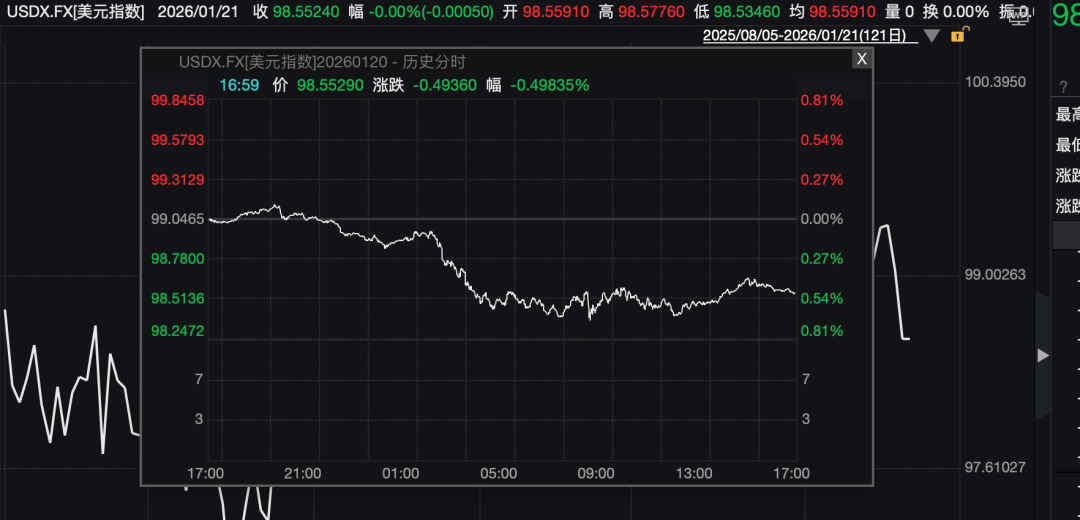
Market Overview - The U.S. stock market experienced a significant decline on January 20, with all three major indices falling sharply. The Dow Jones Industrial Average dropped by 870.74 points, closing at 48,488.59, marking a 1.76% decrease and the largest single-day drop in three months [2][5]. - The S&P 500 index fell by 2.06% to 6,796.86 points, while the Nasdaq index saw a decline of 2.39%, closing at 22,954.32 points [2][3]. Currency and Bond Market - The U.S. dollar index decreased by approximately 0.8% during the day, ultimately closing down nearly 0.5% [1]. - U.S. Treasury yields rose, with the 10-year yield increasing by 6.76 basis points to 4.2906%, and the 30-year yield rising by 7.92 basis points to 4.9158%, reaching the highest levels since early September of the previous year [1]. Sector Performance - Major technology stocks experienced significant declines, with Nvidia and Tesla both dropping over 4%. Other notable declines included Apple and Amazon, which fell by more than 3%, while Meta and Google saw declines of over 2% [3][4]. - Airline stocks also faced downward pressure, with Delta Air Lines and United Airlines both dropping over 4%, and American Airlines falling more than 3% [6]. - Semiconductor stocks were generally down, with the Philadelphia Semiconductor Index declining by 1.68%. Notable declines included Broadcom and Qualcomm, which fell over 5% [6]. Gold and Silver Market - Gold and silver prices continued to rise, reaching historical highs due to geopolitical tensions. COMEX gold futures surpassed $4,770 per ounce, marking a 2% increase [9]. - COMEX silver futures approached $96 per ounce, also setting a new historical high before experiencing a slight pullback [10]. Chinese Stocks - Chinese stocks listed in the U.S. saw an overall decline, with the Nasdaq Golden Dragon China Index dropping by 1.45%. Notable declines included JinkoSolar, which fell over 12%, and CenturyLink, which dropped more than 10% [7]. - However, some Chinese stocks performed well, with Vipshop rising nearly 3% [7].