
垂直整合战略

Search documents
MP-Materials
2026-03-19 02:39
MP Materials Conference Call Summary Company Overview - MP Materials is a leading player in the U.S. rare earth magnet sector, with a fully integrated business model encompassing rare earth mining, refining, and manufacturing of metal alloys and magnets in Texas [3][4] - The company has established a significant partnership with the U.S. Department of Defense, which has become its largest investor and customer, providing a price floor for its downstream and refining businesses [2][3] Key Points and Arguments - **Defense Partnership**: The agreement with the U.S. Department of Defense ensures a minimum profitability level for the company, with the DoD being the sole customer for the new 10X magnet facility [2][3] - **EBITDA Guidance**: The company anticipates a normalized EBITDA floor exceeding $650 million post the 10X facility's launch, based on NDPR prices of $110 per ton and a capacity of 6,000 tons [2][4] - **Market Demand**: There is a surge in demand for rare earth magnets driven by physical AI applications (robots, drones) and hybrid vehicles, offsetting the slowdown in pure electric vehicle growth [2][4] - **Vertical Integration**: The company has achieved a closed-loop vertical integration by recycling old magnets, which provides a cost advantage of 20%-50% against Chinese competitors [2][8] - **Technological Advancements**: Significant breakthroughs have been made in reducing the heavy rare earth content required for automotive-grade magnets by approximately 60% [2][7] - **Independence Facility**: The Independence facility is set to supply General Motors by late 2026, having completed the challenging automotive-grade PPAP certification [2][6] Industry Dynamics - **Supply Constraints**: The tightening supply of NDPR due to export restrictions from China is expected to drive prices higher, with the market showing significant concern over securing NDPR sources [4][10] - **Competitor Landscape**: Other Western competitors are struggling with raw material shortages, which positions MP Materials favorably due to its integrated supply chain [6][10] - **Future Growth**: The company is well-positioned to capitalize on the expected growth in physical AI applications over the next decade, with NDPR supply shortages anticipated [9][10] Additional Insights - **Recycling Strategy**: The recycling business is crucial for the company's vertical integration strategy, allowing it to recover 20%-50% of raw materials lost during production [8][9] - **Capital Expenditure**: The company plans to focus on executing its projects, particularly the 10X project, before considering capital allocation strategies such as mergers, stock buybacks, or dividends [10] - **Market Sentiment**: The overall market sentiment is optimistic regarding the demand for rare earth magnets, especially in defense and AI applications, indicating a robust future outlook for MP Materials [9][10]
比亚迪副总裁李柯:考虑在加拿大建厂,对收购老牌车企持开放态度
Feng Huang Wang· 2026-03-13 02:46
Core Viewpoint - BYD is actively considering building a manufacturing plant in Canada and is open to acquiring a traditional global automaker, reflecting its strategy to expand internationally and enhance competitiveness in the electric vehicle market [1][2]. Group 1: Canadian Market and Manufacturing Plans - BYD is researching the feasibility of establishing a manufacturing facility in Canada, with a preference for owning and operating the plant rather than forming a joint venture [1]. - The Canadian government is encouraging partnerships between Chinese automakers and local companies, having recently agreed to exempt up to 49,000 Chinese-made electric vehicles from a 100% tariff starting in 2024 [1]. Group 2: Acquisition Strategy - BYD is open to acquiring a traditional automaker as competitors struggle to maintain global competitiveness due to simultaneous investments in both internal combustion and electric vehicles [2]. - The company is evaluating potential acquisition targets but has not disclosed any specific candidates, indicating a strategic shift towards independence and efficiency through vertical integration [2]. Group 3: Market Challenges and Focus - BYD has paused its plans to enter the U.S. market, citing a "complex market environment" characterized by high tariffs and restrictions on connected vehicle technologies [3]. - Instead, BYD is focusing on replicating its successful "Brazil model" in other markets, including Europe, and is accelerating the establishment of its first passenger car center in Hungary [4]. Group 4: Sales Performance and Future Goals - In the first two months of the year, BYD's total sales decreased by 36% to 400,241 vehicles, although export momentum is increasing, with a target of selling 1.3 million vehicles overseas by 2026 [4]. - Recent product launches, including the latest generation of blade batteries and ultra-fast charging architecture, are expected to help reverse the sales decline [4]. Group 5: Investment in Infrastructure - In Brazil, BYD plans to invest over 500 million Brazilian Reais (approximately 97 million USD) to install 1,000 ultra-fast charging stations by the end of 2027 [5]. Group 6: Motorsport Exploration - BYD is exploring entry into competitive racing, including F1 and endurance racing, aligning with its technological priorities, although no final decision has been made yet [6].

突发!马斯克直言:特斯拉必须建内存厂,TerraFab扛起芯片自主大旗
是说芯语· 2026-01-30 00:42
Core Viewpoint - Tesla's CEO Elon Musk emphasized the importance of chip autonomy as a core growth driver, announcing plans for a mega wafer fab (TerraFab) and self-developed AI chips to support its AI and robotics business, aiming to reduce supply chain dependencies and enhance production capabilities [1][4]. Financial Performance - Tesla reported Q4 revenue of $24.9 billion and adjusted EPS of $0.50, both exceeding market expectations; automotive gross margin rose to 17.9%, with cash and investments exceeding $44 billion, providing a solid financial foundation for its chip autonomy and capacity expansion initiatives [3][8]. Chip Strategy - The demand for AI and memory chips is expected to surge, particularly with the production of Cybercab and Optimus robots, with an estimated annual chip demand of $6 billion when Optimus reaches a production capacity of 1 million units [3][4]. TerraFab Wafer Fab - The TerraFab facility will focus on integrating logic and memory chip production, aiming for an initial monthly output of 100,000 wafers, with a long-term goal of 1 million wafers per month, comparable to TSMC's 2024 capacity [4][5]. - The facility will utilize innovative "wafer isolation" technology to reduce costs and construction time, although challenges remain due to Tesla's lack of manufacturing experience and the lengthy construction timeline of 5-7 years [4][5]. Chip Development - Tesla is advancing the development of AI5 and AI6 chips, with AI5 nearing completion and expected to deliver significant performance improvements, while AI6 aims for a modular design to support various applications [5][8]. Capital Expenditure - Tesla plans to increase its capital expenditure to over $20 billion in 2026, primarily for new factories and AI infrastructure, excluding the investment for TerraFab, indicating a substantial commitment to chip development [8].


打破“芯片墙”!特斯拉宣布启动TeraFab芯片项目,另投20亿美元加码xAI,垂直整合AI全产业链
Zhi Tong Cai Jing· 2026-01-29 01:29
Group 1 - Tesla is significantly increasing its investment in artificial intelligence (AI) by building a chip manufacturing plant named "TeraFab" to address potential chip supply constraints in the next three to four years [1][2] - The decision to build TeraFab is driven by concerns over geopolitical risks and the current reliance on suppliers like Samsung, TSMC, and Micron, which may not meet Tesla's growing chip demands for AI, autonomous driving, and robotics [2] - The construction of TeraFab aligns with Tesla's vertical integration strategy, allowing the company and its affiliates to accelerate innovation beyond the limitations of the supply chain [3] Group 2 - Tesla announced a $2 billion investment in xAI, a company founded by Elon Musk in 2023, as part of a $20 billion funding round, aiming to develop AI chatbots and image generation tools [4] - This investment is expected to enhance collaboration between Tesla and xAI, particularly in AI product development, despite xAI facing regulatory scrutiny in multiple countries regarding its Grok tool [4][5] - The integration of Grok into Tesla's electric vehicle entertainment systems indicates a strategic move to deepen the synergy between the two companies in AI applications [5]
特斯拉提交新专利:将Starlink接收器嵌入天窗,绕过网络运营商
Hua Er Jie Jian Wen· 2025-12-21 05:06
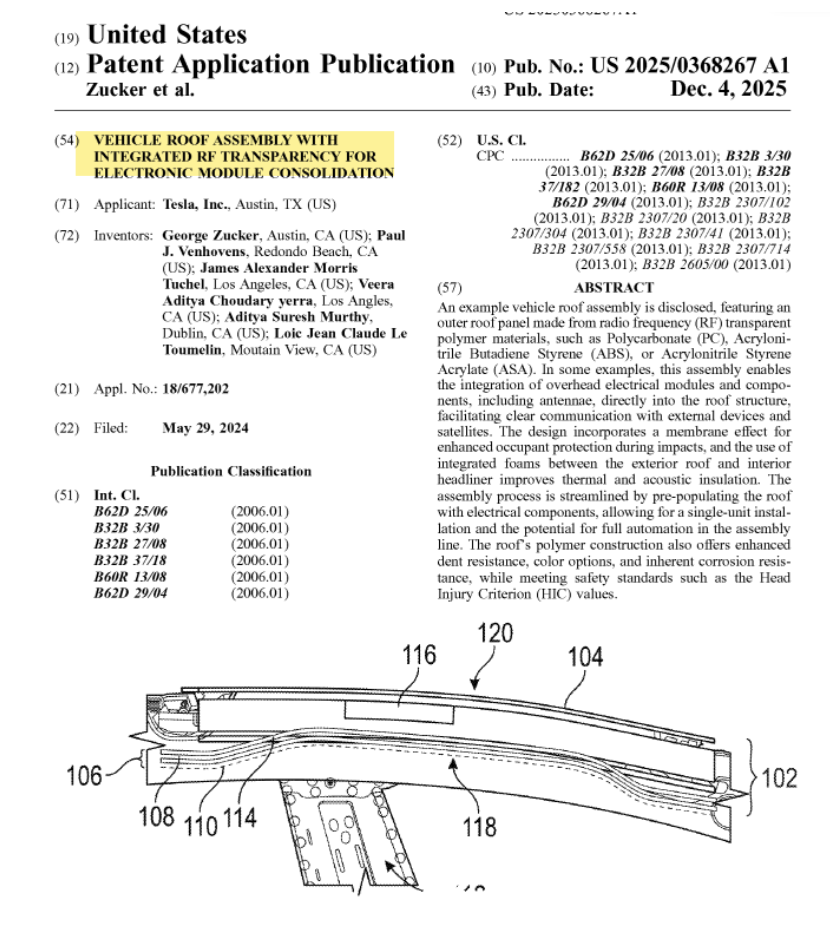
Core Insights - Tesla is developing a new technology to integrate Starlink antennas directly into vehicle roofs, which could significantly change the way electric vehicles connect to the internet and optimize costs [1][2]. Group 1: Patent Details - The recent patent application outlines a roof component that is highly transparent to radio frequencies, allowing satellite signals to penetrate effectively [1]. - The design enables Tesla vehicles to connect directly to the Starlink system for high-speed internet, reducing reliance on third-party cellular network providers like AT&T [1]. - The patent specifies that the antenna system will be fully embedded in the roof structure, avoiding the complexities and aesthetic issues associated with external devices [2]. Group 2: Cost Structure Optimization - The primary motivation behind Tesla's satellite communication integration is cost control, as the company currently pays third-party mobile operators for Premium Connectivity services [8]. - Although the cost savings per vehicle may seem limited, reducing recurring expenses will have a cumulative positive impact on Tesla's profit margins, especially for large-scale subscription services [8]. - This initiative aligns with Elon Musk's long-term strategy of vertical integration, aiming to reduce dependence on external suppliers by controlling more aspects of the value chain [8]. Group 3: Early User Applications - Some Tesla owners have already begun using temporary installations of Starlink Mini devices to provide high-speed satellite internet in areas with weak cellular coverage [9]. - User feedback indicates that satellite connectivity performs significantly better than traditional mobile networks in remote locations [9].
高盛首予MP Materials(MP.US)“买入”评级 看好其垂直整合战略将释放巨大利润空间
智通财经网· 2025-11-20 02:55
Core Viewpoint - MP Materials' stock surged 8.61% following Goldman Sachs' initiation of coverage with a "Buy" rating and a target price of $77, indicating strong market confidence in the company's growth potential in the rare earth magnet supply sector [1] Company Summary - MP Materials is positioned to become the largest rare earth magnet supplier in North America through vertical integration, aiming to capture market share from Chinese companies that currently control 90%-95% of rare earth refining and magnet production [1] - The company's core business revolves around neodymium-praseodymium oxide, a critical material for manufacturing electronic products, electric vehicles, and defense system permanent magnets, which is essential for U.S. manufacturing [1] - Collaboration with the U.S. government is expected to accelerate downstream expansion, allowing MP Materials to achieve significant revenue and EBITDA growth while vertical integration is projected to enhance profit margins [1] - The announcement of a joint venture with the U.S. Department of Defense and Saudi state mining company Maaden to build a rare earth refining plant in Saudi Arabia has also contributed to the stock price increase [1]


MP Materials
2025-11-14 03:48
Summary of Marathon Mining Group's Conference Call Company Overview - **Company**: Marathon Mining Group - **Industry**: Rare Earth and Magnetic Materials Key Points and Arguments Supply Chain Development - Marathon Mining Group is actively building a domestic supply chain for rare earth and magnetic materials in the U.S. to mitigate supply chain risks posed by Chinese commercial policies [2][3][4] - The company has invested $1 billion in private investments and has established cooperation agreements with the U.S. government during both the Trump and Biden administrations to ensure scalable production capabilities in the West [2][4] Production and Capacity Goals - The company plans to complete the commissioning of its heavy rare earth separation circuit by mid-2026, which will process both its own ores and third-party materials to meet the demand for neodymium-iron-boron magnets [2][4][11] - Investment in chloride facilities is aimed at optimizing cost structures by reducing costs associated with hydrochloric acid and soda [2][4] - The second phase of refining aims for a capacity of 6,000 tons, with the ability to handle heavy rare earths [11] Strategic Partnerships and Market Position - The partnership with the U.S. Department of Defense is a recognition of the company's vertical integration strategy initiated in 2017, addressing supply chain insecurity, particularly against Chinese policies [3][5] - The company is collaborating with General Motors (GM) to cautiously build its magnetic business, accumulating experience before scaling up [3][8] Market Dynamics and U.S. Policy - Washington shows a heightened urgency to reduce dependence on China, which extends beyond rare earths to multiple industries, emphasizing the importance of a strong supply chain for competitiveness in sectors like robotics, AI, data centers, and automotive [5][6] - Approximately 30% of magnets are used in the automotive supply chain, which is a significant sector for employment in the U.S. [5] Technological and Operational Challenges - The company has implemented measures to manage technological execution challenges by analyzing past failures and ensuring that each phase of production is well-defined before proceeding [8][9] - The focus is on producing high-grade, high-recovery mineral concentrates to generate substantial free cash flow, which has been sufficient to cover investments for the second phase of operations [8][9] Sales Strategy and Market Conditions - The company has halted sales of certain concentrate products due to tariff-induced transportation fluctuations and prices falling below intrinsic value, in line with agreements with the Department of Defense [10] - The strategy includes entering the Chinese market while adhering to the agreement's requirements [10] Future Outlook - The U.S. is in a positive development phase in the rare earth and magnetic materials sector, relying on Mountain River as a resource source and expanding capabilities for independent growth [7] - The company plans to increase its recycling efforts and expects significant business expansion over the next five years through various initiatives [7] Quality Control and Product Specifications - The company employs a vertical integration strategy to ensure the purity of refined materials, adapting to different application requirements, particularly in the automotive sector [14] - This strategy allows for flexibility in adjusting specifications to optimize supply chain efficiency while maintaining competitive advantages [14]
CoreWeave电话会:推理就是AI的变现,VFX云服务产品使用量增长超4倍(附电话会议实录)
美股IPO· 2025-08-13 05:37
Core Viewpoints - The company has signed expansion contracts with two hyperscale cloud customers in the past eight weeks, with one reflected in Q2 results. The remaining performance contract amount has doubled to $30.1 billion since the beginning of the year, including a $4 billion expansion agreement with OpenAI and new orders from large enterprises to AI startups [1][4][5]. Financial Performance - Q2 revenue reached $1.2 billion, a year-over-year increase of 207%, marking the first time the company achieved over $1 billion in revenue and an adjusted operating profit of $200 million in the same quarter [6][38]. - The remaining performance contract amount (Revenue Backlog) was $30.1 billion at the end of Q2, up 86% year-over-year and increased by $4 billion from Q1 [5][43]. - The company plans to achieve over 900 megawatts of active power delivery capacity by the end of Q4, with a current active power capacity of approximately 470 megawatts and a total contracted capacity of about 2.2 gigawatts [6][9][43]. Capacity Expansion - The company is significantly expanding its capacity to address structural supply shortages, with plans to add over 400 megawatts of power capacity [5][9]. - Capital expenditures totaled $2.9 billion in Q2, reflecting efforts to rapidly expand infrastructure to meet customer demand [10][84]. Customer Demand and Diversification - The customer base is becoming more diversified, with increasing demand for AI applications across various sectors, including media, healthcare, and finance [12][46]. - The company's VFX cloud service product, Conductor, saw usage grow over four times in the first half of 2025, and new contracts were signed with major banks like Morgan Stanley and Goldman Sachs [12][47]. Vertical Integration Strategy - The company is pursuing a vertical integration strategy through acquisitions, including Weights & Biases and a proposed acquisition of CoreScientific, aimed at enhancing infrastructure control and operational efficiency [14][15][63]. - The integration of CoreScientific is expected to provide approximately 1.3 gigawatts of total power capacity and eliminate over $10 billion in future lease liabilities, with an anticipated annual cost saving of $500 million by the end of 2027 [15][71]. Financing and Capital Markets - Since the beginning of 2024, the company has secured over $25 billion in debt and equity financing to build and expand its AI cloud platform [18][85]. - Recent financing transactions have significantly reduced capital costs, with a notable decrease of 900 basis points in borrowing costs [5][18][85]. Market Outlook - The company has raised its full-year revenue guidance for 2025 to a range of $5.15 billion to $5.35 billion, reflecting strong customer demand [8][89]. - The company continues to operate in a structurally supply-constrained environment, with demand far exceeding the supply of its products and services [9][86].

立讯精密股价下跌2.94% 上半年净利润预计超60亿元
Jin Rong Jie· 2025-07-31 20:08
Group 1 - The core viewpoint of the article highlights that Luxshare Precision's stock price decreased by 2.94% to 36.63 yuan as of July 31, 2025, with a trading volume of 1,006,200 hands and a transaction amount of 3.74 billion yuan [1] - Luxshare Precision operates in the consumer electronics industry as a high-end precision manufacturing company, with products spanning consumer electronics, automotive, communication, industrial, and medical sectors [1] - The company anticipates a net profit of 6.475 billion to 6.745 billion yuan for the first half of 2025, representing a year-on-year growth of 20% to 25% [1] Group 2 - Luxshare Precision demonstrates strong risk resistance capabilities in a complex external environment and is enhancing its technological advantages through a deepened vertical integration strategy [1] - On July 31, 2025, the net outflow of main funds for Luxshare Precision was 385 million yuan, accounting for 0.15% of its circulating market value [1]

杜嘉班纳完成债务融资;人人乐终止上市;加拿大鹅任命中国区总裁
Sou Hu Cai Jing· 2025-06-08 13:55
Financing Dynamics - Dolce & Gabbana has secured an additional €150 million in debt financing to support the expansion of its beauty and real estate sectors, with the new debt guaranteed by SACE SpA, an Italian government-backed credit insurance company [3] - Froneri, a joint venture between PAI and Nestlé, is seeking approximately €4.6 billion in debt financing to support its fund, which will increase its total debt to around €9 billion [5] Acquisition Dynamics - Prada Group has acquired a 10% stake in the leather manufacturer Rino Mastrotto Group, enhancing its vertical integration strategy, with the transaction expected to be completed between Q2 and Q3 of 2025 [12] Brand Dynamics - The subsidiary of the popular ice cream brand Zhong Xue Gao, Zhong Mao (Shanghai) Food Technology Co., Ltd., is undergoing bankruptcy review, indicating financial distress within the company [16] - Kiko Milano has appointed Drew Elliott as Chief Brand Officer to enhance its international influence and retail experience [22] - Burberry's corporate relations head, Andrew Roberts, has left the company, potentially creating a communication gap with external stakeholders [26] - Canada Goose has appointed Celine Xie as President for the China region, responsible for the direct operations in the mainland market [29]

