市场情绪扰动

Search documents
观点与策略:国泰君安期货商品研究晨报-20260311
Guo Tai Jun An Qi Huo· 2026-03-11 01:22
Report Industry Investment Ratings - Gold: Not specified [6] - Silver: Not specified [7] - Copper: Not specified [10] - Zinc: Not specified [13] - Lead: Not specified [17] - Tin: Not specified [20] - Aluminum: Positive [24] - Alumina: Negative [24] - Cast aluminum alloy: Positive [24] - Platinum: Not specified [26] - Palladium: Not specified [27] - Nickel: Not specified [31] - Stainless steel: Not specified [31] - Lithium carbonate: Not specified [39] - Industrial silicon: Not specified [44] - Polysilicon: Not specified [45] - Iron ore: Positive [48] - Rebar: Not specified [51] - Hot-rolled coil: Not specified [51] - Ferrosilicon: Not specified [55] - Manganese silicon: Not specified [55] - Coke: Not specified [58] - Coking coal: Not specified [58] - Steam coal: Negative [62] - Logs: Not specified [64] - p-Xylene: Negative [68] - PTA: Negative [68] - MEG: Negative [68] - Rubber: Positive [73] - Synthetic rubber: Not specified [76] - LLDPE: Positive [79] - PP: Positive [79] - Caustic soda: Negative [83] - Pulp: Not specified [87] - Glass: Positive [93] - Methanol: Negative [96] - Urea: Negative [102] - Styrene: Positive [107] - Soda ash: Positive [109] - LPG: Positive [113] - Propylene: Positive [113] - PVC: Negative [121] - Fuel oil: Negative [124] - Low-sulfur fuel oil: Negative [124] - Container shipping index (European line): Not specified [126] - Short fiber: Not specified [141] - Bottle chip: Not specified [141] - Offset printing paper: Not specified [145] - Pure benzene: Positive [150] - Palm oil: Not specified [154] - Soybean oil: Not specified [154] - Soybean meal: Positive [162] - Soybean: Not specified [162] - Corn: Not specified [165] - Sugar: Not specified [170] - Cotton: Positive [175] - Eggs: Not specified [180] - Live pigs: Negative [183] - Peanuts: Not specified [188] Core Views - The report provides a comprehensive analysis of various commodity futures, including precious metals, base metals, energy, agricultural products, etc. It assesses the supply and demand, price trends, and market sentiment of each commodity [2][7][10]. - Geopolitical conflicts, such as the situation in the Middle East, have a significant impact on the commodity market, especially on energy and precious metals [7][9][14]. - The macroeconomic environment, including GDP growth, inflation, and trade policies, also affects the commodity market [48][51][66]. Summaries by Directory Precious Metals - **Gold**: Geopolitical conflicts break out, and the price is affected by factors such as the US dollar index and geopolitical risks [6][7]. - **Silver**: Attention should be paid to liquidity contraction, and the price is influenced by factors such as gold price and industrial demand [7]. - **Platinum and Palladium**: Platinum follows the fluctuations of gold and silver, while palladium fails to break through and remains sluggish [26][27]. Base Metals - **Copper**: The narrowing of the domestic spot discount supports the price, and the supply and demand situation and macro - economic environment have an impact on it [10]. - **Zinc**: It shows a range - bound oscillation, affected by factors such as inventory and supply - demand balance [13]. - **Lead**: The increase in domestic inventory exerts downward pressure on the price [17]. - **Tin**: It is in an oscillatory adjustment state [20]. - **Aluminum**: It remains relatively strong, while alumina returns to the fundamentals, and cast aluminum alloy follows the trend of electrolytic aluminum [24]. - **Nickel**: Tight supply at the mine end supports the current situation, but the accumulation of smelting inventory limits its upward potential. Stainless steel is affected by macro - risk preferences, and the cost center moves up [31]. Energy - **Crude oil - related products**: The situation in the Middle East affects the supply and price of energy products. For example, the conflict in the Middle East leads to supply disruptions and price fluctuations of fuel oil and low - sulfur fuel oil [124]. - **Coal**: Steam coal shows a trend of supply - demand relaxation and price decline [62]. Chemicals - **p - Xylene, PTA, and MEG**: They follow the cost - end adjustment, and the month - spread shows an inverse arbitrage trend [68]. - **Rubber**: It shows an oscillatory and upward - biased trend, affected by factors such as tire industry demand and raw material prices [73]. - **Synthetic rubber**: It fluctuates with energy prices and shows a high - level wide - range oscillation [76]. - **LLDPE and PP**: Geopolitical uncertainties lead to supply contractions, and the upstream start - up rate decreases [79]. - **Caustic soda**: It returns to the fundamentals, and the market is under short - term pressure [83]. - **Methanol and Urea**: They experience a high - level decline, affected by factors such as energy prices and market sentiment [96][102]. - **Styrene and Pure benzene**: They are expected to be strong, affected by factors such as supply reduction and downstream demand [107][150]. - **Soda ash**: The spot market changes little, and the price may be stable with an upward bias [109]. - **Propylene**: The cost - end is affected by geopolitical factors, and the supply is expected to decrease [113]. - **PVC**: It returns to the fundamentals, and the market is under short - term pressure due to factors such as high supply and weak demand [121]. Agricultural Products - **Palm oil and Soybean oil**: Palm oil experiences high - level volatile fluctuations, and attention should be paid to the impact of crude oil. Soybean oil is supported by the cost of US soybeans and shows a short - term high - level oscillation [154]. - **Soybean meal and Soybean**: The USDA report is slightly bullish, and the soybean meal futures price is strong. The trade of soybean grains fails to be sold at auction, and the market turns to a wait - and - see attitude [162]. - **Corn**: It shows an oscillatory operation [165]. - **Sugar**: It mainly shows a range - bound consolidation [170]. - **Cotton**: It is waiting for new driving factors [175]. - **Eggs**: They maintain an oscillatory state [180]. - **Live pigs**: The spot market accumulates inventory passively and shows a continuous decline [183]. - **Peanuts**: Attention should be paid to the impact of the macro - environment [188]. Shipping - **Container shipping index (European line)**: It is dominated by geopolitical sentiment, and the price fluctuation is amplified. The supply and demand situation, freight rates, and cost factors all affect its price [126].
市场情绪扰动,盘面波动加剧
Hong Ye Qi Huo· 2025-11-24 12:27
Report Summary 1. Report Industry Investment Rating - Not provided in the content 2. Core Viewpoints - The current supply and demand of industrial silicon and polysilicon are both weak, with slow inventory depletion for industrial silicon and high inventory levels for polysilicon. Industrial silicon is expected to maintain wide - range fluctuations in the short term, while polysilicon is expected to remain in high - level oscillations, supported by anti - involution policies and market expectations. Attention should be paid to the start - up changes of large northwest factories and the implementation of policies [6][8]. 3. Summary by Related Catalogs Industrial Silicon - **Price**: The spot price of industrial silicon fluctuated significantly this week. As of November 21, 2025, the price of Xinjiang industrial silicon 553 oxygen - passed was 8900 yuan/ton, unchanged from last week. The futures main contract showed a weak oscillation, then a sharp rise and fall, and closed at 8960 yuan/ton on November 21 [6]. - **Supply**: Xinjiang's start - up rate remained stable, with stable supply. There were few changes in the start - up in Qinghai, Ningxia, and Gansu in the Northwest. Some silicon enterprises in Yunnan reduced or stopped production, with a slight decline in output. Sichuan is in the flat - water period and will enter the dry - water period at the end of the month, with a further decline in the start - up rate. Overall, industrial silicon production decreased month - on - month [6]. - **Demand**: The weekly start - up of polysilicon enterprises remained stable, with relatively stable demand for industrial silicon. The start - up of organic silicon was basically stable, with a small increase in monomer production capacity recently. After the organic silicon anti - involution meeting, the price increased, but then fell. The start - up rate of aluminum alloy enterprises increased slightly, with good downstream order demand. In October, industrial silicon exports were 45,100 tons, a 36% month - on - month and 31% year - on - year decrease [6]. - **Cost**: The cost of industrial silicon remained stable this week [6]. - **Inventory**: As of November 20, the national social inventory of industrial silicon was 548,000 tons, an increase of 2000 tons from last week [6]. - **Price Difference**: As of November 21, 2025, the price difference between Yunnan industrial silicon 553 oxygen - passed and 421 oxygen - passed was 400 yuan/ton, unchanged from last week. The price difference between Xinjiang industrial silicon 553 oxygen - passed and 421 oxygen - passed was 300 yuan/ton, also unchanged from last week [15]. - **Output**: As of November 21, 2025, the number of national industrial silicon open furnaces was 267, a decrease of 3 from the previous week; the start - up rate was 33.13%, a 0.37% decrease; the weekly output was 95,900 tons, a decrease of 400 tons from the previous week [22]. Polysilicon - **Price**: The spot price of polysilicon remained stable this week. As of November 21, 2025, the price of N - type dense material was 50,000 yuan/ton, unchanged from last week. The futures main contract fluctuated sharply at a high level and closed at 53,360 yuan/ton on November 21 [8]. - **Supply**: In November, with the shutdown of a large number of production capacities in Sichuan and Yunnan during the dry - water period, the polysilicon output is expected to be close to 120,000 tons, a significant decrease from October. The output is expected to continue to decline in December [8]. - **Demand**: The current terminal demand is weak. The terminal component prices are weakly stable, while the prices of silicon wafers and battery cells continue to fall. Downstream crystal - pulling enterprises have a low willingness to purchase and only maintain rigid restocking. In October, the polysilicon import volume was 1446.4 tons, a 12% month - on - month increase; in September, the polysilicon export volume was 1547.9 tons, a 28% month - on - month decrease [8]. - **Cost**: The cost of polysilicon remained stable this week [8]. - **Inventory**: As of November 21, the polysilicon factory inventory was 268,500 tons, an increase of 2800 tons from last week [8]. Downstream - **Silicon Wafers**: As of November 21, 2025, the average prices of N - type M10 - 182(130µm), N - type G10L - 183.75(130µm), N - type G12R - 210R(130µm), and N - type G12 - 210(130µm) were 1.25, 1.25, 1.275, and 1.575 yuan/piece respectively, a decrease of 0.115, 0.115, 0.04, and 0.05 yuan/piece from last week. Overseas demand declined, battery prices accelerated to the bottom, cost - side games increased, and the later decline space may be small [30]. - **Batteries**: As of November 21, 2025, M10 single - crystal TOPCon, G10L single - crystal TOPCon, G12R single - crystal TOPCon, and G12 single - crystal TOPCon were quoted at 0.295, 0.295, 0.278, and 0.292 yuan/watt respectively, a decrease of 0.01, 0.01, 0.004, and 0.01 yuan/watt from last week. The battery market continued to be under pressure, demand was low, inventory digestion still needed time, and price competition intensified [34]. - **Components**: As of November 21, 2025, 182 single - sided TOPCon, 210 single - sided TOPCon, 182 double - sided TOPCon, and 210 double - sided TOPCon were quoted at 0.68, 0.7, 0.68, and 0.7 yuan/watt respectively, unchanged from last week. The component market operated weakly and stably, prices were slightly loose, mainstream enterprises had not made large - scale adjustments, and the market as a whole showed a state of policy support but no demand support [38]. Organic Silicon - As of November 21, 2025, the price of organic silicon DMC in East China was 13,200 yuan/ton, an increase of 700 yuan/ton from last week. This week, the industry start - up rate was basically stable. After the anti - involution meeting, the price increased, and currently, the high - sentiment has basically been digested by the market [42]. Aluminum Alloy - As of November 21, 2025, the price of Shanghai aluminum alloy ingot ADC12 was 20,800 yuan/ton, a decrease of 400 yuan/ton from last week. Downstream orders were good, and the start - up of aluminum alloy enterprises increased slightly [46].

国泰君安期货商品研究晨报:黑色系列-20250911
Guo Tai Jun An Qi Huo· 2025-09-11 01:35
Report Industry Investment Ratings - Not provided in the given content Core Views - The report provides daily market analysis and trend forecasts for various commodities in the black series, including iron ore, rebar, hot-rolled coils, ferrosilicon, silicomanganese, coke, coking coal, and logs, suggesting that most commodities will experience wide fluctuations or repeated oscillations [2] Summary by Commodity Iron Ore - **Trend Forecast**: Wide fluctuations [2][4] - **Fundamental Data**: The closing price of futures contract 12601 was 805 yuan/ton, with no change. The price of imported and domestic ores remained mostly stable, except for a 1 yuan increase in the price of Super Special ore (56.5%). Some basis and spread values changed slightly [4] - **Macro and Industry News**: In August, China's manufacturing PMI was 49.4%, up 0.1 percentage points from the previous month [4] - **Trend Intensity**: Neutral (0) [4] Rebar and Hot-Rolled Coils - **Trend Forecast**: Wide fluctuations [2][6][7] - **Fundamental Data**: The closing prices of RB2510 and HC2510 decreased, with trading volumes and positions changing. The spot prices in most regions declined. Some basis and spread values changed [7] - **Macro and Industry News**: In August, China exported 951.0 million tons of steel, a 3.3% month-on-month decrease; imports were 50.0 million tons, a 10.6% month-on-month increase. In the week of September 4, the production of rebar and hot-rolled coils decreased, inventories increased, and apparent demand decreased [8][9] - **Trend Intensity**: Neutral (0) [9] Ferrosilicon and Silicomanganese - **Trend Forecast**: Wide fluctuations affected by market sentiment [2][10] - **Fundamental Data**: The closing prices of some futures contracts increased, with changes in trading volumes and positions. Spot prices and various spreads changed [10] - **Macro and Industry News**: On September 10, the prices of different grades of ferrosilicon and silicomanganese varied by region. A steel company's procurement price of 75B ferrosilicon decreased. A large steel group increased its tender volume for silicomanganese in September, and the tender price decreased. UMK lowered its manganese ore price for China in October [10][11][12] - **Trend Intensity**: Neutral (0) [13] Coke and Coking Coal - **Trend Forecast**: Wide fluctuations due to repeated expectations [2][14][15] - **Fundamental Data**: The closing price of JM2601 decreased, while J2601 increased. Spot prices of coking coal and coke changed, and some basis and spread values changed [15] - **Macro and Industry News**: The Ministry of Industry and Information Technology and the State Administration for Market Regulation issued an action plan for stabilizing growth in the electronic information manufacturing industry from 2025 - 2026 [15] - **Trend Intensity**: Neutral (0) [15] Logs - **Trend Forecast**: Repeated oscillations [2][17] - **Fundamental Data**: The closing prices, trading volumes, and positions of different futures contracts changed, with varying daily and weekly price and volume fluctuations. Spot prices remained mostly stable [18] - **Macro and Industry News**: In August, China's manufacturing PMI was 49.4%, up 0.1 percentage points from the previous month [20] - **Trend Intensity**: Neutral (0) [20]
易会满接受审查事件对下周市场影响分析:情绪扰动与政策对冲的博弈
Sou Hu Cai Jing· 2025-09-06 13:52
Core Viewpoint - The investigation of Yi Huiman introduces uncertainty into the capital market, leading to a complex interplay of short-term emotional disturbances and medium-term policy countermeasures [2][10] Short-term Emotional Impact - The financial sector is expected to bear the brunt of the emotional shock, with the financial holding index experiencing a 4.29% drop on September 3, indicating existing vulnerabilities [3] - The Shanghai Composite Index had recently recovered above 3800 points, with over 4800 stocks rising, suggesting a risk appetite was building prior to the event [3] - Historical data indicates that similar regulatory announcements typically require 2-3 trading days for emotional release, with declines generally not exceeding 5% [3] Market Resilience - The ability of the Shanghai Composite Index to maintain the 3800-point level will be a critical indicator of the emotional shock's impact [4] - A significant drop below this level, coupled with increased trading volume, could trigger further selling, while stability around this point may lead to a quick release of emotions [4] Policy Support Mechanisms - Recent regulatory signals from the China Securities Regulatory Commission (CSRC) are expected to alleviate market anxiety, with new guidelines for sustainable development reports indicating continuity in regulatory frameworks [5] - The introduction of a personal consumption loan interest subsidy policy is anticipated to stimulate consumer demand, potentially benefiting sectors like automotive and home goods [5][6] Structural Fund Dynamics - Short-term speculative funds are likely to avoid the financial sector, shifting towards defensive areas such as consumer goods and pharmaceuticals, which may accelerate sector rotation [7] - Institutional investors may view the event as an opportunity to adjust their portfolios, particularly in high-quality consumer and technology stocks that have seen valuation declines [7] Foreign Capital Movements - The investigation may enhance long-term foreign investment confidence in the A-share market, although short-term uncertainties could lead to a cautious approach from some foreign investors [8] Key Observational Indicators - Key indicators to monitor include the turnover rate of financial stocks, trading volume at the 3800-point level, and any new stability signals from the policy front [9] - Investors are advised to reduce exposure to the financial sector in the short term while focusing on sectors benefiting from the consumption subsidy policy [9] Overall Market Outlook - The investigation's impact is expected to manifest as a "pulse-like shock followed by gradual recovery," with short-term disturbances manageable due to robust policy tools and market liquidity [10]


沪指涨破3700点!
Sou Hu Cai Jing· 2025-08-14 06:01
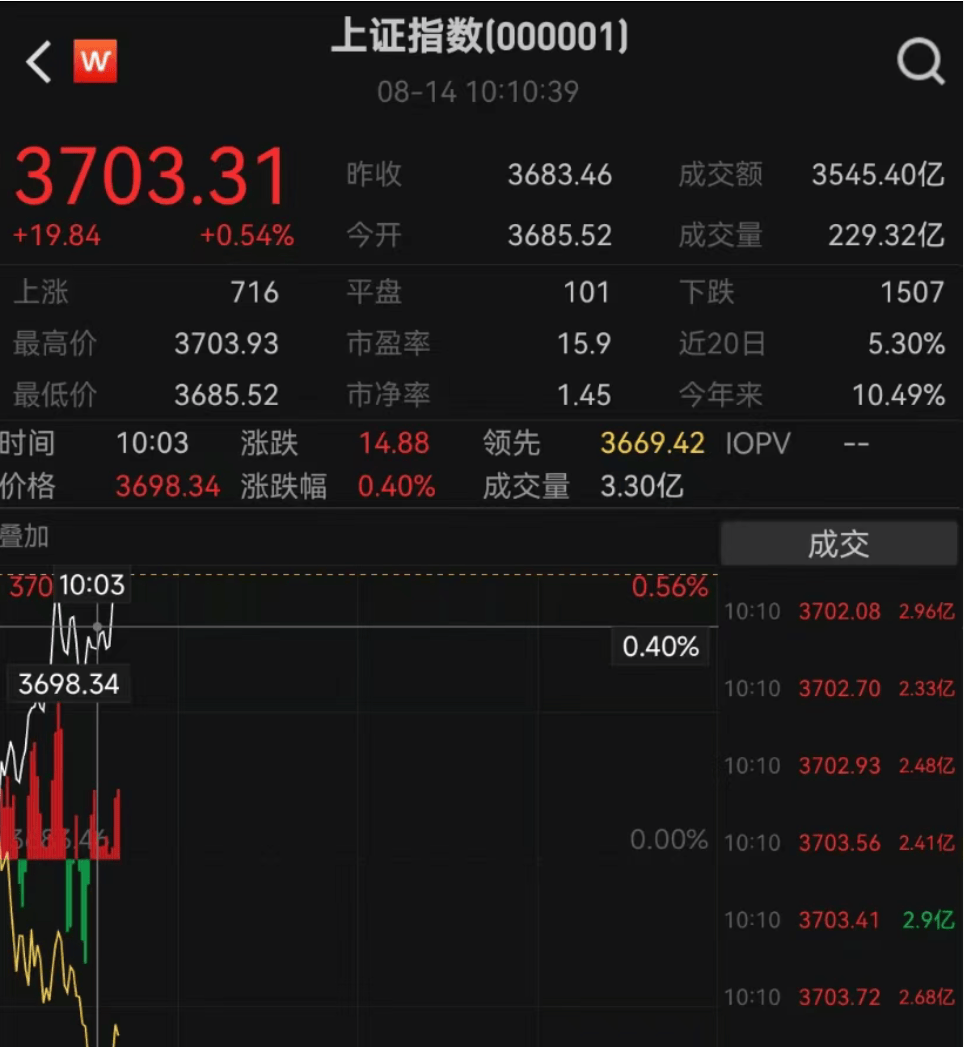
Market Overview - The Shanghai Composite Index briefly surpassed the 3700-point mark for the first time since December 2021, closing at 3690.88 points with a gain of 0.20% [1] - The index opened at 3685.52 and reached a high of 3703.93 during the session, with a trading volume of 354.54 billion [2] Sector Performance - The insurance, real estate, and semiconductor sectors showed significant gains, with the securities sector also rising, highlighted by Longcheng Securities hitting the daily limit, and other firms like Huatai Securities and Dongfang Securities following suit [3] Market Sentiment - Current market trends indicate a structurally driven rise primarily fueled by capital, with small-cap stocks outperforming large-cap stocks. There is a cautionary note regarding potential profit-taking risks following rapid market increases, emphasizing the need for investors to monitor market sentiment closely [4]