弱通胀

Search documents
2025年中国宏观经济回顾与2026年展望:中国宏观经济:今朝虽未开盛宴,街头巷尾已闻钟
Fang Zheng Zhong Qi Qi Huo· 2025-12-15 06:39
Report Industry Investment Rating No information provided in the document. Core Viewpoints of the Report - The economic growth slowed down in 2025 with a decline in quarterly GDP growth rates. Consumption was stable supported by policies, net - export performance exceeded expectations, and investment was the weakest contributor. The economic logic changed from high real growth with deflation in the first half to deflation repair with output deceleration in the second half. The "anti - involution" policy was a major influencing factor [2][5][90]. - In 2026, the inventory cycle is expected to recover, with the bottom likely in the second quarter. The economy will show a pattern of low in the first half and high in the second half, and the internal driving force will strengthen. The easing of Sino - US trade tensions and the slowdown of de - globalization will improve external demand. The real output growth rate will rise steadily, and supply - demand will re - balance [2][5][90]. - The government is likely to set the target of the annual real GDP growth rate at around 5.0% in 2026. Deflation will gradually turn into weak inflation, and the nominal GDP growth rate will improve significantly, which will be the foundation for the improvement of corporate revenue, profits, fiscal revenue, and household income in the long - term [2][5][90]. - The commodity market will continue to rebound in an oscillatory manner in 2026. In the first half, supply constraints and the "anti - involution" narrative will boost new energy and non - ferrous metals. In the second half, the structural market may turn into a systematic one, with a more widespread rise in prices and a reduction in the differences among industrial products. The rebound height of black products depends on the real estate situation. The long - term upward trend of precious metals remains unchanged [2][87][91]. Summary According to the Table of Contents Part 1: Economic Highlights in 2026 May Lie in Nominal Growth 1. External Disturbances End, the Cycle Hits Bottom, and Supply - Demand Will Re - balance - In 2025, industrial added - value growth was stable, and nominal output first declined and then rebounded. The economic growth logic in the second half was different from that in the first half. High - tech and equipment manufacturing industries had the fastest growth rates. The semiconductor industry output was concentrated upstream. The main problem was the imbalance between supply and demand due to weak external and internal demand [15]. - The inventory cycle is expected to recover in 2026, with the bottom likely in the second quarter. The economy will show a pattern of low in the first half and high in the second half. The easing of Sino - US trade tensions will improve external demand. High - tech manufacturing will remain strong, while traditional industries will have limited upward space [15][16]. 2. Weakening Financial Support Leads to a Temporary Slowdown in Investment Growth - In 2025, the investment growth rate continued to slow down, becoming a major drag on domestic demand. By November, the real cumulative year - on - year growth rate of fixed - asset investment decreased to 1.5%, and the nominal year - on - year growth rate dropped to - 1.7% [19]. - Infrastructure investment was weaker than expected, mainly affected by the amount and timing of funds. Manufacturing investment was generally stable, supported by monetary and fiscal policies. The negative impact of Sino - US trade conflicts on manufacturing investment confidence will gradually weaken. Real estate investment was the main drag, with a cumulative decline of nearly 15%. The real estate market sales were poor, and the industry's capital chain was weak. In the long - term, the real estate industry is difficult to return to the upward cycle [19][20][22]. 3. Subsidies Are the Main Support for Consumption, and Income Should Be Concerned in the Long - Term - In 2025, consumption growth first accelerated and then slowed down. The main influencing factor was the subsidy policy, with a total of 300 billion yuan invested, double that of 2024. The decline in consumption growth was mainly due to the reduction in subsidies. The long - term consumption trend depends on income growth, including passive and active income improvement and wage income improvement. Endogenous consumption repair may occur in the second half of 2026 [24]. 4. The Foreign Trade Environment Will Improve in 2026 - In 2025, China's exports exceeded expectations. Sino - US trade was affected by the trade war, with four stages of tariff adjustments. The overall export structure showed an upward trend in emerging industries and a downward trend in traditional labor - intensive industries. The trade surplus continued to reach new highs [28]. - In 2026, exports are expected to maintain growth, especially in the second half. Imports will gradually accelerate with the domestic inventory - building process. The contribution of foreign trade to the economy will increase [28]. Part 2: Deflation Will Turn into Weak Inflation, Increasing Support for Nominal Growth 1. The Driving Logic of CPI Changes, and Core CPI Rises Steadily - In 2025, CPI fluctuated around 0, and core CPI continued to rise, reaching about 1.2% in the fourth quarter. Food prices were mainly affected by seasonality, and pork prices had a negative impact on CPI. Oil prices also dragged down CPI. Core CPI reflected the structural changes in the domestic consumer market and the rise in international gold prices [45]. - In 2026, the pig cycle will have a small positive impact on food prices, and oil price drag will decrease. Core CPI will continue to improve with economic recovery, and its central value may rise to around 0.5% [45]. 2. The Low Point of PPI Has Passed, and Deflation Will Turn into Weak Inflation - In 2025, PPI first declined and then rebounded. The main factors were imported deflation and industrial supply - demand imbalance. High - tech manufacturing prices were stable, which was a key factor in stabilizing PPI. In the second half, the negative factors eased [48]. - In 2026, the global economy will improve cyclically, and PPI is likely to turn positive. The new price - increasing momentum will gradually strengthen, and PPI will change from a drag to a driver of the GDP deflator [48]. Part 3: Loose Fiscal Policy Remains the Pillar, and "Anti - Involution" Enhances Economic Resilience 1. Loose Monetary Policy, and the Risk - Free Yield May Remain Stable - In 2025, the central bank's monetary policy was loose, with interest rate and reserve requirement ratio cuts in May. Government financing was the main factor affecting macro - liquidity in the second and third quarters, and "anti - involution" supported the liquidity of upstream and mid - stream enterprises. The growth rate of broad social financing slowed down in the fourth quarter [54]. - In 2026, fiscal increment will still have the strongest impact on macro - liquidity. The central bank is expected to cut interest rates by 10BP and reserve requirement ratio by 25BP. The risk - free yield may remain volatile [54]. 2. Budgetary Revenue Stabilizes, and Broad Fiscal Policy Shows Structural Improvement - In 2025, fiscal revenue and expenditure growth rates recovered. Tax revenue was stable and increased, while land transfer revenue was low, dragging down the broad fiscal situation. Fiscal expenditure on infrastructure was affected by policies, and the fiscal deficit increased significantly [60]. - In 2026, fiscal policy will remain proactive. Broad fiscal policy will show structural improvement, mainly driven by the improvement of nominal growth and accelerated net financing. The degree of real estate recovery in the second half will be a decisive factor [61]. 3. "Anti - Involution" Is the Largest Policy Increment and Will Continue to Affect the Economy - The "anti - involution" policy was introduced in 2025 to address deflation, supply - demand imbalance, and local government incentive mechanism problems. It mainly focused on emerging industries with over - capacity and price wars [69][70]. - In 2026, the implementation of "anti - involution" policies will continue, improving corporate revenues, especially for upstream enterprises. The policy will focus on optimizing the supply - side structure, and future demand - side policies are important to watch [71]. Part 4: The Renminbi Will Maintain a Relatively Strong Position Against the US Dollar - In 2025, the RMB exchange rate was generally slightly bullish. Against the US dollar, it showed an appreciating trend with a three - stage pattern. The main reasons were the increase in foreign - related net receipts and bank customer net settlement of foreign exchange, as well as the central bank's policy to maintain exchange rate stability [76]. - In 2026, the RMB is likely to continue to appreciate against the US dollar, with the high point expected around 6.7. However, the appreciation space of the exchange rate index is limited due to factors such as stable foreign trade [76][77]. Part 5: The Commodity Market Will Continue to Rebound in an Oscillatory Manner - In 2025, most domestic commodity futures prices declined, with increased differentiation. In the first and second quarters, prices fell, and in the third quarter, they rebounded due to the "anti - involution" policy. In the fourth quarter, most prices oscillated or declined again. Different commodity sectors had different performances [84]. - In 2026, the commodity market will continue to rebound. In the first half, new energy and non - ferrous metals will be boosted, and in the second half, the market may turn into a systematic one. The rebound height of black products depends on the real estate situation, and precious metals will maintain an upward trend [87][91]. Part 6: Full - Text Summary and Outlook for 2026 - The economic situation in 2025 was weak, with consumption as the main support, net - export exceeding expectations, and investment being the weakest. The economic logic changed in the second half of the year, and the "anti - involution" policy had a significant impact [89][90]. - In 2026, the economy is expected to improve with the recovery of the inventory cycle, the easing of Sino - US trade tensions, and the improvement of external demand. The government may set the real GDP growth target at around 5.0%. Deflation will turn into weak inflation, and the commodity market will continue to rebound [90][91].
信用业务周报:通胀数据回升对市场或有何影响?-20251117
ZHONGTAI SECURITIES· 2025-11-17 11:19
Report Industry Investment Rating - Not provided in the document Core Viewpoints of the Report - The marginal improvement in prices and the expectation of a loose macro - policy environment may jointly drive the A - share market into a stage of "shock upward, structure - dominated". The moderate rise in CPI and the bottom - rebound of PPI mean that the economic downward pressure has eased, but the demand recovery has not formed a strong trend. In the short term, the market is more likely to present a market feature dominated by liquidity and structured opportunities [9]. - The cyclical sector is expected to remain strong, but its sustainability depends on the resonance of external demand and the real - estate chain. The technology - growth sector will still be the medium - term main line, and the service consumption will remain relatively stable, while the real - estate chain still needs further policy implementation [9]. - The current market does not need to be pessimistic. It is recommended to maintain a relatively positive position structure, but not blindly chase the index. The optimal strategy is to conduct structured allocation around the dual main lines of "anti - involution + AI application" [9]. Summary by Relevant Catalogs Market Review - Most of the major market indices fell last week, while the Shanghai 50 remained stable. Among the major industries, the healthcare and daily - consumption indices performed relatively well, with weekly changes of 3.27% and 2.72% respectively; the information - technology and industrial indices performed weakly, with weekly changes of - 4.27% and - 1.28% respectively [10][11][16]. - Among the 30 Shenwan primary industries, 19 industries rose. The industries with larger increases were textile and apparel, commercial retail, and beauty care, with increases of 4.41%, 4.06%, and 3.75% respectively; the industries with larger declines were communication, electronics, and computer, with declines of 4.77%, 4.77%, and 3.03% respectively [10][19]. - The average daily trading volume of Wind All - A last week was 20438.27 billion yuan (the previous value was 20123.50 billion yuan), at a relatively high historical level (89.50% of the three - year historical quantile) [22]. - As of November 14, 2025, the valuation (PE_TTM) of Wind All - A was 22.20, unchanged from last week, at the 90.70% quantile of the past five - year history. Among the 30 Shenwan primary industries, 19 industries' valuations (PE_TTM) recovered [27]. Market Observation - The inflation data in October showed an overall upward trend, confirming the continuation of the weak inflation pattern macroscopically. The CPI rose moderately, and the PPI bottomed out and rebounded. The improvement in industrial product prices may boost the overall market risk appetite [6]. - After the release of inflation data, most of the A - share consumer and cyclical industries rose last week, while the technology sector corrected significantly. The industry adjustment logic was consistent with the inflation data [6]. Investment Suggestions - The cyclical sector may maintain a certain strength, but its sustainability depends on external demand and the real - estate chain. The technology - growth sector will still be the medium - term main line, and service consumption will remain relatively stable, while the real - estate chain still needs further policy implementation [9]. - The risk preferences of different capital channels and sectors are differentiated, reflecting the increasing market uncertainty. The market may maintain a shrinking and volatile market, with sector rotation [9]. - It is recommended to maintain a relatively positive position structure, but not blindly chase the index. The optimal strategy is to conduct structured allocation around the dual main lines of "anti - involution + AI application" [9]. Economic Calendar - This week, domestic economic data to be concerned about include the October bank settlement and sales of foreign exchange data and the China Loan Prime Rate (LPR) for 1 - year and 5 - year terms. Overseas economic data include the November New York Fed Manufacturing Index, initial and continued jobless claims, GDP, price data, September and October unemployment rates, and the change in non - farm payrolls in October [30].
中信证券:短期债市可能维持窄幅震荡走势
news flash· 2025-07-10 00:30
Core Viewpoint - The report from CITIC Securities indicates that while the year-on-year CPI has shown a temporary positive change, the domestic demand remains weak, and there is no significant turning point in sight for the economy. The downward pressure on PPI due to overseas tariff impacts continues, suggesting that the weak inflation environment will not significantly change the support structure for the bond market [1]. Group 1 - The CPI has shown a stage-wise positive change year-on-year, but the domestic demand environment remains weak [1]. - There is significant downward pressure on PPI due to overseas tariff impacts, which contributes to the weak inflation scenario [1]. - The bond market is expected to maintain a narrow fluctuation trend in the short term [1]. Group 2 - Future focus will be on the macro policy responses following the end of the tariff suspension period and how external demand shocks manifest in data [1]. - Attention is drawn to the policy direction set during the July Politburo meeting as a potential trading focus for the next phase [1].

申万宏观·周度研究成果(3.8-3.14)
申万宏源宏观· 2025-03-15 03:23
Group 1: Hot Topics - The article discusses the potential economic scenarios for the U.S., questioning whether it will face "stagflation" or recession [7][22] - The recent "late spring cold" phenomenon has had a limited impact on agricultural output and prices, with controllable effects on investment and retail sales [5][4] Group 2: In-depth Research - The article highlights that policy measures aimed at alleviating supply bottlenecks are underestimated by the market, focusing on "consumption-based infrastructure" and breaking consumption supply constraints [8] - A deep analysis of the 2025 fiscal budget is presented, emphasizing its role in addressing economic cycle bottlenecks [8] Group 3: High-Frequency Tracking - The article notes that the "Spring Festival adjustment" is not the main reason for the export slowdown; rather, the end of the "export rush" is crucial [9] - Inflation readings have significantly declined due to the Spring Festival misalignment, with actual levels still remaining weak after adjustments [10] - The U.S. ISM manufacturing PMI fell in February, and the European Central Bank cut interest rates by 25 basis points [11] - Domestic construction activity has seen a decline, indicating a slowdown in the construction industry [12][13] - The central government has reserved ample fiscal space for future policies [14]


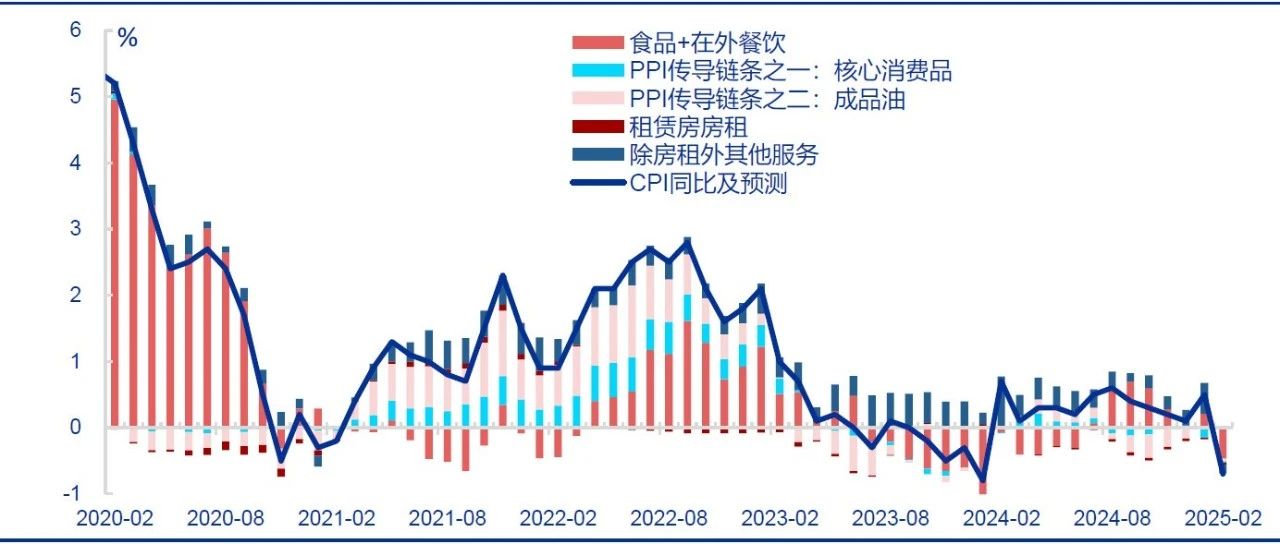
“春节错位”下的“弱通胀”
赵伟宏观探索· 2025-03-09 14:42
Core Viewpoint - The significant drop in inflation readings is attributed to the misalignment of the Spring Festival, and even after excluding this effect, the actual levels remain weak [2][10]. Group 1: CPI Analysis - In February, the CPI decreased by 0.2% month-on-month, influenced by the high base effect from the previous year when the Spring Festival occurred in February [2][10]. - The food CPI fell by 0.5%, with fresh vegetables and pork prices decreasing by 3.8% and 1.9% respectively, reflecting a supply increase due to favorable weather and improved livestock inventory [10][11]. - The core service CPI saw a month-on-month decline of 0.8%, with travel-related prices dropping significantly, including a 22.6% decrease in airfares and a 9.6% drop in tourism prices [3][17]. Group 2: PPI Analysis - The PPI decreased by 0.1% month-on-month in February, with a year-on-year decline of 2.2%, which was below market expectations [12][14]. - The rise in international oil prices contributed positively to the PPI, while coal prices fell significantly, leading to a negative impact on the overall PPI [12][13]. - The low capacity utilization in downstream industries continues to exert downward pressure on the PPI, with expectations of a relative "over-decline" phenomenon in the future [12][13]. Group 3: Future Outlook - The supply-side constraints on inflation are expected to persist in the short term, and the impact of consumption-boosting policies may limit inflation recovery [13]. - In March, the CPI is likely to rebound above zero as the Spring Festival effects dissipate, but the actual recovery may be moderate due to sufficient supply and the "old-for-new" policy suppressing core CPI [13][14]. - The PPI is anticipated to remain under pressure due to low global oil inventories and potential demand suppression from tariff policies, with a projected year-on-year PPI midpoint of -1.2% by 2025 [5][13].