财政预算

Search documents
李迅雷专栏 | 我国财政支出力度不足吗?
中泰证券资管· 2026-03-25 11:32
Core Viewpoint - The article discusses the discrepancy between China's budgeted and actual public expenditure, highlighting that actual spending has consistently fallen short of budgeted amounts since 2020, raising concerns about the adequacy of fiscal policy implementation [1][2]. General Public Budget Expenditure - Actual public budget expenditure has been lower than budgeted amounts since 2020, with notable trends observed in the execution of fiscal revenues and expenditures [3][4]. - The execution of fiscal revenues was higher than budgeted in 2020 and 2021, but both revenues and expenditures fell below budget in 2022 and 2023, with a significant gap in 2024 where revenue shortfalls exceeded expenditure shortfalls [4][6]. General Public Budget Revenue - Since 2022, the execution of general public budget revenue has been below budgeted figures, primarily due to lower-than-expected tax revenues, although non-tax revenues have somewhat compensated for this [7][8]. - In 2020, the budgeted general public budget revenue decreased by 5.3% compared to the previous year, while actual execution showed a smaller decline of 3.9% [8]. Fiscal Accounting Characteristics - The article emphasizes the complexity of China's fiscal accounting, which includes multiple accounts such as general public budget, government fund budget, state capital budget, and social insurance fund budget [1][11]. - The relationship between fiscal revenue, expenditure, and deficit is not straightforward, as it involves various adjustments and transfers that affect the overall fiscal balance [11][17]. Broader Fiscal Support - The analysis includes the second account, government funds, which have provided additional fiscal support not counted in the statutory deficit, such as special bonds and local government financing [20][21]. - Various fiscal resources have different pathways for policy effectiveness, with some funds being used to stimulate investment and consumption, thereby enhancing the overall impact of fiscal policy [22]. Comparative Analysis - The article compares China's fiscal support with that of the United States during the COVID-19 pandemic, noting that China's fiscal support has remained stable and gradually improved since 2023 [23][25]. - The broader fiscal deficit, including various fiscal supports, is estimated to be lower than that of the U.S. during the pandemic, indicating a more measured approach to fiscal policy in China [25][27].


浙商证券浙商早知道-20260308
ZHESHANG SECURITIES· 2026-03-08 10:28
Group 1: Hai Liang Co., Ltd. (海亮股份) - The company is a leading player in copper processing, with overseas expansion and profitability expected to exceed expectations [3] - The copper foil segment is entering a growth phase, with profitability recovery anticipated to surpass expectations [3] - The AI copper-based materials sector presents significant growth potential, with business development progress likely to exceed expectations [3] - Traditional business is driven by better overseas demand compared to domestic, with U.S. production bases expected to capture excess market share and profits due to trade policies [3] - The lithium battery copper foil industry remains highly prosperous, with the company’s 3.5μm product expected to gain excess market share and higher profitability [3] - Breakthroughs in electronic circuit copper foil technology and low domestic production rates indicate vast long-term development potential [3] - The company’s earnings forecast for 2025-2027 includes revenues of 87.93 billion, 112.99 billion, and 123.45 billion CNY, with net profits of 9.62 billion, 17.80 billion, and 26.52 billion CNY respectively [3] Group 2: Wan Guo Gold Group (万国黄金集团) - The company is rapidly growing in the gold industry, with significant production increases expected [5] - The anticipated growth rate is expected to absorb high PE levels, indicating strong future potential [5] - The forecast for net profits from 2025 to 2027 is 1.22 billion, 2.88 billion, and 4.74 billion CNY, reflecting year-on-year growth of 112.09%, 136.06%, and 64.49% respectively [5] Group 3: Macroeconomic Insights - The fiscal budget for 2026 is characterized by a positive spending tone, with fiscal revenues and expenditures in a tight balance [6] - The report indicates that the central and local budget execution for 2025 and the draft for 2026 suggest a slight slowdown in fiscal funding intensity relative to GDP compared to 2025 [6] - The expected midpoint for the RMB to USD exchange rate in 2026 is around 6.9, with potential fluctuations throughout the year [7] - The report highlights that the central bank's recent policy adjustments indicate a focus on managing the pace of RMB appreciation [7]

重要预告!潘功胜、吴清,明日出席经济主题记者会!
券商中国· 2026-03-05 08:53
Group 1 - The 14th National People's Congress will hold a press conference on March 6, 2026, featuring key officials from various ministries to address issues related to development reform, fiscal budget, commerce, finance, and securities [1] - Recent market movements indicate significant volatility, with U.S. stocks experiencing a sharp decline, described as "Black Tuesday," amid major changes in the Federal Reserve's stance [3] - A notable surge of over 115% was reported following incidents involving three British and American oil tankers in the Middle East, highlighting geopolitical risks affecting market dynamics [3]

经济主题记者会,明日下午3时!证监会主席吴清将出席
证券时报· 2026-03-05 08:47
Group 1 - The 14th National People's Congress (NPC) will hold a press conference on economic themes on March 6, 2026, at 3 PM, featuring key officials from various ministries including the National Development and Reform Commission, Ministry of Finance, Ministry of Commerce, People's Bank of China, and China Securities Regulatory Commission [1] - The press conference aims to address issues related to development reform, fiscal budget, commerce, finance, and securities, providing insights to both domestic and international journalists [1] Group 2 - On March 5, the Chairman of the China Securities Regulatory Commission, Wu Qing, visited the Hong Kong delegation to gather opinions ahead of the press conference [2]

中金:如何从地产视角解读香港2026-2027财政预算?
中金点睛· 2026-03-02 23:50
Core Viewpoint - The Hong Kong government's budget for the fiscal year 2026-27 includes adjustments to land revenue, housing supply plans, and tax rates on luxury property transactions, indicating a cautious yet optimistic outlook for the real estate market [2][6][8]. Land Revenue and Budget - The budgeted land revenue for 2026-27 is set at HKD 18 billion, a slight increase from the revised estimate of HKD 17.5 billion for 2025-26, with expectations of potential over-collection based on historical trends and current asset prices [2][7]. - Land revenue has contributed over HKD 1.5 trillion in the past decade, accounting for 15-30% of total revenue during peak market periods [2][7]. Housing Supply - The supply of private residential land is expected to increase to 22,580 units in 2026-27, compared to 13,500 units in 2025-26, which aligns with recent sales trends and aims to stabilize housing prices [3][19][20]. - The government plans to release nine residential sites, providing approximately 6,650 units, with a significant portion coming from the Northern Metropolis development area [20][27]. Commercial Land Supply - For the second consecutive year, the government will not supply pure commercial land due to ongoing pressures in the office and retail property markets, which are experiencing high vacancy rates [4][33]. - The government is focusing on student accommodation projects, with plans to introduce three sites for student dormitories, potentially adding 5,000 beds [4][32][29]. Tax Adjustments - The stamp duty on luxury residential properties valued over HKD 10 million will increase from 4.25% to 6.5%, expected to generate an additional HKD 1 billion in revenue, affecting only 0.3% of housing transactions [2][8]. Market Outlook - The real estate market is anticipated to continue its inventory reduction cycle, with a projected annual completion of approximately 17,000 private residential units over the next five years, which is lower than the expected transaction volume [21][33]. - The overall housing supply strategy aims to maintain a healthy balance between public and private housing, with a target of 420,000 units over the next decade, of which 294,000 will be public housing [32][33].

四川省第十四届人民代表大会预算委员会关于四川省2025年预算执行情况和2026年预算草案的审查结果报告
Xin Lang Cai Jing· 2026-02-27 22:33
Core Viewpoint - The report on the execution of the 2025 budget and the draft budget for 2026 presented by the Sichuan Provincial Government indicates a generally positive fiscal performance, with a focus on supporting economic growth and social welfare while addressing existing challenges in revenue and expenditure management [1][2][3][4][5][7]. Group 1: 2025 Budget Execution - Total provincial revenue reached 585.39 billion yuan, exceeding the budget by 1.8% and showing a growth of 3.9% [2] - Total provincial expenditure was 1.36976 trillion yuan, falling short of the budget by 9.4% with a growth of 1.9% [2] - The social insurance fund revenue was 721.09 billion yuan, achieving 101% of the budget with a growth of 5.6%, while expenditure was 635.11 billion yuan, at 99.7% of the budget with a growth of 6.5% [3] Group 2: 2026 Budget Draft - The proposed total provincial revenue for 2026 is 597.1 billion yuan, with a total of 1.49405 trillion yuan available for allocation after including central transfers and debt [5] - The planned total expenditure for 2026 is 1.41369 trillion yuan, with 720.6 billion yuan allocated for debt repayment [5] - The social insurance fund revenue for 2026 is projected at 739.2 billion yuan, with total available funds of 1.77191 trillion yuan, and planned expenditure of 675.02 billion yuan [6] Group 3: Recommendations and Challenges - The budget committee recommends approval of the budget report and the draft budget, emphasizing the need for a proactive fiscal policy to support economic development and social welfare [8][9] - Key challenges identified include pressure on revenue growth, the need for expenditure structure optimization, and the management of hidden debts [4][9][13] - Recommendations for 2026 include enhancing fiscal management, optimizing revenue sources, and ensuring effective implementation of major strategic projects [10][11][12]
一图读懂丨西安市2026年“账本”安排情况
Xin Lang Cai Jing· 2026-02-27 10:37
Core Viewpoint - The budget report emphasizes a focus on zero-based budgeting, performance enhancement, and strict fiscal discipline to ensure sustainable economic development and social welfare [12][11]. Budget Overview - General public budget revenue is set at 100.9 billion, reflecting a 3% increase, while expenditures are planned at 170.069 billion [14]. - Government fund budget revenue is projected at 124.55 billion, with expenditures of 112.582 billion [14]. - State-owned capital operating budget revenue is estimated at 0.0596 billion, with expenditures of 0.0831 billion [14]. - Social insurance fund budget revenue is expected to be 56.017 billion, with expenditures of 49.132 billion [14]. Key Expenditure Areas - Education spending is budgeted at 29.17354 million, with an increase of 3.3% [15]. - Science and technology spending is set at 7.95808 million, reflecting a 2.5% increase [15]. - Cultural, tourism, sports, and media spending is budgeted at 3.11146 million, with a 7.1% increase [15]. - Social security and employment spending is planned at 24.12619 million, with a 2.2% increase [15]. - Health spending is budgeted at 13.94311 million, with an 8.8% increase [15]. - Resource exploration and industrial information spending is set at 10.00070 million, with an 8.8% increase [15]. - Business services spending is projected at 5.22084 million, showing a significant increase of 33.8% [15]. Strategic Measures - The budget aims to support consumption and investment to consolidate economic recovery [5][16]. - It emphasizes the cultivation of new productive forces and the construction of a modern industrial system [5][16]. - The budget also focuses on promoting urban-rural integration and improving living standards for citizens [5][17]. - There is a commitment to enhance urban capabilities and accelerate urban governance modernization [5][17]. Fiscal Management - The report highlights the importance of strict fiscal management and collaboration between fiscal and tax policies [18]. - It includes measures to activate various financial resources and deepen fiscal reforms for better management [18]. - The implementation of zero-based budgeting and performance management is emphasized to ensure effective allocation of resources [18].

沙特财政部公布2025年实际预算数据
Shang Wu Bu Wang Zhan· 2026-02-25 13:28
Core Insights - The Saudi Ministry of Finance has released the actual budget data for 2025, indicating total revenue of 1.11 trillion riyals and total expenditure of 1.38 trillion riyals, resulting in a budget deficit of 277 billion riyals [1] Revenue and Expenditure - The previously forecasted budget for 2025 was total expenditure of 1.336 trillion riyals, total revenue of 1.091 trillion riyals, and a budget deficit of 245 billion riyals [1] - In the fourth quarter of 2025, actual revenue reached 276.7 billion riyals, while expenditure was 371.6 billion riyals, leading to a deficit of 94.8 billion riyals [1]

肯内阁批准新财年4.7万亿肯先令预算
Shang Wu Bu Wang Zhan· 2026-02-15 15:45
Core Viewpoint - The Kenyan Cabinet has approved a budget policy statement for the fiscal year 2026/27, amounting to 4.7 trillion Kenyan Shillings, with a focus on key sectors such as education, health, energy, infrastructure, agriculture, and social security [1] Summary by Categories Budget Overview - The total budget for the fiscal year is set at 4.7 trillion Kenyan Shillings, with expected total revenue of 3.53 trillion Shillings [1] - Out of the total budget, 3.46 trillion Shillings is allocated for recurrent expenditure, 749.5 billion Shillings for development expenditure, and 495.7 billion Shillings for transfers to county governments [1] Investment Priorities - The budget emphasizes investment in critical areas including education, health, energy, infrastructure, agriculture, and social security [1]
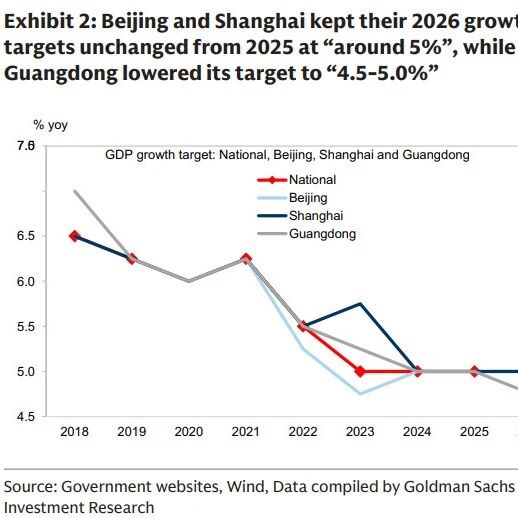
【播客】高盛:多省下调今年增长目标 全国GDP增速如何设定?
Datayes· 2026-02-04 11:44
Group 1: Local "Two Sessions" Signals - The upcoming national "Two Sessions" will set the economic targets for 2026 and release the "14th Five-Year Plan" outline [1] Group 2: Economic Growth in 2025 and 2026 - In 2025, 55% of provinces achieved their growth targets, with a weighted average growth rate of 5.1%, slightly below the target of 5.3% [4] - For 2026, most provinces (19 out of 31) have lowered their growth targets, with the weighted average target expected to decrease to 5.1% from 5.3% in 2025 [4][7] - Beijing and Shanghai have maintained their growth targets at "around 5%", while Guangdong has lowered its target to "4.5%-5.0%" [5][6] Group 3: Inflation and Employment Targets - The inflation target for provinces is expected to remain around "2%", with the actual CPI average projected to rise from 0% in 2025 to 0.6% in 2026 [4] - Employment targets are anticipated to stay at "over 12 million new jobs" and an unemployment rate of "around 5.5%", aligning with the number of college graduates [4] Group 4: Fiscal Budget and Planning - The official deficit rate is expected to remain at 4%, with local government special bond quotas slightly increasing to 4.6 trillion yuan [4] - The broad fiscal deficit rate may expand to 12.0%, maintaining support for economic growth [4] - The "14th Five-Year Plan" will focus on technology, security, and livelihood, aiming for "high-quality development" and "high-level security" [4]