房贷利率下调

Search documents
注意!2026年重磅救市大招来了,房贷利率再降低
Xin Lang Cai Jing· 2026-01-10 07:06
Policy Background - The adjustment of housing loan interest rates is driven by the dual pressures of real estate market adjustments and the need for macroeconomic stability [3] - In 2025, the real estate market did not maintain its early-year recovery, with second-hand housing prices dropping by 8.36% and new home sales declining by 24.1% [3] - Despite a cumulative reduction of approximately 2.5 percentage points in housing loan rates over the past four and a half years, actual rates remain historically high due to falling price levels [3] Core Content - The housing provident fund loan rate is officially reduced by 25 basis points, with the new rates for first-time homebuyers over five years dropping to 2.6% and for second-time buyers to 3.075% [5] - The adjustment is automatic, enhancing policy implementation efficiency, and for a first-time homebuyer with a 500,000 yuan loan, monthly payments decrease by 61.65 yuan [5] - Commercial loan rates are adjusted through the LPR mechanism, with some cities seeing rates as low as 3.0%, significantly reducing monthly payments and total interest costs for borrowers [6] Multi-Dimensional Impact - The reduction in loan rates is expected to alleviate repayment pressure for residents, potentially saving hundreds of billions in interest payments annually, which can be redirected to consumption and improving living standards [6][8] - The policy is anticipated to activate both rigid and improvement housing demand, with significant increases in property visits and transactions following the announcement [8] - The macroeconomic impact includes stimulating related industries such as construction and home appliances, thereby promoting investment and job growth [8] Potential Challenges - Despite the policy benefits, challenges remain, including high inventory levels in third and fourth-tier cities and the need for time and complementary measures for full policy effectiveness [9] - The persistent issue of high actual housing loan rates may limit the impact of nominal rate reductions if price levels remain low [9] - Local government capabilities and fiscal strength vary, affecting the precision of policy implementation and potentially leading to uneven effects across different cities [9] Future Direction - Future adjustments may focus on optimizing housing loan rates through targeted reductions and fiscal subsidies, alongside efforts to enhance the housing provident fund system [9][10] - The real estate policy is transitioning to a phase where both supply and demand sides are coordinated, with measures to expand existing home sales and support various demographic housing needs [10] - The overall goal is to shift the real estate sector from expansion to optimization, ensuring a stable foundation for economic and social development during the 14th Five-Year Plan period [11]


1月1日起,你的房贷月供降了!速查能省多少
Xin Lang Cai Jing· 2026-01-03 03:48
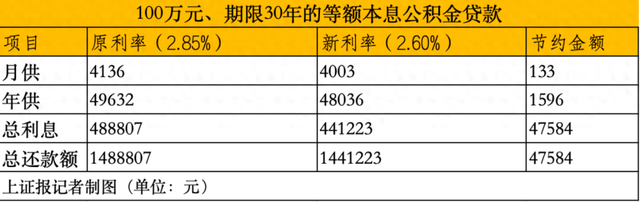
Core Viewpoint - The article discusses the upcoming reduction in housing loan interest rates, which will provide financial relief to borrowers starting January 1, 2026, through adjustments in both public housing fund loans and certain commercial loans [1][3]. Group 1: Public Housing Fund Loan Rate Reduction - Starting January 1, 2026, the interest rate for existing public housing fund loans will be lowered, with the new rates set at 2.1% for loans under 5 years and 2.6% for loans over 5 years for first-time buyers [3][4]. - For a 1 million yuan, 30-year public housing fund loan, the monthly payment will decrease from approximately 4,136 yuan to about 4,003 yuan, resulting in annual savings of around 1,600 yuan [4][5]. - The overall interest savings for the same loan will amount to approximately 47,584 yuan over the loan term [5]. Group 2: Commercial Loan Rate Repricing - Certain existing commercial loan rates will also be repriced in the new year, with the 5-year Loan Prime Rate (LPR) having been reduced by 10 basis points to 3.5% in May 2025 [7][8]. - In Shenzhen, for instance, a borrower with a 1 million yuan loan at a previous rate of 3.15% will see their monthly payment drop from about 4,297 yuan to approximately 4,243 yuan, saving around 54 yuan per month [8][9]. - The total interest savings for this commercial loan will be about 19,580 yuan over the loan period [9]. Group 3: Future Expectations and Recommendations - Experts suggest that there is still room for further reductions in public housing fund rates, but immediate changes are not anticipated as current rates are already low [6]. - The central economic work conference has prioritized public housing fund reform for 2026, indicating that more supportive measures for housing consumption may be forthcoming [6]. - For borrowers, it is recommended to verify eligibility for the new rates and to monitor changes in repayment plans closely, while potential homebuyers should consider prioritizing lower-rate public housing loans [10].
北京楼市成交量显著回升楼市新政后200万元房贷有人能省近8万元利息
Xin Lang Cai Jing· 2025-12-30 12:58
Core Insights - The Beijing real estate market has shown a significant rebound following the recent policy adjustments, with increased visitor numbers to properties and a notable rise in transaction volumes [1] Group 1: Market Response - After the optimization of real estate policies in Beijing, the market reacted positively, with a marked increase in visitor numbers to various properties [1] - From December 25 to 28, the average daily online signing of new residential properties in Beijing reached 133 units, representing an almost 50% increase compared to the period before the policy change [1] Group 2: Financial Implications - The adjustment in mortgage rates saw a reduction from 3.45% to 3.25%, a decrease of 20 basis points [1] - For a second home purchase outside the Fifth Ring Road, using a 30-year fixed-rate mortgage, a loan of 2 million yuan would result in a monthly payment reduction of 220 yuan, leading to a total interest savings of nearly 80,000 yuan over the loan term [1]
楼市传来3个利好,没买房的人要恭喜了,快来看看
Sou Hu Cai Jing· 2025-12-17 03:50
Core Insights - The real estate market is experiencing stabilization in housing prices, a decrease in mortgage rates, and improvements in housing security policies, which collectively create a more favorable environment for potential homebuyers [1][9]. Group 1: Housing Price Stabilization - Housing prices are stabilizing, indicating a return to rational market behavior after years of rapid price increases driven by speculative investments [3][4]. - The previous rapid price increases led to market anxiety, but the current stabilization enhances purchasing power for buyers, allowing them to make more informed decisions [4][9]. Group 2: Mortgage Rate Reduction - Mortgage rates have been decreasing, which directly lowers monthly repayment amounts for homebuyers, making home purchases more affordable [4][5]. - The reduction in mortgage rates is a result of adjustments in national monetary policy aimed at stabilizing the economy, which benefits potential buyers by reducing their financial burden [4][7]. Group 3: Housing Security Policy Improvements - The government has implemented a series of housing security policies to protect buyers' rights, addressing issues such as project delays and misuse of funds by developers [8][9]. - Enhanced housing security measures increase consumer confidence, encouraging more individuals to enter the housing market [8][9]. Group 4: Overall Market Implications - The combination of stabilized prices, lower mortgage rates, and improved housing security policies suggests a healthier real estate market, making it a more opportune time for potential buyers [9][12]. - While these developments are positive, individual circumstances such as financial stability and personal goals should still guide homebuying decisions [11][12].
地产行业周报:降低房贷利率仍有必要,中期关注周期见底可能-20251214
Ping An Securities· 2025-12-14 13:49
Investment Rating - Industry investment rating: Stronger than the market (maintained) [2] Core Viewpoints - The report emphasizes the necessity of lowering mortgage rates to enhance home buying attractiveness, with a focus on potential market stabilization in the second half of 2026 to 2027 [4] - The report highlights the importance of the upcoming annual report season in March and April 2026, where companies with strong inventory structure and product capabilities are expected to benefit [4] - The report expresses optimism regarding Hong Kong real estate investment opportunities in 2026, following the recent interest rate cuts by the Federal Reserve and the Hong Kong Monetary Authority [4] Summary by Sections Market Monitoring - New home transactions in 50 key cities reached 18,000 units, a week-on-week increase of 6.2%, while second-hand home transactions in 20 key cities also increased by 4.6% [11] - As of December 12, 2025, the inventory in 16 cities was 91.77 million square meters, with a slight week-on-week increase of 0.1% and a de-stocking cycle of 22.5 months [14] Capital Market Monitoring - The real estate sector saw a decline of 2.62% this week, underperforming the CSI 300 index, which fell by 0.08% [26] - The current PE ratio for the real estate sector is 59.07 times, significantly higher than the CSI 300's 13.91 times, indicating a valuation at the 94.33 percentile over the past five years [26] Key Company Insights - China Overseas Development is highlighted as a leading central enterprise with a low valuation of 0.34 times PB and a dividend yield of 4.3% [6] - China Resources Land is noted for its stable dividend policy, maintaining around 10 billion RMB in dividends from 2021 to 2024, with a current dividend yield of 5.1% [6] - Other companies such as Country Garden, Greentown China, and China Merchants Shekou are also recommended based on their strong operational capabilities and market positioning [6]


今明两年,打算买房的家庭,不妨先听听这4个建议,非常实用
Sou Hu Cai Jing· 2025-11-25 09:13
Core Insights - The current real estate market presents favorable conditions for homebuyers, with lower mortgage rates and increased housing supply compared to the previous year [1][3][12] Market Environment - Starting January 1, 2025, the mortgage rate for existing loans will be reduced by 60 basis points to 3.3%, and the public housing fund loan rate for first-time buyers with a term over five years will drop to 2.85% [1] - Since Q4 2024, various favorable measures have been implemented across cities, including lower down payment ratios and reduced purchase restrictions, leading to a rebound in transaction volumes in some areas [1][3] Practical Advice for Homebuyers - **Utilize Policy Benefits**: Current mortgage rates are at historical lows, and buyers can save significantly on monthly payments. For example, a loan of 1 million yuan over 30 years at a reduced rate from 3.9% to 3.3% results in a monthly payment decrease from 4717 yuan to 4380 yuan, saving over 10 million yuan in total interest [3][4] - **Choose Property Type and Location Wisely**: Buyers are encouraged to consider properties in sub-central urban areas, which offer good value and potential for growth. Second-hand homes are particularly recommended due to their price adjustments and immediate availability [4][7] - **Plan Purchase Timing**: While the current environment is favorable, timing remains crucial. First-time buyers should consider entering the market now, while those looking to upgrade may benefit from waiting to observe further market changes [4][5] - **Assess Financial Capacity**: Buyers should evaluate their long-term financial commitments, ensuring that monthly payments do not exceed 40% of household income. It's essential to maintain a financial buffer for emergencies and other expenses [7][9] Market Dynamics - The real estate market is undergoing significant changes, moving away from a period of continuous price increases to a more rational assessment of property value. The focus is shifting back to housing as a necessity rather than purely an investment [8][10] - The introduction of online transaction processes in many cities has improved efficiency and transparency in real estate dealings [10] Conclusion - The current period is seen as advantageous for families looking to purchase homes, with favorable policies, increased choices, and lower costs creating a conducive environment for making informed decisions [12]

好消息!2025年11月房贷利率将迎大幅下调,降息已成定局
Sou Hu Cai Jing· 2025-10-30 17:42
Group 1 - The core viewpoint of the articles indicates that a new round of mortgage interest rate cuts is expected to occur in November 2025, potentially more significant than previous reductions [3][9][11] - In May 2023, the People's Bank of China lowered the LPR to 3.5%, and the first home loan rate dropped to 2.6%, resulting in reduced monthly payments for borrowers [3][5] - The financial regulatory authority has indicated plans to accelerate the introduction of financing systems compatible with new real estate development models, with a significant increase in approved loans for real estate projects [3][5] Group 2 - The current economic complexity, including weak domestic demand indicators, is driving the need for mortgage rate cuts [5][9] - Predictions suggest that the LPR may be lowered by 10-30 basis points by the end of 2025, which would further reduce borrowing costs for homebuyers [3][9] - The anticipated reduction in mortgage rates is expected to lower the cost of home purchases significantly, with potential monthly payment reductions of 600-900 yuan for a 1 million yuan loan [9][11] Group 3 - The external environment, particularly the U.S. Federal Reserve's shift to a rate-cutting cycle, has eased constraints on domestic monetary policy, facilitating potential mortgage rate reductions [7][9] - The expected mortgage rate cuts are likely to stimulate the real estate market, benefiting both first-time buyers and those looking to upgrade their homes [9][11] - The collaboration between public and commercial loan rates is projected to save homebuyers over 20 billion yuan annually, with further savings anticipated from upcoming rate cuts [9][11] Group 4 - The reduction in mortgage rates is expected to alleviate financial pressure on real estate companies and stimulate demand for development loans [11][13] - The overall economic impact of lower mortgage rates could enhance consumer spending in related sectors such as home appliances and renovations [11][13] - Despite strong expectations for rate cuts, the current mortgage rates are already at a policy floor, indicating limited room for further reductions [11][13]

买房时一次性付清和还贷30年,区别有多大?你了解吗?
Sou Hu Cai Jing· 2025-10-30 13:25
Core Viewpoint - The continuous decline in mortgage rates in China, currently around 3.5%, lowers the threshold for home purchases, stimulating interest among first-time and upgrading buyers. The debate between choosing a lump-sum payment versus a 30-year mortgage has resurfaced, with most industry experts favoring the latter as a means to alleviate financial pressure on buyers [1]. Group 1: Advantages and Disadvantages of Lump-Sum Payment - The primary advantage of a lump-sum payment is the elimination of monthly mortgage pressure, allowing homeowners to face life challenges without the burden of loan repayments [5]. - Paying in full avoids long-term interest payments, preventing homeowners from being in a position of working primarily for the bank [5]. - However, the significant financial strain of a lump-sum payment can leave families with limited funds for emergencies, making them vulnerable to unexpected events [8]. - Additionally, opting for a lump-sum payment means missing out on potential investment opportunities that could lead to wealth growth [8]. Group 2: Advantages and Disadvantages of 30-Year Mortgage - A 30-year mortgage allows buyers to make a down payment, significantly reducing the financial burden of paying the full price upfront, thus improving cash flow [11]. - Compared to a 20-year mortgage, the monthly payments are lower, providing more financial flexibility for homeowners [11]. - The remaining funds can be invested to potentially offset some mortgage interest, although this requires a certain level of investment acumen [11]. - On the downside, the long repayment period introduces risks such as income reduction or job loss, which can increase repayment pressure [11]. - Over the 30 years, a substantial portion of income will be directed towards mortgage payments, potentially diminishing the quality of life [11]. - Ultimately, the total interest paid over 30 years could equate to the price of another home, indicating that homeowners may spend a significant part of their lives financially tied to the bank [11].

二手房的抛售愈演愈烈,行内人士:我们在创造一个人类的奇迹
Sou Hu Cai Jing· 2025-10-26 04:02
Core Insights - The Chinese second-hand housing market is experiencing unprecedented changes, with a significant increase in listings and a continuous decline in average prices over the past 25 months [1][3]. Group 1: Market Trends - The average price of second-hand residential properties in 100 cities has dropped to 14,870 yuan per square meter as of May 2024, marking a sustained decline [1]. - Major cities such as Chengdu, Chongqing, and Wuhan have seen listings exceed 200,000 units, with Hangzhou reaching 210,000 and Shanghai at 180,000 [1]. Group 2: Factors Driving Change - The long-term upward trend in housing prices since the 1998 reform has created a significant "bubble," leading to a rush among early investors to liquidate their assets as the market shifts [3]. - Policy relaxations in many cities have removed previous restrictions on purchases and sales, facilitating a surge in listings as investors take advantage of the new environment [4]. - The reduction in mortgage rates has prompted homeowners to refinance, leading to increased supply in the second-hand market as they sell their existing properties to take advantage of lower rates [5]. - A decline in purchasing demand, influenced by the economic impact of the COVID-19 pandemic and a shift towards more rational consumer behavior, has resulted in a surplus of listings without corresponding buyer interest [6].
房贷利率下调到4.25%,那么当初利率5.88%的购房者怎么办?
Sou Hu Cai Jing· 2025-10-17 05:18
Core Viewpoint - The article discusses the impact of the recent reduction in mortgage rates on homeowners who purchased properties at higher rates, specifically those who bought at 5.88%, and explores their potential responses to this situation [1][10]. Group 1: Mortgage Rate Context - The current mortgage rate has decreased to 4.25%, while many homeowners are still burdened by higher rates from previous years [1][7]. - China's mortgage scale is approximately 38.8 trillion, with 96% of families owning at least one property, indicating a strong reliance on real estate as a primary asset [3][5]. Group 2: Homeownership Sentiment - The preference for real estate among Chinese citizens is driven by various factors, including rapid price increases and the social significance of property ownership for issues like residency, marriage, and education [5][6]. - Real estate constitutes 77% of total household assets in China, highlighting the central role of property in wealth accumulation [3][5]. Group 3: Government Policies and Market Response - To cool down the overheated real estate market, the government implemented policies that included raising mortgage rates, which peaked at 5.88% [7]. - In response to market conditions, banks have begun to lower mortgage rates to stimulate demand and alleviate the financial burden on buyers [7][9]. Group 4: Homeowners' Strategies - Homeowners with a 5.88% mortgage should first review their loan contracts to determine if they have a floating or fixed rate, as this will affect their ability to benefit from lower rates in the future [9][10]. - Options for homeowners include considering early repayment of loans, although this requires significant funds and may incur penalties [9]. - A more aggressive strategy involves selling their current home to buy a new one at the lower rate, but this carries risks such as potential delays and the possibility of losing the first-time buyer rate [9][10].