
新能源板块

Search documents
二季度A股或为震荡,关注红利与新能源板块
AVIC Securities· 2026-03-30 03:34
Market Outlook - The A-share market is expected to experience fluctuations in Q2, with a focus on dividend and new energy sectors[4] - High oil prices will likely remain a key trading theme in the coming months, influenced by ongoing Middle East conflicts[8] - The current market sentiment is cautious, with a conservative risk appetite anticipated in Q2[9] Economic Indicators - As of March 25, the probability of the Federal Reserve cutting interest rates in Q2 dropped from 45.7% to 0%, while the probability of maintaining rates increased from 54.3% to 88.2%[11] - The correlation between stock prices and earnings is at its highest in April, indicating a focus on sectors with strong fundamental performance[6] Sector Analysis - The new energy sector is poised to benefit significantly from the global energy transition, with China leading in renewable energy systems[16] - Industries such as fiberglass, batteries, computer equipment, software development, agricultural processing, cement, and energy metals are expected to show improved earnings in Q3 2025 and continued positive forecasts for 2026[6] Investment Recommendations - Investors are advised to focus on sectors with solid earnings support, particularly in the dividend and new energy sectors[4] - The commercial aerospace sector is gaining attention due to SpaceX's potential IPO, which could reshape valuation standards in the industry[24]
碳酸锂市场周报:宏观风险持续资金动能弱化,盘面宽幅调整-20260320
Guang Fa Qi Huo· 2026-03-20 02:28
1. Report Industry Investment Rating - No relevant information provided 2. Core Viewpoints of the Report - The lithium carbonate market experienced wide - range fluctuations last week, with the price center moving down. Macro risks persisted, and the trading momentum of funds in the new energy sector weakened. The fundamentals remained in a state of increasing supply and demand. Geopolitical conflicts led to increased market uncertainty, and the previous over - valuation of the lithium carbonate market and the flow of funds to other sectors weakened the trading momentum of the new energy sector. The short - term unilateral driving force of the market is limited, and it will mainly undergo wide - range shock adjustments. The main contract is expected to fluctuate between 148,000 - 162,000 yuan. The recommended strategy is to wait and see and conduct short - term range operations [3]. 3. Summary by Directory Market Overview - Last week, the lithium carbonate futures market fluctuated widely, with the main contract fluctuating between 150,000 - 165,000 yuan. As of March 13, the main futures contract LC2605 fell 2.61% to 152,080 yuan, and the trading activity decreased. The weighted contract's total open interest was 623,000 lots. In the spot market, as of March 13, the average price of SMM battery - grade lithium carbonate was 159,000 yuan/ton, and that of industrial - grade lithium carbonate was 155,500 yuan/ton, both down about 2.8% week - on - week. The spot price mainly followed the futures market, and there were differences in market sentiment. Downstream buyers increased purchases at low prices but were less accepting of high - priced goods [3]. Macro - Geopolitical conflicts have not shown significant signs of easing. Iran's new supreme leader, Mojtaba Khamenei, stated that Iran will continue strategic measures such as blocking the Strait of Hormuz and may open new battlefronts if necessary, increasing the uncertainty risk from overseas geopolitical factors [3]. Supply - Last week, production continued to increase. After the Spring Festival, the planned maintenance of upstream salt plants gradually ended, and most enterprises resumed production, driving up supply. In March, imports from Chile were sufficient to provide some supplementation. As of March 12, the weekly production of SMM lithium carbonate was 22,590 tons, an increase of 768 tons week - on - week. In February, the lithium carbonate production was 83,090 tons, a decrease of 14,810 tons month - on - month but a 35% increase year - on - year. Among them, the production of battery - grade lithium carbonate was 60,930 tons, a decrease of 10,510 tons from the previous month but a 36% increase year - on - year; the production of industrial - grade lithium carbonate was 22,160 tons, a decrease of 4,300 tons from the previous month but a 35% increase year - on - year. The production in March is expected to increase to 106,390 tons [3][42]. Demand - The overall demand outlook is optimistic. The power terminal's power - carrying capacity has increased significantly, and leading energy - storage enterprises are basically operating at full capacity. Downstream production schedules remain resilient. With rigid orders, the material production is expected to remain stable. In March, the production schedules of battery cells and materials are expected to increase month - on - month, with a significant increase in lithium iron phosphate and relatively weak performance of ternary materials. In February, the demand for lithium carbonate was 111,503 tons, a decrease of 13,180 tons from the previous month but a 47.5% increase year - on - year. Affected by the holiday in February, the demand in March is expected to increase to 132,845 tons, a month - on - month increase of about 19% [3][72]. Inventory - Last week, the inventory in all links continued to decline, but the decline rate further slowed down. The inventory of upstream smelters decreased, while downstream enterprises continued to replenish inventory last week, and the inventory of battery cell manufacturers and traders decreased overall. As of March 12, the total sample weekly inventory was 98,958 tons, a decrease of 415 tons week - on - week; the smelter inventory was 16,291 tons, the downstream inventory was 45,647 tons, and the inventory in other links was 37,020 tons. As of March 12, the total number of warehouse receipts was 36,455, a decrease of 385 during the week [3][64]. Price - The lithium carbonate futures market fluctuated widely, and the spot market was mainly for rigid - demand purchases. The trade premium and discount remained strong, and the domestic - foreign price difference converged. The raw material price was firm, and the short - term port arrivals decreased. The prices of major materials fluctuated at a high level [4][12][21][29]. Production - The production continued to increase, and the maintenance gradually ended. In March, the production is expected to increase significantly, and the supply in major production areas has recovered. According to SMM, in March, the estimated production of lithium carbonate from spodumene is about 65,400 tons, an increase of 15,200 tons from the previous month; the production of lithium carbonate from mica is expected to be 13,930 tons, an increase of 2,610 tons; the production of lithium carbonate from salt lakes is expected to be 16,440 tons, an increase of 2,500 tons. In terms of regional production, the production in the three major main production areas of Jiangxi, Sichuan, and Qinghai is expected to increase significantly. It is expected that the lithium carbonate production in Jiangxi in March will be 26,680 tons, an increase of 2,460 tons from the previous month; the production in Sichuan is expected to increase by 7,200 tons to 18,200 tons; the production in Qinghai is expected to increase by 1,700 tons to 14,350 tons [35][42][47]. Capacity and Operation - The upstream smelting capacity continued to expand, but the operating rate decreased, and there was a trend of flexible production lines switching to lithium carbonate production. The capacity continued to expand, and the central value of lithium carbonate production has significantly increased. Some new projects are gradually ramping up, driving up the lithium carbonate capacity. Currently, there is limited room for improvement in the operating rate of leading enterprises. Affected by the holiday, the operating rate in February decreased significantly. According to SMM, the monthly lithium carbonate capacity in March is expected to be 157,700 tons, a 0.26% increase from the previous month, and the lithium hydroxide capacity is 52,200 tons, a slight decrease from the previous month. The monthly operating rate of lithium carbonate in February was 48%, a decrease of 8% from the previous month; the operating rate of lithium hydroxide was 38%, a decrease of 5% from the previous month [48][50]. Import - The average monthly import volume of lithium carbonate currently remains around 15,000 - 25,000 tons, and the recent imports are relatively stable. The import structure is relatively stable, and the import regions are still mainly in South American countries such as Chile and Argentina. According to Chile's shipping data, domestic downstream enterprises have a strong willingness to supplement raw materials through imported lithium salts, and the import volume in March may increase significantly. Customs data shows that in December, the total monthly import volume of lithium carbonate was 23,988.66 tons, an increase of 1,933.5 tons from November. In terms of the import country structure, the import data from Argentina and Chile both increased in December. In February, Chile's total lithium salt exports were 33,900 tons of LCE, a 14% decrease month - on - month but a 56% increase year - on - year. The lithium carbonate export volume was 26,800 tons, accounting for 79%, an increase of 21%; the lithium sulfate export volume was 122,100 physical tons; the lithium hydroxide export volume decreased to 942 tons [51][56]. Demand Details - **Iron Lithium Production Schedule**: Affected by seasonal subsidy cuts, the power terminal data was weak, but the seasonality of lithium iron phosphate was diluted under the support of energy storage. In February, the production of major materials decreased month - on - month due to the holiday. In March, the production schedule of lithium iron phosphate was significantly revised upwards. After the end of the holiday impact on two - wheeled vehicles and 3C consumption, the supply is expected to gradually recover, and the production schedules of cobalt - acid lithium and manganese - acid lithium are expected to increase slightly. According to SMM, the production of lithium iron phosphate in March is expected to be 430,400 tons, an increase of 82,200 tons month - on - month. The monthly production of cobalt - acid lithium in March is expected to be 8,480 tons, an increase of 1,760 tons month - on - month; the production of manganese - acid lithium in March is expected to be 10,310 tons, an increase of 2,490 tons month - on - month [73][80]. - **Ternary Material Production Schedule**: In March, the production of ternary materials is expected to increase overall. Although the seasonal impact is gradually digested, the weakening of the terminal and the structural squeeze of lithium iron phosphate still have an impact, and the increase in the production schedule of ternary materials is less than that of lithium iron phosphate. Structurally, it is expected that the production schedules of medium - and high - nickel materials and NCA will be significantly revised upwards, while the production of low - nickel materials accounts for a small and stable proportion. According to SMM data, the production of ternary materials in March is expected to be 84,360 tons, an increase of 13,640 tons month - on - month. Among them, the production of 3 - series materials is expected to remain at 30 tons, the production of medium - and low - nickel ternary (5/6 - series) materials is expected to be 10,220 tons and 40,180 tons respectively, with a larger increase in the production of medium - nickel materials; the production schedules of high - nickel ternary (8/9 - series) materials are expected to be 20,320 tons and 12,079 tons respectively, also showing a month - on - month increase; the production of NCA is expected to be 1,390 tons, with a relatively large month - on - month increase [81][85]. - **Waste Recycling**: After the overall increase in the lithium carbonate price center, the recycling end increased rapidly under high profits. In February, the recycling volume decreased overall due to the holiday. Structurally, there were slight differences between different materials, with a larger decrease in ternary material recycling and a slower decrease in lithium iron phosphate and cobalt - acid lithium. According to SMM, the total monthly recycling volume of domestic waste lithium batteries in February was 27,708 tons, a 26% decrease month - on - month but a 36.7% increase year - on - year. Among them, the monthly recycling volume of ternary waste materials was 10,720 tons, a decrease of 5,059 tons from the previous month; the total recycling volume of lithium iron phosphate waste materials was 14,026 tons, a decrease of 3,446 tons from the previous month; the total recycling volume of cobalt - acid lithium waste materials was 2,962 tons, a decrease of 1,196 tons from the previous month [86][88]. - **New Energy Vehicle Market**: In 2026, the new energy vehicle subsidy policy was adjusted from a fixed - amount subsidy to a proportional subsidy, resulting in a decrease in subsidies for mid - and low - end models and a weakening of the purchase tax preference policy. The impact of seasonality and the pre - consumption due to policy withdrawal gradually emerged, and the new energy vehicle market has cooled down significantly since the beginning of the year. However, the power - carrying capacity per vehicle has increased significantly, and the market growth structure has also changed, gradually shifting to the joint drive of the steady growth of passenger vehicles and the explosion of commercial vehicles. According to the Passenger Car Association, in February, the retail sales of the new energy passenger vehicle market were 464,000 units, a 32.0% year - on - year decrease; from January to February, the retail sales of the new energy passenger vehicle market were 1.06 million units, a 25.7% year - on - year decrease; the retail penetration rate in February was 44.9%, a 4% year - on - year decrease. In February, the wholesale sales of new energy passenger vehicles reached 723,000 units, a 13.1% year - on - year decrease; from January to February, the wholesale sales of new energy passenger vehicles reached 1.589 million units, a 7.9% year - on - year decrease; the manufacturer's wholesale penetration rate in February was 47.6%, a 1% year - on - year increase [89]. - **Power Battery Market**: In February, the production, sales, and installation data of batteries met expectations. Affected by seasonality, the data continued to weaken month - on - month, but the production increased year - on - year. Lithium iron phosphate batteries still dominated the market share. On a monthly basis, the demand for ternary batteries in high - end new energy vehicles was relatively stable, while the demand in the economy - class electric vehicle market weakened more significantly, and the demand for lithium iron phosphate batteries also contracted. According to the data of the Power Battery Industry Innovation Alliance, in February, the total production of power and energy - storage batteries in China was 141.6 GWh, a 15.7% decrease month - on - month but a 41.3% increase year - on - year. The domestic power battery installation volume was 26.3 GWh, a 37.4% decrease month - on - month and a 24.6% decrease year - on - year. Among them, the installation volume of ternary batteries was 5.7 GWh, accounting for 21.7% of the total installation volume, a 39.1% decrease month - on - month and an 11.4% decrease year - on - year; the installation volume of lithium iron phosphate batteries was 20.6 GWh, accounting for 78.3% of the total installation volume, a 36.9% decrease month - on - month and a 27.5% decrease year - on - year [94][99]. - **Energy - Storage Market**: The production and sales of energy - storage batteries decreased seasonally, and the inventory - to - sales ratio remained at a low level. In February, the production and sales data of energy - storage batteries decreased month - on - month, and the inventory - to - sales ratio remained low [100].
磷酸铁锂厂商下月起集体涨价,新能车ETF(515700)冲击6连涨
Xin Lang Cai Jing· 2025-12-26 02:16
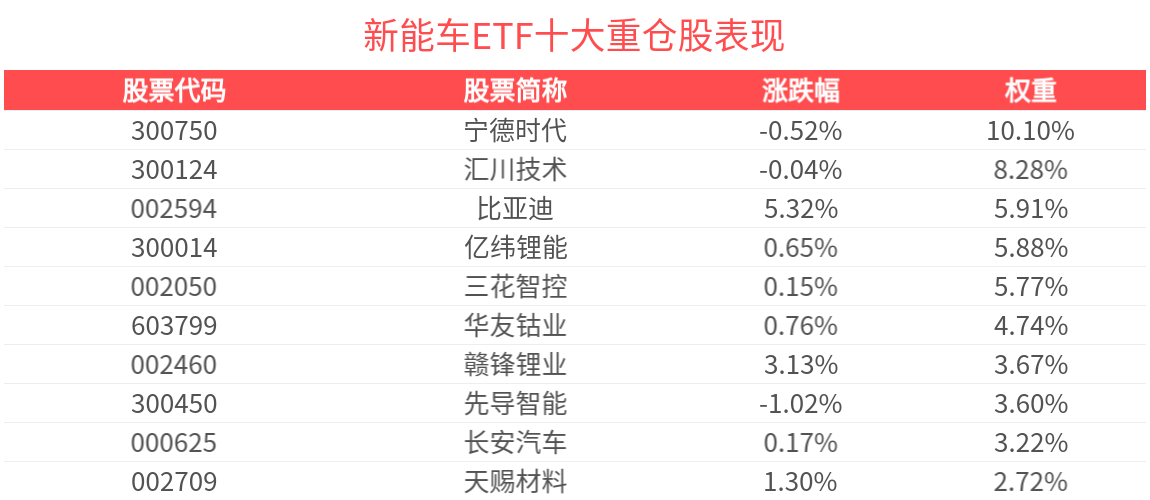
Core Viewpoint - The new energy vehicle (NEV) sector is experiencing significant growth, driven by rising lithium carbonate prices and increased demand for electric vehicles, with key companies in the industry showing strong stock performance [1][2]. Group 1: Market Performance - The China Securities New Energy Vehicle Industry Index (930997) rose by 1.50%, with notable gains from companies such as Tianhua New Energy (7.58%), Defang Nano (7.40%), and BYD (5.32%) [1]. - The New Energy Vehicle ETF (515700) increased by 1.59%, marking its sixth consecutive rise, with the latest price at 2.5 yuan [1]. - The latest scale of the New Energy Vehicle ETF reached 2.149 billion yuan, a one-month high [2]. Group 2: Lithium Prices and Industry Trends - According to Infolink Consulting, lithium carbonate prices continue to rise, with spodumene concentrate (SC6) CIF prices at $1,250 to $1,330 per ton, averaging $1,290, a nearly 20% increase over two weeks [1]. - The spot price for battery-grade lithium carbonate is between 95,000 to 102,000 yuan per ton, averaging approximately 98,000 yuan, reflecting an 8% increase from two weeks prior [1]. - Major domestic lithium iron phosphate manufacturers have initiated price hikes, with Hunan Yuno increasing processing fees by 3,000 yuan per ton starting January 2026 [1]. Group 3: Key Companies in the Index - The top ten weighted stocks in the China Securities New Energy Vehicle Industry Index account for 51.96% of the index, including CATL, Huichuan Technology, and BYD [3]. - The performance of these companies varies, with CATL showing a slight decline of 0.52%, while BYD increased by 5.32% [4].

上证的新高 | 谈股论金
水皮More· 2025-11-13 10:17
Core Viewpoint - The A-share market experienced a strong performance, with the Shanghai Composite Index reaching a ten-year high, driven significantly by the performance of CATL and the overall enthusiasm in the electronic and new energy sectors [3][5][6]. Market Performance - The three major A-share indices collectively strengthened, with the Shanghai Composite Index rising by 0.73% to close at 4029.50 points, the Shenzhen Component Index increasing by 1.78% to 13476.52 points, and the ChiNext Index up by 2.55% to 3201.75 points [3][5]. - The total trading volume in the Shanghai and Shenzhen markets reached 20.42 billion, an increase of 969 million compared to the previous day [3]. Key Drivers - CATL's stock surged nearly 9%, playing a crucial role in driving the indices higher, particularly impacting the ChiNext Index and the Shenzhen Component Index [6][7]. - The electronic sector, especially the energy storage and solid-state electronics segments, received multiple positive stimuli, including a surge in key lithium battery material prices and announcements from CATL's chairman regarding the company's leading position in the global solid-state battery market [8]. Sector Analysis - The new energy sector, represented by CATL, showed significant influence in the market, with many stocks in this sector rising over 20% [8]. - The market also saw a rebound in the photovoltaic equipment sector after a previous decline, indicating the resilience and impact of the new energy sector [8]. Fund Flow and Market Sentiment - There was a notable shift in fund flows, with a report circulating about insurance companies adjusting their long-term investment strategies, which may have pressured high P/E technology stocks [8]. - The A-share market saw a net inflow of 20.9 billion, with northbound funds contributing a net inflow of 22.1 billion, while domestic funds exhibited a significant outflow [9]. Hong Kong Market Performance - The Hong Kong market also showed resilience, with the Hang Seng Index rising by 0.58% and the Hang Seng Tech Index increasing by 0.8%, driven by positive news related to Alibaba [9]. - Notably, there was a net outflow of 3.3 billion from southbound funds, marking a shift after a period of continuous inflow [9].

数据宝下周A股调研出炉:新能源板块看好比例大幅提升
Zheng Quan Shi Bao Wang· 2025-11-09 13:08
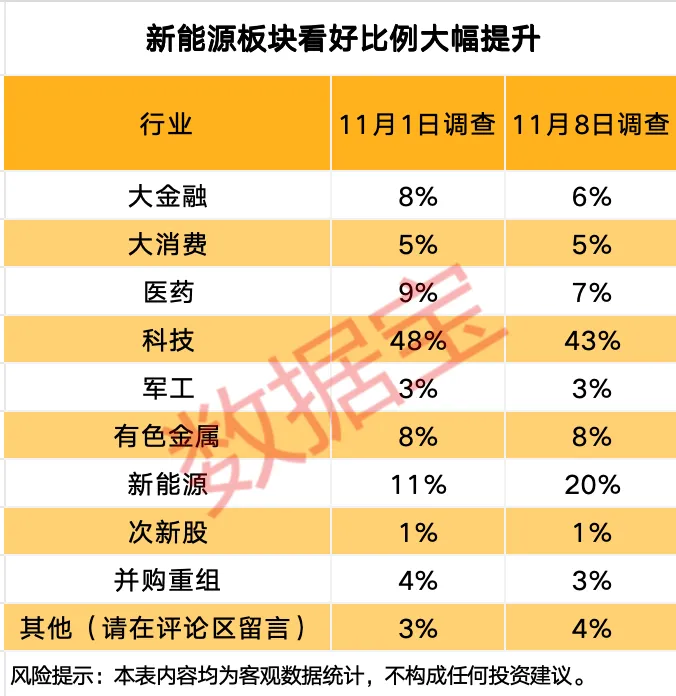
Core Insights - The survey conducted by Securities Times Data Treasure indicates a mixed sentiment among investors regarding A-share market movements, with a notable increase in optimism towards the new energy sector [1] Group 1: Investor Sentiment - 23% of surveyed investors increased their positions, while 18% reduced their holdings, and 5% completely exited their positions; 54% maintained their current holdings [1] - Approximately 52% of respondents believe that A-shares will rise above 4000 points and stabilize, while 28% expect a rise followed by a decline [1] Group 2: Sector Outlook - The proportion of investors optimistic about the new energy sector has significantly increased from 11% to 20%, marking a 9 percentage point rise [2] - Other sectors such as technology, pharmaceuticals, and large financials have seen a decrease in positive sentiment, with technology dropping from 48% to 43%, pharmaceuticals from 9% to 7%, and large financials from 8% to 6% [2]
公司债ETF:泊舟侧停千帆过,谨逢盛世谱华章
Sou Hu Cai Jing· 2025-10-31 05:56
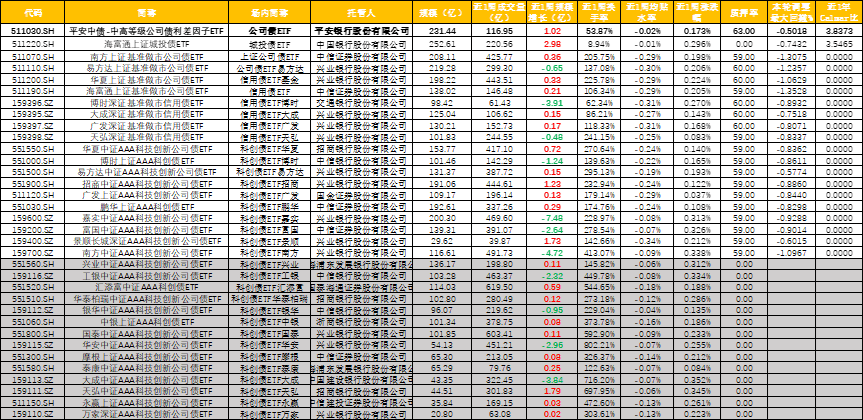
Group 1 - The core viewpoint of the news indicates a generally optimistic market sentiment following the recent talks between Chinese and American leaders, leading to a mixed performance in global stock index futures and a rise in gold and rare earth prices [1] - Despite a decline in the overall market, the release of tariff details and the performance of Hong Kong stocks suggest that market sentiment remains optimistic, indicating no need for excessive concern about future market trends [1] - The performance of major companies like Moutai and China Merchants Bank in their recent quarterly reports reflects differing market perceptions, with one stock rising and the other falling [1] Group 2 - Institutional trading data shows a net subscription for bond funds, equity funds, and fixed income products, indicating a shift in investor preference despite outflows from credit bond ETFs [2] - The Ping An Company Bond ETF (511030) has seen a contrary growth in scale, attributed to its short duration (1.94 years), static high yield (currently 1.95%), and minimal discount [2] - The bond market has experienced fluctuations influenced by factors such as Sino-US negotiation expectations, anticipated interest rate cuts, and the delay in new fund redemption regulations [2]
储能产业链机会
2025-09-08 04:11
Summary of Key Points from the Conference Call Industry Overview - The energy storage market in China is transitioning from policy-driven growth to economic-driven growth, with regions like Inner Mongolia and Shandong benefiting from supportive electricity prices and improved spot market returns, leading to robust market growth and increased market share for leading companies [2][3] - The overseas energy storage market, particularly in Europe and the United States, is experiencing rapid development of large-scale projects driven by economic factors, with emerging markets showing increased demand for backup power, particularly in commercial storage due to electricity shortages and improved returns [2][4] Core Insights and Arguments - The domestic energy storage market is expected to grow sustainably as it shifts towards a product-oriented model, with leading companies gaining more market share and orders [3] - The chemical industry is currently undervalued and facing a potential turnaround, with policies aimed at reducing overcapacity likely to improve cash flow and dividend yields, enhancing valuation advantages [2][10] - The renewable energy sector is emerging strongly in a bull market, with the energy storage sector poised to become a new focal point in technology investments [2][9] Investment Opportunities - Key areas to focus on include lithium battery technology, emerging residential and commercial storage solutions, and overseas power conversion systems (PCS) and operators [2][6] - The energy storage sector is expected to become a new mainstay in the technology field, particularly as market styles shift towards urgent investments and high-cut-low strategies [9] Specific Company Insights - Companies in the chemical sector related to energy storage include: 1. **Yuntianhua and Xingfa Group** in the phosphate chemical sector, benefiting from stable demand and improving profitability [4][13] 2. **New Zobon**, a leader in electrolyte technology, maintaining strong profitability and stable deliveries [4][13] 3. **Zhenhua Co.**, focusing on chromium salt and metal chromium, expected to benefit from supply constraints and strong downstream demand [4][13] Market Dynamics - The lithium battery sector is expected to stabilize and grow, driven by domestic and overseas expansion plans from major battery manufacturers [14][15] - Solid-state batteries are a significant variable for price-to-earnings (PE) ratios, with multiple catalysts expected in the coming years [16][17] - Lithium prices have seen a significant increase due to supply disruptions and rising demand, with expectations for continued strength in pricing [18][21] Future Trends - The energy storage sector is projected to thrive as more renewable energy sources enter the spot market, with supportive policies enhancing project profitability [24] - Beneficial stocks in the energy storage sector include green power operators and storage operators, which are expected to gain from green energy subsidies and improved future returns [25]
光大期货工业硅日报-20250702
Guang Da Qi Huo· 2025-07-02 07:59
Group 1: Report Industry Investment Rating - No relevant content found Group 2: Report's Core View - On July 1, polysilicon fluctuated with a slight upward trend. The main contract 2508 closed at 32,700 yuan/ton, with an intraday decline of 2.39%. The position decreased by 5,137 lots to 61,196 lots. The price of SMM polysilicon N-type silicon material dropped to 34,500 yuan/ton, and the price of the lowest deliverable N-type silicon material also dropped to 34,500 yuan/ton. The premium of the spot over the main contract widened to 1,800 yuan/ton. Industrial silicon fluctuated with a downward trend. The main contract 2509 closed at 7,765 yuan/ton, with an intraday decline of 4.31%. The position increased by 5,325 lots to 361,000 lots. The reference price of Baichuan industrial silicon spot remained stable at 8,738 yuan/ton compared to the previous trading day. The price of the lowest deliverable 553 changed from a discount to a premium of 165 yuan/ton over the futures. The news of production cuts by large industrial silicon manufacturers in Xinjiang has been gradually digested by the market. After a rebound, both silicon products started to correct synchronously. Trump's tax policy targeting the new energy sector has affected the market. Due to the previous oversold situation of polysilicon, its recent futures performance has been slightly stronger than that of industrial silicon. In reality, the pace of industrial silicon warehouse receipts flowing back to the market has slowed down, and high-quality polysilicon warehouse receipts still need a significant price decline to relieve pressure. With high inventory levels, silicon prices are more likely to fall than to rise. Continuous monitoring of the price ratio between the two silicon products and news related to policies and industry capacity regulation is recommended [2] Group 3: Summary by Relevant Catalogs 1. Daily Data Monitoring - **Industrial Silicon**: The futures settlement prices of the main and near - month contracts decreased by 280 yuan/ton. Among various spot prices, the price of some grades remained stable, while the price of 421 silicon (for organic silicon use in Kunming) decreased by 150 yuan/ton, and the prices of some grades in Xinjiang increased by 100 yuan/ton. The industrial silicon warehouse receipts decreased by 336, the Guangzhou Futures Exchange inventory increased by 19,735 tons, the inventory at Huangpu Port decreased by 3,000 tons, the inventory at Tianjin Port decreased by 11,000 tons, the inventory at Kunming Port decreased by 2,000 tons, and the industrial silicon factory warehouse inventory decreased by 54,860 tons. The total social inventory of industrial silicon decreased by 70,860 tons [3] - **Polysilicon**: The futures settlement prices of the main and near - month contracts decreased by 835 yuan/ton and 535 yuan/ton respectively. The spot prices of N - type polysilicon material, dense material/single - crystal use, and cauliflower material/single - crystal use remained stable. The premium of the spot over the futures widened by 835 yuan/ton. The polysilicon warehouse receipts remained unchanged, the Guangzhou Futures Exchange inventory was 78,000 tons, the factory warehouse inventory increased by 4,000 tons, and the total social inventory increased by 4,000 tons [3] - **Organic Silicon**: The prices of DMC in the East China market, raw rubber, and 107 glue remained stable, while the price of dimethyl silicone oil increased by 2,000 yuan/ton [3] - **Downstream Products**: The prices of silicon wafers (single - crystal M10/G12) and battery cells (single - crystal M10/G12) remained unchanged [3] 2. Chart Analysis - **Industrial Silicon and Cost - end Prices**: Charts show the prices of different grades of industrial silicon, grade price differences, regional price differences, electricity prices, silica prices, and refined coal prices [4][6][9] - **Downstream Product Prices**: Charts display the prices of DMC, organic silicon products, polysilicon, silicon wafers, battery cells, and components [12][16][18] - **Inventory**: Charts present the industrial silicon futures inventory, factory warehouse inventory, weekly industry inventory, weekly inventory changes, DMC weekly inventory, and polysilicon weekly inventory [21][24] - **Cost and Profit**: Charts show the average cost and profit levels in major production areas, weekly cost and profit of industrial silicon, profit of the aluminum alloy processing industry, DMC cost and profit, and polysilicon cost and profit [27][29][33]