
民宿经济

Search documents
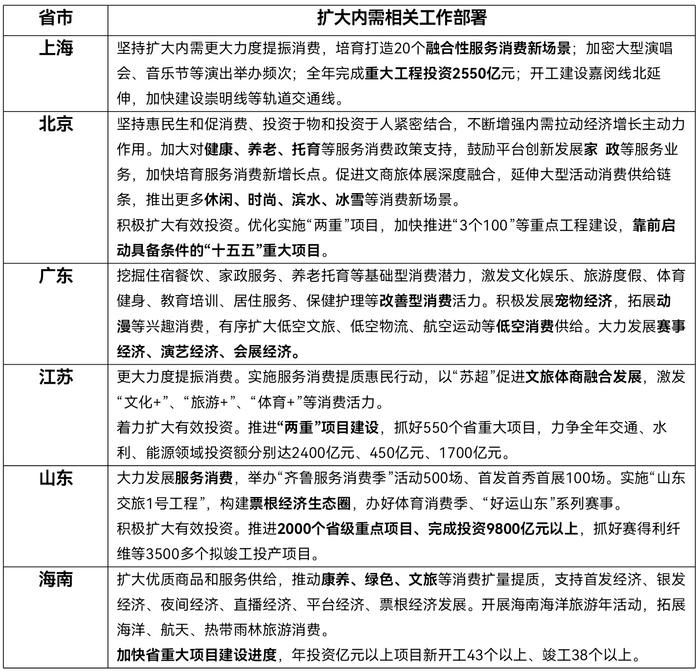
31省2026年扩内需“新招数”:场景创新、供给创新、民生补短板
Xin Lang Cai Jing· 2026-02-11 07:30
Core Viewpoint - The expansion of domestic demand is a central theme in the local government work reports across 31 provinces, emphasizing the need for a strong domestic market driven by effective investment and service consumption [1][4]. Group 1: Domestic Demand Expansion - The core logic of domestic demand expansion is to achieve a virtuous cycle of "demand driving supply and supply creating demand" [1]. - The focus has shifted from relying primarily on investment and scale expansion to optimizing demand structure and upgrading drivers, emphasizing quality, sustainability, and endogenous growth of domestic demand [1][5]. - New consumption scenarios are being explored and developed to expand domestic demand growth, with a focus on innovative consumption and service expansion [1][2]. Group 2: Local Government Initiatives - Beijing aims to promote the integration of culture, commerce, tourism, and sports, creating new consumption scenarios such as leisure and fashion [2][4]. - Shanghai plans to enhance service quality and efficiency while developing 20 new integrated service consumption scenarios [2][4]. - Guangdong is focusing on expanding new consumption formats and utilizing artificial intelligence to reshape consumption platforms [2][4]. Group 3: Consumer Trends - Consumption is transitioning from a focus on physical goods to a balanced emphasis on both goods and services, with traditional consumption quality improvement and new consumption expansion being key themes [5][7]. - The "old-for-new" policy is set to become a normalized approach, with local governments expanding subsidy ranges to include various new consumer products [5][6]. - Service consumption is gaining unprecedented attention, with new service consumption areas such as elderly care and cultural tourism being prioritized [7][8]. Group 4: Investment Focus - Investment is being directed towards addressing livelihood shortfalls, upgrading industries, and enhancing infrastructure, with a focus on effective investment as a key driver for expanding domestic demand [9][10]. - Local governments are increasing investment in public services and infrastructure to support consumption and improve living standards [11][12]. - There is a notable shift in investment logic from a focus on physical assets to a balanced approach that includes human capital development [9][12]. Group 5: Emerging Industries - Investment in new infrastructure and emerging industries is being prioritized, with a focus on artificial intelligence, integrated circuits, and biotechnology [13]. - Provinces are establishing mechanisms to leverage social capital for consumption upgrade projects, creating a closed-loop chain of "investment - innovation - output - consumption" [13].

中部六省加快构建增长新引擎
Jing Ji Wang· 2026-02-10 06:04
Group 1: Economic Growth and Investment - The GDP of the central region is expected to approach 30 trillion yuan by 2025, with Henan leading at a growth rate of 5.6% [1] - The focus for 2026 among central provinces is on "stabilizing growth and expanding domestic demand," leveraging local resources and insights into new consumption trends [1] - Effective investment is crucial for stabilizing economic growth, with provinces exploring investment potential in water conservancy and other sectors [4] Group 2: New Consumption Trends - Central provinces are focusing on "emotional value" and "emotional economy" in their government work reports, indicating a shift in consumer trends [2] - Various provinces are cultivating new consumption growth points, such as the "first launch economy" and "night economy," to enhance consumer vitality [2][3] - Specific initiatives include promoting local business innovations and developing new consumption scenarios in provinces like Henan and Shanxi [2] Group 3: Modern Manufacturing and High-Tech Industries - The central region aims to build a modern industrial system with a focus on new energy, new materials, and optoelectronic information [6] - Provinces like Hubei and Hunan are advancing projects in high-tech sectors, including lithium batteries and new energy systems [6][7] - Jiangxi is enhancing its capabilities in aircraft manufacturing and electric vehicles, while Shanxi is focusing on high-end equipment manufacturing and new materials [7]
布局新消费 促进有效投资 中部六省加快构建增长新引擎
Shang Hai Zheng Quan Bao· 2026-02-09 18:33
Core Insights - The central provinces of China are focusing on "stabilizing growth and expanding domestic demand" as key priorities in their 2026 government work reports, with a projected GDP nearing 30 trillion yuan for 2025 [1][2] - The concept of "emotional value" and "emotional economy" has emerged as a significant trend in consumer behavior, prompting these provinces to innovate in consumption and investment [1][2] Economic Growth and Investment - Henan leads the central provinces with a GDP growth rate of 5.6%, while Hubei, Anhui, and Jiangxi also report growth rates exceeding 5% [1] - The provinces are enhancing their investment in sectors like water conservancy and logistics to strengthen their roles as key hubs in the domestic and international economy [3][5] New Consumption Trends - Provinces are actively cultivating new consumption growth points such as the "first release economy," "exhibition economy," and "silver economy" to meet evolving consumer demands [2] - Specific initiatives include promoting local business innovations and developing diverse consumption scenarios to stimulate economic activity [2] Industrial Development - The central region aims to establish a modern industrial system with a focus on new energy, new materials, and high-tech industries [5][6] - Hubei is working on a world-class integrated storage and computing industry base, while other provinces are advancing projects in electric vehicles, lithium batteries, and aerospace [5][6] Infrastructure and Project Development - Significant infrastructure projects are being prioritized, with Hunan announcing 389 key projects totaling 2 trillion yuan in investment [3] - The provinces are also focusing on enhancing their logistics and transportation networks to facilitate economic growth and connectivity [3][5]
以新质生产力推进转型发展 山西:2026年GDP增长目标为4.5%至5%
Shang Hai Zheng Quan Bao· 2026-02-02 18:44
Economic Growth Targets - Shanxi Province aims for a GDP growth target of 4.5% to 5% for 2026, with fixed asset investment and social retail sales also targeted to grow by 5% [1] - The province emphasizes the importance of high-quality development and comprehensive transformation during the 14th Five-Year Plan period [1] Key Development Strategies - Shanxi will focus on ten key tasks including expanding domestic demand, promoting energy transition, upgrading industries, and fostering moderate diversification [1] - The province plans to continue major project construction, targeting over 600 billion yuan in transportation infrastructure investment, over 220 billion yuan in water conservancy investment, and over 600 billion yuan in municipal infrastructure investment [1] Energy Transition Initiatives - Energy transition is highlighted as a critical focus, with plans to implement nine paths for energy technology innovation and build a new energy system [2] - Specific initiatives include constructing 60 intelligent coal mines, expanding wind and solar power installations, and developing smart grids and virtual power plants [2] Industrial Upgrading Efforts - Shanxi aims to strengthen emerging pillar industries through innovation and large-scale application of new technologies [3] - The province will focus on developing new materials, high-end equipment manufacturing, and electronic information industries, while also promoting sustainable development in non-coal mining [3]
实探溧阳民宿:美丽乡村背后的底气
Xin Lang Cai Jing· 2026-01-20 12:46
Core Viewpoint - Liyang has been recognized as a key area for rural revitalization in Jiangsu Province, showcasing the integration of urban and rural development through its thriving homestay economy, which serves as a vital engine for local economic growth [2][3]. Group 1: Homestay Economy - Liyang's homestay sector includes over 400 establishments, contributing significantly to the local economy and attracting tourists as popular destinations [2][3]. - The transformation of abandoned sites, such as the "Qingfeng Xianju" homestay, exemplifies the successful conversion of industrial wastelands into tourist attractions, earning national recognition [3][4]. - Local entrepreneurs, often with a deep connection to their roots, have initiated homestays by renovating old houses, thus fostering a sense of community and cultural preservation [4]. Group 2: Community Engagement - The homestay business model encourages local residents to actively participate in rural development, shifting them from passive beneficiaries to proactive builders and guardians of their communities [4]. - The establishment of the Liyang Homestay Association in 2020 has facilitated resource sharing and collaboration among homestay operators, enhancing operational efficiency and reducing costs [8]. Group 3: Infrastructure Development - The "Liyang No. 1 Highway," a 365-kilometer scenic route, connects 31 administrative villages and over 220 rural tourism sites, integrating homestays with local attractions and boosting tourism [7]. - This infrastructure has led to the creation of various tourism-related facilities, significantly increasing income for nearly 100,000 farmers along the route [7]. Group 4: Collaborative Growth - The homestay operators in Liyang have adopted a cooperative approach, sharing resources and expertise to improve service quality and resilience against market fluctuations [8]. - The association has established a resource-sharing platform that allows for tailored recommendations based on visitor needs, fostering a complementary ecosystem among different types of homestays [8].

机构:元旦假期热门城市民宿订单量同比增长1.6倍
Bei Jing Shang Bao· 2026-01-03 08:40
Group 1 - The core viewpoint of the article highlights a significant increase in vacation rental bookings during the New Year's holiday, with a year-on-year growth of 1.6 times for popular cities on the Tujia platform [1] - Chengdu, Guangzhou, and Chongqing are identified as the cities with the highest number of vacation rental orders [1] - The "post-00s" demographic accounts for nearly 70% of the vacation rental orders, indicating a strong preference among younger travelers [1] Group 2 - The report from Muniu Vacation Rentals indicates that cross-province travel has become mainstream, with vacation rental orders increasing by 169% during the three-day New Year's holiday [1] - Nearly 40% of tourists opted for "puzzle leave" travel, and orders for stays of two days or more accounted for 39% of total bookings, highlighting a trend towards extended stays [1] - There is a notable increase in family-oriented travel, with orders for two-bedroom or larger rentals rising by 13%, and "family-friendly" labeled rentals seeing a year-on-year growth of 227% [1]
住进风景里 乐在山水间 句容民宿让长三角多一处“诗与远方”
Zhen Jiang Ri Bao· 2025-12-27 10:35
Core Insights - The development of the homestay industry in Jurong reflects a high-quality transformation, supported by its ecological advantages and strategic location within the Yangtze River Delta urban agglomeration [1] Group 1: Policy Support - The growth of Jurong's homestay sector is significantly influenced by top-level design and supportive policies, with the central government's focus shifting from "quality upgrade" to "homestay economy" [2] - Jurong has taken the lead in implementing local standards and regulations to facilitate the development of homestays, including a joint filing mechanism for rural homestays that simplifies approval processes [2] - As a result of these policies, Jurong has seen a notable increase in quality, with three out of four newly rated national-level homestays in Jiangsu Province located in Jurong [2] Group 2: Collaborative Development - The rise of homestays in Jurong is characterized by a shift from individual operations to collaborative development through village-enterprise partnerships and associations [3] - The Nanshan Bamboo Garden homestay exemplifies successful village-enterprise cooperation, achieving a 90% occupancy rate by offering customized accommodation options and shared facilities [3] - The establishment of a township-level homestay association in the Meishan scenic area has further promoted standardized and scaled development, enhancing brand promotion and product packaging [3] Group 3: Cultural Empowerment - The uniqueness and attractiveness of homestays in Jurong are enhanced through cultural empowerment, with operators creating distinctive IPs that reflect local culture [4] - Various homestays offer themed experiences, such as Daoist cultural activities and historical reenactments, contributing to a diverse portfolio of themed homestays [4] - This cultural focus not only boosts employment for local farmers but also strengthens collective village economies, leading to personalized development strategies [4] Group 4: Infrastructure and Future Plans - Jurong is leveraging its homestay sector to drive broader industrial development, focusing on improving infrastructure and creating beautiful rural environments [5] - Recent promotional events have highlighted Jurong's appeal as a micro-vacation destination, integrating homestays with scenic spots and recreational activities [6] - The city is committed to optimizing its productivity layout and enhancing the role of homestays in utilizing local resources and stimulating tourism consumption [6]
让“沉睡”老宅变身文艺民宿
Jin Rong Shi Bao· 2025-07-22 01:00
Core Insights - The article highlights the significant role of financial products like "民宿贷" (Homestay Loan) in revitalizing rural tourism and supporting the transformation of traditional homes into modern homestays, contributing to rural economic development [1][3][6] Group 1: Financial Support for Homestay Development - Financial institutions are providing tailored loan products to support the renovation and establishment of homestays, which has become a crucial factor in enhancing rural tourism [1][6] - The "民宿贷" has been instrumental in helping entrepreneurs like Mr. Li and Mr. Lü to upgrade their facilities and expand their businesses, thus increasing their income opportunities [2][3] - In Deqing County, the introduction of loans has allowed many homestay operators to transform dilapidated houses into attractive accommodations, showcasing the positive impact of financial support on local entrepreneurship [4][5] Group 2: Growth of the Homestay Economy - The demand for homestays is rising, particularly in popular tourist destinations like Beidaihe and Deqing, driven by an increase in domestic tourism during the summer season [2][4] - The homestay economy is flourishing, with many local residents shifting from traditional fishing to entrepreneurship in the hospitality sector, indicating a significant economic transition [3][4] - Various banks are innovating by creating specialized loan products tailored to local tourism needs, such as "鲜花贷" (Flower Loan) and "烧烤贷" (Barbecue Loan), which further stimulate rural economic growth [6][7]
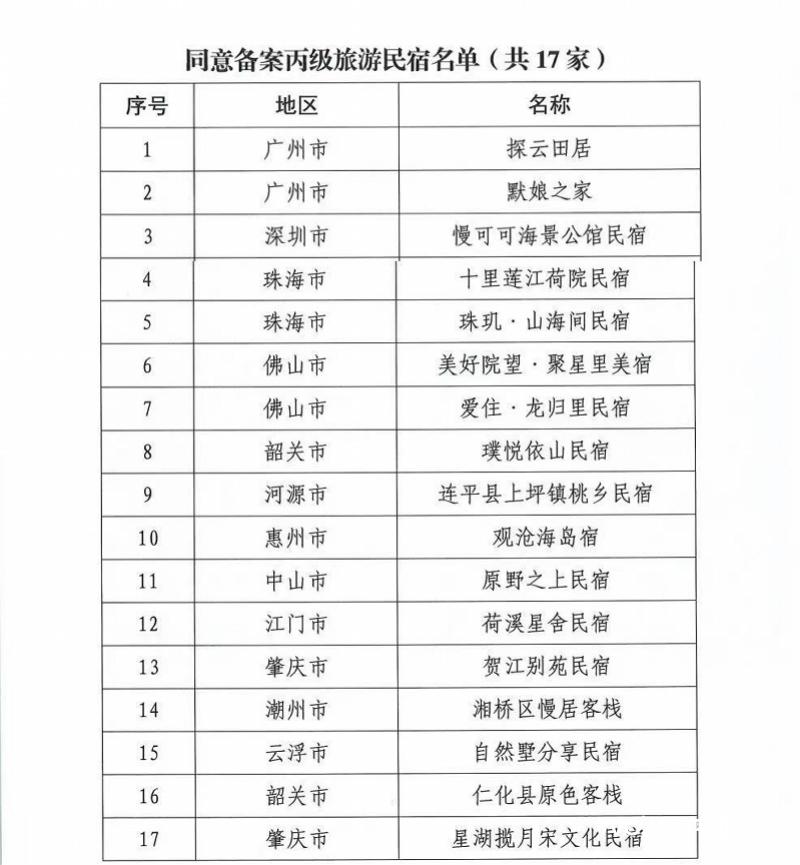
上新!广东首批17家丙级民宿出炉,广州首拥国家级旅游民宿
Nan Fang Du Shi Bao· 2025-07-14 19:20
Core Viewpoint - The first batch of Class C tourism homestays in Guangdong has been approved, marking a significant development in the region's tourism industry [1][4]. Group 1: Approval and Standards - The National Tourism Standardization Technical Committee has approved 17 Class C tourism homestays in Guangdong, following a review of materials and on-site inspections [1]. - The evaluation process for Class C tourism homestays is conducted by provincial tourism homestay grading institutions, which report results to the National Tourism Standardization Technical Committee for verification [4]. Group 2: Regional Impact - With the addition of the 17 newly approved Class C homestays, Guangdong now has a total of 31 national-level tourism homestays, including 14 previously rated as Class A and B [4]. - Guangzhou has achieved a "zero breakthrough" in national-level tourism homestays with two entries: "探云田居" and "默娘之家" [8]. Group 3: Economic and Cultural Contributions - "探云田居" serves as a bridge between tourists and the rural community, providing contract jobs for 8 local villagers and promoting local economic development through agriculture and aquaculture [9]. - The homestay integrates rural tourism, accommodation, dining, and cultural experiences, contributing to the revitalization of rural resources since its opening in June 2020 [9].
余杭审计精准破题为民宿经济装上“生态安全阀”
Hang Zhou Ri Bao· 2025-07-11 03:13
Group 1 - The core viewpoint of the articles highlights the environmental concerns arising from the lack of sewage network coverage in the booming homestay economy in Yuhang District, which is part of the "Western Beautiful" strategy [1] - Nearly 60% of homestays in western towns of Yuhang District lack sewage network coverage, leading to potential ecological and public health issues [1] - Over 70% of the problematic homestays have completed rectification, and new homestays are required to have full sewage network coverage or meet treatment standards [1] Group 2 - Yuhang Audit has implemented a series of effective rectification plans, including stricter approval processes for homestays and investment in sewage treatment facilities [1] - The audit also focuses on various projects, identifying issues in overdue projects and enhancing management mechanisms to accelerate project construction [2] - The audit emphasizes a problem-oriented approach, aiming to reveal risks and contribute to the development of Hangzhou's new urban center [2]