牛熊指标

Search documents
美银“牛熊指标”冲上近20年新高!策略师建议避开“网红亿万富翁概念股”
Ge Long Hui A P P· 2026-02-09 01:53
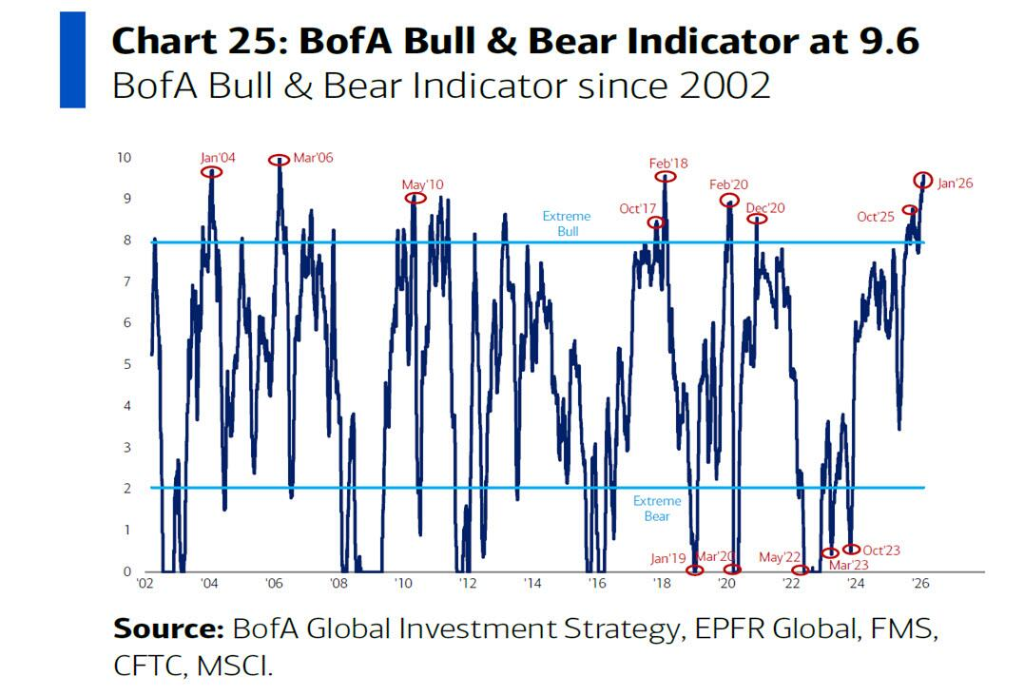
Group 1 - The "Bull-Bear Indicator" has risen to 9.6, the highest level since March 2006, indicating that market positions and sentiment are nearing extreme bullishness, which may trigger selling [1] - The current reading represents a peak in holdings, liquidity, and market divergence, with a sell signal issued as early as December 17 of the previous year [1] - Investment strategy suggests avoiding "celebrity billionaire concept stocks" such as Tesla, Palantir, and Nvidia, while favoring small-cap stocks, REITs, and bank stocks [1] Group 2 - The company maintains that international market allocation remains a core focus, emphasizing that significant historical events have often led to shifts in asset leadership [1] - For 2026, the company is optimistic about international stocks, Chinese consumer themes, and emerging market commodity producers [1]
美银Hartnett:小盘股比科技股更值得押注 科技巨头不再是赢家
Xin Lang Cai Jing· 2026-02-08 09:18
Core Insights - The Bull & Bear Indicator has reached its highest level since 2006, signaling a "sell" recommendation from Bank of America strategist Michael Hartnett, with a current reading of 9.6, indicating extreme market conditions [1] - Hartnett suggests a shift in asset allocation for 2026, advocating for a strategy of "long Main St, short Wall St," which involves moving funds from crowded tech giants and cryptocurrencies to small-cap stocks and international markets [3] Market Dynamics - The recent market downturn aligns with Hartnett's warnings, marked by a sudden crash in software stocks and significant declines in silver and Bitcoin prices, exacerbated by political factors [4] - The cryptocurrency market has lost $2 trillion in value since October 2025, equivalent to 10% of U.S. consumer spending, which Hartnett warns will have a substantial economic impact [4] Technology Sector Analysis - Tech giants are facing a "capital expenditure trap," with projected AI-related capital expenditures for 2026 reaching $670 billion, which is 96% of their combined cash reserves, compared to 40% in 2023 [5] - This shift from a "light asset" to a "heavy asset" model threatens the market leadership of tech stocks in the 2020s [5] Economic Policy Implications - Hartnett believes that the Trump administration will intervene in various sectors to lower inflation, which, combined with AI's impact on the labor market, could lead to unexpected declines in inflation by 2026, benefiting small and mid-cap stocks [6] - Since the new government took office, small-cap stocks have outperformed billionaire concept stocks, with small caps rising 13% compared to a mere 6% increase for the latter [7] Capital Flow Trends - Recent EPFR data indicates a significant style shift in the market, with outflows from safe-haven assets like gold and cryptocurrencies, while undervalued markets are seeing substantial inflows [10] - Investment-grade bonds have experienced 41 consecutive weeks of net inflows, indicating a preference for safer assets amid market volatility [11] Future Outlook - Hartnett posits that the years 2025-2026 will mark the end of "American exceptionalism" and the beginning of "global rebalancing," with emerging markets and commodities becoming the new winners [15] - The current market decline is viewed as a "healthy and overdue bubble deflation," unless a systemic event occurs [13]

美银Hartnett:小盘股比科技股更值得押注,科技巨头不再是赢家
Hua Er Jie Jian Wen· 2026-02-08 07:59
Group 1 - The Bull & Bear Indicator has reached its highest level since 2006, currently at 9.6, signaling a "sell" recommendation from Bank of America's chief investment strategist Michael Hartnett [1] - Hartnett attributes this extreme reading to a combination of "position peak, liquidity peak, and inequality peak" [1] - The recent market downturn aligns with Hartnett's warnings, including significant drops in software stocks and cryptocurrencies, leading to a broader panic in the market [4] Group 2 - Hartnett suggests a strategic shift for 2026: "long Main St, short Wall St," indicating a move away from crowded tech giants and cryptocurrencies towards small-cap stocks and international markets [3] - The anticipated capital expenditures for tech giants in AI for 2026 are projected to reach $670 billion, which is 96% of their combined cash reserves, compared to only 40% in 2023 [5] - This shift from a "light asset" to a "heavy asset" model poses a significant threat to the market leadership of tech stocks in the 2020s [5] Group 3 - Hartnett believes that the Trump administration will intervene in various sectors to lower inflation, which, combined with AI's cooling effect on the labor market, will benefit small and mid-cap stocks in 2026 [7] - Since the new government took office, small-cap stocks have risen by 13%, while billionaire concept stocks like NVDA and META have only increased by 6% [7] - There is a significant style shift in the market, with key "bubble support levels" identified for tech ETFs, Bitcoin, and gold [10] Group 4 - Recent data shows a net outflow from safe-haven assets, with gold funds experiencing their first weekly net outflow since November 2025, and cryptocurrency funds seeing a $1.5 billion outflow [14] - Conversely, there has been a massive inflow into undervalued markets, with the Korean stock market recording a historic $5.2 billion weekly inflow [14] - Hartnett views the current period as a historical turning point, marking the end of "American exceptionalism" and the beginning of "global rebalancing," with a focus on international stocks and emerging market commodities [15]


美银1月基金经理调查 除了乐观还是乐观【播客】
Datayes· 2026-01-21 10:54
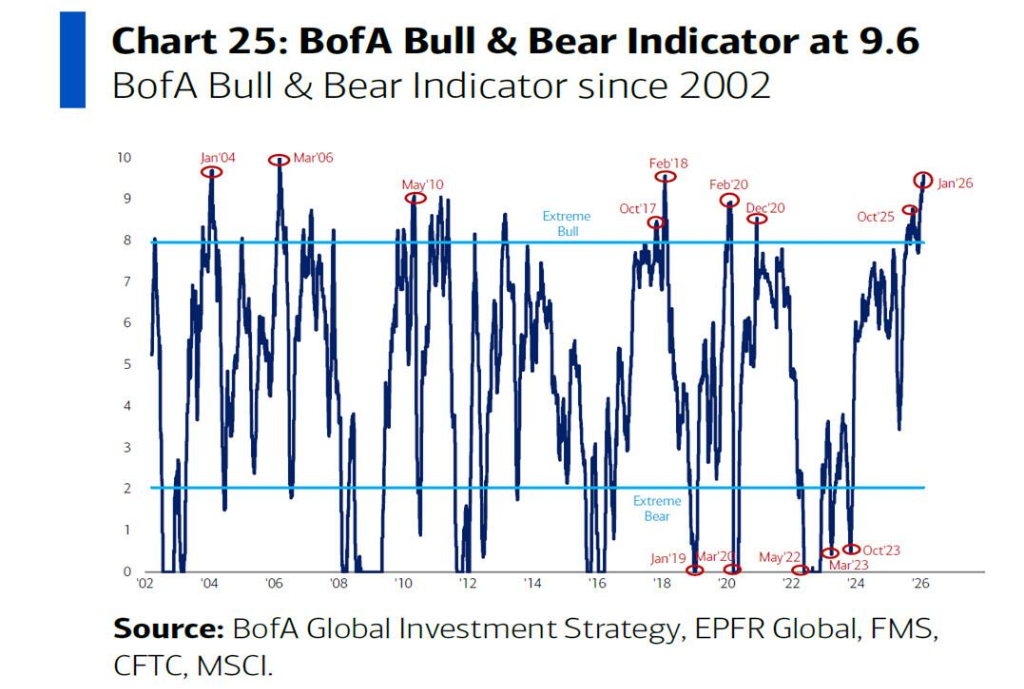
Core Insights - The sentiment among fund managers is extremely optimistic, with a significant shift in macroeconomic expectations from "recession" to "prosperity" [1][2] - Global growth expectations have risen to 38%, an increase of 20 percentage points, marking the highest level since July 2021, while the probability of recession has dropped to 9%, the lowest since January 2022 [1] - Profit expectations are also high, with a net 44% of managers optimistic about EPS over the next 12 months, the highest since July 2021 [2] - Concerns about stagflation have decreased from 58% to 39%, with 34% anticipating a "prosperity" scenario and 18% a "golden age" [3] - Inflation expectations driven by tariffs have significantly declined, with a net 3% believing CPI will decrease [4] Asset Allocation - There is a strong preference for equities and commodities, while bonds are being abandoned [5] - Stock allocation is at a net overweight of 48%, the highest since December 2024, and commodity allocation is at 26%, the highest since June 2022, while bond allocation is at a net underweight of 35%, the highest since September 2022 [12] - The banking sector has become the most overweight industry, while consumer staples are at their largest underweight since February 2014 [12] - High-yield bonds are expected to outperform investment-grade bonds for the first time [12] - The most crowded trade is long gold, with 51% of managers favoring it, surpassing the "Seven Sisters" trade at 27% [12] Risk Landscape - The primary risks identified are geopolitical tensions and the potential for an AI bubble, with geopolitical conflict cited by 28% of respondents and AI bubble concerns by 27% [5][6] - Credit events are anticipated to be triggered by private equity/private credit (39%) and large-scale capital expenditures in AI (35%) [6] - Political expectations for the 2026 midterm elections are nearly evenly split between "red wave" and "blue wave" scenarios [7] - There is a notable division regarding AI stocks, with 55% believing they are "not in a bubble" [8] Market Sentiment - The bull-bear indicator stands at 9.4, indicating a deep "sell" zone, with cash levels at 3.2%, a historical low [11] - A record 48% of respondents are "zero hedged" against market downturns, the highest since January 2018 [11] - Risk appetite is above normal by 16%, the highest in four years, with 49% of managers expecting an "impossible landing" scenario for the global economy [11] Strategic Insights - Michael Hartnett warns that in a world filled with good news, low hedging may seem harmless, but any unexpected negative turn could amplify impacts, highlighting current market fragility [9]
最准分析师最新警告:市场已提前透支2026年的好日子
Jin Rong Jie· 2025-12-22 03:16
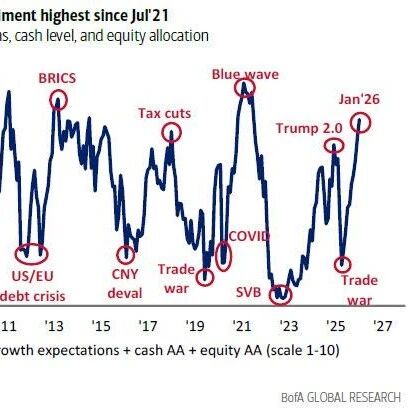
Group 1 - The core viewpoint is that the market has preemptively priced in a favorable economic environment expected in 2026, characterized by low inflation, a robust economy, and loose policies [1] - Michael Hartnett, a prominent analyst, suggests that the current market conditions reflect an anticipation of a return to easy monetary policies and lower costs, indicating that money is flowing back into the market [1] - The report highlights significant inflows into equities, with $98.2 billion entering the stock market in one week, including $77.9 billion into U.S. stocks, marking the second-highest historical inflow [1] Group 2 - Hartnett's investment strategy focuses on low inflation rather than high growth, favoring zero-interest bonds, mid-cap stocks, emerging market equities, and commodities [1] - The Bull-Bear Indicator has reached 8.5, signaling an overheated market, which historically suggests a potential pullback in global stock markets by 2-3% on average, with extreme cases leading to a 4-9% decline over 1-3 months [1] - The real risk identified is that the market has already over-leveraged the positive outlook for 2026, rather than reacting to negative news [2]
BofA_Hartnett_市场正提前押注_2026_年经济“火热运行”
2025-12-15 01:58
Summary of Key Points from Conference Call Industry Overview - The market is anticipating a "hot economy" in 2026, leading to a shift in asset allocation from traditional high-valuation assets favored by Wall Street to "Main Street" assets that directly benefit from economic expansion [1][5] - The TMT (Technology, Media, and Telecommunications) industry is experiencing a shift from "light asset" models to "heavy asset" models, requiring significant capital investment in areas like AI infrastructure, chip manufacturing, and data center expansion [3] Core Insights and Arguments - Investors are adjusting their strategies in response to the Federal Reserve's monetary policy and other economic indicators, such as falling gasoline prices and stimulus checks, which have contributed to a bullish outlook [1] - The "K-shaped" narrative of consumption, where wealth disparity influences spending, is becoming prominent, with a rotation from tech stocks to mid-cap and small-cap stocks [5] - The current market sentiment has shifted from an overly optimistic view to recognizing potential contradictions and risks, particularly in the TMT sector [3] Market Dynamics - Recent fund flows indicate a preference for bonds, with $8.8 billion flowing into bonds, compared to $5.8 billion into stocks, marking the lowest stock inflow in three months [16] - The adjusted Bull-Bear Indicator from Bank of America reflects a reading of 7.8, indicating investor sentiment is nearing extreme bullishness [19] - The Bull-Bear Indicator reached a recent high of 8.9 on October 1, 2025, suggesting a potential market peak [20] Additional Important Insights - The ongoing global bond bear market is highlighted by the significant drop in Austrian 100-year bond prices, which have fallen 76% since their peak in March 2020 [10] - The hope for economic prosperity is tied to productivity gains, which could lead to lower yields; otherwise, a significant depreciation of the dollar may be necessary [12] - The Bull-Bear Indicator has historically provided actionable contrarian trading signals, with 35 signals triggered since 2002, including 19 buy recommendations and 16 sell recommendations [26]
美银:牛熊指标接近触发“卖出”信号 资金轮动预示2026年经济“火热运行”预期
智通财经网· 2025-12-15 01:46
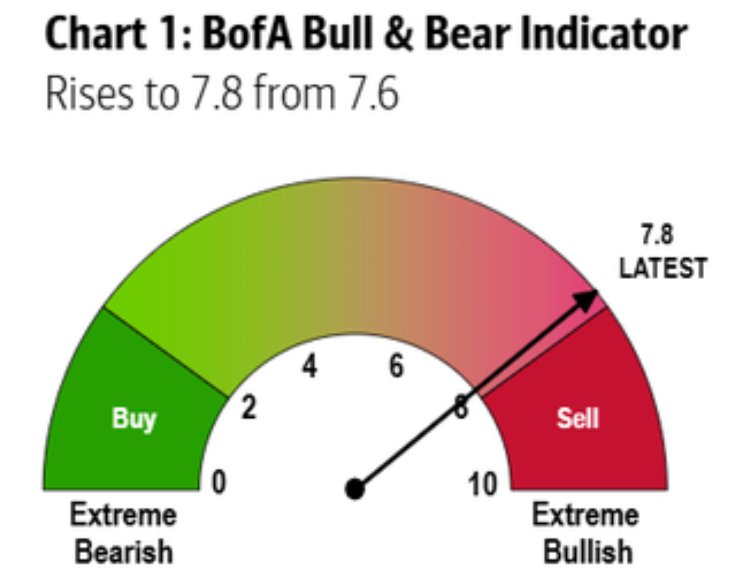
Group 1 - The core viewpoint of the report indicates a significant rotation of funds towards small-cap stocks, a resurgence of risk assets, and a rise in investor confidence, suggesting a "hot run" expectation for the economy in 2026 [1] - The revised Bank of America Bull & Bear Indicator has risen to 7.8, indicating that market positioning is approaching an "extremely bullish" zone, with historical correlations to tactical market tops [1][7] Group 2 - Investors are betting on a policy environment that supports growth without significantly increasing borrowing costs, which could be achieved through a surge in productivity or a substantial depreciation of the dollar [2] - The notable shift of funds from mega-cap stocks to small-cap stocks is linked to expectations of a hotter economy driven more by domestic factors in 2026 [3] - Consumer spending behavior continues to show a divide by income levels, with market expectations indicating that economic momentum will extend beyond 2025, moving towards a broader base [3] Group 3 - The ongoing asset purchases by the Federal Reserve, approximately $40 billion in short-term Treasury bonds monthly, alleviate concerns about global liquidity peaking [4] - The upcoming Bank of Japan meeting and anticipated U.S. Supreme Court ruling are highlighted as potential risks [4] Group 4 - Weekly fund flows indicate a complex risk appetite, with $8.8 billion flowing into bonds, $5.8 billion into stocks (the smallest inflow in three months), and $2.3 billion into gold [5] - The technology sector has seen significant outflows of $600 million, part of a larger $1.7 billion outflow over two weeks, marking the largest outflow since February [5] - Private client allocations remain predominantly in equities (64.9%), with bond exposure at 17.7% and cash at 10.3% [5]