物价回暖

Search documents
——2026年1月价格数据点评:涨价开始向下游传导
EBSCN· 2026-02-11 11:42
CPI Analysis - In January 2026, the CPI year-on-year growth rate dropped to +0.2%, down from +0.8% in the previous month, and below the market expectation of +0.4%[2] - The food prices decreased by 0.7% year-on-year, compared to an increase of 1.1% in the previous month, contributing to a decline of 0.32 percentage points in CPI[4] - The core CPI year-on-year growth rate fell to +0.8%, down from +1.2% in the previous month, influenced by the Spring Festival timing[5] PPI Analysis - The PPI month-on-month growth rate increased to +0.4% in January 2026, up from +0.2% in the previous month, marking the fourth consecutive month of increase[6] - The year-on-year PPI decline narrowed to -1.4%, a reduction of 0.5 percentage points from the previous month[6] - The prices in the non-ferrous metal mining sector rose by 5.7% month-on-month, driven by international price increases[6] Market Outlook - The upward trend in CPI is expected to continue, supported by rising raw material prices affecting durable consumer goods[3] - The central government's focus on regulating pig production capacity is anticipated to lead to a moderate improvement in pork prices in the second half of the year, supporting CPI readings[3] - The PPI is projected to turn positive year-on-year in the second quarter of 2026, influenced by global commodity price increases and domestic policy adjustments[11]
扩内需促消费政策显效 物价回暖,经济“体温”回升
Sou Hu Cai Jing· 2026-01-12 03:24
Core Insights - The Consumer Price Index (CPI) in December 2025 increased by 0.2% month-on-month and 0.8% year-on-year, while the core CPI, excluding food and energy, rose by 1.2% year-on-year [2] - The Producer Price Index (PPI) rose by 0.2% month-on-month but decreased by 1.9% year-on-year, with a decline of 2.6% for the entire year of 2025 [2] - Analysts predict a moderate recovery in overall prices in 2026, supported by proactive macroeconomic policies and the development of new economic drivers [2] CPI Analysis - The year-on-year increase in CPI in December 2025 was the highest since August 2023, driven primarily by rising vegetable and fruit prices due to adverse weather conditions, as well as the effects of year-end consumption promotion policies [2][3] - Specific price increases included fresh vegetables and fruits, which rose by 18.2% and 4.4% respectively, contributing approximately 0.16 percentage points to the CPI increase [3] - The prices of household appliances and vehicles also saw a month-on-month increase, exceeding market expectations [2] PPI Analysis - The PPI's year-on-year decline narrowed by 0.3 percentage points in December 2025, influenced by rising raw material prices and the effects of policies aimed at reducing excessive competition [4] - The PPI experienced a continuous month-on-month increase for three consecutive months, indicating a potential stabilization in industrial prices [4] - For 2025, the PPI's year-on-year decline was 2.6%, which is a larger drop compared to the previous year, attributed to insufficient external demand and ongoing economic structural adjustments [4] Future Outlook - Experts anticipate that the CPI will see a moderate increase in 2026, potentially around 1.2%, as the effects of growth-stimulating and consumption-promoting policies take hold [7] - The PPI is expected to enter a recovery phase in 2026, with a projected year-on-year decline narrowing to around 0.5%, although a return to positive growth may take longer [4][5] - Measures to ensure the supply and price stability of essential goods are being implemented, with local governments actively working to maintain market stability [6]


10月CPI同比由降转升,物价数据释放经济回暖积极信号
Hua Xia Shi Bao· 2025-11-11 12:34
Group 1 - The core viewpoint of the articles indicates a slight recovery in pork prices in October, with the average wholesale price of white strip pork in Beijing's Xinfadi market decreasing to 14.9 yuan/kg from 15.40 yuan/kg at the end of October, despite a small increase earlier in the month [2][5] - The Consumer Price Index (CPI) showed a month-on-month increase of 0.2% and a year-on-year increase of 0.2% in October, marking a recovery from a 0.3% decline in September, driven by factors such as the National Day and Mid-Autumn Festival consumption [2][6] - The Producer Price Index (PPI) also showed positive changes, with a year-on-year decline of 2.1% in October, but the rate of decline narrowed by 0.2 percentage points compared to the previous month, indicating a potential turning point in price trends [3][8] Group 2 - The increase in the average daily market supply of white strip pork in late October contributed to a "small spring" for pork prices, with a year-on-year increase of 15.48% in daily supply [5] - The overall food prices performed better than seasonal expectations, with pork prices down 16.0% year-on-year, impacting CPI by approximately 0.23 percentage points, while the declines in egg and fresh vegetable prices also narrowed [6][9] - The PPI's first month-on-month increase of 0.1% in October is attributed to improved supply-demand relationships in certain industries and rising prices in sectors such as coal mining and photovoltaic equipment manufacturing [8][9]
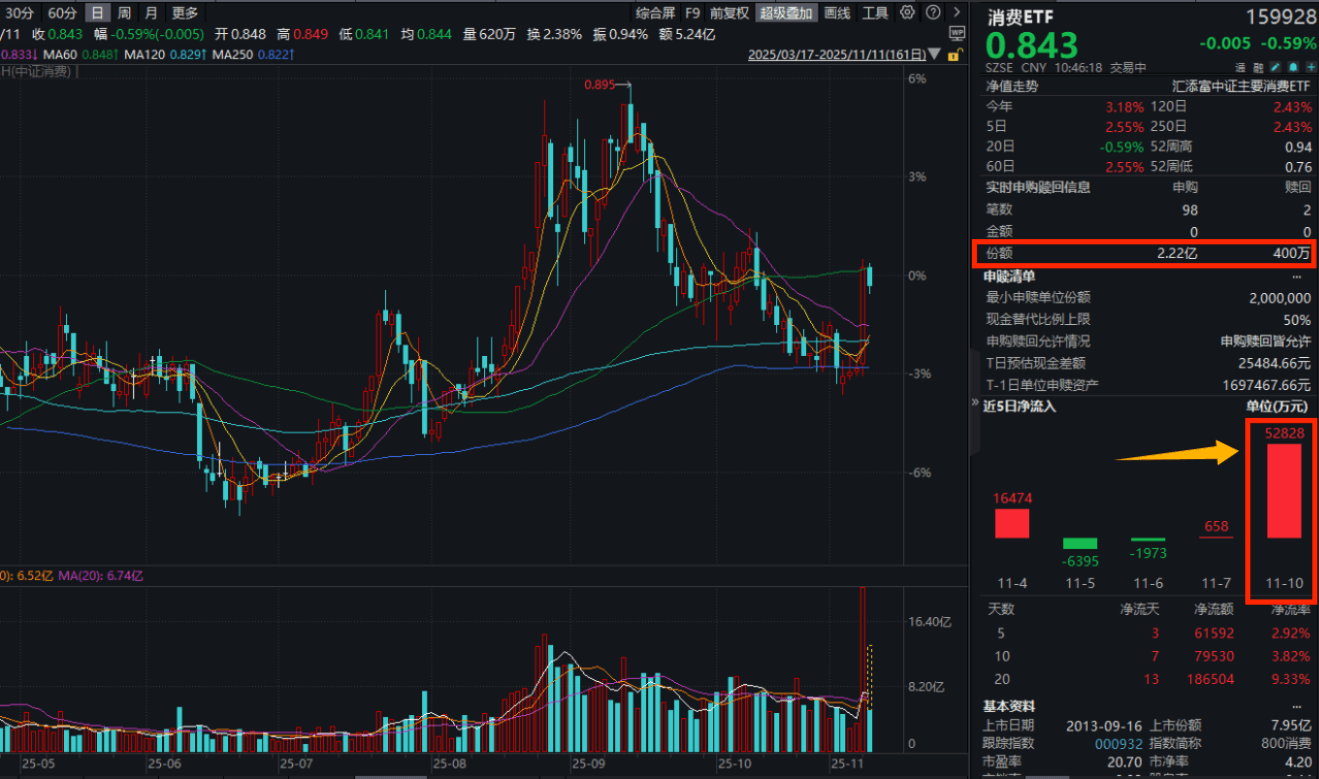
10月物价数据反应消费回暖拐点?消费ETF(159928)昨日净流入超5.28亿元,盘中再度“吸金”超2.2亿份!机构:消费企稳信号明确!
Xin Lang Cai Jing· 2025-11-11 03:44
Group 1: Market Performance - The consumer ETF (159928) experienced a slight decline of 0.59% after a significant increase of over 3% the previous day, with a trading volume of 600 million [1] - The consumer ETF attracted substantial capital inflow, with over 528 million yuan on the previous day and a net inflow of over 224 million yuan today, reaching a new high of over 22.1 billion yuan [1][3] - The majority of the weighted stocks in the consumer ETF saw a decline, with notable drops in Luzhou Laojiao (over 2%) and Muyuan Foods (over 1%), while Yili maintained a slight increase [3] Group 2: Valuation and Market Trends - The valuation of the consumer ETF remains attractive, with a TTM price-to-earnings ratio of 20.54, which is at the 7.2% percentile over the past decade, indicating it is cheaper than 92% of the historical time [3] - Seasonal trends suggest that Q4 often sees changes in market style, with December being a period where low valuation stocks may gain more attention [3] Group 3: Economic Indicators - The October CPI showed a positive growth trend, driven by strong service consumption, indicating a recovery in domestic demand [7] - Core CPI increased from 1.0% to 1.2%, marking the sixth consecutive month of growth, with notable price increases in services such as airline tickets and hotel accommodations [9] - The PPI also showed signs of improvement, with a month-on-month increase for the first time this year, suggesting a potential recovery in industrial profitability [7][9] Group 4: Sector Analysis - The liquor industry is currently in a destocking phase, with signs of recovery as companies report easing pressure on their financials [11] - The restaurant supply chain is expected to improve, with new product launches and channel expansions potentially enhancing profitability [11] - The snack food sector is benefiting from health trends and innovation, with strong growth anticipated for products like oats and konjac [11][12]
“生产性”信贷的魔咒
一瑜中的· 2025-09-15 01:45
Core Viewpoint - Since 2020, productive credit (excluding real estate and infrastructure loans) has been continuously increasing, while terminal demand credit (related to real estate and infrastructure) has been declining, indicating that credit support is more reflected on the supply side rather than the demand side [2][4][5] Group 1: Productive Credit Needs to Decline - A clear definition is established: terminal demand credit includes infrastructure loans, real estate loans, and consumer loans, while productive credit includes business loans and non-real estate infrastructure loans [4][13] - Data observation shows that since 2020, the growth of productive credit has significantly outpaced that of terminal demand credit, with productive credit increasing by 4.8 trillion compared to a decrease of 4.9 trillion in terminal demand credit from 2019 to 2024 [4][13] - The excessive increase in productive credit may exacerbate supply-demand contradictions, where productive investment serves as both current demand and future supply [4][15] Group 2: Weekly Economic Observation - The Huachuang Macro WEI index as of September 7, 2025, is at 6.93%, up 0.17 points from the previous week, indicating a recovery in economic activity driven mainly by infrastructure and durable goods consumption [6][17] - Infrastructure indicators such as asphalt plant operating rates and cement shipment rates have improved compared to last year, with asphalt plant operating rates at 34.9%, up 9% year-on-year [7][26] - Real estate sales have shown a significant increase, with a 16.6% year-on-year growth in residential sales in 67 cities during the first five days of September [8][24] Group 3: Price Trends - Prices of gold, oil, and copper have risen, with COMEX gold at $3646.3 per ounce, up 1.3%, and LME copper at $10068 per ton, up 1.2% [8][44] - Domestic commodity prices have remained stable, while overseas prices have increased, indicating a divergence in price trends [8][44] Group 4: Interest Rates and Debt - The yield on government bonds has shown an upward trend, with the 10-year government bond yield at 1.8670%, reflecting a steepening yield curve [8][65] - The government has planned to issue new local government bonds amounting to 118.5 billion, indicating a proactive fiscal policy approach [8][49]