电力时代

Search documents
我国为什么被外媒称为世界首个重要“电力国家”?
Ren Min Ri Bao· 2026-01-31 23:37
Core Insights - China has emerged as the world's first significant "power nation," playing a crucial role in the global energy transition and setting a benchmark for clean energy development [1][3][4] Group 1: Electricity Consumption and Production - China's electricity consumption is projected to exceed 10 trillion kilowatt-hours by 2025, nearly doubling from approximately 5.5 trillion kilowatt-hours in 2015, making it more than twice the size of the United States' consumption [2][3] - By the end of 2025, China's cumulative installed capacity of wind and solar power is expected to surpass 1.8 billion kilowatts, equivalent to about 82 Three Gorges power stations [1][2] Group 2: Energy Transition and Policy - The transition to a clean energy system in China is guided by scientific planning, with significant investments in ultra-high voltage projects and the establishment of a unified national electricity market [2][3] - Over 95% of China's coal-fired power plants have ultra-low emissions, and more than 50% can perform deep peak regulation, contributing to the world's largest clean coal power supply system [3] Group 3: Global Impact and Technological Leadership - China supplies 70% of the world's wind power equipment and 80% of solar photovoltaic components, with its renewable energy products being exported to over 200 countries [4] - The country is actively promoting technology sharing and international standards in the renewable energy sector, addressing global energy challenges and providing affordable energy transition options for developing nations [4]
人民日报丨中国实践引领“电力时代”能源转型
国家能源局· 2026-01-30 02:42
Core Viewpoint - China has emerged as the world's first significant "electric power nation," playing a crucial role in the global energy transition towards clean and low-carbon energy sources [2][4][6]. Group 1: Electricity Development in China - By the end of 2025, China's cumulative installed capacity of wind and solar power is expected to exceed 1.8 billion kilowatts, equivalent to approximately 82 Three Gorges power stations [2]. - China's electricity consumption is projected to surpass 10 trillion kilowatt-hours by 2025, setting a record for the highest annual electricity consumption by a single country [2][3]. - In the past decade, China's electricity consumption has nearly doubled from about 5.5 trillion kilowatt-hours in 2015, now exceeding that of the United States by more than two times and surpassing the total consumption of the EU, Russia, India, and Japan combined [3]. Group 2: Energy Transition and Green Development - The International Energy Agency has declared that the "electricity era" has arrived, with electricity being the primary choice for replacing fossil fuel consumption [4]. - Over 50% of coal-fired power plants in China are capable of deep peak regulation, and more than 95% of coal power units have ultra-low emissions, establishing the world's largest clean coal power supply system [4]. - By 2030, China's electrification rate is expected to reach around 35%, indicating a steady increase in the use of electricity across various sectors, including transportation, industry, and construction [4]. Group 3: Global Impact and Technological Contributions - China supplies 70% of the world's wind power equipment and 80% of solar photovoltaic components, with exports reaching over 200 countries and regions [5]. - In sub-Saharan Africa, China's off-grid solar systems have contributed to over half of the new electricity connections, showcasing its role in global energy access [5]. - China is actively promoting technology sharing and standard-setting in the energy sector, addressing global energy challenges and providing affordable energy transition options for developing countries [5][6].


中国实践引领"电力时代"能源转型
Ren Min Ri Bao· 2026-01-29 08:19
Core Viewpoint - China has been recognized as the world's first significant "electric power nation," reflecting its high-quality development and the global energy transition towards a future driven by electricity and grounded in green energy [1][2][3]. Group 1: Electricity Consumption and Growth - China's electricity consumption is projected to exceed 10 trillion kilowatt-hours by 2025, nearly doubling from approximately 5.5 trillion kilowatt-hours in 2015, making it more than twice the size of the United States' consumption [2][3]. - By the end of 2025, China's cumulative installed capacity of wind and solar power is expected to surpass 1.8 billion kilowatts, equivalent to about 82 Three Gorges power stations [1][2]. Group 2: Energy Transition and Planning - The transition to a "power nation" is driven by China's scientific planning and high-quality development in the energy sector, including the establishment of 46 ultra-high voltage projects and a unified national electricity market [2][3]. - China is leading the way in replacing fossil fuel consumption with electricity, with over one-third of its electricity coming from renewable sources [3]. Group 3: Global Impact and Technological Contributions - China supplies 70% of the world's wind power equipment and 80% of solar photovoltaic components, significantly impacting global energy transitions [4]. - The country is actively promoting technology sharing and international standards in renewable energy, contributing to energy solutions for developing nations [4].
中国实践引领“电力时代”能源转型
Ren Min Ri Bao· 2026-01-29 03:29
Core Insights - China has been recognized as the world's first significant "power nation," highlighting its pivotal role in the global energy transition and the increasing importance of electricity in national energy systems [1][2][3] Group 1: Electricity Consumption and Production - By the end of 2025, China's cumulative installed capacity of wind and solar power is expected to exceed 1.8 billion kilowatts, equivalent to approximately 82 Three Gorges power stations [1] - China's electricity consumption is projected to surpass 10 trillion kilowatt-hours by 2025, setting a record for the highest annual electricity consumption by a single country [1][2] - In the past decade, China's electricity consumption has nearly doubled from about 5.5 trillion kilowatt-hours in 2015, now exceeding that of the United States by more than two times [2] Group 2: Energy Transition and Environmental Impact - Over 95% of China's coal-fired power plants have ultra-low emissions, and more than 50% can perform deep peak regulation, establishing the world's largest clean coal power supply system [3] - China is actively promoting the replacement of fossil fuels with electricity across various sectors, including transportation, industry, and construction, with a steady increase in electrification expected to reach around 35% by 2030 [3] Group 3: Global Influence and Technological Contributions - China supplies 70% of the world's wind power equipment and 80% of solar photovoltaic components, with its renewable energy products being exported to over 200 countries and regions [4] - The country is playing a significant role in global energy transition by establishing international standards and facilitating technology sharing, thereby providing affordable energy transition options for developing nations [4] - China's initiatives are reshaping not only its own energy landscape but also influencing the energy frameworks of other countries, as noted by international media [4]
中国实践引领“电力时代”能源转型(和音)
Ren Min Ri Bao· 2026-01-28 22:05
Core Viewpoint - China has become the world's first significant "electric power nation," showcasing high-quality development and reflecting a new global energy transition towards a future driven by electricity and grounded in green energy [1][4]. Group 1: Electricity Consumption and Production - By the end of 2025, China's cumulative installed capacity of wind and solar power is expected to exceed 1.8 billion kilowatts, equivalent to approximately 82 Three Gorges power stations [1]. - China's total electricity consumption is projected to surpass 10 trillion kilowatt-hours by 2025, setting a record for the highest annual electricity consumption by a single country [1][2]. - In the past decade, China's electricity consumption has nearly doubled from about 5.5 trillion kilowatt-hours in 2015 to over 10 trillion kilowatt-hours in 2025, now more than twice that of the United States and higher than the combined total of the EU, Russia, India, and Japan [2]. Group 2: Energy Transition and Policy - The term "electric power nation" is used to measure the share of electricity in a country's energy system, with China's planning and scientific guidance playing a crucial role in its energy sector's high-quality development [2][3]. - China is leading the way in energy transition by replacing fossil fuel consumption with electricity, with over one-third of its electricity now coming from renewable sources [3]. - The country has established the world's largest clean coal power supply system, with over 95% of coal power units meeting ultra-low emissions standards [3]. Group 3: Global Impact and Technological Contributions - China provides 70% of the world's wind power equipment and 80% of solar photovoltaic components, exporting these technologies to over 200 countries and regions [4]. - In regions like sub-Saharan Africa and Pakistan, Chinese solar technology has significantly contributed to new electricity connections and investments [4]. - China is actively promoting technology sharing and standard-setting in the energy sector, addressing global energy challenges and providing affordable energy transition options for developing countries [4].
国际能源署:能源安全将是重中之重
Zhong Guo Hua Gong Bao· 2025-11-26 02:25
Group 1 - The International Energy Agency (IEA) emphasizes that energy security will be the top priority for countries in a changing world, as highlighted in its "World Energy Outlook 2025" report [1] - The report analyzes various scenarios based on different assumptions regarding policy implementation and technological challenges, with the "Current Policies Scenario (CPS)" indicating that global oil and gas demand may continue to grow until 2050 [1] - A common trend across all scenarios is the increasing demand for energy services driven by transportation, residential and industrial heating, cooling, lighting needs, and advancements in data and artificial intelligence (AI) [1] Group 2 - Emerging economies, particularly India and Southeast Asia, along with countries from the Middle East, Africa, and Latin America, are expected to increasingly influence energy market trends in the coming years [1] - The report highlights the vulnerability of key mineral supply chains due to regional concentration, with 19 out of 20 strategic energy minerals being dominated by a single country, which poses risks to energy security [1] - Investment in electricity supply and electrification of equipment and facilities has accounted for half of global energy investments, indicating a shift towards an "electricity era" [2] Group 3 - The growth in electricity consumption is no longer limited to emerging markets and developing countries, as rapid demand growth driven by data centers and AI is also increasing electricity consumption in developed economies [2]
IEA:全球数据中心投资有望首超石油
Di Yi Cai Jing· 2025-11-20 12:28
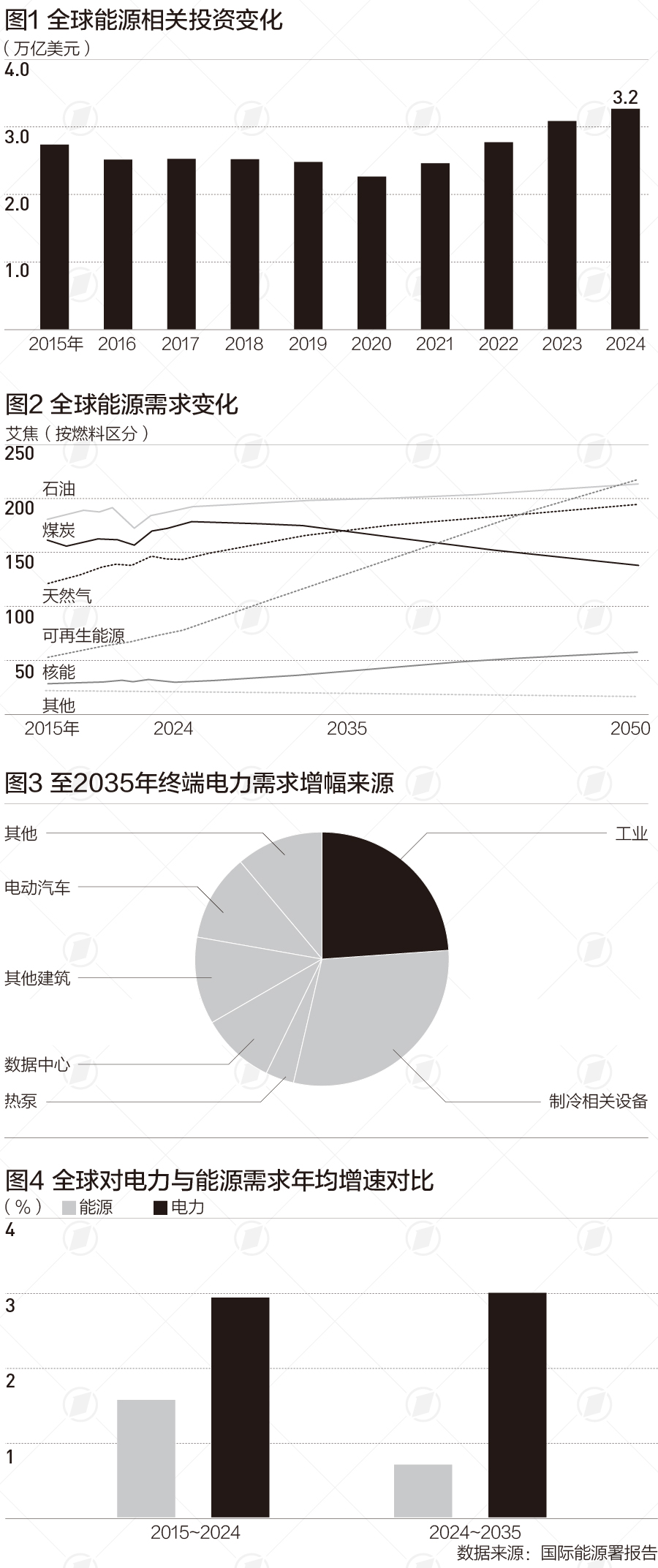
Core Insights - The global data center investment is projected to reach $580 billion, surpassing investments in the oil sector, which are estimated at $540 billion [8] - The International Energy Agency (IEA) emphasizes that the current surge in electricity consumption is not limited to emerging economies but is also significantly driven by developed economies due to the demand from data centers and artificial intelligence [2][3] - By 2035, global energy demand is expected to rise from 654 exajoules (EJ) to 705 EJ, with electricity demand projected to increase by approximately 40% under current and stated policy scenarios [1][3] Investment Trends - The IEA forecasts that total investment in the energy sector will reach approximately $3.3 trillion in 2025, marking a 2% increase from 2024 and setting a historical high [1] - Investment in low-emission power, grids, low-emission fuels, energy efficiency, and end-use sectors is expected to rise from $1 trillion a decade ago to over $2 trillion by 2024, accounting for more than 60% of global investment [3] Electricity Demand Dynamics - The demand for electricity is anticipated to grow explosively, particularly driven by data centers and AI, with a projected annual growth rate exceeding 4% starting in 2024 [8] - By 2030, AI-optimized server electricity consumption is expected to increase fivefold, leading to a doubling of global data center electricity usage from current levels [8] Renewable Energy Outlook - Renewable energy sources, particularly solar and wind, are expected to meet the rising electricity demand, with solar photovoltaic demand growing the fastest [9] - The global nuclear power capacity is projected to increase by at least one-third by 2035, indicating a potential revival of nuclear energy [9] Infrastructure Challenges - The IEA highlights that while investment in generation has surged nearly 70% since 2015, annual investment in the grid has not kept pace, raising concerns about energy security [11] - Over 85% of new data center capacity is expected to be concentrated in the US, China, and the EU, which may exacerbate existing grid burdens [11] Strategic Mineral Supply Concerns - The market for critical minerals essential for the energy transition is highly concentrated, with a single country dominating the refining of 19 out of 20 strategic minerals [12] - Approximately 7.3 billion people still lack access to electricity, with significant disparities in coverage, particularly in rural and underdeveloped areas [12]
全球格局,将进入全新的能源竞争时代!
大胡子说房· 2025-11-14 09:14
Core Viewpoint - The article emphasizes that China is on the verge of becoming the world's first "electric power empire," driven by advancements in technology and energy production, particularly in the context of AI development and energy consumption [1][3]. Group 1: Energy and Technology - The International Energy Agency predicts that the energy market is entering an "electric era" led by China, linking energy control to global influence [3]. - The future of industrial upgrades relies heavily on technology and AI, which require substantial electricity for operations, with AI training consuming significant energy [4][5]. - By 2030, global AI industry electricity consumption is expected to exceed 945 billion kilowatt-hours annually, highlighting the critical need for sufficient and cost-effective electricity [4]. Group 2: China's Energy Strategy - China is not a major oil producer, making the development of renewable energy essential for its future, aiming for electric power dominance [14][15]. - China's projected electricity generation in 2024 is expected to reach 10 trillion kilowatt-hours, significantly surpassing the United States' 4.8 trillion kilowatt-hours [17][18]. - China's advancements in renewable energy, such as solar and hydropower, contribute to its ability to produce electricity at lower costs, with average electricity costs around 0.5 yuan per kilowatt-hour [34][35]. Group 3: Technological Innovations - Recent breakthroughs in controlled nuclear fusion and thorium-based molten salt reactors position China as a leader in safe and efficient energy production [22][26]. - These technologies could potentially provide energy for thousands of years, ensuring energy security and low costs for China [29][30]. Group 4: Competitive Landscape - The article argues that the low cost of electricity in China gives it a competitive edge in manufacturing and AI development, making it less vulnerable to energy shortages compared to the U.S. [60][61]. - The U.S. faces significant challenges in electricity supply, with predictions of a 20% power shortfall by 2028, which could hinder its technological advancements [6][66]. Group 5: Investment Opportunities - Investors are encouraged to look beyond traditional tech sectors and consider opportunities in the electricity grid and power equipment, as these areas will be crucial for supporting the growing demand for energy in high-tech industries [78][79].

IEA:2025年世界能源发展呈现五大趋势
Sou Hu Cai Jing· 2025-11-12 08:39
Core Insights - The International Energy Agency (IEA) emphasizes that energy issues are central to economic and national security due to immediate threats and long-term risks [1] - The energy landscape is increasingly shaped by geopolitical tensions and supply chain vulnerabilities, particularly concerning critical minerals [2] Group 1: Energy Security and Supply Chain Risks - The supply chain for critical minerals is highly concentrated, with a single country dominating the refining of 19 out of 20 strategic minerals, averaging a market share of about 70% [2] - Over half of the strategic minerals are subject to some form of export control as of November 2025, highlighting the urgent need to enhance resilience against weather-related risks and cyber threats [2] Group 2: Electricity Demand and Economic Impact - Electricity demand is projected to grow approximately 40% by 2035 in established and committed policy scenarios, and over 50% in net-zero scenarios by 2050 [3] - Data center investments are expected to reach $580 billion by 2025, surpassing global oil supply expenditures of $540 billion, indicating a significant shift in energy consumption patterns [3] Group 3: Shifts in Global Energy Demand - The center of global energy demand is shifting from China to emerging economies like India and Southeast Asia, with these regions increasingly shaping energy market dynamics [4] - From 2010 onwards, China accounted for over half of the global oil and gas demand growth, but this trend is expected to diversify as new emerging economies contribute to future growth [4] Group 4: Renewable Energy Growth - Renewable energy, particularly solar photovoltaic (PV), is growing faster than any other major energy source, with China expected to account for 45%-60% of global deployment in the next decade [5] - The growth of renewable technologies is accompanied by significant advancements in energy efficiency [5] Group 5: Nuclear Energy Revival - Over 40 countries are incorporating nuclear energy into their strategies, with more than 70 GW of new nuclear capacity currently under construction, marking the highest level in 30 years [6] - The global nuclear capacity is expected to increase by at least one-third by 2035, driven by innovations and new business models [6]