
石油过剩

Search documents
KPMG's Mayor Expects Oil Glut to Continue
Youtube· 2025-12-30 17:37
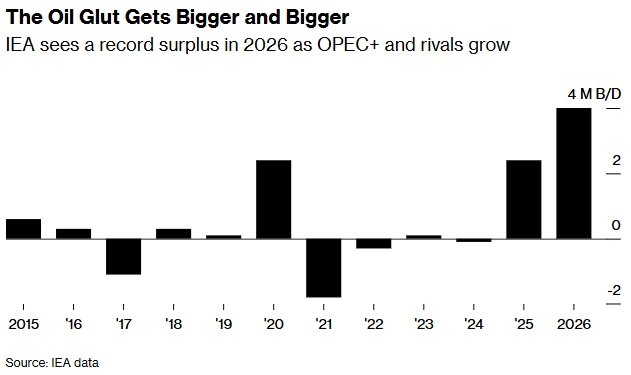
Core Viewpoint - The oil market is currently facing a structural oversupply, which is expected to keep crude prices low through 2026, with predictions of Brent averaging $55 and a potential excess of up to 4 million barrels per day by 2026 [3][4]. Group 1: Oil Market Dynamics - Clients in the oil sector are planning for a prolonged period of low prices, incorporating budgets around $60 or below [2]. - The current oversupply situation has worsened from an excess of 1.5 million barrels per day to 2 million barrels per day, with projections indicating it could reach 4 million barrels per day by 2026 [3]. - The structural oversupply is seen as a significant factor that will limit any potential increases in crude oil prices through 2026 [4]. Group 2: Comparison with Other Energy Sources - While oil prices remain stagnant, natural gas and electricity prices are experiencing significant increases, with natural gas trading at approximately $4.30 per MMBtu, up from $2 [5]. - The demand for natural gas for electricity generation has increased by 3% in the previous year, contributing to rising electricity prices, which have seen a national average increase of nearly 5% in 2025, with some states experiencing increases as high as 20% [6]. - Expectations for electricity prices indicate an additional increase of 4% in 2026, impacting consumer costs significantly [6][7].


买家恢复俄油采购,油价持续下跌
Hua Tai Qi Huo· 2025-12-17 02:50
1. Report Industry Investment Rating - The short - term driving force of oil prices is downward, and a medium - term short - position allocation is recommended [3] 2. Core View of the Report - The oil price has recently seen a relatively smooth decline. The starting point of the decline is that some buyers began to resume purchasing Russian oil last week. The increase in the purchase of sanctioned oil means a decrease in the purchase of compliant oil, which is bearish for oil prices. In the future, as Russia finds ways to circumvent sanctions, it is highly likely that the surplus of sanctioned oil will turn into a surplus of compliant oil. However, the geopolitical risks in Venezuela have been continuously escalating recently, and the potential risk of logistics interruption needs to be monitored [2] 3. Summary According to Relevant Catalogs Market News and Important Data - As of the close, the price of light crude oil futures for January 2026 delivery on the New York Mercantile Exchange fell $1.55 to $55.27 per barrel, a decline of 2.73%; the price of Brent crude oil futures for February delivery fell $1.64 to $58.92 per barrel, a decline of 2.71% [1] - Russian crude oil prices have fallen to the lowest level since the start of the Russia - Ukraine conflict. Western sanctions have increased the discounts that the country's oil industry needs to offer, and benchmark crude oil futures have tumbled. The average selling price of crude oil shipped by Russian oil exporters from the Baltic, Black Sea, and the eastern port of Kozmino is slightly above $40 per barrel, a 28% drop from the past three months. Sanctions on oil giants Rosneft and Lukoil have further increased the discount. Western pressure on Russian oil trade has made the sale and transportation of Russian oil increasingly difficult, and relevant measures also target refineries in major buyers such as India. Additionally, global benchmark crude oil prices are also falling, with Brent crude falling below $60 per barrel on Tuesday for the first time since May [1] - Trump posted on social media that he ordered a "full and complete blockade of all sanctioned oil tankers entering and leaving Venezuela." The fleet surrounding Venezuela will only grow larger, and the impact on them will be unprecedented until they return all the oil, land, and other assets they "stole" from the US. Trump also labeled Venezuelan President Maduro's regime a "foreign terrorist organization," accusing this "illegal" regime of using oil from the "stolen" oil fields to fund itself, drug terrorism, human trafficking, murder, and kidnapping. This move marks an escalation of the Trump administration's pressure on Maduro. Last week, the US seized a sanctioned oil tanker off the coast of Venezuela [1] - Venezuelan Vice - President and Oil Minister Rodriguez issued a government communiqué on the 15th, stating that Trinidad and Tobago had assisted the US in "stealing" Venezuelan oil tankers. The communiqué said that Trinidad and Tobago allowed the US to install military radars on its territory to besiege Venezuelan oil tankers passing by, and Trinidad and Tobago has become an accomplice of the US in its aggression against Venezuela. The Venezuelan government is aware of the Trinidad and Tobago government's participation in the recent US seizure of a Venezuelan oil tanker, which is a pirate act and violates international law. The Venezuelan government decided to immediately terminate all natural gas supply contracts, agreements, and related negotiations with Trinidad and Tobago [1] - Oil prices are hovering near the lowest level since 2021. Traders are weighing the prospect of a possible cease - fire in Ukraine, which may pave the way for reducing export restrictions on Russian oil, putting more pressure on an already oversupplied market. Due to OPEC+ restoring idle production capacity and other oil - producing countries increasing production, the expectation of a global oil surplus is constantly growing, and oil is heading for an annual decline. An agreement to end the conflict may prompt the US to relax sanctions on Russia, although Moscow has basically maintained a continuous supply of crude oil since the conflict started in early 2022 [1] Investment Logic - The increase in the purchase of sanctioned oil means a decrease in the purchase of compliant oil, which is bearish for oil prices. In the future, it is likely that the surplus of sanctioned oil will turn into a surplus of compliant oil, but attention should be paid to the potential risk of logistics interruption due to the escalating geopolitical risks in Venezuela [2] Strategy - The short - term driving force of oil prices is downward, and a medium - term short - position allocation is recommended [3] Risk - Downside risks: A peace agreement is reached between Russia and Ukraine, and macro black - swan events occur - Upside risks: The supply of sanctioned oil (from Russia, Iran, and Venezuela) tightens, and large - scale supply disruptions are caused by conflicts in the Middle East [4]
港股异动丨石油股走低 三桶油均跌超2% 国际油价下跌
Ge Long Hui· 2025-12-16 02:46
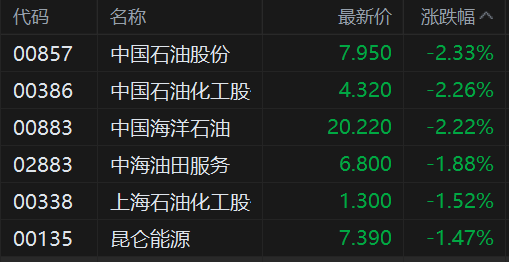
Group 1 - International oil prices have declined, leading to a collective drop in Hong Kong's oil stocks, with China National Offshore Oil Corporation (CNOOC), China Petroleum & Chemical Corporation (Sinopec), and China Petroleum & Natural Gas Corporation (PetroChina) all falling over 2% [1] - WTI January crude oil futures closed down by $0.62, a decrease of 1.08%, at $56.82 per barrel; Brent February crude oil futures fell by $0.56, a decrease of 0.92%, at $60.56 per barrel [1] - Oil prices are hovering near their lowest levels since 2021, as traders assess the potential for a ceasefire in Ukraine, which could ease restrictions on Russian oil exports and exacerbate an already oversupplied market [1] Group 2 - The expectation of global oil oversupply is growing due to OPEC+ restoring idle production capacity and other oil-producing countries increasing output, leading to a forecast of annual declines in oil prices [1] - Specific stock performance includes: - PetroChina (00857) at HKD 7.950, down 2.33% - Sinopec (00386) at HKD 4.320, down 2.26% - CNOOC (00883) at HKD 20.220, down 2.22% - CNOOC Oilfield Services (02883) at HKD 6.800, down 1.88% - Shanghai Petrochemical (00338) at HKD 1.300, down 1.52% - Kunlun Energy (00135) at HKD 7.390, down 1.47% [2] - China Petroleum & Chemical Corporation has repurchased shares, spending HKD 330.6 million for 764,000 shares on December 15 and HKD 292.43 million for 678,000 shares on December 12 [3]



华尔街五大投行共识:油价“至暗时刻”未过,2026年或下探59美元
Zhi Tong Cai Jing· 2025-12-10 13:48
Group 1 - Oil prices have experienced their worst year since the pandemic, with Wall Street predicting that the decline is not over yet [1] - The average forecast from major banks indicates that Brent crude oil futures, currently trading around $62 per barrel, will further decline to approximately $59 by 2026, reflecting a 17% drop this year [1] - The five banks predict a surplus of about 2.2 million barrels per day in the global oil market next year due to production exceeding demand growth [1] Group 2 - Goldman Sachs holds the most pessimistic forecast among the five banks, with an annual average price of $56 per barrel, while Citigroup is the most optimistic at $62 per barrel [4] - Goldman Sachs believes that delayed oil projects during the pandemic will come online, increasing supply in the market [4] - JPMorgan expects the oil surplus to be less than the reported figures, as the OPEC+ alliance, led by Saudi Arabia, may reverse its strategy and significantly cut production by mid-next year [4][5]


燃料油日报:油价大跌带动盘面价格走低-20251114
Hua Tai Qi Huo· 2025-11-14 05:26
Group 1: Report Industry Investment Rating - No specific industry investment rating provided in the report Group 2: Core Views of the Report - The sharp decline in oil prices drove down the prices of fuel oil futures. The main contract of SHFE fuel oil futures closed down 3.71% at 2,595 yuan/ton, and the main contract of INE low-sulfur fuel oil futures closed down 4.41% at 3,164 yuan/ton [1] - OPEC's latest monthly oil market report shows that the oil market will experience a slight surplus in 2026 as global supply increases, which has an important impact on the overall market expectations [1] - Since Q3, the oil supply in the Middle East, Latin America, and Russia has increased significantly, and the problem of oil inventory accumulation will become more prominent in the future [1] - Excluding the impact of geopolitical and macro events on market sentiment, the fundamentals are bearish for oil prices, which will drive down the price center of downstream fuel oil [1] - The current contradictions in the fundamentals of fuel oil itself are relatively limited. The spread between high-sulfur and low-sulfur fuel oil is in a stage of bottom rebound, but there is no strong expectation of differentiation in their strength [1] Group 3: Strategy Summary - High-sulfur fuel oil: Neutral in the short term and bearish in the medium term [2] - Low-sulfur fuel oil: Neutral in the short term and bearish in the medium term [2] - Cross-variety strategy: Go long on the spread of LU2601 - FU2601 at low levels [2] - Cross-period strategy: None [2] - Spot-futures strategy: None [2] - Options strategy: None [2] Group 4: Chart Information - Multiple charts are provided, including the spot prices, swap near-month contracts, and monthly spreads of Singapore high-sulfur 380 fuel oil and low-sulfur fuel oil, as well as the closing prices, trading volumes, and open interests of fuel oil FU and low-sulfur fuel oil LU futures contracts [3]
The oil glut will last into 2026. Here's why it's unclear how big it will be.
Yahoo Finance· 2025-11-02 16:15
Core Viewpoint - The oil market, previously expected to face a significant glut, may not experience as severe an oversupply due to recent geopolitical developments, particularly US sanctions on Russia's major oil producers [1][2]. Supply and Demand Dynamics - Current oil glut is approximately 1.9 million barrels per day, with expectations that it will persist through 2026, but geopolitical factors may limit its growth [2]. - Demand remains robust, particularly from China, which has been stockpiling oil reserves, absorbing surplus that could have depressed prices [4]. - Middle Eastern demand has also been stronger than anticipated, and India has increased its purchases of cheaper Russian crude [4]. Production Trends - OPEC+ has consistently raised production targets for six consecutive months, with a recent increase of 137,000 barrels per day agreed upon in early October [5]. - There is a significant amount of oil, approximately 1.4 billion barrels, currently on tankers globally, indicating a potential oversupply situation [5]. Market Pricing - Brent crude futures have decreased over 13% since the start of the year, trading around $64, while West Texas Intermediate has fallen over 14% to around $60 [3]. - Despite the decline, both benchmarks have shown relatively stable trading patterns over the past six months [3]. Future Projections - The International Energy Agency projects that oversupply could reach an "untenable" four million barrels per day by 2026, which would double the average surplus observed earlier this year [6].
IEA执行董事:石油过剩将抑制近期油价上涨并趋于平缓
智通财经网· 2025-10-27 07:05
Core Viewpoint - The International Energy Agency (IEA) predicts that oil prices will stabilize due to ample supply, driven by increased production in the Americas and OPEC+ policy adjustments, alongside slowing demand growth [1] Group 1: Supply and Demand Dynamics - The IEA's Executive Director, Fatih Birol, states that the oil market is expected to remain stable without significant geopolitical events, with only a minor boost to prices anticipated from potential US-China trade agreements [1] - Oil production growth in the "Five Americas" (the United States, Canada, Brazil, Guyana, and Argentina) has outpaced demand growth, leading to an oversupply in the oil market [1] - Demand growth is slowing primarily due to China's gradual reduction in reliance on heavy industry and fuel-powered vehicles [1] Group 2: Future Projections - The IEA has raised its forecast for oil surplus by 2026, predicting a record level of oversupply by that time [1] Group 3: Market Reactions - Recent US sanctions on major Russian oil producers have raised concerns about actual oil supply, resulting in a nearly 8% increase in crude oil prices [1] - Indian refineries, as major buyers of Russian oil, have announced a halt in purchases, and some Chinese refineries are also experiencing panic-driven stoppages in procurement [1]
原油成品油早报-20251024
Yong An Qi Huo· 2025-10-24 01:52
Report Industry Investment Rating - No information provided in the given content. Core Viewpoints of the Report - From October 13 - 17, international oil prices continued to decline, and the monthly spreads of the three markets weakened. The geopolitical premium faded, and the fundamental surplus intensified. The latest IEA monthly report raised the global oil surplus forecast for 2026 again. With a large number of oil tankers heading to major trading and transportation centers, on - land inventory pressure increased significantly in October, which is the point with the largest absolute surplus throughout the year. [7] - Tensions in the Middle East flared up again as the Israeli Defense Forces carried out an air - strike on southern Gaza. Meanwhile, multiple factors influenced Russian oil supply, with India stating it would stop purchasing Russian oil, but the export volume from Russia to India in the first half of October increased by 250,000 barrels per day month - on - month. [7] - Fundamentally, global on - land oil inventories fluctuated this week, and the total waterborne inventory remained flat. OPEC production increased by about 500,000 barrels per day in September, and crude oil net exports soared. Non - OPEC countries like Brazil, the US, Guyana, and Norway also saw a significant increase in crude oil net exports. [7] - This week, oil prices and global refinery profits weakened. The profit of gasoline in the external market was slightly stronger than that of diesel, while in the domestic market, gasoline was significantly weaker than diesel. During the peak maintenance period, downstream profits declined, and the domestic start - up rate was expected to weaken marginally. The demand side provided weak support for oil prices. [7] - The subsequent oil price trend depends on whether Russian crude oil supply declines marginally and the progress of Sino - US trade negotiations before the APEC meeting at the end of October. In the baseline scenario, the surplus in the fourth quarter is over 2 million barrels per day, and it is currently in the trend of waterborne inventory converting to OECD inventory. The expected surplus in 2026 is 1.8 - 2.5 million barrels per day. Attention should be paid to the impact of sanctions on Russia and Iran on their export volumes in the fourth quarter. It is expected that the absolute price center in the fourth quarter will fall to $55 - 60 per barrel, and short - term oil prices will be in a volatile consolidation phase. [7] Summary by Relevant Catalogs 1. Oil Price Data - From October 17 to 23, WTI increased from $57.54 to $61.79, a rise of $3.29; BRENT rose from $61.29 to $65.99, an increase of $3.40; DUBAI went up from $63.26 to $65.24, a gain of $1.38. [3] - During the same period, SC increased by 12.50, OMAN rose by 4.93. The spread between SC and BRT changed by - 1.61, and the spread between SC and WTI changed by - 1.50. [3] - The price of Japanese naphtha CFR increased from $537.00 to $551.50, and the spread between Japanese naphtha and BRT increased from $86.52 to $91.46. The Singapore 380CST fuel oil premium changed by 0.73, and the spread between Singapore 380 and BRT changed by - 6.65. [3] 2. Daily News - German Chancellor Merz is optimistic that the US will exempt the German subsidiary of Russian oil company Rosneft. There are concerns that without the exemption, the German subsidiary may be cut off from major customers. [3] - The US government is preparing a proposal to open almost all US coastal waters for new offshore oil drilling, which has been opposed by local governors. The preliminary draft indicates a significant expansion of areas eligible for oil and gas leasing in the US. [4] - Kuwait's oil minister said that OPEC is ready to increase production in response to rising demand. This statement was made against the backdrop of rising oil prices after the US imposed new sanctions on Russia. [4] 3. Regional Fundamentals - According to the EIA report for the week of October 17, US crude oil exports decreased by 263,000 barrels per day to 4.203 million barrels per day; domestic crude oil production decreased by 700 barrels to 13.629 million barrels per day; commercial crude oil inventories excluding strategic reserves decreased by 1 million barrels to 422.8 million barrels, a decrease of 0.2%; the four - week average supply of US crude oil products was 20.474 million barrels per day, a decrease of 0.1% compared to the same period last year; the Strategic Petroleum Reserve (SPR) inventory increased by 800,000 barrels to 408.6 million barrels, an increase of 0.2%; commercial crude oil imports excluding strategic reserves were 5.918 million barrels per day, an increase of 393,000 barrels per day compared to the previous week. [6] - For the week of October 10, US EIA gasoline inventory decreased by 267,000 barrels (expected - 75,000 barrels, previous value - 1.601 million barrels), and EIA refined oil inventory decreased by 4.529 million barrels (expected - 294,000 barrels, previous value - 2.018 million barrels). [6] - From September 19 - 25, the operating rate of major refineries decreased, while the operating rate of Shandong local refineries increased. Domestic gasoline production decreased, while diesel production increased. Gasoline inventory increased, while diesel inventory decreased. The comprehensive profit of major refineries fluctuated downward, and the comprehensive profit of local refineries decreased month - on - month. [6]
原油成品油早报-20251023
Yong An Qi Huo· 2025-10-23 01:37
Report Industry Investment Rating - No relevant information provided Core Viewpoints - From October 13 - 17, international oil prices continued to decline, the monthly spreads of the three markets weakened, and Dubai 1 - 2 weakened to 0. The geopolitical premium subsided, and the fundamental surplus intensified. The latest IEA monthly report raised the global oil surplus forecast for 2026 again. With a large number of oil tankers transporting to major trading and transportation centers recently, the on - land inventory pressure increased significantly, and October was the point with the largest absolute surplus throughout the year. The follow - up oil price trend needs to focus on whether Russian crude oil supply declines marginally and the progress of Sino - US trade negotiations before the APEC meeting at the end of October. In the benchmark scenario, the surplus in the fourth quarter is over 2 million barrels per day, and it is expected to be 1.8 - 2.5 million barrels per day in 2026. It is expected that the absolute price center in the fourth quarter will fall back to $55 - 60 per barrel, and short - term oil prices will be in a volatile consolidation [6]. Summary by Relevant Catalogs 1. Oil Price and Related Data - From October 16 - 22, WTI increased by $1.26, BRENT by $1.27, and DUBAI by $0.52. Other related indicators such as spreads and prices of refined products also had corresponding changes [3]. 2. Daily News - On October 23, international oil prices soared 4% as the US Treasury Department blacklisted Russian state - owned oil giants Rosneft and Lukoil and their subsidiaries, which account for nearly half of Russia's crude oil exports (about 2.2 million barrels per day in the first half of this year). The US Treasury Department stated that this move would weaken Russia's ability to raise revenue for the conflict. Oil prices were also supported by the growth of US energy demand, as the EIA reported a decline in US crude, gasoline, and distillate inventories last week [3][4]. - As of the week of October 20, the total refined oil inventory in Fujairah, UAE increased by 2.202 million barrels to 20.014 million barrels, with light distillate inventory decreasing by 0.851 million barrels, medium distillate inventory increasing by 0.668 million barrels, and heavy residual fuel oil inventory increasing by 2.385 million barrels [4]. 3. Regional Fundamentals - In the week of October 17, US crude oil exports decreased by 263,000 barrels per day to 4.203 million barrels per day, domestic crude oil production decreased by 700 barrels to 13.629 million barrels per day, commercial crude oil inventory (excluding strategic reserves) decreased by 1 million barrels to 422.8 million barrels (a 0.2% decrease), the strategic petroleum reserve (SPR) inventory increased by 800,000 barrels to 408.6 million barrels (a 0.2% increase), and commercial crude oil imports (excluding strategic reserves) increased by 393,000 barrels per day to 5.918 million barrels per day. The four - week average supply of US crude oil products was 20.474 million barrels per day, a 0.1% decrease from the same period last year [5]. - From September 19 - 25, the operating rate of major refineries decreased, while that of Shandong local refineries increased. Domestic gasoline production decreased while diesel production increased, gasoline inventory increased while diesel inventory decreased. The comprehensive profit of major refineries fluctuated downward, and the comprehensive profit of local refineries decreased month - on - month [5]. 4. Weekly Viewpoints - In the week of October 13 - 17, international oil prices continued to decline, the monthly spreads of the three markets weakened, and the geopolitical premium subsided. The fundamental surplus intensified, and the latest IEA monthly report raised the global oil surplus forecast for 2026. The on - land inventory pressure increased significantly, and October was the point with the largest absolute surplus throughout the year. The follow - up oil price trend needs to focus on Russian crude oil supply and Sino - US trade negotiations. In the benchmark scenario, the surplus in the fourth quarter is over 2 million barrels per day, and it is expected to be 1.8 - 2.5 million barrels per day in 2026. It is expected that the absolute price center in the fourth quarter will fall back to $55 - 60 per barrel, and short - term oil prices will be in a volatile consolidation [6].
全世界都在预测“巨大石油过剩”,为何油价就是不崩?
Jin Shi Shu Ju· 2025-09-19 08:31
Core Viewpoint - Despite predictions of an impending oil surplus, global crude oil prices remain resilient, trading around $67 per barrel, contrary to forecasts suggesting a drop to $50 or lower [1][2]. Group 1: Supply and Demand Dynamics - Major institutions, including the International Energy Agency (IEA) and the U.S. Energy Information Administration (EIA), predict significant oil surpluses, with the IEA forecasting a record surplus of 3.3 million barrels per day by 2026 and the EIA estimating a surplus of 2.1 million barrels per day in the second half of this year [1][2]. - The current market is characterized by a "spot premium," where immediate delivery oil is priced higher than future delivery, indicating market tightness rather than an imminent surplus [2]. Group 2: China's Role in the Oil Market - China is viewed as a stabilizing force in the oil market, actively purchasing crude oil, which traders interpret as a sign of increasing consumption rather than oversupply [2]. - The IEA projects that global oil consumption will rise by only 700,000 barrels per day next year, marking the slowest growth since 2009, excluding the pandemic period [2]. Group 3: OPEC+ Production and Market Reactions - OPEC+ has increased production quotas by 2.5 million barrels per day since April, but actual production increases are expected to be lower due to several member countries reaching maximum capacity [3]. - Analysts suggest that if OPEC+ fails to meet production targets, the anticipated surplus may be smaller than predicted, potentially limiting downward pressure on oil prices [3]. Group 4: Market Sentiment and Future Outlook - Some analysts believe that the anticipated surplus may not significantly impact oil prices, as long as demand from China continues and OPEC+ maintains limited spare capacity [3][4]. - There is a sentiment that when too many traders align on a bearish outlook, it often does not materialize, indicating that unexpected factors could influence market dynamics [4].