
科技重估

Search documents
老牌私募发声!2026年对正收益充满信心 关注AI、出海以及大宗商品
Zhong Guo Zheng Quan Bao· 2025-12-29 05:01
2025年,中国资产迎来一波久违的行情,上证指数多次站上4000点。这一轮市场行情,由硬科技和新经 济作为先锋,走出一轮科技突破和产业驱动、资金流入和风险偏好提升同频共振推动下的"科技重估"行 情。 近两个月以来,资产轮动告一段落,A股上涨动能有所减弱,恒生科技明显回调。一方面,科技成长的 单边行情歇脚,"AI泡沫论"的浮现也透露出投资者对双创行情的迟疑;但另一方面,在更加积极的财政 政策和适度宽松的货币政策总基调下,业内人士认为,不应悲观。 一个关键而又急迫的话题摆在眼前:展望2026年,是否会上演从估值抬升的"急而促"行情转向盈利支撑 的"缓而慢"的行情? 近日,老牌知名私募相聚资本在2026年年度投资策略展望中表示,市场整体下行风险较小,对取得一定 的绝对回报充满信心。但或不同于2025年宽基指数接近20%的涨幅,需适当降低投资回报预期。未来一 年,大概率依旧是以结构性行情为主,选股逻辑与当前保持一致,关注人工智能、大宗商品以及出海等 方向的投资机会。 外部环境宽松支持股市继续走强 在2024年底的投资展望中,梁辉表示,人工智能和半导体的投资机会值得高度关注,这样的判断也在后 来的市场走势中不断得到验证 ...
这场盛会,多位大咖发声
中国基金报· 2025-10-22 12:06
Core Viewpoint - The article emphasizes that despite the complex global macro environment, investment opportunities in the Chinese market are becoming increasingly prominent, with a bullish outlook on the A-share market and a focus on technology and high-dividend strategies [2]. Group 1: Market Outlook - The current bull market in A-shares is believed to be in its second phase, driven by fundamental improvements, with the starting point traced back to September 24 of last year [4]. - The bull market is compared to the "5·19行情" of 1999, indicating a similar macro policy-driven initiation during a period of market adjustment [4]. - The market is currently experiencing a phase where technology is the main focus, with value sectors like real estate and liquor showing potential for revaluation [5]. Group 2: Investment Strategies - Investment strategies recommended include focusing on high-quality assets amidst global economic slowdowns and adjusting allocations among stocks, bonds, commodities, and currencies [9]. - Long-term investment areas highlighted include AI, energy, and health economics, particularly where AI intersects with health [12]. - The article suggests maintaining a position in gold as a hedge against market volatility, with expectations of a 5% price increase due to various supporting factors [9][13]. Group 3: Global Context - The article notes a trend of global diversification in investments, with long-term funds from Europe, Latin America, and the Middle East beginning to enter the Chinese market [12]. - The anticipated interest rate cuts by the Federal Reserve are expected to influence global asset allocation, with a projected total of 75 basis points of cuts by the first quarter of next year [12].




北水动向|北水成交净买入234.26亿 内资再度抢筹港股ETF 科网股亦获加仓
智通财经网· 2025-08-05 10:07
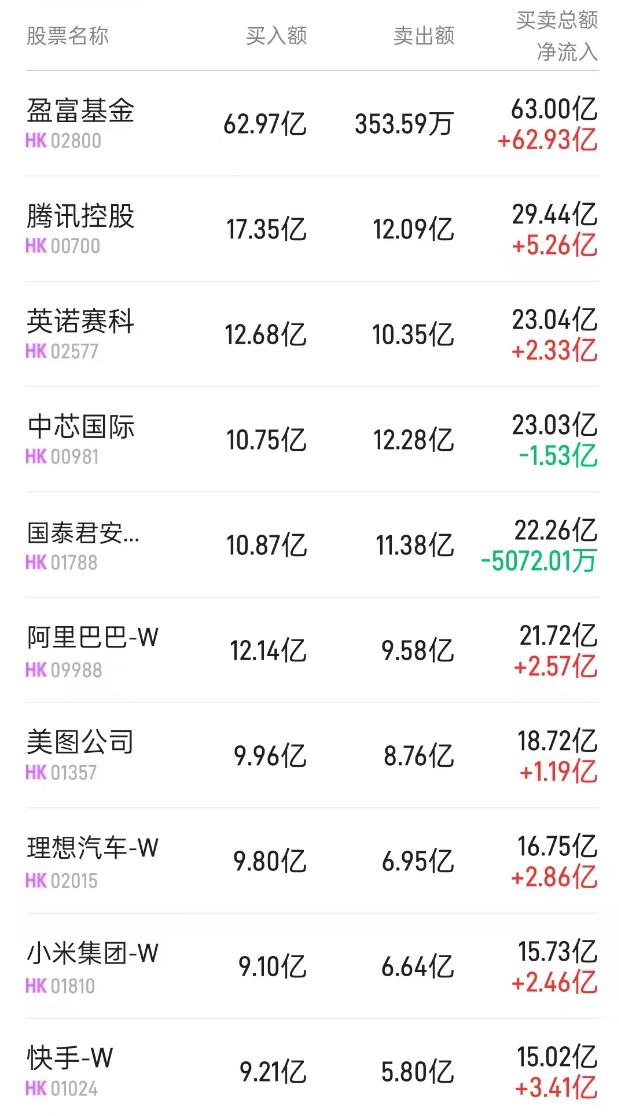
Summary of Key Points Core Viewpoint - The Hong Kong stock market experienced significant net inflows from northbound trading, indicating a positive sentiment among investors towards certain stocks and sectors, particularly technology and ETFs [1][6]. Group 1: Northbound Trading Activity - Northbound trading recorded a net buy of HKD 234.26 billion, with HKD 139.36 billion from the Shanghai Stock Connect and HKD 94.89 billion from the Shenzhen Stock Connect [1]. - The most purchased stocks included the Tracker Fund of Hong Kong (盈富基金, 02800), Tencent (00700), and the Southern Hang Seng Technology ETF (南方恒生科技, 03033) [1][6]. - The stock with the highest net sell was Guotai Junan International (国泰君安国际, 01788), with a net outflow of HKD 50.72 million [1][9]. Group 2: Individual Stock Performance - The Tracker Fund of Hong Kong (02800) saw a net inflow of HKD 62.93 billion, while Tencent (00700) had a net inflow of HKD 5.26 billion [2]. - Other notable net inflows included InnoCare Pharma (英诺赛科, 02577) with HKD 2.33 billion, and Alibaba (阿里巴巴-W, 09988) with HKD 2.57 billion [2][8]. - Li Auto (理想汽车-W, 02015) received a net inflow of HKD 5.86 billion following an announcement of configuration adjustments for its i8 model [7]. Group 3: Sector Insights - The technology sector, which constitutes nearly one-third of the Hong Kong market, is expected to undergo a revaluation driven by improving fundamentals and policy expectations [6]. - Companies like Meitu (美图公司, 01357) reported a projected net profit increase of 65% to 72% year-on-year, indicating strong operational performance [7]. - UBS highlighted the potential of Akeso's core product AK112 in various cancer treatments, projecting significant revenue contributions from upcoming clinical trials [8].




资金抢筹港股市场,港股科技ETF(513020)午后翻红,近5日净流入超1.7亿元
Sou Hu Cai Jing· 2025-08-05 06:46
Group 1 - The core viewpoint indicates that despite increased market volatility due to accumulated gains, the mid-term allocation logic for the Hong Kong stock market remains unchanged, with recent market pullbacks attracting further capital inflows [1] - Southbound capital inflows significantly increased, with a net inflow of 59 billion HKD in a single week, marking the highest weekly inflow since April 11 [1] - The global liquidity trend is leaning towards easing rather than tightening, influenced by weaker-than-expected US employment data and external pressures on the US dollar index [1] Group 2 - Investors are advised to focus on sectors with improving sentiment and low valuations, particularly in the context of upcoming earnings releases in mid-August for Hong Kong stocks [1] - The performance expectations for the new energy vehicle and semiconductor sectors show significant divergence, indicating higher potential volatility, while consumer electronics have a more certain outlook for improvement [1] - The valuation of Hong Kong stocks remains reasonable compared to A-shares, with the Hang Seng Technology Index's valuation percentile around 20%, suggesting substantial long-term recovery potential for technology and pharmaceutical sectors [1] Group 3 - The Hong Kong Technology ETF (code: 513020) tracks the Hong Kong Stock Connect Technology Index (code: 931573), which selects up to 50 quality companies from the technology sector listed under the Stock Connect [2] - The index aims to reflect the overall performance of technology sector securities available for investment through the Stock Connect, highlighting significant growth potential and market volatility characteristics of its constituent stocks [2] - Investors without stock accounts can consider the Cathay CSI Hong Kong Stock Connect Technology ETF Initiated Link C (015740) and Link A (015739) for exposure [2]
北水成交净买入131.26亿 北水抢筹港股ETF及科网股 买入盈富基金(02800)超24亿港元
Zhi Tong Cai Jing· 2025-07-31 10:59
Group 1: Market Overview - On July 31, the Hong Kong stock market saw a net inflow of 13.126 billion HKD from northbound trading, with 7.604 billion HKD from the Shanghai Stock Connect and 5.522 billion HKD from the Shenzhen Stock Connect [2] - The most bought stocks included the Tracker Fund of Hong Kong (02800), Hang Seng China Enterprises (02828), and Meituan-W (03690) [2][3] - The most sold stocks were Laopuhuangjin (06181), CSPC Pharmaceutical Group (01093), and Shandong Molong Petroleum Machinery (00568) [2] Group 2: Active Stocks - The top net bought stocks included Meituan-W (03690) with 2.622 billion HKD, Alibaba-W (09988) with 2.222 billion HKD, and Xiaomi Group-W (01810) with 2.031 billion HKD [3] - The top net sold stocks included Shandong Molong (00568) with 940 million HKD and CSPC Pharmaceutical Group (01093) with 891 million HKD [3] Group 3: ETF and Sector Insights - Northbound trading showed strong interest in ETFs, with the Tracker Fund of Hong Kong (02800) receiving a net inflow of 2.405 billion HKD, Hang Seng China Enterprises (02828) with 1.781 billion HKD, and Southern Hang Seng Technology (03033) with 973 million HKD [6] - The technology sector is highlighted as a significant part of the Hong Kong market, accounting for nearly one-third, with a focus on potential revaluation driven by technology [6] Group 4: Company-Specific News - Meituan-W (03690) received a net inflow of 13.98 billion HKD, while Kuaishou-W (01024) and Alibaba-W (09988) received 13.82 billion HKD and 10.43 billion HKD respectively [6] - Semiconductor company SMIC (00981) saw a net inflow of 2.21 billion HKD amid concerns regarding Nvidia's chip security issues [7] - Meitu Company (01357) received a net inflow of 15.3 million HKD, with Morgan Stanley raising its target price by 140% [7] Group 5: Performance Expectations - Laopuhuangjin (06181) faced a net outflow of 2.78 billion HKD, with analysts questioning the sustainability of its profit growth [8] - Analysts expect Laopuhuangjin's revenue to grow by 26% year-on-year next year, with adjusted net profit expected to rise by 30% [8] - Xiaomi Group-W (01810) received a net inflow of 441 million HKD, while CSPC Pharmaceutical Group (01093) and Shandong Molong (00568) faced net outflows [8]



2025年下半年宏观、政策及资产配置展望:拨云见日-德邦证券
Sou Hu Cai Jing· 2025-06-10 10:12
Group 1 - The core viewpoints presented in the strategy reports "Manufacturing Nation" and "Seeing the Dragon in the Field" highlight new trends and dynamics in the Chinese economy and industry, aiming to break the constraints on RMB assets [1][20] - The current macroeconomic environment is influenced by three main factors: external changes, internal trends, and policy shifts, which create uncertainties that complicate asset allocation strategies [1][20] - The U.S. political landscape is entering a new cycle, with the Trump administration implementing long-term strategies aimed at reshaping global distribution systems, which includes pressure on China and a push for "de-risking" [1][20] Group 2 - The report emphasizes the importance of "self-reliance and diligent governance," advocating for confidence and breaking free from the "Thucydides Trap" narrative, while promoting initiatives for global cooperation and development [2][21] - It argues that the negative perceptions of China's development model and innovation capabilities need to be addressed, as global investors are beginning to reassess their views on China's economic development and institutional advantages [2][21] - The need for high-quality development is highlighted as a response to external uncertainties, with a focus on expanding high-level openness and stabilizing employment and market expectations [3][22] Group 3 - Key areas of focus for the second half of the year include the peak of U.S. tariffs, the survival of the European economy, and the resilience of the Japanese economy, alongside China's ability to achieve its 5% growth target for 2025 [4][22] - The report suggests that macroeconomic policies should not only focus on past measures but also prioritize innovation, industrial upgrades, and environmental protection, ensuring that economic benefits are shared among the population [3][22] - The asset allocation strategy should be "defensive and offensive," with attention to low inflation, technological advancements, and the importance of domestic policy variables [23][24]
