绿电+算力

Search documents
联合解读十五五规划纲要与机会挖掘
2026-03-17 02:07
Summary of Key Points from Conference Call Records Industry or Company Involved - The conference call discusses the "15th Five-Year Plan" (十五五规划) and its implications across various industries including service consumption, biomedicine, home appliances, construction materials, power and environmental protection, and semiconductors. Core Insights and Arguments Service Consumption - The "15th Five-Year Plan" positions service consumption as a key driver of domestic demand due to its lack of quantity constraints and a higher leverage effect (1:10) compared to durable goods (1:3) [1][6] - The travel industry, outdoor sports, and the silver economy are highlighted as significant areas for investment [1] Biomedicine - Biomedicine is elevated to a new pillar industry, focusing on original innovation, biomanufacturing, and brain-machine interfaces, with a target output of 5 trillion yuan [1][11] - Investment opportunities are identified in areas such as dual antibodies, ADCs, synthetic biology, and AI in pharmaceuticals [1][11] Home Appliances - The home appliance sector shows resilience, with leading companies like Midea, Gree, and Haier benefiting from policies favoring offline channels [1][8] - TCL Electronics is noted for its potential profitability and high dividend yield following its integration with Sony's business [1][9] Construction and Building Materials - The construction materials sector is shifting towards stock operation and smart technology, with coal chemical and green energy becoming core growth areas [1][13] - Investment in coal chemical is expected to rise from 20 billion to a peak of 100 billion yuan [1][14] Power and Environmental Protection - The plan includes nuclear fusion as a future industry and emphasizes the need for new data centers to consume over 80% green electricity, benefiting solar and energy storage sectors [1][18] Semiconductors - The semiconductor industry is focusing on advanced process expansion and domestic production of photoresists, with key companies like Northern Huachuang and Zhongwei being highlighted [1][19] Other Important but Possibly Overlooked Content - The plan emphasizes the importance of digital transformation in various sectors, including the integration of digital economy with traditional industries [4] - The focus on high-quality development in the express delivery industry suggests a shift from volume to revenue growth, indicating potential price increases and improved profitability [12] - The construction industry is expected to undergo significant changes, with a focus on smart manufacturing and green production, which may alter competitive dynamics [16][17] - The "anti-involution" strategy aims to regulate capacity and promote profit-oriented growth in the construction and building materials sectors, potentially leading to a more sustainable industry environment [17] This summary encapsulates the key insights and implications of the "15th Five-Year Plan" across various industries, highlighting potential investment opportunities and strategic shifts.
申万公用环保周报(26/03/09~26/03/13):十五五新型能源体系建设出台欧亚气价小幅回落-20260316
Shenwan Hongyuan Securities· 2026-03-16 10:34
Investment Rating - The report maintains a positive outlook on the public utility and environmental protection sectors, indicating a favorable investment environment for these industries [1]. Core Insights - The report highlights the implementation of the "14th Five-Year Plan" focusing on the construction of a new energy system, emphasizing the integration of various energy sources such as wind, solar, hydro, and nuclear power [3][6]. - It notes the recent slight decline in global gas prices due to geopolitical tensions affecting LNG supply, particularly from Qatar, while also mentioning the stable domestic supply in the U.S. [14][20]. - The report provides specific investment recommendations across various sectors, including thermal power, hydropower, nuclear power, green energy, and gas companies, reflecting a diversified approach to energy investments [12][34]. Summary by Sections 1. Electricity - The "14th Five-Year Plan" emphasizes the construction of a new energy system, promoting non-fossil energy sources and setting ambitious installation targets for nuclear, offshore wind, and pumped storage by 2030 [3][7]. - The plan aims to enhance the efficiency and resilience of the power system, optimize energy flow, and accelerate the development of smart grids and new energy storage solutions [6][8]. 2. Gas - The report discusses the impact of ongoing Middle Eastern tensions on global gas prices, with specific price data indicating fluctuations in various markets, including a 10.27% increase in U.S. Henry Hub spot prices [14][15]. - It highlights the current state of LNG prices in Northeast Asia, which have decreased by 13.33% recently, while also noting the overall supply constraints due to geopolitical factors [28][32]. 3. Weekly Market Review - The public utility, electricity, and environmental sectors outperformed the Shanghai and Shenzhen 300 index during the reporting period, while the gas sector lagged behind [36]. 4. Company and Industry Dynamics - The report mentions recent developments in energy safety and the approval of new energy storage projects in Inner Mongolia, indicating ongoing investments in energy infrastructure [39][42]. - It also highlights significant projects such as the completion of the first unit of the "Hualong One" nuclear power plant in Zhejiang, marking a milestone in China's nuclear energy development [45][46].



申万公用环保周报:十五五新型能源体系建设出台,欧亚气价小幅回落-20260316
Shenwan Hongyuan Securities· 2026-03-16 09:11
Investment Rating - The report maintains a positive outlook on the energy sector, particularly in the context of the new energy system construction outlined in the 14th Five-Year Plan [3][7]. Core Insights - The 14th Five-Year Plan emphasizes the construction of a new energy system, promoting a multi-energy approach including wind, solar, hydro, and nuclear power, with specific capacity targets set for 2025 and 2030 [3][8]. - Natural gas prices have shown slight declines due to easing panic premiums and geopolitical tensions affecting supply, with various price metrics reflecting this trend [16][22]. - The report identifies several investment opportunities across different energy sectors, including thermal power, hydropower, nuclear power, green energy, and natural gas [13][36]. Summary by Sections 1. Electricity - The 14th Five-Year Plan outlines a comprehensive strategy for carbon emission control and the development of a new energy infrastructure, focusing on the integration of various energy sources [3][7]. - Specific targets for nuclear power, offshore wind, and pumped storage have been established, aiming for significant capacity increases by 2030 [8][9]. 2. Natural Gas - Ongoing geopolitical tensions have impacted LNG supply from Qatar, leading to fluctuations in global gas prices, with recent data showing a decrease in prices across various markets [16][22]. - The report highlights the importance of U.S. domestic supply and demand dynamics, noting that the U.S. has reached its LNG export capacity limit, which contributes to price stability [16][30]. 3. Weekly Market Review - The report indicates that the utility, electricity, and environmental sectors have outperformed the Shanghai and Shenzhen 300 index, while the gas sector has underperformed [39]. 4. Company and Industry Dynamics - Recent developments include the approval of new energy projects and the establishment of safety protocols in energy production, emphasizing the importance of safety in the energy sector [42][45]. - The report mentions significant projects in renewable energy, including the construction of large-scale wind and solar facilities, which are expected to contribute to the energy transition [46][48].

一亿千瓦装机带来的电能如何消纳
Jing Ji Ri Bao· 2026-01-25 21:55
Group 1 - Sichuan has become the first province in China to surpass 100 million kilowatts in hydropower installed capacity, accounting for approximately 25% of the national total, equivalent to about 4.4 Three Gorges power stations [1] - The "West-to-East Power Transmission" project is a major initiative to address the imbalance between energy resources and electricity load distribution, significantly contributing to China's dual carbon goals and environmental improvement [1] - Since the start of external power transmission in 1998, Sichuan has delivered over 1.9 trillion kilowatt-hours of clean electricity to regions such as Central and Eastern China, which is equivalent to the annual electricity consumption of Jiangsu, Zhejiang, and Anhui provinces combined, and about five times Sichuan's projected electricity consumption in 2024 [1] Group 2 - Investment in the power grid is increasing, providing solid support for the high-quality consumption of hydropower, with Sichuan enhancing its transmission capacity by over 30 million kilowatts since the 14th Five-Year Plan [2] - The establishment of a unified remote dispatching center for nine hydropower stations in Sichuan has achieved centralized control of 11.1 million kilowatts, and innovative "one-click adjustment" technology has increased annual power generation by 300 million kilowatt-hours [2] - Sichuan's hydropower development is optimizing the energy structure, transitioning towards a dual-source clean energy system with hydropower as the foundation and wind and solar power as important supplements [3] Group 3 - The launch of the "Green Power + Computing Power" integration project at the Lianghekou Super Reservoir marks a significant step in exploring the synergy between new energy and emerging industries [3] - Sichuan aims to evolve from a single electricity supplier to a comprehensive service provider integrating energy and computing power, aligning with national strategies such as "East Data West Computing" [3] - The province still has potential for further hydropower development, with a focus on balancing electricity supply and flexible regulation, reinforcing its position as a clean electricity supply hub [3]
先行探路 让企业愿转敢转会转
Xin Lang Cai Jing· 2026-01-11 22:26
Core Insights - The Sichuan government aims to establish itself as a leading province in digital economy innovation over the next 3 to 5 years, targeting the creation of 1 to 2 national-level emerging industry clusters and around 10 leading enterprises in the digital economy sector [1][2]. Group 1: Goals and Objectives - The plan includes the establishment of approximately 20 digital application scenario laboratories and around 200 provincial digital transformation promotion centers, along with the cultivation of 200 advanced intelligent manufacturing factories [1][4]. - The total computing power in Sichuan is expected to reach 40 EFLOPS within 3 to 5 years, up from the current 16.8 EFLOPS [6]. Group 2: Key Tasks and Measures - The initiative outlines 5 main areas and 17 key tasks to address challenges in the development of the digital economy, including enhancing the core competitiveness of digital industries and improving the innovation system for digital technologies [3]. - A detailed task list has been issued, breaking down the main content of the plan into 31 specific tasks involving 33 provincial departments, with a focus on 20 pilot tasks approved by the National Data Bureau [3]. Group 3: Support for Enterprises - The plan emphasizes the construction of digital transformation promotion centers to assist small and medium-sized enterprises (SMEs) in their digital transition, providing them with guidance and best practices [5]. - The initiative aims to leverage the advantages of rich application scenarios in Sichuan to accelerate the transformation into industrial development advantages [5]. Group 4: Infrastructure Development - Sichuan plans to integrate deeply into the national computing power network and advance data infrastructure, including pilot projects for the integration of computing power and electricity [6]. - The province will support the development of "green electricity + computing power" initiatives in regions rich in clean energy, promoting local industrial parks that combine these elements [6][7].
城市24小时 | “人工智能第一城” 喊出两年破万亿
Mei Ri Jing Ji Xin Wen· 2026-01-05 16:51
Group 1 - Beijing's core AI industry is expected to reach a scale of 450 billion yuan by 2025, with over 2,500 companies, accounting for about half of the national total [1] - The "Beijing AI Innovation High Ground Construction Action Plan" aims to achieve a trillion yuan core industry scale within two years, establishing Beijing as a global AI innovation hub [1] - Beijing ranks second globally in terms of AI innovation cities, with 148 influential AI scholars, representing over 40% of the national total [2][3] Group 2 - The first four AI innovation districts have been launched in Beijing, focusing on a "one core, multiple points" layout centered in Haidian [3] - The core AI industry in Beijing is projected to grow from nearly 350 billion yuan in 2024 to approximately 450 billion yuan in 2025, indicating strong growth momentum [3] - Other cities like Shanghai, Shenzhen, and Hangzhou are also competing to become leading AI cities, each with unique strengths in the AI sector [3] Group 3 - The action plan for 2024-2025 emphasizes building an AI-native city and enhancing Beijing's global influence in AI innovation and application [2] - The plan includes various initiatives such as technology innovation, data aggregation, and safety governance to support the AI industry's growth [1]


城市24小时 | “人工智能第一城”,喊出两年破万亿
Mei Ri Jing Ji Xin Wen· 2026-01-05 16:30
Group 1: Beijing's AI Development - Beijing's AI core industry is expected to reach 450 billion yuan by 2025, with over 2,500 companies, accounting for about half of the national total [1] - The "Beijing AI Innovation High Ground Construction Action Plan" aims to achieve a core industry scale of over 1 trillion yuan within two years, establishing Beijing as a global AI innovation hub [1] - Beijing ranks second globally in terms of AI innovation cities, with 148 influential AI scholars, representing over 40% of the national total [2] Group 2: Industry Growth and Competition - The AI industry in Beijing is projected to grow from nearly 350 billion yuan in 2024 to approximately 450 billion yuan in 2025, indicating strong growth momentum [3] - Other cities like Shanghai, Shenzhen, and Hangzhou are also competing to become leading AI cities, each focusing on different aspects of AI development [3] - Beijing's unique position is characterized by its focus on foundational AI innovations, while other cities are advancing through different stages of AI development [3]

四川:开展“绿电+算力”融合发展
Bei Ke Cai Jing· 2026-01-05 07:05
Core Viewpoint - The Sichuan Provincial Government has issued a plan to establish a National Digital Economy Innovation Development Experimental Zone, focusing on the integration of computing power and electricity [1] Group 1: Development Strategy - The plan emphasizes the advancement of computing power and electricity integration, promoting the construction of data center clusters in conjunction with renewable energy development and grid construction [1] - It aims to support cities such as Panzhihua, Ganzi, Aba, and Liangshan in conducting collaborative pilot experiments on "computing power-electricity" [1] Group 2: Energy Optimization - The initiative encourages the optimization of data center energy consumption structures and promotes participation in green electricity trading and green electricity certificate trading to enhance the utilization of renewable energy [1] - It supports the establishment of "green electricity + computing power + industry" parks in areas rich in clean energy [1]
走近大国工程 | 绿色电力支撑零碳算力探访全国首个高海拔岩洞式算力舱智算中心
Zhong Yang Ji Wei Guo Jia Jian Wei Wang Zhan· 2026-01-04 23:58
Core Viewpoint - The establishment of the "Lianghekou Power and Computing Integration Demonstration Project" marks a significant step towards building a digital China, integrating data as a key element of the digital economy, and promoting the fusion of the real economy and digital economy [1][22]. Group 1: Project Overview - The Lianghekou project is the first high-altitude rock cave computing center in China, officially launched on December 19, 2025, through a collaboration between Yalongjiang Company and China Telecom Sichuan Branch [4][12]. - The project features six computing cabins located in the construction tunnel of the Lianghekou Hydropower Station, which is situated at an altitude of approximately 2800 meters [6][10]. Group 2: Technical Innovations - The computing cabins are designed to meet stringent requirements for safety, reliability, and stable operating conditions, utilizing the stable geological structure of the tunnel to provide a secure environment for computing equipment [7][11]. - The project achieves a Power Usage Effectiveness (PUE) value of below 1.2, indicating high energy efficiency, with only 0.2 kilowatt-hours used for cooling and lighting per 1.2 kilowatt-hours consumed [11][21]. Group 3: Environmental Impact - The project is closely aligned with green and low-carbon development goals, utilizing green electricity from hydropower to support computing operations, thereby achieving "zero-carbon computing" [8][21]. - The integration of computing power and green energy is expected to enhance the efficiency of energy consumption and contribute to the national "dual carbon" goals [18][22]. Group 4: Applications and Benefits - The computing power provided by the project will support various applications, including artificial intelligence platforms, scientific data processing, and local government digital city construction [16][17]. - The project is part of a larger initiative to develop a comprehensive energy and computing service model, transitioning from an energy supplier to an integrated "energy + computing" service provider [22].

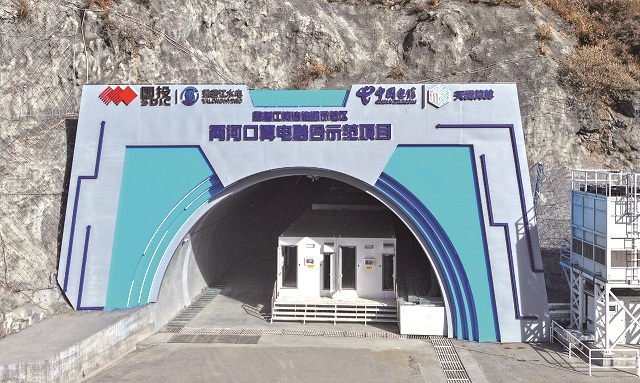
全国首个高海拔岩洞式算力舱智算中心——雅砻江两河口算电融合示范项目投运
Xin Hua She· 2025-12-19 12:26
Core Insights - The project marks the launch of China's first high-altitude rock cavern computing power integration center, located in the Yalong River Basin, Sichuan Province, with a total investment of approximately 350 million yuan [1][3] - The project consists of six computing power cabins, providing a peak computing power of about 600 PFLOPS, aimed at exploring new pathways for the development of "green electricity + computing power" [1][3] - The project will utilize domestic computing chips and aims to build an AI innovation platform for applications such as weather forecasting and operational maintenance [3] Group 1 - The project is a collaboration between State Investment Group Yalong River Hydropower Development Co., Ltd. and China Telecom Sichuan Branch [1] - It is designed to leverage the stable geological structure of the hydropower station's rock cavern, providing a safe and reliable operating environment for computing equipment [3] - The project aims to achieve a "zero-carbon computing power" supply by relying on clean energy and forming a stable energy supply system that meets the computing center's year-round 100% reliable power demand [3] Group 2 - As a representative project for green zero-carbon computing power integration in Sichuan Province, it will further promote the "East Data West Computing" initiative and contribute to the high-quality development of the digital economy in the region [4]