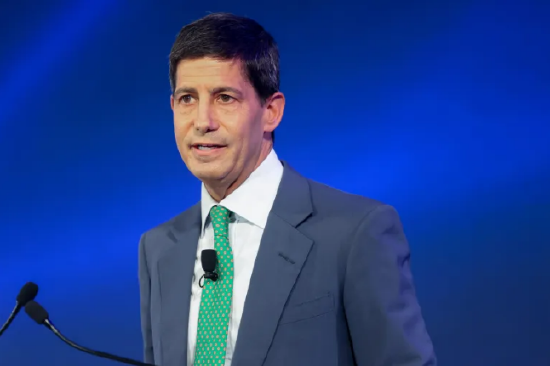
缩减美联储资产负债表

Search documents
1公斤金条卖断货,顾客不问价就出手,有门店已排队!分析师提醒
Sou Hu Cai Jing· 2026-02-20 06:53
Group 1 - The core viewpoint of the article highlights the ongoing consumer enthusiasm for gold purchases during the Spring Festival, despite fluctuations in gold prices [1][20]. - Lao Pu Gold announced a price adjustment for its products, set to take effect on February 28, 2026, with the specifics of the adjustment yet to be determined [3][5]. - The company employs a pricing strategy of "fixed price + periodic adjustments," differing from traditional gold stores, and has previously raised prices three times in 2025 [5][9]. Group 2 - Several gold brands, including Chow Sang Sang and Chow Tai Fook, have adjusted their "fixed price" products this year, with some price increases ranging from 15% to 30% [9]. - In Shanghai, gold jewelry sales have been robust during the Spring Festival, with long queues observed at stores, particularly from tourists [18][20]. - Beijing's Cai Bai Hall, known as "China's first gold store," reported a surge in sales of large gold bars, with 1000-gram investment bars selling out [20][22]. Group 3 - As of February 18, gold prices showed a slight increase, with spot gold at approximately $4914.64 per ounce, reflecting a 0.78% rise [22]. - Market expectations suggest that the Federal Reserve may begin to lower interest rates in June, influencing gold and silver prices positively [21][24]. - Analysts note that while gold is considered a safe-haven asset, it is still subject to price volatility, particularly in light of changing Federal Reserve policies [24].


黄金白银,调整!知名品牌,调价!
Sou Hu Cai Jing· 2026-02-20 06:04
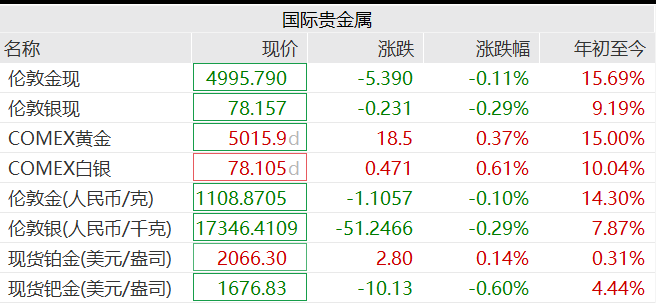
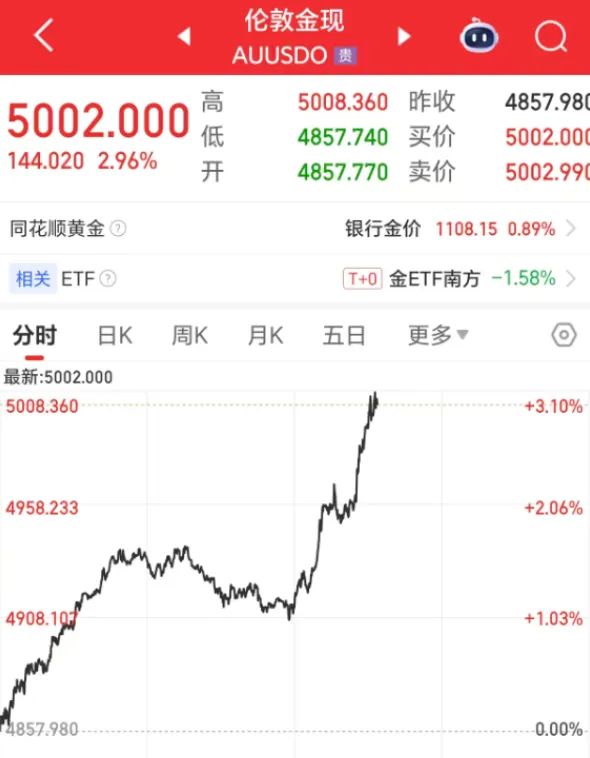
Group 1 - On February 19, spot gold reached $5000 per ounce, with a daily increase of 0.48%, but faced resistance due to cooling expectations of Federal Reserve rate cuts and profit-taking by investors, leading to downward price pressure [1] - As of February 20, spot gold was priced at $4995.790, down 0.11% year-to-date, while COMEX gold was at $5015.9, reflecting a year-to-date increase of 15.00% [1] - HSBC's chief precious metals analyst noted that gold's status as a safe-haven asset does not prevent price volatility, with market fluctuations expected to be a key feature of the precious metals market by 2026 [2] Group 2 - Goldman Sachs projected that central bank gold purchases and increased exposure from private investors due to Federal Reserve rate cuts could gradually raise gold prices to $5400 per ounce by the end of 2026 [2] - The old gold brand announced a price increase starting February 28, 2026, with a strategy of "fixed price + regular adjustments," differing from traditional pricing models [5] - Various gold brands have already adjusted their "fixed price" products this year, with some price increases ranging from 15% to 30%, particularly in high-end gold jewelry [5] Group 3 - There has been a significant consumer response to the anticipated price increase, with long queues forming at old gold stores as customers aim to purchase before the price adjustment [5][26] - As of February 20, the stock price of old gold fell to 762 HKD per share, a decline of over 3% [26] - The Hang Seng Index Company announced an adjustment to its index components, with old gold being added to the Hang Seng Index, effective March 9 [28]
金价,直线飙涨!有人不问价直接出手
Sou Hu Cai Jing· 2026-02-19 12:17
Core Viewpoint - Gold and silver prices are experiencing a technical rebound after significant declines, supported by market anticipation of the Federal Reserve's monetary policy direction and ongoing geopolitical tensions [1][2]. Group 1: Market Trends - The CME FedWatch Tool indicates a high probability that the Federal Reserve will begin interest rate cuts in June [2]. - Despite gold prices reaching historical highs, consumer demand remains strong, with notable purchases during the Spring Festival period [2][4]. - The price of gold in retail settings is reported at 1528 CNY per gram for 24K gold, with larger gold bars, particularly 1000 grams, seeing high sales volume [4]. Group 2: Investment Insights - Analysts suggest that the expectation of a rate cut by the Federal Reserve may be tempered, leading to resistance for gold prices around the $5000 mark [4]. - HSBC's chief precious metals analyst notes that gold, while considered a safe-haven asset, is still subject to price volatility, with market fluctuations expected to be a significant feature in 2026 [4]. - The next Federal Reserve Chair, Kevin Warsh, has indicated that reducing the Fed's balance sheet could negatively impact international gold prices, emphasizing the need for the Fed to maintain its professional independence [4].

金价大涨!有商场1000克金条卖断货,“顾客不问价直接出手”,专家严肃提醒
Qi Lu Wan Bao· 2026-02-19 04:52
Group 1 - The core viewpoint of the articles indicates that international precious metal prices, particularly gold, have seen a significant increase, with spot gold surpassing $5000 per ounce, reflecting a daily increase of over 2.5% [1][3] - Market expectations suggest that the Federal Reserve is likely to begin interest rate cuts in June, which has contributed to the rebound in gold and silver prices after a significant decline [3] - There is a notable increase in consumer demand for gold, with reports of high sales of large gold bars, particularly around the Chinese New Year, indicating strong market interest despite high prices [4][6] Group 2 - Current prices for gold and silver are reported, with London spot gold at $4914.64 per ounce, up 0.78%, and silver at $75.807 per ounce, up 3.15% [3] - The demand for large gold bars, especially 1000-gram investment bars, has surged, with reports of these items selling out in stores, highlighting a trend towards gifting and investment in gold [6] - Analysts caution that despite the current bullish sentiment, there are ongoing bearish influences, particularly related to the Federal Reserve's monetary policy and potential market volatility in the precious metals sector [7]
缩表撞上财政扩张,沃什的白宫蜜月注定短暂?
Hua Er Jie Jian Wen· 2026-02-04 15:17
Core Viewpoint - Kevin Walsh's nomination as Federal Reserve Chair aligns with the White House's short-term interest rate cut demands, but his policy framework conflicts with the administration's expansionary fiscal agenda [1] Group 1: Interest Rate Policy - Walsh's support for interest rate cuts is based on optimistic productivity growth predictions, which are uncertain in the current economic context [2] - The anticipated productivity shock may not translate into a definitive deflationary trend, and could lead to increased demand, putting upward pressure on the natural interest rate [2] - Lowering rates based solely on expectations before inflation declines could create a dilemma for the Federal Reserve, especially with low unemployment and steady economic growth [2] Group 2: Data Dependency Dilemma - Walsh questions the Federal Reserve's reliance on lagging and often revised data indicators, complicating his policy proposals [3] - He lacks a clear alternative decision-making framework, relying instead on intuitive judgments about potential inflation trends, which may not convince market investors [3] - His past criticisms of colleagues may hinder his ability to unify the committee, potentially leading to a minority vote in favor of rate cuts during his first policy meeting [3] Group 3: Balance Sheet Strategy Constraints - Walsh criticizes the Federal Reserve's past quantitative easing for encouraging excessive government borrowing, which has led to a higher and flatter yield curve [4] - Reducing the balance sheet to guide interest rates lower faces significant operational constraints, requiring a phased approach to avoid market disruptions [4] - He suggests a new agreement with the Treasury to redefine the central bank's role within traditional monetary policy limits, though this may conflict with the administration's fiscal goals [5] Group 4: Independence Principle Conflict - Walsh emphasizes the importance of central bank independence, which is at odds with the current administration's stance [6] - A well-functioning and independent Federal Reserve could meet the President's short-term rate cut demands, but economic data misalignment could complicate this goal [6] - If Walsh cannot lead the committee towards decisions aligned with presidential expectations early on, his leadership may face immediate scrutiny [6]
特朗普提名凯文·沃什接任美联储主席 历史数据显示新任主席上任后标普500平均回撤最高达16%
Sou Hu Cai Jing· 2026-02-03 03:15
Core Viewpoint - The nomination of Kevin Walsh as the next Federal Reserve Chairman by President Trump may lead to increased market volatility, as historical transitions in leadership have often resulted in significant fluctuations in the U.S. stock market [1][2]. Group 1: Historical Context - Historical data shows that new Federal Reserve Chairmen often coincide with market turbulence, with the S&P 500 index experiencing average declines of 5%, 12%, and 16% in the first month, three months, and six months following their appointment, respectively [1]. - Notable past transitions include Powell's appointment in February 2018, which led to a market drop due to rising inflation expectations, and Bernanke's tenure beginning in 2006, which saw significant sell-offs due to concerns over interest rate hikes [1]. Group 2: Kevin Walsh's Profile and Market Reaction - Kevin Walsh, known for his hawkish stance during his tenure as a Federal Reserve Governor from 2006 to 2011, has recently advocated for interest rate cuts, aligning with President Trump's views, which has raised speculation about potential rapid balance sheet reduction under his leadership [2]. - Following the announcement of Walsh's nomination, U.S. stock markets declined, and precious metal prices experienced significant volatility, indicating market perception of Walsh as the least dovish candidate among the potential nominees [2]. Group 3: Current Economic Context - The Federal Reserve's monetary policy is currently constrained by high inflation and signs of a cooling job market, making the leadership change potentially heighten uncertainty regarding future monetary policy directions [2]. - Analysts suggest that Walsh's reputation as a hawkish figure may lead to a reduction in liquidity from the financial system, which could negatively impact risk assets [2].
美元上涨,受特朗普提名沃什为美联储主席提振
Ge Long Hui· 2026-02-02 08:12
Core Viewpoint - The nomination of Kevin Warsh as the Federal Reserve Chairman by Trump has led to a strengthening of the US dollar, with indications that Warsh may favor reducing the Fed's balance sheet in the coming years if inflation remains persistent [1] Group 1: Economic Impact - The US dollar index increased by 0.1%, reaching 97.108 points, and previously hit a one-week high of 97.298 [1] Group 2: Influencing Factors - Other factors influencing the diversified trading of the US dollar include Trump's policies, increased tariff threats, and the demand for asset allocation from other countries [1]
一文详解|下一任美联储主席沃什的政策倾向
Xin Lang Cai Jing· 2026-01-30 15:05
Core Viewpoint - The appointment of Kevin Warsh as the new Federal Reserve Chairman by President Trump is seen as an opportunity to implement more control over interest rate policy, reflecting Warsh's critical stance towards the Fed and his advocacy for monetary policy reform [2][10]. Group 1: Appointment and Market Reaction - Warsh's nomination follows a lengthy selection process and is expected to influence interest rate policies, with markets reacting positively by pushing global stock prices higher and the dollar up, while gold prices fell sharply [2][10]. - Trump's announcement of Warsh's nomination via social media indicates his intent to imprint his vision on the Federal Reserve, having previously criticized the Fed for not lowering borrowing costs as he desired [2][10]. Group 2: Senate Confirmation Challenges - Warsh's nomination requires Senate confirmation, but there are significant political divisions, particularly from Republican Senator Thom Tillis, who has stated he will oppose any Fed nominee until the Department of Justice's investigation into Powell is resolved [3][11]. - The Senate Banking Committee, which holds a Republican majority, may face a deadlock if Tillis maintains his position, as all Democrats are likely to oppose Warsh's nomination [3][11]. Group 3: Warsh's Background and Views - Warsh, a former Fed governor, is known for his close ties to Trump and has been a vocal critic of the Fed's policies, advocating for significant reforms including reducing the Fed's balance sheet and easing bank regulations [5][14]. - His experience includes a background in Wall Street and a role as a key liaison during the 2007-2009 financial crisis, which positions him as a knowledgeable figure in financial matters [7][16]. Group 4: Potential Impact on Monetary Policy - Warsh's leadership is anticipated to shift the Fed's focus towards its core statutory responsibilities, with an emphasis on reforming its monetary policy management [12][14]. - The immediate impact on interest rates remains uncertain, but the Fed's current stance indicates a pause in rate hikes, with expectations of potential rate cuts in the future [6][15].