
货币主导

Search documents
下一轮金融危机,会由沃什引爆吗?
华尔街见闻· 2026-02-04 11:56
Core Viewpoint - The article discusses the potential implications of Kevin Warsh's appointment as the next Federal Reserve Chairman, questioning whether he will adopt a hawkish stance on inflation or align with political pressures from Trump [2][3][5]. Group 1: Warsh's Background and Views - Martin Wolf highlights Warsh's past statements and recent shifts in his positions to gauge future monetary policy directions [4]. - Warsh is characterized as a strong advocate for hard currency, expressing concerns about the Fed's credibility and independence in his 2010 speech [7][8]. - He emphasized that the Fed's independence should only apply to monetary policy, not regulatory or consumer protection roles [9]. Group 2: Critique of Current Fed Policies - In a 2025 speech, Warsh criticized the Fed for failing to maintain price stability and contributing to explosive federal spending [11][12]. - He warned against the dangers of fiscal dominance, where the central bank becomes the ultimate arbiter of fiscal policy, which he views as a significant risk [12]. Group 3: Political Dynamics and Implications - The article raises questions about Trump's choice of Warsh, suggesting that Trump may appreciate Warsh's critical stance on the Fed's expansionary policies [14]. - Wolf notes that Warsh's recent conclusion that inflation is no longer a threat represents a significant shift from his earlier views during the 2010 recession [15]. Group 4: Potential Risks and Consequences - Wolf warns that Warsh's leadership could lead to another financial crisis due to the inherent contradictions in policy, such as fiscal expansion coupled with attempts to maintain monetary discipline [24]. - The article concludes that the market requires a Fed Chair who can resist political pressures, contrasting Warsh with the current chair, Powell, who has demonstrated independence [26].


下一轮金融危机,会由沃什引爆吗?
Hua Er Jie Jian Wen· 2026-02-04 07:52
Core Viewpoint - The article discusses the potential implications of Kevin Warsh's appointment as the next Federal Reserve Chair, questioning whether he will adopt a hawkish stance on inflation or align with political pressures from Trump [1][2]. Group 1: Warsh's Economic Philosophy - Warsh is characterized as a typical "hard currency" central banker, emphasizing the importance of the Federal Reserve's independence and the dangers of excessive monetary policy intervention [3]. - In a 2010 speech, Warsh outlined four key points regarding the Fed's responsibilities, including the need to resist becoming the ultimate rescuer and the importance of maintaining a reputation for historical significance rather than political expediency [3]. - His recent criticisms of the Fed's performance suggest a continuity of his hardline stance, particularly regarding the need for price stability and the dangers of fiscal dominance over monetary policy [4]. Group 2: Political Dynamics and Implications - The article raises concerns about Warsh's potential to act as a political tool, shifting his stance on monetary policy based on the ruling party, which could lead to unpredictable economic risks [2]. - Trump's choice of Warsh, despite his own fiscal dominance, suggests a complex relationship where Warsh's criticisms of the Fed's expansion may align with Trump's agenda [5][6]. - The potential for Warsh to adopt a more lenient view on inflation due to technological advancements raises questions about the risks associated with such a shift, especially given the current economic context of high fiscal deficits [6]. Group 3: Risks and Future Outlook - Concerns persist regarding Warsh's willingness to defend Trump's policies, which may lead to a scenario where fiscal expansion and deregulation undermine monetary discipline, potentially sowing the seeds for a financial crisis [8]. - The article warns that the combination of short-term political considerations and long-term economic stability could heighten systemic risks within the financial system [9]. - The need for a Federal Reserve Chair who can resist political pressures is emphasized, with the current chair, Powell, being recognized for his ability to maintain independence [9].
沃什执掌美联储,市场的风向变了
凤凰网财经· 2026-02-02 15:01
Group 1 - The core viewpoint of the article highlights the shift in financial market focus from interest rate trends to the Federal Reserve's balance sheet, which stands at $6.6 trillion, following Trump's nomination of Kevin Warsh as the next Fed Chair [1] - Warsh is a strong critic of the Fed's expanded balance sheet and his return may signify the end of the quantitative easing (QE) era, advocating for a reduction in the Fed's direct market interventions [3] - The article discusses the potential challenges of aggressively shrinking the Fed's balance sheet, noting historical instances where such actions led to market volatility and increased borrowing costs [4] Group 2 - Warsh's policy approach suggests a transition from interest rate management to a strategy of "balance sheet reduction for rate cuts," aiming to create a low-interest environment without distorting market mechanisms [3] - The market is expected to remain highly sensitive until Warsh clarifies his policy agenda, with potential significant adjustments to the existing banking regulatory framework if he pursues a return to a "scarce reserves" era [5] - The article emphasizes that the current government is actively purchasing $20 billion in mortgage-backed securities to lower market costs, which may conflict with Warsh's proposed policies [4]
沃什被提名后,华尔街不再盯着降息,6.6万亿的“大包袱”才是风暴眼
Jin Shi Shu Ju· 2026-02-02 00:46
Core Viewpoint - The nomination of Kevin Warsh as the next Federal Reserve Chair has shifted market focus from short-term interest rates to the Fed's $6.6 trillion balance sheet and its role in the market [1] Group 1: Warsh's Critique and Potential Actions - Warsh has been a vocal critic of the Fed's balance sheet expansion, suggesting he may quickly act to reduce asset size, which has led to speculation about rising long-term U.S. Treasury yields and a stronger dollar [1][2] - He believes the Fed has overstepped its bounds, aligning with Treasury Secretary Mnuchin's desire for reform, but acknowledges that significant changes could impact long-term rates and major markets crucial for global financial institutions [1][2] - Warsh's past support for quantitative easing (QE) has turned into criticism, leading to his resignation from the Fed due to dissatisfaction with ongoing asset purchases [2][4] Group 2: Implications for Government and Market - If the Fed withdraws, it may conflict with the government's goal of lowering long-term borrowing costs, potentially increasing pressure on the Treasury and other U.S. agencies to manage the market more actively [2] - Warsh's approach could lead to a tightening of financial conditions, allowing the Fed to cut benchmark rates significantly [2][4] - The need for a new Treasury-Fed agreement, similar to the 1951 accord, has been emphasized by Warsh to redefine the relationship between the Fed and the Treasury [5] Group 3: Market Sensitivity and Future Outlook - The financial market has shown sensitivity to even minor changes in liquidity, as evidenced by past instances where the Fed had to intervene to alleviate funding pressures [5][6] - Analysts suggest that there is some flexibility within the Fed's definition of "ample" reserves, which could allow for adjustments in asset purchases and financing costs [7][8] - The current framework makes it difficult to envision a shift in policy soon, but the addition of a more hawkish member to the Fed could suppress future asset purchases or reinvestment policies [8]
若沃什当选主席,美联储将“以降息换缩表”?
智通财经网· 2026-02-01 23:06
Core Viewpoint - The appointment of Kevin Warsh as the next Federal Reserve Chair has shifted the debate from short-term interest rates to the Fed's $6.6 trillion balance sheet, with expectations that he may take swift action to reduce asset size, impacting long-term interest rates and market dynamics [1][2]. Group 1: Warsh's Critique and Policy Implications - Warsh has been a vocal critic of the Fed's balance sheet expansion, suggesting that it has led to excessive risk-taking in financial markets and increased reliance on central bank support [4][5]. - He advocates for a new Treasury-Fed agreement to redefine their relationship, similar to the 1951 agreement, to clarify the Fed's balance sheet goals [4][5]. - If Warsh's policies are implemented, they could lead to a tightening of financial conditions, potentially allowing the Fed to lower benchmark interest rates further [2][4]. Group 2: Market Reactions and Challenges - The speculation around Warsh's potential actions has already led to an increase in long-term U.S. Treasury yields and a stronger dollar, while gold and silver prices have fallen [1]. - The challenge of managing the market increases as U.S. debt surpasses $30 trillion, with the need for the Treasury and other agencies to engage more in market management [2]. - The Fed's balance sheet, which has grown significantly since the financial crisis and during the COVID-19 pandemic, poses a challenge for Warsh if confirmed, as it is much larger than during his previous tenure [3][5]. Group 3: Financial Market Sensitivity - The financial markets are highly sensitive to liquidity changes, as evidenced by the 2019 funding pressures that led the Fed to intervene [7]. - Analysts suggest that the Fed's definition of "adequate" reserves may allow for some flexibility, but any significant reduction in the balance sheet could lead to increased borrowing costs and volatility [8][9]. - The current framework of "adequate" reserves is unlikely to change in the short term, but the addition of a more hawkish member like Warsh could influence future asset purchase policies [9].
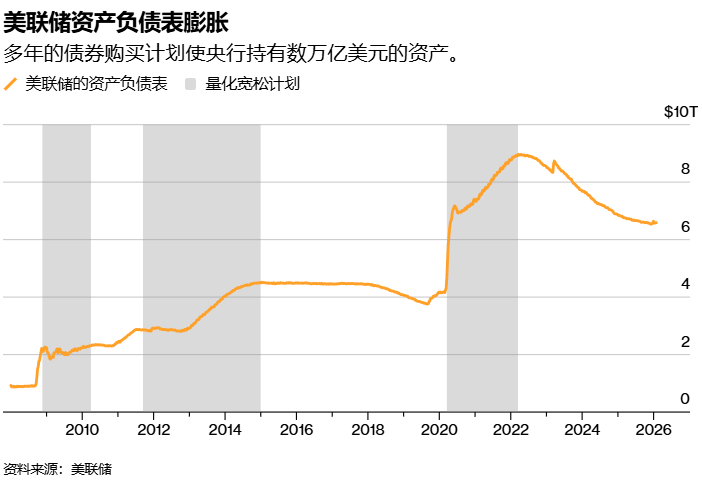
美联储新掌门终极挑战:6.6万亿美元”缩表炸弹“与白宫降息令的正面冲突
智通财经网· 2026-01-22 00:26
Core Viewpoint - The upcoming nomination of the next Federal Reserve Chair by President Trump raises critical questions about how to manage the central bank's $6.6 trillion balance sheet, particularly whether to continue purchasing government bonds or to withdraw liquidity from the financial system [1][2]. Group 1: Candidates and Their Views - Kevin Walsh is seen as the leading candidate for the Fed Chair position, advocating for a smaller balance sheet, contrasting with the current expansionary policy [2][3]. - Other candidates, such as Rick Reed from BlackRock and current Fed Governor Christopher Waller, have more moderate views, suggesting that the Fed should halt balance sheet reduction to maintain market stability [2][4]. - The next chair will need to navigate a sensitive money market that reacts sharply to changes in reserve conditions, as evidenced by the volatility in 2019 [2][3]. Group 2: Market Implications - The decision regarding the balance sheet will directly impact key markets, particularly the core areas where major financial institutions engage in interbank lending [2]. - Recent volatility in the financing market has led to increased demand for the Fed's standing repo facility, highlighting the challenges of reducing the balance sheet without causing instability [3][4]. - The market's reaction to fiscal risks and liquidity conditions is becoming increasingly sensitive, indicating that the new Fed Chair will face significant pressure from the White House to lower interest rates [6].