
彭博商品指数(BCOM)

Search documents
外部干扰落定!白银后市关注三方面变化
Qi Huo Ri Bao· 2026-01-19 00:02
Group 1 - The core viewpoint of the articles indicates that despite rumors of a decline in silver prices due to the Bloomberg Commodity Index (BCOM) rebalancing, silver prices have reached new highs due to changes in supply-demand dynamics and market perceptions [1][2][3] - As of January 16, silver prices in London reached $90.134 per ounce, with a weekly increase of 12.8%, and COMEX silver futures rose by 13.37%, while Shanghai silver futures surged by 22.83% [1] - The investment demand for silver remains strong, with non-commercial net long positions on COMEX increasing from 30,000 contracts in late December to 32,000 contracts by January 13 [1][2] Group 2 - The BCOM annual rebalancing period was strictly limited to January 8-14, 2026, indicating that the selling pressure was concentrated and not expected to have a long-term impact on prices [2] - The supply-demand imbalance, along with the shift in Federal Reserve monetary policy and significant capital inflows, is driving the current bull market in silver [2][3] - Global silver production fell to 820 million ounces in 2025, a 12% decrease from the peak in 2020, while recycled silver supply increased only slightly, failing to meet industrial demand [2] Group 3 - The rapid development of sectors such as photovoltaics, electric vehicles, AI infrastructure, and 5G communications has led to a new growth phase in silver consumption [3] - Experts predict that silver prices will likely remain high in Q1 2026, with the possibility of reaching new highs, although volatility is expected to increase due to various supporting factors [3][4] - The recent announcement by the U.S. government to refrain from imposing comprehensive tariffs on key minerals, including silver, suggests a potential short-term risk of price correction [3] Group 4 - The ongoing supply shortage of silver is expected to persist for a considerable time, providing significant advantages to bullish forces in the market [4] - Future silver trading should focus on whether previous bullish factors have been fully priced in, the impact of risk control measures on trading activity, and the escalation of global geopolitical tensions [4]


RadexMarkets瑞德克斯:指数调仓或引金银剧震
Xin Lang Cai Jing· 2026-01-09 11:42
Group 1 - Gold demonstrated strong resilience during trading on January 9, rebounding from an intraday low of $4,415 per ounce to close at $4,487, marking a daily increase of $20.80. This performance underscores the core role of safe-haven assets in a complex environment despite increasing global market uncertainties [1][3] - Silver futures faced more significant pressure during the same period, with prices dropping by $1.30, a decline of 1.67%, ultimately settling at $76.89. Silver had previously touched a low of $73.52 before a mild recovery alongside gold [4][5] - The divergence in the performance of gold and silver highlights a subtle shift in investor sentiment and reflects distinctly different fundamental drivers behind the two markets [5] Group 2 - RadexMarkets warns investors of potential volatility due to the Bloomberg Commodity Index (BCOM) annual rebalancing scheduled from January 9 to 15, which aims to accurately reflect the global commodity landscape based on last year's liquidity and production data. Historical trends indicate that rebalancing periods often lead to increased trading activity and short-term price dislocations [2][5] - The market is currently focused on the upcoming U.S. non-farm payroll report, with recent economic data showing that job openings in November fell to 7.7 million, below the expected 7.8 million, marking a 14-month low. This weak labor demand suggests a potential basis for the Federal Reserve to pursue further monetary easing [2][5] - Despite the U.S. dollar index rising by 1.23% over the past nine trading days, gold has managed to remain close to its historical high set on December 29. The decoupling of gold from its traditional negative correlation with the dollar signals significant market developments, indicating that geopolitical risks and strong central bank demand for gold are currently dominating pricing factors [3][6]

141亿美元砸盘预警!指数调仓杀到,金银或迎“机械性抛售”海啸
Xin Lang Cai Jing· 2026-01-08 02:55
Core Viewpoint - The Bloomberg Commodity Index (BCOM) is undergoing a significant rebalancing, with a large scale of fund flows expected from January 4 to January 14, following the principle of "sell winners, buy losers" due to the performance disparity between precious metals and oil [2][10]. Fund Flow Breakdown - The rebalancing will involve approximately 20% of daily trading operations, with a notable focus on selling precious metals and buying underperforming commodities [2][10]. - Precious metals are expected to face over $14 billion in nominal selling pressure, with silver alone facing up to $7.1 billion and gold $7 billion in sell orders [4][6][14]. Market Insights - Analysts from Scotiabank and other banks suggest that despite the anticipated selling pressure on gold and silver, fundamental factors may still support their prices, advising investors to consider buying on price dips caused by these fund flows [4][5][12]. - The energy market is highlighted as having significant potential, particularly natural gas, which is expected to transition from being heavily sold to a net buying commodity due to a 23% price drop since early December [15]. Specific Commodity Insights - Cocoa is experiencing a notable influx of buying funds, with 56% of its open contracts affected, indicating potential volatility in this market [16]. - Brent crude oil is projected to see a net inflow of $3.6 billion, while WTI crude oil is expected to see $2.4 billion, reflecting a shift in investor sentiment towards energy commodities [7][19].
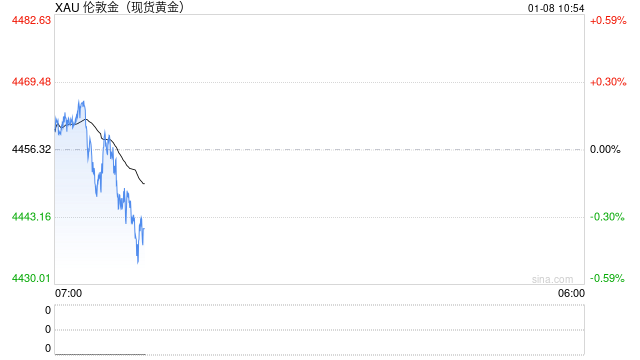
技术性超买引发回调,全球股市涨势暂歇,纳指期货跌0.2%,贵金属全线重挫,油价承压
Hua Er Jie Jian Wen· 2026-01-07 08:37
Core Market Trends - Asian stock markets have entered a "technically overbought" zone, leading to a pause in the upward trend driven by the AI boom and expectations of Federal Reserve rate cuts [1] - U.S. stock index futures showed mixed results, while European markets opened with varied performance [2] - Precious metals experienced significant declines, with gold, silver, and palladium all dropping, and oil prices also under pressure [1][2] Commodity Market Adjustments - The Bloomberg Commodity Index (BCOM) is set for annual weight rebalancing from January 8 to 14, which is expected to trigger substantial passive fund reallocations [1][4] - The anticipated sell-off due to this rebalancing is projected to account for 9% of total silver holdings and 3% of total gold holdings, creating significant downward pressure on prices [1][4] Precious Metals Impact - The adjustment is causing notable selling pressure in the precious metals sector, particularly for silver, which faces a sell-off equivalent to 9% of its total holdings [4] - This "non-fundamental" selling triggered by index rules is forcing speculative funds to exit before the event, exacerbating short-term price volatility [4] Oil Market Developments - The announcement by the Venezuelan government to deliver 30 to 50 million barrels of oil to the U.S. has raised concerns about increased supply, contributing to a decline in WTI crude oil prices [9] - Goldman Sachs analysts noted that while short-term supply prospects are uncertain, a potential recovery in Venezuelan oil production could exert significant downward pressure on global oil prices in the long term [9]

贵金属集体跳水!关键大宗商品指数再平衡明日开启
Hua Er Jie Jian Wen· 2026-01-07 06:04
Group 1 - Spot gold has fallen below $4,450 per ounce, with spot silver dropping over 3%, spot platinum declining more than 7%, and spot palladium decreasing over 5% [1] - The Bloomberg Commodity Index (BCOM) is set for an annual weight rebalancing in January 2026, which will force passive funds to execute "technical selling" [1] - The expected futures selling pressure is projected to account for 9% of total silver holdings and 3% of total gold holdings [1]
重要指数 即将调整!金银会跌吗?
Zhong Guo Zheng Quan Bao· 2026-01-05 15:21
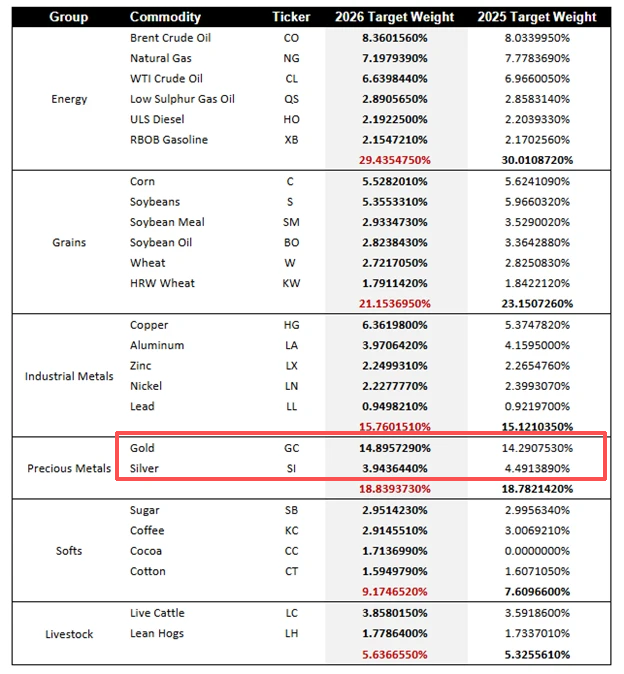
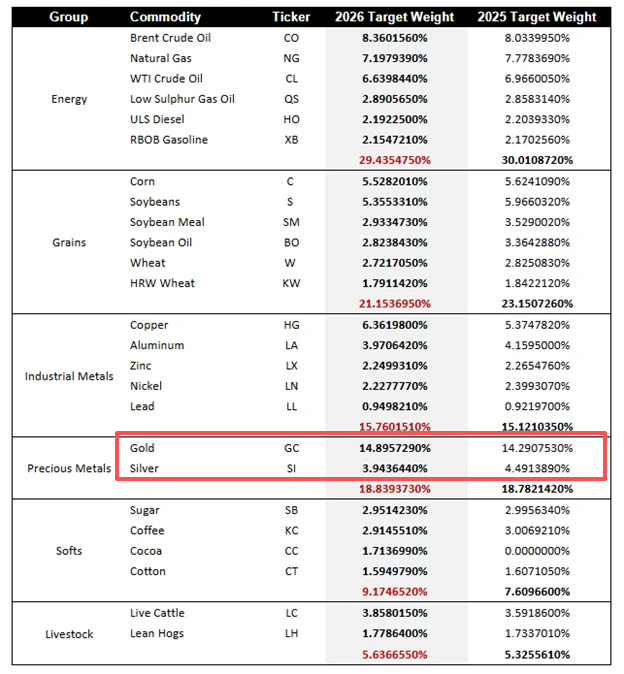
Core Viewpoint - The upcoming adjustment to the Bloomberg Commodity Index (BCOM) is expected to create short-term selling pressure on precious metals, particularly gold and silver, but is unlikely to alter the long-term market dynamics for these commodities [1][4]. Group 1: Index Adjustment Impact - The target weight for precious metals in the BCOM will be adjusted to 18.84%, with gold's target weight increasing from 14.29% to 14.90% and silver's decreasing from 4.49% to 3.94% [2]. - The actual weights of gold and silver in the index have significantly exceeded their target allocations, with gold's weight dropping from 20.7% to 14.9% and silver's from 8.3% to 3.9% due to price increases anticipated in 2025 [2]. Group 2: Market Reactions and Analyst Insights - Analysts predict that passive funds will need to sell gold and silver futures to realign with the new target weights, leading to short-term price fluctuations primarily in early to mid-January [4]. - The overall impact of this adjustment is considered limited, as the announcement was made well in advance, and the market may have already priced in the potential selling pressure [4]. - The fundamental drivers of the precious metals market, such as geopolitical risks and macroeconomic changes, are expected to remain strong despite the technical adjustments [4][5]. Group 3: Investment Strategies - Analysts recommend focusing on the long-term fundamentals that drive the market, suggesting that investors should consider increasing their positions in gold during this period of price pressure [5]. - The rising geopolitical uncertainties are expected to support gold's resilience and safe-haven attributes, with recommendations to overweight gold in investment portfolios [5]. - There is an expectation that historical price peaks for gold and silver may not have been reached yet, with potential for significant price increases in the coming years, particularly for silver around the Lunar New Year [5].
重要指数,即将调整!金银会跌吗?
Zhong Guo Zheng Quan Bao· 2026-01-05 12:18
Core Viewpoint - The recent adjustment to the Bloomberg Commodity Index (BCOM) is expected to create short-term selling pressure on precious metals, particularly gold and silver, but it is unlikely to alter the long-term dynamics of the precious metals market [1][4]. Group 1: Index Adjustment Impact - The target weight for precious metals in the BCOM will be adjusted to 18.84%, with gold's target weight increasing from 14.29% to 14.90% and silver's decreasing from 4.49% to 3.94% [2]. - The actual weights of gold and silver in the index have significantly exceeded their target allocations, with gold's actual weight dropping from 20.7% to 14.9% and silver's from 8.3% to 3.9% due to price increases anticipated in 2025 [2]. Group 2: Market Reactions and Analyst Insights - Passive funds tracking the index will need to sell gold and silver futures to realign with target allocations, leading to expected selling pressure primarily in early to mid-January [4]. - Analysts believe that while this adjustment may cause short-term price fluctuations, it will not change the underlying fundamental forces driving the precious metals market, such as geopolitical risks and macroeconomic factors [4][5]. Group 3: Investment Strategies - Analysts recommend focusing on long-term market fundamentals rather than short-term adjustments, suggesting that investors should consider increasing their positions in gold and silver during this price pressure [5]. - The ongoing geopolitical uncertainties and central bank purchases of gold are expected to support long-term gold prices, with predictions of potential new highs for silver prices around the Lunar New Year [5].
2026开年第一炸,遇上第一劫
Xin Lang Cai Jing· 2026-01-04 07:40
Group 1: Venezuela's Economic Decline - Venezuela has transitioned from a prosperous nation to one of the most severe economic downturns globally, with 86% of its population living in poverty and a GDP contraction exceeding 70% since 1999 [1][3] - The country experienced hyperinflation, peaking at 10 million percent in 2019, leading to a situation where citizens used money as toilet paper rather than for purchases [3] Group 2: Geopolitical Implications - The U.S. has engaged in aggressive actions in Venezuela, viewing it as a strategic move in a broader geopolitical game, particularly concerning oil and resources [2][7] - The U.S. has signaled a new Monroe Doctrine, indicating that its interests in the Western Hemisphere will not be limited to Venezuela alone, suggesting a potential escalation in regional conflicts [8] Group 3: Commodity Market Reactions - The recent geopolitical tensions are expected to impact commodity markets, particularly gold and silver, with significant sell-offs anticipated due to rebalancing in the Bloomberg Commodity Index [10][12] - Analysts predict substantial sell-offs in precious metals, estimating around $3.8 billion in total for gold and silver due to market adjustments [11][12]
华泰期货:白银黄金强震荡,需做好仓位控制
Xin Lang Cai Jing· 2025-12-31 02:00
Core Viewpoint - Precious metal prices have experienced a significant pullback, with the main contract for gold (沪金2602) closing at 984.84 CNY per gram, down 3.11%, and silver (沪银2602) at 18,140 CNY per kilogram, down 3.96% [2][7]. Price Adjustment - The recent adjustment in precious metal prices has been previously indicated, particularly for silver, which has seen a rise exceeding fundamental pricing logic since December, driven by tight spot supply and low inventory levels [2][8]. - The market is facing bearish factors, including a slowdown in the Federal Reserve's easing pace expected in 2026, stable U.S. economic data, and rising raw material prices potentially leading to inflationary pressures that may suppress the likelihood of unexpected easing by the Fed [2][8]. Index Weight Adjustment - The Bloomberg Commodity Index (BCOM) will undergo an annual weight adjustment starting January 8, 2026. Due to the strong performance of gold and silver over the past three years, their weights in the index have significantly exceeded target levels, which may create short-term bearish pressure on gold and silver prices [2][8]. Market Outlook - The long-term logic of gold as a substitute for dollar assets remains fundamentally unchanged, maintaining an optimistic view on gold [2][8]. - Silver prices have shown strength due to spot shortages, reaching historical highs, but the price volatility necessitates careful position management and strict stop-loss execution, with caution advised against profit-taking risks during high-level fluctuations [2][8].

有色金属ETF(512400)连续4日获资金净流入,机构:短期扰动不改贵金属中长期配置逻辑
Xin Lang Cai Jing· 2025-12-30 02:28
Group 1 - The core viewpoint of the news highlights the performance and market dynamics of the non-ferrous metal ETF (512400), which has seen a trading volume of 6.91 billion yuan and a turnover rate of 3.46% as of December 30, 2025 [1] - The non-ferrous metal ETF has experienced a net inflow of 15.54 billion yuan over the last four days, indicating strong investor interest [1] - The Bloomberg Commodity Index (BCOM) rebalancing in 2026 may lead to short-term technical disturbances in precious metals, particularly affecting silver due to its weaker liquidity [1] Group 2 - The non-ferrous metal ETF (512400) closely tracks the Zhongzheng Shenwan Non-Ferrous Metal Index, which consists of 50 listed companies in the non-ferrous metal and non-metal materials sectors from the Shanghai and Shenzhen markets [2] - The top ten weighted stocks in the index include Zijin Mining, Luoyang Molybdenum, Northern Rare Earth, Huayou Cobalt, China Aluminum, Ganfeng Lithium, Shandong Gold, Zhongjin Gold, Tianqi Lithium, and Chifeng Gold [2]