贸易限制措施

Search documents
十六张图看2026年出口
Yin He Zheng Quan· 2026-02-01 12:00
Group 1: Export Growth and Economic Outlook - China's export growth is projected to be 5.4% in 2026, slightly down from 5.5% in 2025, driven by resilient export competitiveness and market diversification[1] - Global economic growth is forecasted to be between 2.6% and 3.3% in 2026, a slight decline from 2025, indicating a fragile recovery[2] - Leading indicators suggest that China's exports will remain strong in the first half of 2026, despite external demand uncertainties[2] Group 2: Global Trade Environment - The number of global trade restrictions has reached a historical high from 2020 to 2025, reversing decades of trade liberalization trends[2] - In 2026, while the intensity of the "tariff war" may ease, targeted restrictions are expected to proliferate, such as the EU's carbon border adjustment mechanism and the U.S. imposing a 25% tariff on specific semiconductors[2][10] - Global merchandise trade volume showed a monthly average growth rate of 4.4% as of November 2025, a significant rebound from 0.9% in 2023[2][16] Group 3: China's Supply Chain Dominance - China accounted for 14.6% of global exports and 28% of global manufacturing GDP in 2024, indicating its dominant position in the global supply chain[3][23] - From 2019 to 2024, China captured 28.9% of the new export markets in the fastest-growing sectors, significantly higher than its overall export share[4][25] - China's export competitiveness in high-tech products, such as semiconductors and industrial robots, has improved, with its share in global robot exports rising from 11.3% in 2017 to nearly parity with Germany by 2024[5][27] Group 4: Export Market Diversification - In 2025, China's export share to the U.S. decreased by 3.5 percentage points, while shares to ASEAN and the EU increased by 1.2 and 0.4 percentage points, respectively[5][30] - Direct investment in Belt and Road countries surged from 5.4% in 2024 to 18.4% in the first eleven months of 2025, enhancing China's international standards and technology influence[5][30] - Despite trade tensions, China's trade surplus with other economies has increased, indicating a stable position in global supply chains[5][31]
2026年初美最高法院或就特朗普关税宣判,市场准备好了吗?
Di Yi Cai Jing· 2025-12-31 09:19
Core Viewpoint - The U.S. Supreme Court is expected to rule on the legality of tariffs imposed by the Trump administration under the International Emergency Economic Powers Act (IEEPA) by January 2026, creating uncertainty around Trump's economic policies and tariffs [1][5][11]. Group 1: Legal Context and Implications - The IEEPA allows the President to impose trade restrictions during a national emergency, which has been a basis for various tariffs since Trump's second term [3][4]. - The Supreme Court's expedited handling of the case suggests a decision will be made relatively soon, with expectations of a ruling by early 2026 [1][5]. - Regardless of the Supreme Court's decision, the Trump administration may utilize other legal frameworks to maintain tariffs, such as the Trade Expansion Act and the Trade Act of 1974 [6][7][8]. Group 2: Potential Legal Strategies - If the Supreme Court rules against the government, the Trump administration may resort to broader applications of the Trade Expansion Act's Section 232, which has been used for tariffs on various goods [7][9]. - The administration could also invoke Section 301 of the Trade Act of 1974 to investigate trade practices of other countries, including Brazil [8][9]. - Other legal provisions, such as Section 122 and Section 338 of the Tariff Act of 1930, may also be considered for imposing tariffs [10]. Group 3: Economic and Market Reactions - A ruling against the Trump administration could significantly limit its ability to use tariffs as a tool for trade negotiations, potentially leading to a need for justification for any future tariff implementations [11]. - If the government loses, it may have to refund a substantial portion of the $195 billion in tariffs collected, raising concerns about fiscal deficits and increased borrowing [11][12]. - The market has reacted to the uncertainty surrounding the Supreme Court's decision, with notable fluctuations in U.S. Treasury yields following the court's hearings [13].

WTO:与AI相关商品贸易措施“限制数量”逐年增加
Di Yi Cai Jing· 2025-11-13 11:51
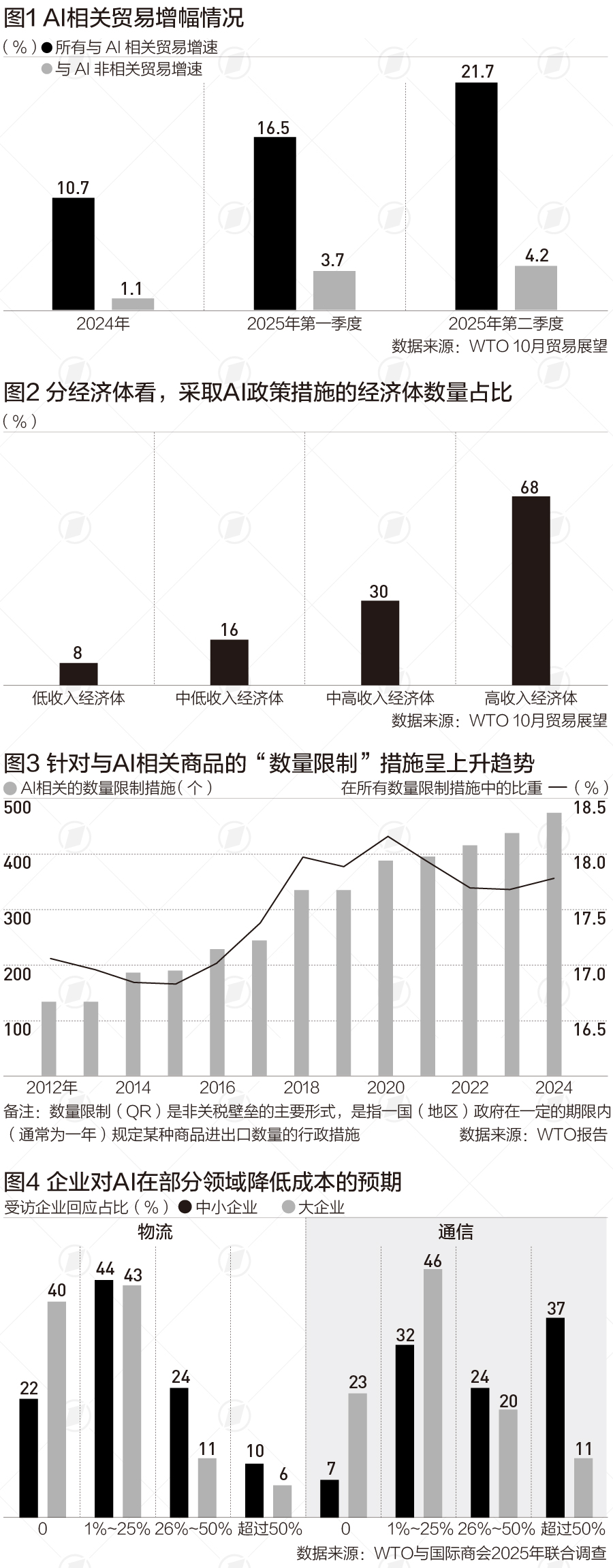
Core Insights - The rapid development of artificial intelligence (AI) is expected to significantly reshape global trade, with projections indicating that AI could drive global service trade growth by nearly 40% and global GDP growth by 12% to 13% by 2040 [1][12]. Group 1: AI and Trade Growth - AI-related goods trade reached $2.9 trillion in 2022 but slightly decreased to $2.3 trillion in 2023, with a notable increase in imports driven by intermediate goods such as computer components [2]. - The trade growth of AI-related goods was robust in the first half of 2025, with a year-on-year increase of 20%, despite AI goods accounting for less than 10% of total global goods trade [2][3]. - The majority of AI-related trade growth is concentrated in Asia, which accounted for nearly two-thirds of the total growth in AI-related trade in the first half of 2025 [3]. Group 2: Cost Reduction and Efficiency - AI is recognized as a crucial catalyst for trade-driven growth, optimizing supply chains, automating customs clearance, and reducing language barriers, thereby lowering trade costs [11]. - A joint survey by WTO and ICC revealed that 70% of businesses expect AI to reduce trade costs, with small and medium-sized enterprises (SMEs) being more optimistic than larger firms [11]. - In logistics, compliance, and communication, a significant percentage of SMEs anticipate substantial cost reductions due to AI, with 44% expecting at least a 25% reduction in logistics costs [11]. Group 3: Trade Policy and Digital Divide - The report highlights an increase in non-tariff measures, particularly quantity restrictions on AI-related goods, which are projected to reach nearly 500 by 2024 [15]. - There is a notable digital divide, with low-income economies lagging in internet access and AI application, as over 26 billion people globally remain unconnected, primarily in developing regions [15][16]. - To bridge the digital divide, international cooperation is deemed essential, with WTO planning to expand the scope of the Information Technology Agreement and promote data rule coordination [16].
下一个被美国加税的“热门对象”:铂族金属
Hua Er Jie Jian Wen· 2025-10-22 04:18
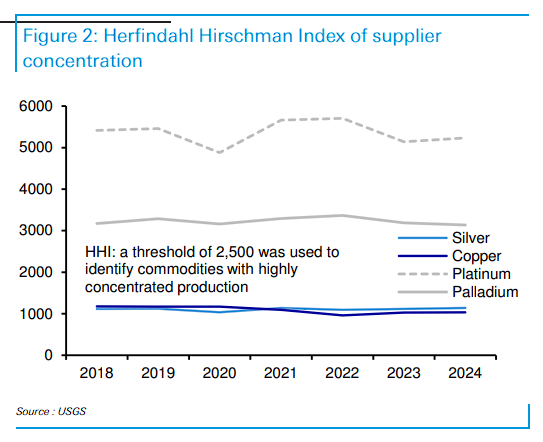
Core Insights - The U.S. is considering significant adjustments to its critical minerals policy, with platinum group metals facing a notable risk of tariffs under Section 232 due to supply chain concentration and geopolitical risks [1][12] Group 1: Policy and Regulatory Developments - The U.S. Department of Commerce is overdue in submitting a critical minerals report that will assess the national security implications of imports, including platinum and palladium [1] - The report is linked to Executive Order 14272 and is expected to evaluate the impact of key mineral imports on national security [1] - The U.S. International Trade Commission's preliminary ruling on anti-dumping for Russian palladium was due on October 20, indicating dual policy risks for palladium [1] Group 2: Market Dynamics and Supply Chain - Potential trade restrictions could exacerbate existing supply tightness in the white precious metals market, with leasing rates for platinum group metals currently above normal levels [2] - Industrial users are experiencing rising operational costs, prompting some to shift from ownership to leasing of metals [2] - Umicore's decision to sell its long-held gold inventory in favor of leasing highlights the market pressure [2] Group 3: Risk Assessment of Platinum Group Metals - According to Deutsche Bank's policy risk scorecard, platinum and palladium exhibit high risk across several dimensions, including global supply concentration and import dependency [5][7] - The Herfindahl-Hirschman Index (HHI) for platinum is 5230 and for palladium is 3137, indicating a high concentration risk [5] - Platinum's net import reliance is 85%, significantly exceeding the 50% threshold for high dependency [7] Group 4: Supply Capability and Geopolitical Risks - South Africa, the primary supplier of platinum, has a risk score of 81, while Russia, the main supplier of palladium, has a score of 90, both categorized as high risk [10] - The U.S. imports nearly 50% of its platinum from South Africa and a similar proportion of palladium from Russia, highlighting the geopolitical vulnerabilities in the supply chain [12] Group 5: Strategic Policy Tools - The U.S. has adopted non-tariff strategies for rare earth elements, contrasting with the current administration's support for tariffs as a tool to stimulate domestic manufacturing [11] - The Department of Defense has established partnerships and funding frameworks to support critical mineral projects, emphasizing flexible financial support over tariffs [11] - The rapid timeline of policy actions seen in copper could be mirrored in the case of platinum group metals, with significant tariff risks looming [12]
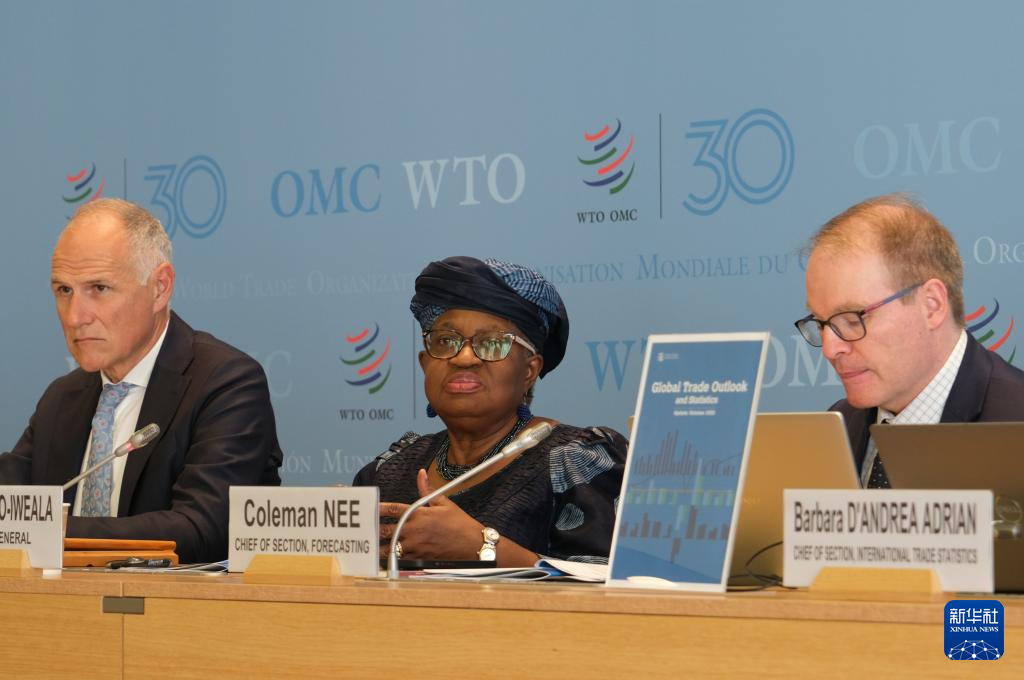
世贸组织大幅下调2026年全球货物贸易增长预期
Xin Hua Wang· 2025-10-07 21:51
Group 1 - The World Trade Organization (WTO) has significantly lowered the global goods trade growth forecast for 2026 to 0.5%, down from the previous prediction of 1.8% made in August [1] - The report indicates that the slowdown in goods trade will also indirectly impact service trade, with global service export growth expected to decline from 6.8% in 2024 to 4.6% in 2025, and further to 4.4% in 2026 [1] - Trade restrictions and policy uncertainties are spreading across more economies and industries, posing major downside risks to global trade [4] Group 2 - Despite the challenges posed by unilateral tariff measures and trade policy uncertainties, the global trade system shows resilience, supported by the stability provided by the multilateral trade system and appropriate responses from members to tariff changes [4] - The WTO has revised the global goods trade growth forecast for 2025 upward to 2.4%, from the previous estimate of 0.9% made in August [6] - In the first half of 2025, global goods trade volume is expected to grow by 4.9% year-on-year, with the dollar value of global goods trade increasing by 6%, driven by factors such as increased imports in North America to avoid high tariffs, improved macroeconomic conditions, and a surge in demand for AI-related products [6]
态度趋于强硬,印度就汽车关税问题挑战美国
Hua Er Jie Jian Wen· 2025-06-04 11:55
Core Viewpoint - India has formally challenged the U.S. automotive tariffs at the World Trade Organization (WTO), indicating a tougher trade stance amid ongoing bilateral trade negotiations with the U.S. [1][3] Group 1: Trade Challenge - India has submitted a complaint to the WTO, claiming that the 25% tariffs on imported passenger cars, light trucks, and certain auto parts constitute "safeguard measures" that adversely affect its exporters [1][6] - The timing of India's challenge coincides with a visit from the U.S. trade team to New Delhi, aimed at advancing bilateral trade discussions [3][6] Group 2: U.S. Tariff Policy - The U.S. has labeled India's tariffs as "very unfair and high," and recently increased tariffs on steel and aluminum products from 25% to 50%, effective June 4, 2025 [3][6] - Following the announcement of the increased tariffs, Indian stock markets saw a slight uptick, with the NIFTY and SENSEX indices rising approximately 0.3% [3] Group 3: India's Trade Negotiation Strategy - India has proposed a "zero-for-zero" tariff arrangement for specific goods, including steel, auto parts, and pharmaceuticals, based on reciprocity and limited to a certain quantity of imports [3][6] - The complaint reserves all rights under the WTO agreements, allowing India to suspend equivalent trade concessions to the U.S. if no agreement is reached within 30 days of consultations [7]