
钢材库存

Search documents
钢材周报2026/3/9:成本端的未雨绸缪-20260312
Zi Jin Tian Feng Qi Huo· 2026-03-12 09:13
1. Report Industry Investment Rating - Not provided in the content 2. Core Viewpoints of the Report - The steel market is generally strong. Last week, the futures market fluctuated upward. Due to geopolitical factors overseas, the market has strong expectations for future energy prices. Coal may be a strong substitute for crude oil, but geopolitical conflicts also have an impact on steel exports. In the short term, hot metal production decreased significantly, while the total output of five major steel products increased slightly week-on-week, and inventory accumulated. The apparent demand increased seasonally. There is a divergence between hot metal and steel mill production data, mainly due to production cuts by some long-process steel mills in the north. Rebar production increased and inventory accumulated, while hot-rolled coil production decreased and inventory accumulated. In the short term, the fundamentals of rebar are stronger than those of hot-rolled coil. The profits of long-process steel mills in the spot market have recovered, while the valley electricity profits of short-process steel mills have declined slightly. The price difference between scrap iron and steel has widened, and the profit margin of the futures market has narrowed. Raw materials are stronger than steel products. In terms of strategies, investors can consider shorting the spread between hot-rolled coil and rebar when prices are high [3]. - The rebar month spread is neutral. The 5 - 10 month spread of rebar is -27 yuan/ton, which has strengthened slightly week-on-week [3]. - Steel mill profits are strong. This week, the profitability rate of 247 steel enterprises is 38.1%, which has decreased slightly week-on-week and is still significantly lower than the same period last year [3][13]. - Scrap steel is strong. According to calculations, current flat electricity production of electric arc furnaces in East China results in a loss of 142 yuan/ton, and valley electricity production results in a loss of 38 yuan/ton [3]. - The inventory of steel products is neutral. The overall inventory of five major steel products has accumulated seasonally [3]. 3. Summary by Relevant Catalogs 3.1 Market Review - As of March 6, 2026, the daily average pig iron output was 227.59 tons, a significant week-on-week decline of 5.69 tons, lower than the same period last year. The blast furnace operating rate of 247 domestic steel enterprises was 77.71%, a significant week-on-week decline; the capacity utilization rate of 85 electric arc furnaces was 20.71%, a significant week-on-week increase [13]. - This week, the total output of five major steel products was 797.24 tons, an increase of 0.47 tons from last week. Among them, rebar production was 173.31 tons, an increase of 8.21 tons from last week; hot-rolled coil production was 301.11 tons, a significant week-on-week decline of 8.5 tons. The production of cold-rolled and medium-thick plates was significantly higher than the historical average [20]. - In terms of demand, the total consumption of five major steel products this week was 691.35 tons, a seasonal increase week-on-week. Rebar consumption was 98.23 tons, a slight week-on-week increase; hot-rolled coil consumption was 281.6 tons, a slight week-on-week decline [41]. - After the Spring Festival, spot trading volume has increased seasonally, but overall it is lower than the same period last year. Attention should be paid to the subsequent recovery [60]. - This week, the billet inventory of 55 billet-rolling mills was 59.7 tons, a significant week-on-week increase, approaching the same period last year. The mainstream warehouse billet inventory was 247.57 tons, a significant week-on-week increase, reaching a record high [76]. 3.2 Valuation - Rebar warehouse receipts increased slightly but are still significantly lower than the same period last year. Hot-rolled coil warehouse receipts increased significantly week-on-week, reaching a high level for the same period in history [109]. 3.3 Balance Sheet - The report provides a monthly balance sheet for crude steel from July 2025 to July 2026, including data such as initial steel mill and social inventory, pig iron and crude steel production, imports and exports, total consumption, production-demand balance, ending steel mill and social inventory, surplus, year-on-year production and consumption growth, and cumulative year-on-year production and consumption growth [110].
螺纹热卷日报-20260309
Yin He Qi Huo· 2026-03-09 15:18
1. Report Industry Investment Rating - Not provided in the document 2. Core Viewpoints of the Report - Steel prices rose today. The black sector as a whole surged in the morning, with coking coal hitting the daily limit, but the market pulled back in the afternoon. Spot steel transactions were generally favorable, with active spot and futures purchases and improved rigid demand. The basis narrowed. Last week, the output of the five major steel products increased slightly, with an increase in rebar output and a shift to increased hot-rolled coil output. Steel mills were still in the mode of shutdown and maintenance. After the Spring Festival, downstream demand recovered seasonally, but inventories continued to accumulate rapidly, especially for rebar, and inventory shifted from mill warehouses to social warehouses. Last week, the capital availability of downstream construction sites across the country improved, with better capital availability for housing construction projects than non-real estate projects. The "Two Sessions" announced this year's economic growth target, with the GDP growth rate lower than last year, and the other targets remaining the same as in 2025. Since capital expenditure in the first quarter may fall short of expectations, the demand recovery situation remains to be seen. The pessimistic expectations of steel mills may also limit the height of hot metal production this year, putting pressure on raw materials. However, overseas geopolitical frictions have increased, and the oil price has soared due to the impact of the Strait of Hormuz, driving up global energy prices in the short term and raising the cost of steel raw materials. Therefore, steel prices are likely to remain volatile and slightly stronger in the near term, but there is still a chance for steel prices to return to fundamentals in March, and pressure on steel prices remains. Follow-up attention should be paid to hot metal production, downstream demand performance, and overseas geopolitical frictions [6] 3. Summary by Relevant Catalogs 3.1 Market Information 3.1.1 Rebar - **Futures**: RB05 rose 31 yuan to 3088 yuan/ton, RB10 rose 32 yuan to 3147 yuan/ton, and RB01 rose 33 yuan to 3174 yuan/ton. The spreads between different contracts also changed. The 05 contract rebar disk profit decreased by 10 yuan to -151 yuan/ton, the 10 contract decreased by 6 yuan to -108 yuan/ton, and the 01 contract decreased by 9 yuan to -99 yuan/ton [2] - **Spot**: The prices of rebar in different regions increased to varying degrees. The cheapest deliverable was 3190 yuan/ton, and the basis for different contracts also changed. The regional spreads and spot profits also showed different trends [2] 3.1.2 Hot-rolled Coil - **Futures**: HC05 rose 40 yuan to 3270 yuan/ton, HC10 rose 38 yuan to 3282 yuan/ton, and HC01 rose 28 yuan to 3291 yuan/ton. The spreads between different contracts changed. The 05 contract hot-rolled coil disk profit decreased by 1 yuan to 0 yuan/ton, the 10 contract remained unchanged at 27 yuan/ton, and the 01 contract decreased by 14 yuan to 18 yuan/ton [2] - **Spot**: The prices of hot-rolled coils in different regions increased. The cheapest deliverable was 3260 yuan/ton, and the basis for different contracts also changed. The regional spreads and spot profits also showed different trends [2] 3.2 Market Analysis 3.2.1 Relevant Prices - The spot price of Shanghai Zhongtian rebar was 3190 yuan (+30), Beijing Jingye was 3130 yuan (+30), Shanghai Angang hot-rolled coil was 3260 yuan (+30), and Tianjin Hegang hot-rolled coil was 3180 yuan (+40) [5] 3.2.2 Trading Strategies - **Options**: It is recommended to wait and see [7] - **Unilateral**: Follow overseas sentiment and maintain a volatile and slightly stronger trend [9] - **Arbitrage**: It is recommended to short the hot-rolled coil to coking coal ratio at high levels and continue to hold the short position of the hot-rolled coil to rebar spread [9] 3.2.3 Important Information - In February 2026, the national consumer price index increased by 1.3% year-on-year and 1.0% month-on-month. The average consumer price from January to February increased by 0.8% compared with the same period last year [8][10] - In February 2026, the national industrial producer price index decreased by 0.9% year-on-year, with the decline narrowing by 0.5 percentage points compared with the previous month, and increased by 0.4% month-on-month. The average industrial producer price from January to February decreased by 1.2% compared with the same period last year [10] 3.3 Related Attachments - Multiple charts are provided, including the price trends, basis, spreads, and disk profits of rebar and hot-rolled coils, as well as the cash profits of different steel products and the cost of electric furnaces [15][17][20]
基本面边际改善,旺季钢价或企稳:2026年3月钢材月报-20260302
Bao Cheng Qi Huo· 2026-03-02 02:19
Group 1: Report Industry Investment Rating - No relevant content provided Group 2: Core Viewpoints of the Report - In February, steel prices fluctuated weakly due to the accumulation of industrial contradictions in the steel market during the holiday and the return of the trading logic to the industrial end [4][11][126] - Steel inventories continued to accumulate, with significant increases in all varieties but varying growth rates. Construction steel inventories had the most obvious increase, while plate inventories were also at the highest level in the same lunar period in recent years [4][24][28] - During the Spring Festival, the production of long - and short - process steel mills differed. Short - process steel mills' shutdown led to a decline in construction steel production, while long - process steel mills maintained stable production, and plate supply increased steadily. After the festival, short - process steel mills will resume production, but the probability of a significant increase in production is not high [4][49][57] - Steel demand continued to weaken, with all varieties experiencing a decline in demand but varying amplitudes. After the festival, steel demand will improve marginally, and there will be differences in performance between varieties. Infrastructure investment is expected to be optimistic, bringing an increase in construction steel demand, but the real estate fundamentals are weak. Plate demand still has concerns [4][72][126] - Although the industrial contradictions in the steel market during the holiday have accumulated and steel prices are still prone to pressure, the downstream demand is recovering, the steel market fundamentals will improve marginally, and with the fermentation of policy expectations, steel prices may stabilize and rebound in the peak season [5][13][127] Group 3: Summary According to the Directory 1. Steel prices fluctuated weakly in February - Due to the holiday, the industrial contradictions in the steel market accumulated, the trading logic returned to the industrial end, and steel prices were under pressure. As of February 27, the futures prices of rebar and hot - rolled coil main contracts decreased by 1.95% and 2.22% respectively compared with the end of last month, and the spot prices also declined [11] - In February, steel - related price differences changed. The basis strengthened, the futures price curve remained in a contango pattern but with a lower premium than in previous years, the spread between hot - rolled coil and rebar shrank, and the regional spread of building materials returned to normal [12] - Looking forward, steel prices are still under pressure due to accumulated contradictions, but they are at a relatively low level. As demand recovers and policy expectations are strong, steel prices may stabilize and rebound in the peak season [13] 2. Steel inventories increased significantly - As of the week of February 27, the total inventory of the five major steel products increased by 44.40% month - on - month and 10.47% year - on - year. Construction steel and plate inventories both increased, with construction steel having a more significant increase [24][28] - Both steel social and factory inventories increased. Social inventory increased by 45.47% month - on - month, and factory inventory increased by 41.93% month - on - month [29] - Rebar inventory increased significantly during the holiday, and the de - stocking pressure increased. The total rebar inventory increased by 68.36% month - on - month, and the inventory - to - sales ratio was at a relatively high level. The social inventory of rebar had obvious regional differentiation [36][37] - Hot - rolled coil inventory remained high, and the pressure needed to be relieved. The total hot - rolled coil inventory increased by 27.16% month - on - month and year - on - year, and the inventories of its main downstream products also increased significantly [45] 3. Steel supply increased steadily - In 2026, steel mill production was relatively stable, and steel supply increased steadily. The daily average crude steel production of key steel enterprises in January increased significantly compared with the previous month but was still lower than the same period last year [49] - High - frequency data showed that steel mill production was stable, and supply increased steadily, with obvious differences between varieties. Due to the shutdown of short - process steel mills during the holiday, the output of construction steel decreased, while the output of plates increased steadily [52][56] - Steel mill profitability did not improve. The proportion of profitable steel mills was relatively low, and the profitability of different regions was also differentiated. After the festival, short - process steel mills will resume production, but the probability of a significant increase in production is not high [57] - Rebar production was low during the holiday but is expected to increase after the festival, and the supply pressure may increase. Hot - rolled coil production remained high, and the supply pressure needed to be relieved [62][67] 4. Steel demand improved marginally 4.1 High - frequency indicators showed seasonal weakness - Due to the holiday, steel demand weakened, and high - frequency indicators showed a seasonal decline. In February, the total steel demand decreased by 18.90% month - on - month and 11.66% year - on - year. The demand for construction steel decreased more significantly [72] - Rebar demand will improve marginally, but the performance of downstream industries varies, and the quality of peak - season demand needs further observation. Hot - rolled coil demand was weak and stable, and there were still concerns about demand [78][85] 4.2 Steel exports faced challenges - In 2025, China's steel exports were strong. In December, the export volume reached a monthly record high, and the annual export volume also refreshed the record. The export of some varieties showed significant growth, and the export destinations were also differentiated [92][93][95] - In 2026, although there is still arbitrage momentum for direct steel exports, the output impulse may face more policy restrictions, and there is a risk of a decline in direct exports [95] 4.3 The domestic economy showed resilience - In January 2026, the core CPI showed a "good start" sign of inflation, and the PPI was supported by input factors, but the manufacturing PMI declined, and the "good start" of credit was not satisfactory [100][101][103] - In the real estate market, sales were under pressure year - on - year, and the improvement of real estate enterprise funds was limited, but positive policies were continuously introduced, and the downward drag effect may weaken. Infrastructure investment is expected to be optimistic, and there may be an inflection point in the industry, which may bring an increase in steel demand [104][108][118] 5. Conclusion - The industrial contradictions in the steel market accumulated during the holiday, and steel prices fluctuated weakly in February. Steel inventories increased significantly, supply was stable with variety differentiation, and demand continued to weaken but will improve marginally after the festival [126] - Although steel prices are still under pressure, with the recovery of demand and the fermentation of policy expectations, steel prices may stabilize and rebound in the peak season, and attention should be paid to demand performance and domestic policies [127]
螺纹热卷日报-20260224
Yin He Qi Huo· 2026-02-24 10:19
1. Report Industry Investment Rating No relevant information provided. 2. Core View of the Report - Today, the steel futures market declined overall, and the spot prices decreased slightly compared to before the holiday. During the holiday, the overall production of the five major steel products increased, and the impact on hot metal production was small. The total steel inventory increased at an accelerated pace, but the inventory accumulation rate of rebar was slower than in previous years. The export of steel was affected by the decline in export licenses, and the overseas manufacturing industry ended the restocking process. The inventory of hot-rolled coils accumulated rapidly, and the current inventory levels of billets and plates were high, with great demand pressure. The performance of rebar was stronger than that of hot-rolled coils. The raw material replenishment of steel mills before the holiday has ended, and the enthusiasm for winter storage this year was insufficient. Currently, the steel inventory is high, and the capital expenditure after the holiday may fall short of expectations. The demand recovery situation remains to be seen. The pessimistic expectations of steel mills may also limit the height of hot metal production this year, putting pressure on raw materials. However, the current absolute price of steel is low, and even if it falls, the space is relatively limited. Overall, it may maintain a weak and volatile trend [5]. 3. Summary by Relevant Catalogs Market Information - Spot prices: Shanghai Zhongtian rebar was priced at 3,180 yuan (-10), Beijing Jingye rebar at 3,110 yuan (-10), Shanghai Angang hot-rolled coil at 3,220 yuan (-20), and Tianjin Hegang hot-rolled coil at 3,130 yuan (-10) [4]. Market Research and Judgment Trading Strategy - Unilateral: Maintain a weak and volatile trend before the holiday [6]. - Arbitrage: It is recommended to short the hot-rolled coil to coking coal ratio at high levels, and continue to hold the short position of the hot-rolled coil to rebar spread [6]. - Options: It is recommended to wait and see [7]. Important Information - On February 20, 2026, US President Trump signed an announcement, stipulating that a 10% import tax would be imposed on imported goods within 150 days. The temporary import tariff would take effect at 00:01 on February 24, 2026. On February 21, Trump raised the import tariff rate on global goods from 10% to 15% [8]. - On February 24, 2026, the price of common billet resources of Songting Iron and Steel in Qian'an, Tangshan decreased by 10, and the ex-factory price was 2,880 yuan including tax [9]. Relevant Attachments - The report provides multiple charts, including the basis of rebar and hot-rolled coil contracts in different months, the price difference between different contracts, the spread between hot-rolled coil and rebar, the disk profit of rebar and hot-rolled coil contracts, the cash profit of different steel products, the cost of electric furnaces, etc. The data sources are Galaxy Futures, Mysteel, and Wind [14][16][18].
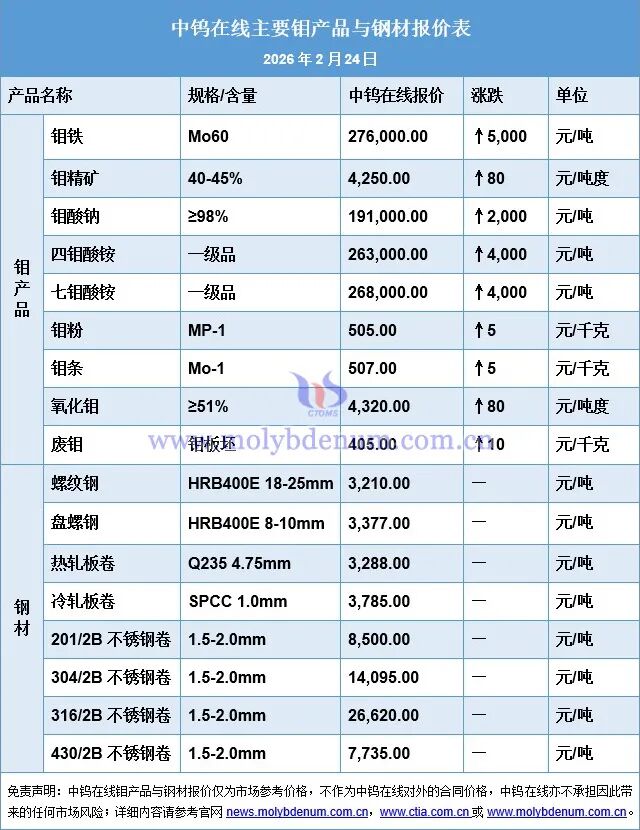
钼价格|钼市开门红!钼精矿价格涨80元
Xin Lang Cai Jing· 2026-02-24 05:10
Group 1: Molybdenum Market Overview - The domestic molybdenum market experienced a positive start after the holiday, with most product prices significantly increasing. Molybdenum concentrate prices rose by approximately 80 yuan/ton, molybdenum iron prices increased by about 5,000 yuan/ton, and molybdenum powder prices went up by around 5 yuan/kg [1][4]. - Key factors influencing the molybdenum market include a reduction in molybdenum product imports during the Spring Festival and a decrease in production from domestic manufacturers, both contributing to rising prices. Additionally, international molybdenum prices fluctuated significantly during the holiday period [1][4]. Group 2: Steel Inventory Data - According to the China Iron and Steel Association, the steel inventory of key statistical steel enterprises reached 15.11 million tons in early February 2026, an increase of 400,000 tons (2.7%) compared to the previous period, and a rise of 970,000 tons (6.9%) since the beginning of the year [2][5]. - Year-on-year comparisons show a decrease of 1.1 million tons (6.8%) compared to the same period last year, and a reduction of 1.02 million tons (6.3%) compared to two years ago. Regionally, steel inventories increased in Northeast (350,000 tons), Northwest (40,000 tons), Southwest (30,000 tons), and Central South (240,000 tons) regions, while inventories decreased in North China (160,000 tons) and East China (110,000 tons) [2][6].

节后黑色观点综述-20260224
Chang Jiang Qi Huo· 2026-02-24 02:50
1. Report Industry Investment Rating - No relevant content provided 2. Core View of the Report - After the holiday, steel prices are expected to fluctuate weakly; iron ore prices face certain downward pressure; coking coal and coke prices are expected to fluctuate; and glass prices will continue to fluctuate weakly with increased post - holiday volatility [1][2][3] 3. Summary by Variety Steel - During the long holiday, the price of Tangshan Qian'an common billet remained stable at 2,900 yuan/ton. The US tariff policy first cut 20% and then added 15%, reducing the tariff burden on Chinese goods exported to the US, but the US will still maintain high tariff barriers on the steel industry. The futures price of rebar has fallen below the cost of electric furnace off - peak electricity and long - process production, with a low static valuation. In the short term, the domestic market is in a policy vacuum, and overseas tariff policies have limited boosting effects. After the holiday, focus on the increase in steel inventories and the progress of demand recovery. Steel prices are expected to fluctuate weakly [1] Iron Ore - During the long holiday, the Singapore Exchange iron ore swap fell slightly, with the main contract down 1.39% compared to the pre - holiday domestic closing period. Before the holiday, the daily average pig iron output rose to 230,490 tons, and port iron ore inventories are at a historical high, while steel mills' iron ore inventories have been replenished to normal levels in recent years. The post - holiday trading core lies in steel demand, which will affect the resumption of production by steel mills and the iron ore shipping situation. Iron ore prices are expected to face downward pressure [2][3] Coking Coal and Coke - During the Spring Festival, the de - stocking efficiency of imported coking coal spot resources was average, and the prices of forward Australian and Canadian coking coal declined due to the contraction of overseas demand before the year. The customs clearance of Mongolian coal was suspended during the Spring Festival, and the port coking coal inventory was digested but remained at a high level. After the holiday, steel mills and coking plants will mainly digest their in - plant inventories. The prices of coking coal and coke are expected to fluctuate [3] Glass - Before the holiday, some small production lines were cold - repaired and shut down, with the daily melting volume falling below 150,000 tons. The upstream manufacturers' inventories accumulated rapidly, and the downstream demand will be temporarily sluggish after the holiday. There are risks such as the expected large - scale cold repair of production lines and the impact of Hubei's environmental protection policy on supply. Although there is still pressure on glass prices, the futures price has fallen to a relatively low level. The 05 main contract is expected to fluctuate weakly with increased post - holiday volatility [3]
中钢协:2月上旬重点统计钢企钢材库存量1511万吨
Xin Lang Cai Jing· 2026-02-14 09:15
Core Viewpoint - The steel inventory of key statistical steel enterprises in China increased by 400,000 tons, representing a growth of 2.7% compared to the previous ten days [1] Group 1: Inventory Data - As of early February 2026, the steel inventory reached 15.11 million tons [1] - The inventory increased by 970,000 tons, showing a growth of 6.9% since the beginning of the year [1] - Compared to the same period last month, the inventory rose by 70,000 tons, which is a 0.5% increase [1] Group 2: Year-on-Year Comparison - The inventory decreased by 1.1 million tons compared to the same period last year, reflecting a decline of 6.8% [1] - Compared to the same period two years ago, the inventory also saw a reduction of 1.02 million tons, which is a decrease of 6.3% [1]
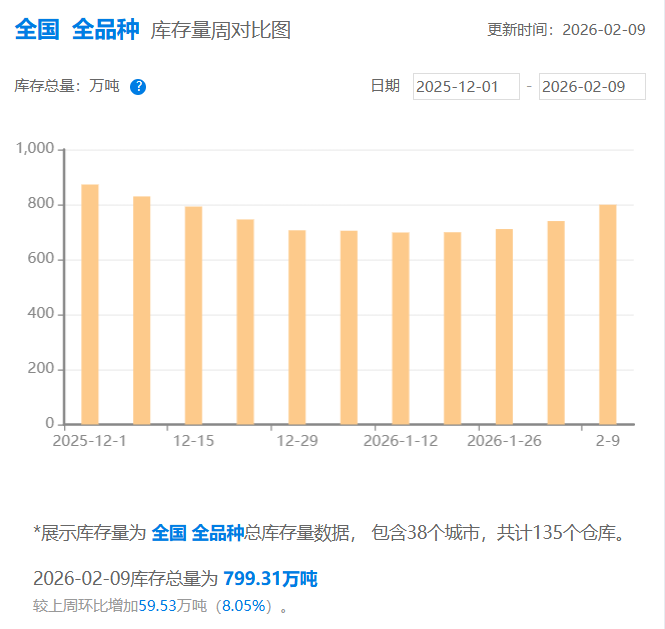
钢银电商:本周全国城市钢材库存环比增加59.53万吨 建筑钢材库存增超13%
Xin Hua Cai Jing· 2026-02-09 00:04
Group 1 - The total inventory of steel in 38 cities across the country reached 7.9931 million tons as of February 9, with an increase of 595,300 tons week-on-week, representing a growth of 8.05% [1] - The total inventory of construction steel amounted to 3.8190 million tons, increasing by 444,500 tons (+13.17%) compared to the previous week [1] - Hot-rolled coil inventory totaled 2.2381 million tons, with a week-on-week increase of 129,800 tons (+6.16%) [1] Group 2 - Medium and heavy plate inventory reached 748,000 tons, up by 18,000 tons (+2.47%) from the previous week [1] - Cold-rolled and coated inventory stood at 1.1880 million tons, with a slight increase of 3,000 tons (+0.25%) week-on-week [1]
钢材:下游需求停摆,节前弱势震荡
Yin He Qi Huo· 2026-02-06 08:48
1. Report Industry Investment Rating No information provided in the content. 2. Core Viewpoints - The overall fundamentals of steel have weakened marginally. Currently, the five major steel products are reducing production, but hot metal production is still increasing. Steel mills are entering the holiday shutdown and maintenance mode. Steel inventory is accumulating at an accelerated pace, with rebar inventory accumulating faster than hot - rolled coil, and the overall social inventory pressure is greater than that of the mill inventory. The demand for building materials has declined rapidly due to cold weather and construction site shutdowns, and the demand for hot - rolled coils has also decreased due to factors such as a decline in export licenses and the end of the restocking phase in overseas manufacturing. It is expected that steel prices will continue to fluctuate following macro - economic sentiment before the holiday. However, the high steel inventory, potential lower - than - expected post - holiday capital expenditure, and the pessimistic expectations of steel mills may limit the increase in hot metal production this year and put pressure on raw materials [7]. - The trading strategies suggest that the steel market will maintain a weak and volatile trend. For arbitrage, it is recommended to short the spread between hot - rolled coil and rebar at high prices and continue to hold the short position of the ratio of hot - rolled coil to coking coal. For options, it is advisable to wait and see [9]. 3. Summary by Chapters Chapter 1: Steel Market Summary and Outlook Summary - **Supply**: This week, the small - sample production of rebar was 191.68 tons (a decrease of 8.15 tons), and that of hot - rolled coil was 309.16 tons (a decrease of 0.05 tons). The daily average hot metal output of 247 steel mills was 228.58 tons (an increase of 0.6 tons), and the capacity utilization rate of 49 independent electric arc furnace steel mills was 16.9% (a decrease of 15.8%). The cost of electric arc furnaces has increased, leading to a decline in profits and a significant drop in capacity utilization. Long - process steel mills are still profitable, but the enthusiasm for increasing production is limited [4]. - **Demand**: The apparent demand for small - sample rebar was 147.64 tons (a decrease of 28.76 tons), and that for hot - rolled coil was 305.54 tons (a decrease of 5.87 tons). The demand for building materials has decreased due to cold weather and construction site shutdowns. The demand for hot - rolled coils has also declined as overseas manufacturing enters the off - season. The investment in domestic fixed assets has a lack of incremental projects, and the real estate market is still in a downward trend. The manufacturing PMI in January showed a decline, and the production and sales data of some industries such as automobiles and white goods also showed different trends [4]. - **Inventory**: Rebar inventory increased by 44.04 tons (4.52 tons in mill inventory and 39.52 tons in social inventory), hot - rolled coil inventory increased by 3.62 tons (1.50 tons in mill inventory and 2.12 tons in social inventory), and the total inventory of the five major steel products increased by 59.24 tons [4]. - **Outlook**: It is expected that steel prices will maintain a volatile trend following macro - economic sentiment before the holiday. However, the high inventory, potential lower - than - expected post - holiday capital expenditure, and the pessimistic expectations of steel mills may limit the increase in hot metal production this year and put pressure on raw materials. Attention should be paid to the resumption rhythm of coal mines, hot metal production, downstream demand performance, overseas tariffs, and domestic macro and industrial policies [7]. - **Trading Strategies**: The steel market will maintain a weak and volatile trend. For arbitrage, short the spread between hot - rolled coil and rebar at high prices and continue to hold the short position of the ratio of hot - rolled coil to coking coal. For options, wait and see [9]. Chapter 2: Price and Profit Review Summary - **Spot Prices**: On Friday, the aggregated price of rebar in Shanghai was 3220 yuan (a decrease of 30 yuan), and in Beijing was 3130 yuan (a decrease of 20 yuan). The price of hot - rolled coil in Shanghai was 3250 yuan (a decrease of 20 yuan), and in Tianjin (Hebei Steel) was 3160 yuan (a decrease of 20 yuan) [13]. - **Profit**: The flat - rate electricity profit of electric arc furnaces in East China was - 234.68 yuan (a decrease of 83 yuan), and the off - peak electricity profit was - 70 yuan (a decrease of 83 yuan). The long - process steel mills still had profits, but the short - process steel mills' profits were under pressure [32]. Chapter 3: Important Domestic and International Macroeconomic Data Summary - **International**: The US ISM manufacturing PMI in January reached 52.6, a new high since August 2022. The eurozone's CPI in January increased by only 1.7% year - on - year, the lowest since September 2024, and the core CPI dropped to 2.2%, the lowest since October 2021. Indonesia plans to cut coal production and may impose export tariffs in 2026 [34]. - **Domestic**: In December, the new social financing was 22075 billion yuan, a year - on - year decrease of 22.64%. The new RMB loans were 9100 billion yuan. The investment in fixed assets from January to December 2025 decreased by 3.80% year - on - year, with a significant decline in real estate, infrastructure, and manufacturing investment. The real estate market data such as new construction, completion, and sales still showed negative growth, and the willingness of residents to buy houses was insufficient [41]. Chapter 4: Steel Supply, Demand, and Inventory Situation Summary - **Supply**: The daily average hot metal output of 247 steel mills was 228.58 tons (an increase of 0.6 tons), and the capacity utilization rate of 49 independent electric arc furnace steel mills was 16.9% (a decrease of 15.8%). The small - sample production of rebar was 191.68 tons (a decrease of 8.15 tons), and that of hot - rolled coil was 309.16 tons (a decrease of 0.05 tons) [59][65]. - **Demand**: The apparent demand for small - sample rebar was 147.64 tons (a decrease of 28.76 tons), and that for hot - rolled coil was 305.54 tons (a decrease of 5.87 tons). The demand for building materials has decreased due to cold weather and construction site shutdowns, and the demand for hot - rolled coils has also declined as overseas manufacturing enters the off - season. The investment in domestic fixed assets has a lack of incremental projects, and the real estate market is still in a downward trend [68]. - **Inventory**: Rebar inventory increased by 44.04 tons (4.52 tons in mill inventory and 39.52 tons in social inventory), hot - rolled coil inventory increased by 3.62 tons (1.50 tons in mill inventory and 2.12 tons in social inventory), and the total inventory of the five major steel products increased by 59.24 tons [4].
螺纹钢:市场情绪共振,偏弱震荡,热轧卷板:市场情绪共振,偏弱震荡
Guo Tai Jun An Qi Huo· 2026-02-03 02:29
Report Summary 1. Report Industry Investment Rating No information provided. 2. Core View The market sentiment of hot-rolled coil plates resonates, showing a weak and volatile trend [1]. 3. Summary by Relevant Catalogs 3.1 Fundamental Tracking - 1/29 Steel Union weekly data: For production, rebar increased by 0.28 tons, hot-rolled coil by 3.8 tons, and the total of five major varieties by 3.58 tons; for inventory, rebar increased by 23.43 tons, hot-rolled coil decreased by 2.2 tons, and the total of five major varieties increased by 21.43 tons; for apparent demand, rebar decreased by 9.12 tons, hot-rolled coil increased by 1.45 tons, and the total decreased by 7.78 tons [2][3] - In December, among key statistical enterprises, the output of medium and heavy plate mills increased year-on-year, while the output of hot continuous rolling mills and cold continuous rolling mills decreased year-on-year. Among major plate varieties, the output of shipbuilding plates, household appliance plates, and engineering machinery steel plates increased significantly year-on-year; the output of container plates and wind power steel plates decreased significantly year-on-year. In terms of product prices, except for medium and heavy wide steel strips, which increased month-on-month, other product prices decreased [3] - From January 1 - 12, the cumulative output of medium and heavy plate mills and cold continuous rolling mills increased year-on-year, while the cumulative output of hot continuous rolling mills remained flat year-on-year. Among major plate varieties, the cumulative output of shipbuilding plates increased significantly year-on-year; the output of container plates decreased significantly year-on-year [3] - In mid-January 2026, key statistical steel enterprises produced 19.79 million tons of crude steel, with an average daily output of 1.979 million tons, a 0.9% decrease in daily output month-on-month; 17.94 million tons of pig iron, with an average daily output of 1.794 million tons, a 1.8% increase in daily output month-on-month; 18.77 million tons of steel, with an average daily output of 1.877 million tons, a 3.0% increase in daily output month-on-month. The steel inventory of key enterprises was 16.13 million tons, a 7.3% increase from the previous ten-day period, a 14.1% increase from the beginning of the year, a 0.8% increase from the same ten-day period of the previous month, a 24.7% increase from the same ten-day period of last year, and a 5.1% increase from the same ten-day period of the year before last [3] - In mid-January, the social inventory of five major steel products in 21 cities was 7.09 million tons, a 0.3% decrease from the previous month, a 1.7% decrease from the beginning of the year, and a 5.2% increase from the same period of last year [3] - BHP Billiton announced that its first-half iron ore output reached a record high, and it has accepted a partial reduction in iron ore prices in the annual contract negotiation with China [3] - On January 19, a 650m³ saturated water and steam spherical tank in the steelmaking operation department of Baotou Baogang Plate Mill exploded, damaging some plants and equipment, which will affect the production of the plate mill production line and the surrounding affected production lines [3] - According to customs statistics, in December 2025, China imported 517,000 tons of steel, a 4.2% increase from the previous month; the average price was $1,810.3 per ton, an 11.0% increase from the previous month. From January - December, the cumulative steel imports were 6.059 million tons, an 11.1% decrease from the previous year [4] - The Ministry of Commerce and the General Administration of Customs: Implement export license management for some steel products [4] 3.2 Trend Intensity - Rebar trend intensity: 0; Hot-rolled coil plate trend intensity: 0. The trend intensity ranges from -2 to 2, with -2 being the most bearish and 2 being the most bullish [4]