门罗主义的特朗普推论

Search documents
子思:进入“推土机政治”时代,中国的定力意味着什么?
Xin Lang Cai Jing· 2026-02-17 00:43
Core Viewpoint - The article discusses the evolving geopolitical landscape, particularly the shift in U.S. foreign policy under the Biden administration and its implications for global competition, especially with China and Russia. It highlights the transition from a "Decisive Decade" to a more chaotic and uncertain international order, marked by the U.S. abandoning its global leadership role and the resulting confusion among Western allies [1][6][10]. Group 1: U.S. Foreign Policy and Global Competition - The Biden administration has defined the 2020s as a "Decisive Decade," emphasizing the importance of this period in shaping the future international order, with a focus on competition against China and Russia [1][2]. - The U.S. aims to rebuild Western alliances, categorizing China as a significant competitor and Russia as a major threat, thereby attempting to create a unified Western front [1][2]. - The shift in U.S. policy under Trump 2.0 marks a departure from the global competition strategy, with a focus on national interests over ideological battles, leading to a significant change in how the U.S. perceives its role in global affairs [6][8]. Group 2: Responses from Other Nations - The UK, Germany, and Japan have echoed the U.S. sentiments, introducing concepts like "Era of Competition" and "Systemic Competition," indicating a long-term strategic rivalry with China [2][3]. - France, however, has taken a more cautious approach, emphasizing "strategic autonomy" and recognizing the end of Western dominance without fully aligning with the competitive narrative [3][6]. Group 3: Implications for China - The changing U.S. stance has led to a re-evaluation of China's role, with the U.S. now seeking a stable and mutually respectful relationship rather than viewing China solely as a threat [8][10]. - China's strategic consistency and refusal to alter its policies in response to external pressures have been highlighted as key strengths, suggesting that its approach may lead to a more favorable position in the evolving global landscape [11][12]. Group 4: Future Outlook - The article suggests that while the immediate phase of U.S.-China competition may be temporarily subdued, the potential for renewed conflict remains, particularly as the U.S. continues to grapple with internal chaos and shifting foreign policy [12][14]. - China's role as a stabilizing force in a tumultuous world is emphasized, indicating that its strategic determination will be crucial in navigating future challenges [14].

美媒:美国发布新版国防战略 寻求与中国相互尊重关系 只字未提台湾
Xin Lang Cai Jing· 2026-01-25 06:55
Core Viewpoint - The 2026 National Defense Strategy released by the U.S. Department of Defense adopts a relatively moderate tone towards China and Russia, emphasizing a desire for stable and respectful relations with China while omitting any mention of Taiwan [2][3][4]. Group 1: U.S.-China Relations - The new strategy indicates that the Trump administration seeks to establish stable, peaceful, and fair trade relations with China, showing a willingness to engage directly with Chinese leadership [3][4]. - The document acknowledges China as the world's second strongest nation and states that the U.S. will maintain a favorable military balance in the Indo-Pacific region, not to dominate or humiliate China, but to ensure that neither China nor anyone else can dominate the U.S. or its allies [3][4]. Group 2: U.S.-Russia Relations - The strategy describes the threat from Russia as primarily concentrated in Eastern Europe and "manageable," contrasting with the Biden administration's view of Russia as an immediate threat [4][5]. - It emphasizes that the responsibility for addressing the ongoing conflict in Ukraine lies primarily with Europe, with the U.S. providing limited support [4]. Group 3: NATO and Defense Spending - The strategy stresses that U.S. allies must fulfill NATO's agreement to significantly increase defense spending, with a target of at least 3.5% of GDP for defense and an additional 1.5% for related expenditures [3]. - The document reflects a shift in focus from direct confrontation to encouraging allies to take on more defense responsibilities, particularly in Europe [2][3]. Group 4: Domestic Security Focus - The strategy highlights the importance of border security as a component of national security, prioritizing actions to secure the U.S. borders and address illegal immigration [5]. - It does not address climate change as a risk, which was previously identified as an emerging threat by the Biden administration [6]. Group 5: Regional Priorities - The strategy elevates Latin America on the U.S. agenda, aiming to restore military dominance in the Western Hemisphere and protect U.S. interests in key areas such as the Panama Canal and the Gulf of Mexico [6][7]. - It refers to this approach as the "Monroe Doctrine of the Trump inference," indicating a proactive stance in the region [7].
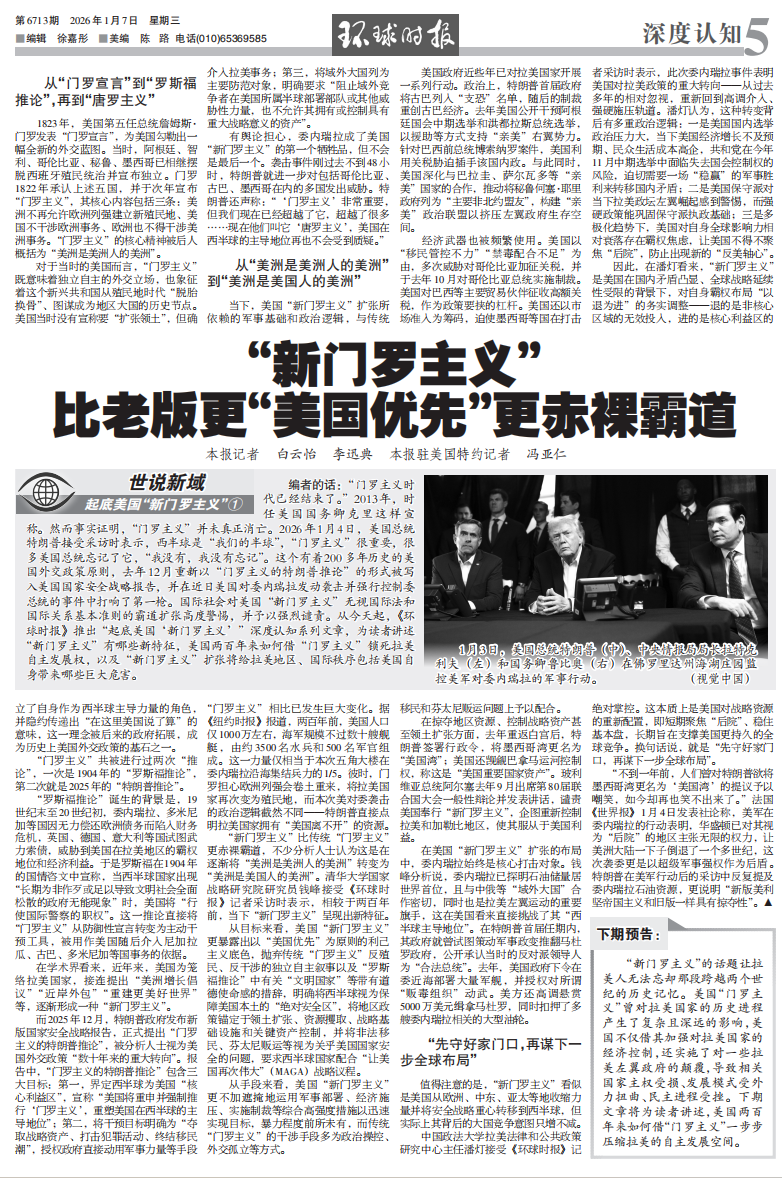
“新门罗主义”比老版更“美国优先”更赤裸霸道
Huan Qiu Shi Bao· 2026-01-07 02:10
Core Viewpoint - The article discusses the resurgence of the Monroe Doctrine in U.S. foreign policy, particularly under the Trump administration, which has been termed "New Monroeism." This approach emphasizes U.S. dominance in the Western Hemisphere and has led to military interventions, notably in Venezuela, raising concerns about violations of international law and the implications for Latin America and global order [1][5][11]. Historical Context - The Monroe Doctrine, articulated by President James Monroe in 1823, established a framework for U.S. foreign policy, asserting that the Americas should be free from European colonialism and interference [3][4]. - The doctrine has evolved through two significant iterations: the Roosevelt Corollary in 1904, which justified U.S. intervention in Latin America, and the recent "Trump Doctrine," which reasserts U.S. interests in the region [4][5]. New Monroeism Characteristics - The "New Monroeism" is characterized by a more aggressive and interventionist stance, focusing on military deployment, economic pressure, and direct intervention in Latin American affairs [6][7]. - The Trump administration's national security strategy identifies the Western Hemisphere as a core interest area, with explicit goals to reclaim U.S. dominance and prevent foreign influence [5][9]. Military and Economic Strategies - The U.S. has employed military force and economic sanctions as primary tools in its "New Monroeism," contrasting with the more diplomatic approaches of the past [8][12]. - Recent actions include military deployments near Venezuela and sanctions against countries like Colombia and Cuba, aimed at controlling resources and curbing perceived threats to U.S. security [9][10]. Implications for Latin America - The focus on Venezuela is particularly notable due to its vast oil reserves and alliances with countries like China and Russia, which the U.S. views as challenges to its influence [9][12]. - The article suggests that the "New Monroeism" could lead to increased instability in Latin America, as the U.S. prioritizes its interests over regional autonomy and development [1][11].
新加坡发现自己上当了,悔不当初却为时晚矣,20年真心错付美国
Sou Hu Cai Jing· 2026-01-03 04:54
Core Viewpoint - Singapore's Prime Minister expressed strong dissatisfaction with the U.S. decision to impose a 10% reciprocal tariff, which undermines the free trade agreement signed 20 years ago, leading to a significant trade deficit of $30 billion with the U.S. [1][3] Group 1: Trade Relations - Singapore is the only ASEAN country with a long-term trade deficit with the U.S., importing significantly more than it exports, with a trade surplus of $2.8 billion for the U.S. in 2024, an increase of nearly 85% from 2023 [3][5] - The U.S. announced a reciprocal tariff policy on April 2, 2025, which was a shock to Singapore, despite the tariff being lower than those imposed on Cambodia and Vietnam [3][5] - Singapore's trade dependency is extremely high, with a trade dependency ratio of 327%, indicating that its total trade volume is more than three times its GDP [5][6] Group 2: Economic Impact - Following the tariff announcement, Singapore's stock market experienced a significant drop, with the Straits Times Index falling 7.5%, marking the largest single-day decline since the 2008 financial crisis [8] - Economic forecasts for Singapore's GDP in Q2 2025 predict a contraction of 2.4%, with a potential risk of technical recession, leading to a downward revision of GDP growth expectations from 1%-3% to 0%-2% [8][10] Group 3: Geopolitical Context - The U.S. tariff policy is seen as a departure from the global trade rules established by the WTO, with implications for Singapore's economic and security balance, which relies on both the U.S. for security and China for economic ties [10][11] - Singapore's former Prime Minister noted that while Singapore is a key security partner of the U.S., it does not consider itself an ally, highlighting the complexities of its geopolitical stance [13] Group 4: ASEAN Response - Malaysia's Prime Minister is seeking a unified response among ASEAN countries to the U.S. tariffs, but significant differences in positions exist, indicating a divided response to U.S. pressure [15][17] - The U.S. has implemented varying tariff rates for different ASEAN countries, with Singapore facing a 10% tariff, while other countries like Thailand and Malaysia face higher rates [17] Group 5: Global Trade Dynamics - The U.S. tariff policy is part of a broader strategy to regain control over supply chains, while China is establishing a free trade zone in Hainan, indicating a shift in global trade dynamics [19][21] - Experts suggest that the disruption caused by U.S. tariffs is prompting countries to seek alternatives to reduce dependence on the U.S., with ASEAN countries exploring regional cooperation and new trade routes [23]
国际社会强烈批评美国干涉拉美事务(国际视点)
Ren Min Ri Bao· 2025-12-30 22:06
Group 1 - The United Nations Security Council held an emergency meeting regarding the situation in Venezuela, with representatives from Russia and China criticizing the actions of the United States and emphasizing the need to resolve disputes peacefully in accordance with the UN Charter [1] - The U.S. has deployed multiple warships in the Caribbean Sea near Venezuela under the pretext of "anti-drug" operations, sinking over 30 vessels since early September, resulting in over a hundred deaths [2] - The U.S. has labeled the Venezuelan government as a "foreign terrorist organization" and ordered a comprehensive blockade on sanctioned oil tankers entering or leaving Venezuela [2] Group 2 - The Venezuelan government has accused the U.S. of attempting to instigate regime change and military expansion in Latin America, condemning U.S. actions as acts of piracy [3] - The U.S. military's actions have raised concerns among regional countries and the international community, with experts from the UN Human Rights Council stating that the U.S. has no right to enforce unilateral sanctions through armed blockades [3] - The Bolivarian Alliance for the Peoples of Our America condemned the U.S. actions as unacceptable aggression against legitimate trade and national sovereignty, labeling it a form of neo-colonialism [4] Group 3 - Russian Foreign Minister Lavrov expressed serious concerns over the escalating U.S. actions in the Caribbean, indicating that these actions threaten international shipping and reaffirming support for the Venezuelan government [5] - China's representative at the UN called for an immediate cessation of U.S. actions against Venezuela, stating that such actions violate international law and threaten peace and security in the region [5] - Venezuela's UN representative claimed that U.S. ambitions extend beyond Venezuela, aiming to dominate the entire South American continent [6] Group 4 - The latest U.S. National Security Strategy report prioritizes the Western Hemisphere, viewing it as a frontline for U.S. border security and geopolitical competition, with a focus on preventing foreign intervention and using lethal force against drug trafficking groups [7] - The report has faced opposition from Latin American and Caribbean nations, with leaders expressing concerns that it exacerbates challenges and promotes a view of the hemisphere as a U.S. sphere of influence [7] - Nicaragua's UN representative criticized U.S. actions as "modern piracy" that undermines regional stability and peace [8]
突发!美战机飞入委内瑞拉领空,无人机现身近海,特朗普暗示:还可能对墨西哥和哥伦比亚出手
Mei Ri Jing Ji Xin Wen· 2025-12-10 14:07
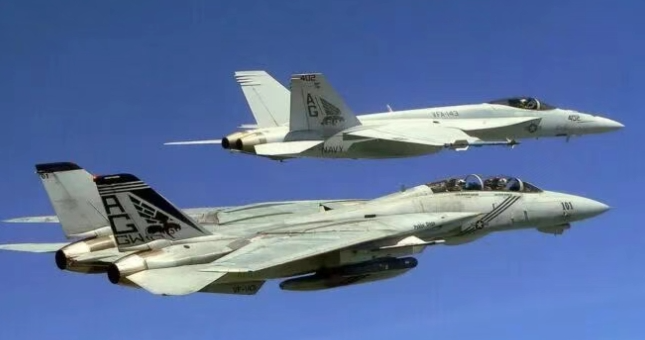
Group 1 - The U.S. government is intensifying its military actions against suspected drug traffickers in Venezuela, with President Trump hinting at possible expansions into Mexico and Colombia [1] - A secret briefing was held for Congress members by key national security officials, including Secretary of State Rubio and Defense Secretary Hegseth, to discuss the strategy against drug trafficking [1] - Democratic leaders expressed dissatisfaction with the lack of a clear strategy presented during the briefing, while most Republicans remained non-committal [1] Group 2 - U.S. military aircraft, including F-18 fighter jets, entered Venezuelan airspace, flying close to the city of Maracaibo and remaining for at least 40 minutes [2] - The flight path of the U.S. fighter jets indicated they flew over critical energy regions in Venezuela, specifically between La Guajira and Falcon state [3] - An MQ-4C Triton drone was also reported in the vicinity, conducting surveillance along the Venezuelan coastline without entering its sovereign airspace [5] Group 3 - The U.S. National Security Strategy report released on December 4 introduced the "Trump Doctrine" as a new version of the Monroe Doctrine, aiming to assert U.S. dominance in the Western Hemisphere and strengthen military presence in Latin America [7] - The U.S. has previously deployed multiple naval vessels in the Caribbean near Venezuela under the pretext of anti-drug operations, which Venezuela claims is a military threat aimed at regime change [7]
“美国战略重大转向”,欧洲又惊又气
Di Yi Cai Jing· 2025-12-08 00:44
Core Viewpoint - The latest National Security Strategy (NSS) from the U.S. marks a significant shift in American foreign policy, moving away from traditional ideologies and emphasizing a pragmatic approach focused on U.S. interests, encapsulated in the phrase "America First" [1][4]. Summary by Sections U.S. Foreign Policy Principles - The NSS outlines that U.S. foreign, defense, and intelligence policies must adhere to several core principles, with a focus on core national security interests rather than generalized "national interests" [4]. - Five core national interests are identified: ensuring stability and dominance in the Western Hemisphere; maintaining economic security and a free and open Indo-Pacific; safeguarding European security and cultural health; preventing hostile forces from dominating the Middle East; and establishing technological superiority and controlling global standards [4]. Shift from Previous Strategies - Compared to the 2017 NSS, which emphasized "great power competition," the new NSS does not highlight great power confrontation but instead states that the economy is the "greatest stake" [4][5]. - The new NSS significantly downplays the Biden administration's stance on maintaining a rules-based international order, which was frequently mentioned in the 2022 NSS but appears only once in the latest version, used to criticize the Biden administration's failures [5]. Critique of European Allies - The NSS sharply criticizes European allies, suggesting they should engage in an ideological struggle against "woke" trends and highlighting deeper issues such as political freedom erosion and demographic changes due to immigration [2][6]. - It warns of the potential for "civilization erasure" in Europe and calls for the U.S. to assist in correcting Europe's current trajectory [6]. Economic Security Emphasis - The NSS emphasizes that economic security is foundational to national security, advocating for a "rebalancing" of global trade relations and expanding U.S. access to critical minerals and materials [10]. - It also calls for monitoring global supply chains and technological advancements, promoting U.S. re-industrialization through "strategic tariffs" and new technologies [10][11]. - The document acknowledges challenges in achieving economic goals, noting a loss of 58,000 manufacturing jobs since April and a contraction in manufacturing employment for nine consecutive months [10]. Energy and Financial Dominance - The NSS aims to restore U.S. energy dominance across various sectors, including oil, natural gas, coal, and nuclear energy, while rejecting climate change and net-zero concepts [11]. - It recognizes the financial markets as a pillar of U.S. influence, providing leverage for advancing national security priorities [11].
“美国战略重大转向”,欧洲又惊又气!
第一财经· 2025-12-08 00:11
Core Viewpoint - The latest National Security Strategy (NSS) from the U.S. marks a significant shift in American foreign policy, moving away from traditional ideologies and emphasizing a pragmatic approach focused on national interests and economic security [3][8]. Summary by Sections U.S. Foreign Policy Principles - The NSS outlines that U.S. foreign, defense, and intelligence policies must adhere to several core principles, with a focus on core national security interests rather than generalized ones. The five core interests include: ensuring stability and dominance in the Western Hemisphere, maintaining economic security and a free and open Indo-Pacific, safeguarding European security and cultural health, preventing Middle Eastern dominance by hostile forces, and establishing technological superiority [8][9]. Critique of European Allies - The NSS sharply criticizes European allies, suggesting they engage in an ideological struggle against "woke" trends and highlighting deeper issues such as political freedom erosion and demographic changes due to immigration. It warns of a potential loss of civilization in Europe and calls for U.S. action to help correct its current trajectory [5][11][12]. Economic Security Emphasis - The document emphasizes that economic security is foundational to national security, advocating for a "rebalancing" of global trade relations, increased access to critical minerals, and monitoring of global supply chains. It also promotes the idea of strategic tariffs and new technologies to drive U.S. reindustrialization [17][18]. Focus on the Western Hemisphere - The NSS indicates a renewed focus on Latin America, suggesting the re-establishment of Monroe Doctrine principles to restore U.S. influence in the region. It emphasizes the importance of securing exclusive contracts for U.S. companies in countries heavily reliant on American support [14][15]. Shift from Interventionism - The NSS reflects a clear non-interventionist stance, setting high standards for foreign intervention and advocating for flexible realism in international relations. It suggests that the U.S. should not impose democratic changes on other nations but rather seek peaceful commercial relationships [9][10].

欧洲又惊又气!特朗普政府国家安全战略转向,划定核心利益与新边界
Di Yi Cai Jing· 2025-12-07 13:05
Core Viewpoint - The new National Security Strategy (NSS) emphasizes that the economy is the "greatest interest" and marks a significant shift in U.S. foreign policy, moving away from the previous focus on great power competition [1][4]. Group 1: U.S. Foreign Policy Principles - The NSS outlines that U.S. foreign, defense, and intelligence policies must adhere to several core principles, with a focus on core national security interests rather than generalized "national interests" [4]. - Five core national interests are identified: ensuring stability and dominance in the Western Hemisphere, maintaining economic security and a free and open Indo-Pacific, safeguarding European security and cultural health, preventing hostile forces from dominating the Middle East, and establishing technological superiority [4]. Group 2: Economic Security Emphasis - The document stresses that economic security is foundational to national security, advocating for a "rebalancing" of global trade relations and expanding U.S. access to critical minerals and materials [10]. - It calls for monitoring global supply chains and technological advancements, promoting U.S. re-industrialization through "strategic tariffs" and new technology applications [10][11]. - The NSS aims to restore U.S. energy dominance and financial leadership, rejecting climate change and net-zero concepts [11]. Group 3: Critique of European Allies - The NSS sharply criticizes European allies for insufficient military spending and economic stagnation, highlighting deeper issues such as the erosion of political freedom and national sovereignty in Europe [6]. - It warns of the potential for European civilization to be erased and calls for the U.S. to assist Europe in correcting its current trajectory [6]. Group 4: Focus on the Western Hemisphere - The NSS emphasizes the need to re-establish and execute Monroe Doctrine principles, restoring U.S. dominance in the Western Hemisphere as a fundamental prerequisite for U.S. security and prosperity [9]. - It suggests that U.S. diplomats should seek major business opportunities in countries heavily reliant on the U.S., ensuring that contracts are exclusively awarded to American companies [9].
重磅!特朗普发布第二任期《国家安全战略》(全文&与以前有何不同&美国媒体评论)
美股IPO· 2025-12-06 23:00
Group 1 - The article emphasizes the need for a coherent and focused global engagement strategy for the United States to maintain its status as the world's strongest and most influential nation [3][4][5] - It critiques past U.S. strategies post-Cold War for failing to align with core national interests and for misjudging the American public's willingness to bear global burdens [4][5] - The article highlights the importance of prioritizing core national interests in U.S. foreign policy, focusing on security, economic stability, and the protection of American values [7][10] Group 2 - The article outlines the core objectives of U.S. strategy, including the protection of national sovereignty, economic interests, and the well-being of its citizens [7][8] - It stresses the need for a resilient national infrastructure capable of withstanding various threats, including military attacks and foreign influence [8] - The article advocates for a strong military presence and advanced defense systems to safeguard U.S. interests and deter potential adversaries [8][9] Group 3 - The article discusses the importance of maintaining a robust economy as the foundation of U.S. power, emphasizing the need for a strong industrial base and innovative energy sector [8][9] - It highlights the necessity of protecting intellectual property and fostering technological advancements to sustain economic leadership [9] - The article calls for a focus on re-industrialization and energy independence to bolster economic resilience and reduce reliance on foreign sources [12][18] Group 4 - The article outlines the U.S. approach to foreign relations, advocating for a pragmatic and principle-driven diplomacy that prioritizes American interests [11][13] - It emphasizes the need for burden-sharing among allies and partners, particularly in defense spending and regional security responsibilities [14][15] - The article critiques the past U.S. approach to China, calling for a rebalancing of economic relations to ensure fairness and protect American economic independence [25][26] Group 5 - The article identifies the strategic importance of the Western Hemisphere, advocating for a return to Monroe Doctrine principles to safeguard U.S. interests in the region [16][18] - It discusses the need for a proactive stance against foreign adversaries in the Western Hemisphere, emphasizing cooperation with regional allies to combat illegal immigration and drug trafficking [19][20] - The article highlights the importance of economic partnerships and investment opportunities in the region to strengthen U.S. influence and counter external threats [22][23]