
零基预算理念

Search documents
财政部:2025年安排1000亿元对3周岁以下婴幼儿发放育儿补贴
Xin Lang Cai Jing· 2026-01-26 06:39
Core Viewpoint - The Chinese government is implementing a more proactive fiscal policy in 2025 to support current economic growth and improve long-term structural transformation, ensuring sustainable development for the economy and society. Group 1: Fiscal Policy and Social Welfare - The fiscal policy will continue to strengthen social welfare, with a 2% increase in basic pension levels for retirees and a monthly increase of 20 yuan in the minimum standard for urban and rural residents' pensions [1] - In 2025, the central government will allocate approximately 1.2 trillion yuan for basic pension insurance subsidies and will gradually implement free preschool education, benefiting around 14 million people [1] - The government will also increase the standards for national scholarships and student aid, while establishing a childcare subsidy system with a budget of 100 billion yuan for children under three years old, exempting these subsidies from personal income tax [1] Group 2: Employment and Health Insurance - The central government will prioritize employment, allocating 66.74 billion yuan for employment support and extending social insurance subsidies and unemployment insurance [2] - The fiscal subsidy standards for residents' medical insurance and basic public health services will be raised to 700 yuan and 99 yuan per person per year, respectively, with a total of about 490 billion yuan allocated for these subsidies in 2025 [2] - These measures are expected to enhance residents' consumption capacity and stimulate consumer willingness [2] Group 3: Future Fiscal Strategy - In 2026, the fiscal strategy will focus on increasing total expenditure, ensuring necessary spending levels, and maintaining fiscal deficits and debt at necessary levels [4] - The government aims to optimize the expenditure structure, ensuring funds are allocated to critical areas, and will adopt zero-based budgeting to reduce ineffective spending [4] - The goal is to enhance residents' income through effective spending arrangements that provide tangible benefits to the public [4]


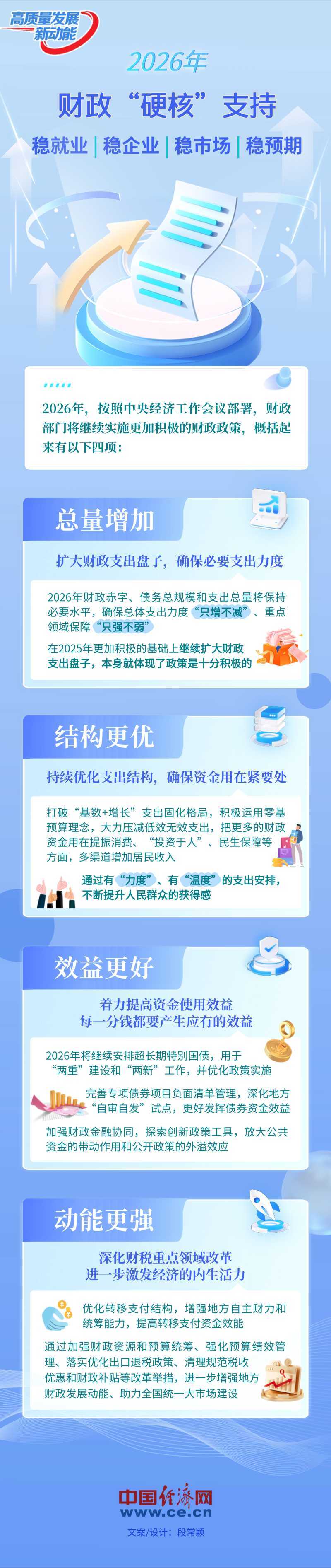
确保“十五五”良好开局,2026年财政“硬核”支持有哪些?
Zhong Guo Jing Ji Wang· 2026-01-23 06:30
Core Viewpoint - The Chinese government is committed to maintaining a proactive fiscal policy in 2026 to promote high-quality economic and social development, ensuring that fiscal deficits, debt levels, and total expenditures remain at necessary levels while focusing on key areas of support [1][3]. Group 1: Fiscal Policy and Expenditure - The fiscal deficit, total debt scale, and total expenditure for 2026 will be maintained at necessary levels, ensuring that overall expenditure intensity "only increases and does not decrease," with a focus on strengthening key areas of support [3]. - The government plans to continue expanding the fiscal expenditure framework in 2026, building on the more proactive measures of 2025, indicating a very positive policy stance [3]. - There will be a continuous optimization of expenditure structure to ensure funds are allocated to critical areas, breaking the "base + growth" expenditure solidification pattern, and actively applying zero-based budgeting principles to reduce ineffective spending [3]. Group 2: Efficiency and Effectiveness of Fund Utilization - Every penny spent must generate the expected benefits, with plans to arrange super long-term special government bonds in 2026 for "two heavy" constructions and "two new" initiatives, while optimizing policy implementation [5]. - The government aims to enhance fiscal and financial collaboration, exploring innovative policy tools to amplify the effects of public funds and the spillover effects of public policies [5]. - There will be a focus on deepening fiscal and tax reforms to further stimulate the internal vitality of the economy, optimizing transfer payment structures, and enhancing local fiscal capabilities [5].
去年3000亿元以旧换新撬动2.6万亿元消费,2026年财政总体支出力度“只增不减”
Hua Xia Shi Bao· 2026-01-21 14:18
Group 1 - The core viewpoint of the article emphasizes the implementation of a more proactive macroeconomic policy in China for 2025, aimed at supporting economic growth and structural transformation while ensuring long-term sustainable development [2][3] - The fiscal policy for 2025 includes a deficit rate set at around 4%, marking a historical high, and a new government debt scale of 11.86 trillion yuan, which is an increase of 2.9 trillion yuan compared to the previous year [4] - The issuance of special bonds in 2025 is projected to reach 4.59 trillion yuan, the highest in five years, with a focus on infrastructure and social projects [4] Group 2 - In 2025, significant funding is allocated to key areas such as social security, employment, technology, education, and health, with expenditures exceeding 10 trillion yuan in the first eleven months, accounting for over 40% of the general public budget [5] - The government plans to replace 2 trillion yuan of existing hidden debt and allocate 800 billion yuan in new special bonds to support local government financial capacity [5] - A notable initiative includes a 300 billion yuan fund for consumer subsidies, aimed at boosting consumption and driving sales of related goods by approximately 2.6 trillion yuan [5] Group 3 - For 2026, the fiscal policy will continue to maintain necessary levels of deficit, debt, and expenditure, ensuring that spending in key areas remains robust [6] - The government will adopt a zero-based budgeting approach to reduce ineffective spending and redirect funds towards consumption, investment in people, and social welfare [6] - The issuance of long-term special bonds will continue to support key construction and new initiatives, with an increase in personal consumption loan interest subsidies [7] Group 4 - The Ministry of Finance aims to enhance the role of government investment funds to support early-stage investments in hard technology and innovative sectors [8] - New policies will include interest subsidies for technology innovation loans, with a focus on supporting small and medium-sized enterprises in high R&D sectors [8] - Measures to stimulate private investment include loan interest subsidies and risk-sharing mechanisms for private enterprises, alongside a 1 trillion yuan re-loan for private enterprises [8]

更加积极的财政政策增总量优结构
Jing Ji Ri Bao· 2026-01-21 01:08
Core Viewpoint - The Chinese government is set to implement a more proactive fiscal policy in 2026, focusing on increasing total expenditure while optimizing the structure and effectiveness of spending to support high-quality economic development [1][2]. Group 1: Fiscal Policy Implementation - In 2026, the fiscal deficit, total debt, and overall expenditure will be maintained at necessary levels, ensuring that overall spending "only increases" and key areas are "only strengthened" [1]. - The proactive fiscal policy in 2025 has played a significant role in achieving economic and social development goals, balancing current needs with long-term sustainability [1][2]. Group 2: Budget and Expenditure - The national general public budget revenue is expected to show a recovery growth trend in 2025, with overall stability in budget execution [1]. - The general public budget expenditure will maintain strong intensity to provide necessary financial support for economic and social development, with expectations of achieving a balance between revenue and expenditure for the year [1]. Group 3: Structural Optimization - The focus will be on optimizing the expenditure structure, ensuring funds are allocated to critical areas, breaking the "base + growth" spending pattern, and applying zero-based budgeting principles [2]. - The fiscal department aims to support employment, businesses, markets, and expectations through robust financial backing [2]. Group 4: Policies to Stimulate Investment and Consumption - A comprehensive set of policies will be implemented to stimulate domestic demand, including optimizing personal consumption loan interest subsidies and extending support for service industry loans [2][3]. - The policies targeting private investment are expected to significantly reduce financing costs and enhance profitability for enterprises, thereby invigorating private investment [3]. - The personal consumption loan interest subsidy policy will be extended to the end of 2026, with improvements such as including credit card installment payments and raising subsidy standards [3].
财政政策有力支持经济增长
Ren Min Ri Bao Hai Wai Ban· 2026-01-21 01:01
Core Viewpoint - The Chinese government is set to implement a more proactive fiscal policy in 2025, focusing on economic growth, social welfare, and structural transformation to ensure sustainable development in the long term [1] Group 1: Fiscal Policy Measures - The fiscal policy for 2025 will emphasize four main areas, including increased counter-cyclical adjustments, with a deficit rate set at around 4%, up by 1 percentage point from the previous year [2] - New government debt issuance will reach 11.86 trillion yuan, an increase of 2.9 trillion yuan compared to the previous year, significantly exceeding average levels from prior years [2] - Special government bonds worth 500 billion yuan will be issued to bolster the core tier-one capital of major state-owned commercial banks [2] Group 2: Consumer Stimulus - A long-term special bond issuance of 1.3 trillion yuan will support consumption, including 300 billion yuan allocated for a trade-in program for consumer goods, expected to drive sales exceeding 2.6 trillion yuan [2] - Policies will be introduced to stimulate consumption from both supply and demand sides, including interest subsidies for personal consumption loans and support for new consumption models [2] - Adjustments to duty-free shop and tax refund policies will be made to encourage and expand related consumer spending [2] Group 3: Social Welfare Enhancements - Employment support funds of 66.74 billion yuan will be allocated to enhance employment stability, alongside expanded social insurance subsidies and reduced unemployment insurance rates [3] - Fiscal subsidies for residents' medical insurance and basic public health services will be raised to 700 yuan and 99 yuan per person per year, respectively [3] - A 2% increase in basic pension levels for retirees will be implemented, along with a gradual rollout of free preschool education [3] Group 4: Risk Management and Development - The government will continue to manage hidden debt replacement, with 2 trillion yuan allocated for replacing existing hidden debts [3] - An additional 800 billion yuan in new special bonds will be issued to enhance local government financial capacity [3] - The focus will be on maintaining a stable overall fiscal operation while ensuring that key areas receive robust support [3] Group 5: Financial Collaboration - A package of fiscal and financial policies aimed at promoting domestic demand will be introduced, including interest subsidies for loans to small and micro enterprises in key industries [6][7] - A special guarantee plan for private investment will be launched, with a single credit limit set at 20 million yuan [7] - The government will enhance support for private enterprises through risk-sharing mechanisms for bond issuance, helping to lower financing barriers [7]
筹划重大资产重组!“小巨人”拟收购“小巨人”
Zhong Guo Zheng Quan Bao· 2026-01-20 23:27
Group 1: Government Policies and Economic Measures - The Ministry of Finance announced multiple policies to enhance personal consumption loan interest subsidies and implement a special guarantee plan for private investment [1] - The fiscal deficit, total debt, and overall expenditure will maintain necessary levels through 2026, ensuring that overall expenditure "only increases" and key areas are "only strengthened" [1][2] - A tax and fee exemption policy for community service industries, including elderly care and childcare, will be effective from January 1, 2026, to December 31, 2027 [2] Group 2: Company News and Financial Performance - Hikvision reported a revenue of 92.518 billion yuan for 2025, with a slight year-on-year increase of 0.02%, while net profit grew by 18.46% to 14.188 billion yuan [5] - Tongfu Microelectronics expects a net profit of 1.1 billion to 1.35 billion yuan for 2025, representing a growth of 62.34% to 99.24% year-on-year [5] - Puxin Technology anticipates a net profit of 2.3 billion to 2.4 billion yuan for 2025, marking a growth of 93.18% to 101.58% year-on-year [5] - Aifan Transmission plans to acquire 87.07% of Beijing Heli Technology Co., which is expected to constitute a major asset restructuring [6][7] - Aifan Transmission's acquisition is expected to enhance its overall strength and improve business performance [7] Group 3: Clinical and Pharmaceutical Developments - Baili Tianheng received approval for its innovative drug application for a dual-target antibody ADC for treating recurrent or metastatic esophageal squamous cell carcinoma, marking a significant milestone in clinical development [8] - Aibo Medical plans to acquire at least 51% of Demai Medical, a high-tech enterprise, to expand into the sports health sector [9][10] Group 4: Market and Investment Insights - CITIC Securities reports that the recent pullback in the securities sector does not indicate the end of the market rally, suggesting potential upward paths for the sector [11]
总量增加、结构更优 2026年财政政策更加积极
Zhong Guo Zheng Quan Bao· 2026-01-20 23:17
Core Viewpoint - The Ministry of Finance will implement a more proactive fiscal policy in 2026, focusing on increasing total expenditure, optimizing structure, improving efficiency, and enhancing momentum to ensure a good start for the 14th Five-Year Plan [1] Group 1: Fiscal Policy and Expenditure - The total fiscal expenditure will be expanded, maintaining necessary levels of fiscal deficit and debt, ensuring that overall expenditure "only increases" and key areas are "strengthened" [2] - In 2025, the national general public budget revenue is expected to show a recovery growth trend, with a balanced revenue and expenditure situation anticipated [2] - Key expenditure areas such as social security, employment, technology, education, and health have received strong support, with over 10 trillion yuan allocated to these areas in the first 11 months of 2025, accounting for over 40% of total public budget expenditure [3] Group 2: Structural Optimization - The expenditure structure will be continuously optimized to ensure funds are allocated to critical areas, breaking the "base + growth" spending pattern [4] - In 2025, the central government allocated 66.74 billion yuan for employment subsidies and increased financial support for healthcare and public health services [4] - A new childcare subsidy system will be established, with 100 billion yuan allocated for subsidies to families with children under three years old [4] Group 3: Efficiency Improvement - The focus will be on improving the efficiency of fund usage, with plans to issue long-term special bonds to support key projects and enhance the effectiveness of bond funds [6] - In 2025, 1.3 trillion yuan of long-term special bonds were issued, with 300 billion yuan specifically allocated for consumer subsidies [6][7] - The total expenditure from special bonds and other financial instruments increased by 45.5% in the first 11 months of 2025 compared to the same period in 2024, amounting to 51.5 trillion yuan [7] Group 4: Reform and Market Dynamics - The Ministry of Finance aims to deepen fiscal and tax reforms to stimulate economic vitality, including optimizing transfer payment structures and enhancing local fiscal capabilities [8] - Continuous efforts will be made to standardize fiscal subsidies and improve government procurement processes to foster a fair competitive environment [9]
总量增加 结构更优 效益更好 动能更强 ——2026年财政政策更加积极
Zhong Guo Zheng Quan Bao· 2026-01-20 22:06
Core Viewpoint - The Ministry of Finance will implement a more proactive fiscal policy in 2026, focusing on increasing total expenditure, optimizing structure, improving efficiency, and enhancing momentum to ensure a good start for the 14th Five-Year Plan [1] Group 1: Fiscal Policy Implementation - The total fiscal expenditure will be expanded, maintaining necessary levels of fiscal deficit and debt, ensuring that overall expenditure "only increases" and key areas are "strengthened" [2] - In 2025, the national general public budget revenue is expected to show a recovery growth trend, with a balanced revenue and expenditure situation anticipated [2] - The first three quarters of 2025 saw a gradual increase in public budget revenue, with a notable 2.5% growth in Q3 and 3.2% in October [2] Group 2: Key Expenditure Areas - The fiscal department will continue to optimize expenditure structure, ensuring strong support for social security, employment, technology, education, and health sectors, which accounted for over 10 trillion yuan, over 40% of total public budget expenditure in the first 11 months of 2025 [3] Group 3: Structural Optimization - The focus will be on optimizing expenditure structure to ensure funds are allocated to critical areas, breaking the "base + growth" spending pattern and applying zero-based budgeting principles [4] - Increased funding for employment support, healthcare, and child-rearing subsidies aims to enhance residents' consumption capacity and willingness [5] Group 4: Efficiency Improvement - The government will arrange for long-term special bonds to support key projects and optimize policy implementation, aiming to improve the effectiveness of every expenditure [6] - In 2025, 1.3 trillion yuan of long-term special bonds were issued, with 300 billion yuan allocated for consumer subsidies, promoting economic transformation [6][7] Group 5: Strengthening Economic Momentum - The Ministry of Finance will deepen fiscal and tax reforms to enhance local financial capabilities and improve the efficiency of transfer payments [8] - Continuous efforts will be made to standardize fiscal subsidies and improve government procurement processes to foster a fair competitive environment [9]
总量增加 结构更优 效益更好 动能更强——2026年财政政策更加积极
Zhong Guo Zheng Quan Bao· 2026-01-20 21:04
Core Viewpoint - The Ministry of Finance will implement a more proactive fiscal policy in 2026, focusing on increasing total expenditure, optimizing structure, improving efficiency, and enhancing momentum to ensure a good start for the 14th Five-Year Plan [1] Group 1: Fiscal Policy and Expenditure - The total fiscal expenditure will be expanded, maintaining necessary levels of fiscal deficit and debt, ensuring that overall expenditure "only increases" and key areas are "only strengthened" [1] - In 2025, the fiscal revenue is expected to achieve a balanced budget, with public budget revenue showing a recovery growth trend [2] - The fiscal department will continue to optimize expenditure structure, ensuring strong support for key areas such as social security, employment, technology, education, and health [2] Group 2: Social Welfare and Employment - In 2025, the central government allocated 66.74 billion yuan for employment subsidies and increased standards for medical insurance and public health service funding [3] - The basic pension for retirees will be raised by 2%, and the minimum standard for urban and rural residents' pensions will increase by 20 yuan per month [3] - A new childcare subsidy system will be established, with 100 billion yuan allocated for subsidies for children under three years old [3] Group 3: Efficiency and Effectiveness - The focus will be on improving the efficiency of fund usage, ensuring that every penny generates expected benefits [4] - In 2025, 1.3 trillion yuan of ultra-long-term special bonds will be issued to support key projects, with 300 billion yuan allocated for consumer subsidies [4] - The use of bond funds will be accelerated, with a total expenditure of 5.15 trillion yuan in the first 11 months of 2025, a 45.5% increase from the previous year [4] Group 4: Fiscal and Tax Reforms - The Ministry of Finance aims to deepen fiscal and tax reforms to enhance local financial development and support the construction of a unified national market [5] - There will be a focus on clarifying fiscal responsibilities between central and local governments in public services, education, and healthcare [5] - Continuous efforts will be made to standardize fiscal subsidies and improve government procurement processes to foster a fair competitive environment [6]
财政部2026年的“硬核”政策是什么?
Jing Ji Guan Cha Wang· 2026-01-20 12:50
Core Viewpoint - The Ministry of Finance plans to implement a more proactive fiscal policy in 2026, focusing on increasing total spending, optimizing structure, improving efficiency, and enhancing momentum to ensure a strong start for the 14th Five-Year Plan [1][2]. Group 1: Total Increase - The fiscal policy aims to expand the fiscal spending envelope, maintaining necessary levels of fiscal deficit, total debt, and overall expenditure, ensuring that spending increases rather than decreases [2]. - The fiscal deficit for 2026 is expected to exceed 56,600 billion yuan, based on a 4% deficit rate set for 2025, which is an increase of 1 percentage point from 2024 [2]. Group 2: Optimized Structure - The focus will be on optimizing the expenditure structure, ensuring funds are allocated to critical areas such as consumption stimulation, human investment, and social welfare [3]. - There is a shift from "investment in material" to "investment in people," indicating a transition towards a welfare-oriented fiscal policy [3][4]. - Expenditure related to consumption and social welfare has shown significant growth, with social security and employment spending reaching 40,721 billion yuan, a year-on-year increase of 8.1% [3]. Group 3: Better Efficiency - The goal is to enhance the effectiveness of fund utilization, ensuring that every yuan spent generates the expected benefits [4][5]. - In 2025, 1.3 trillion yuan of special long-term bonds will support major projects, with 8,000 billion yuan allocated to "two heavy" projects and 5,000 billion yuan for "two new" policies, driving total investment growth by 1.8 percentage points [5]. Group 4: Stronger Momentum - The policy aims to deepen fiscal and tax reforms to stimulate internal economic vitality, enhance local financial capabilities, and improve the efficiency of transfer payments [6]. - Cleaning up and standardizing tax incentives and subsidies is crucial for building a unified national market, which will help eliminate local protectionism and market segmentation [6].