零碳工厂建设

Search documents
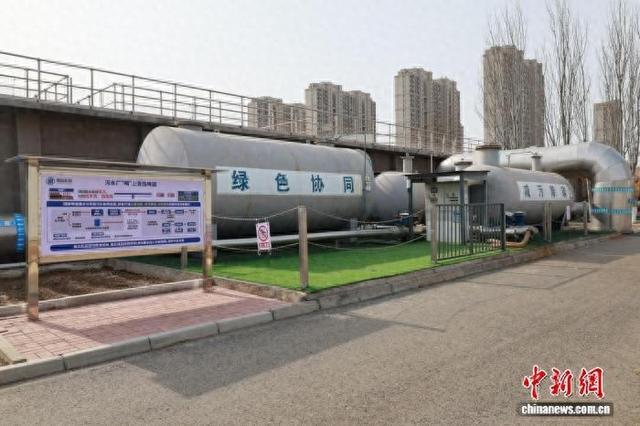
污水处理绿意浓 零碳工厂建设催动中国多领域绿色转型
Xin Lang Cai Jing· 2026-02-24 06:58
Core Viewpoint - The construction of zero-carbon factories, exemplified by the Li Village River wastewater treatment plant, represents a significant step towards reducing carbon emissions in various industries, aligning with national policies aimed at achieving carbon neutrality [1][2]. Group 1: Zero-Carbon Factory Initiatives - The Li Village River wastewater treatment plant is implementing a series of measures to upgrade to a zero-carbon factory, aiming to reduce carbon emissions by approximately 2,000 tons of CO2 equivalent annually through the use of beer production waste [1][2]. - The "14th Five-Year Plan" emphasizes the construction of zero-carbon factories and parks, with the Ministry of Industry and Information Technology and other departments issuing guidelines to systematically promote zero-carbon factory construction [1][5]. Group 2: Carbon Reduction Strategies - The zero-carbon factory construction involves continuous reduction of CO2 emissions through technological innovation, structural adjustments, and management optimization, with a focus on the unique challenges faced by different industries [2][4]. - The Li Village River plant has reduced carbon emissions by 6,250 tons of CO2 equivalent over the past three years by utilizing beer waste for wastewater treatment, showcasing an innovative "waste-to-waste" approach [3][4]. Group 3: Technological Innovations - The plant is applying self-developed zero-carbon nitrogen and phosphorus removal technology, which efficiently removes nitrogen and phosphorus without additional carbon source agents, contributing to the overall carbon reduction efforts [4]. - The plant is also developing distributed photovoltaic power generation projects to increase the proportion of green electricity used on-site, further enhancing its sustainability [4]. Group 4: Broader Implications and Future Plans - The zero-carbon factory initiative is expected to extend beyond wastewater treatment to other sectors, with plans to cultivate zero-carbon factories in industries such as automotive, lithium batteries, and electronics by 2027, and expand to traditional high-energy industries by 2030 [5]. - The shift towards zero-carbon factories is seen as a transformative force for various industries, moving from a mindset of "mandatory carbon reduction" to "voluntary carbon reduction," thus driving green transformation across sectors [4][5].

上海石化发布2025年度业绩盈警,预计净亏损超12亿元
Jing Ji Guan Cha Wang· 2026-02-12 07:51
Core Viewpoint - Shanghai Petrochemical Company (00338.HK) has issued a profit warning, expecting a net loss of approximately 1.289 billion to 1.576 billion yuan for the fiscal year 2025, indicating a shift from profit to loss [1][2]. Group 1: Financial Performance - The company anticipates a net loss attributable to shareholders of approximately 1.289 billion to 1.576 billion yuan for the fiscal year 2025, marking a year-on-year transition from profit to loss [2]. - The stock price has experienced fluctuations recently, influenced by oil prices and sector performance [1]. Group 2: Industry Policy and Environment - On February 4, 2026, the Ministry of Industry and Information Technology and four other departments issued guidelines for the construction of zero-carbon factories, with plans to select benchmark zero-carbon factories starting in 2026 and expanding to the petrochemical industry by 2030. This policy may have long-term implications for chemical companies, including Shanghai Petrochemical [3]. Group 3: Stock Performance - On January 9, 2026, the company's H-shares rose by 2.7%, closing at 1.52 HKD, partly driven by a rebound in international oil prices and overall strength in the oil and petrochemical sector. Long-term performance will still depend on industry cycles and the company's profit recovery progress [4].

零碳工厂建设:一场以碳效率为核心的系统性产业升级
Zhong Guo Hua Gong Bao· 2026-02-06 02:59
Core Viewpoint - The Ministry of Industry and Information Technology and other departments have issued guidelines for the construction of zero-carbon factories, emphasizing that this initiative is not merely about emission reduction but a comprehensive industrial upgrade centered on carbon efficiency, which will drive high-quality development in China's real economy [1] Group 1: Zero-Carbon Factory Construction Blueprint - The guidelines outline a measurable, reportable, and verifiable carbon management system as the core of zero-carbon factory construction [2] - A phased approach is established, starting with selection in 2026, construction in 2027, and gradual expansion by 2030, considering industry characteristics and carbon emission features [2] - The initiative aims to create leaders in sectors like automotive and lithium batteries while exploring transformation paths for traditional high-energy industries like petrochemicals [2] Group 2: Systematic Emission Reduction Measures - Zero-carbon factories focus on technological innovation, structural adjustments, and management optimization to continuously reduce CO2 emissions [3] - The guidelines propose using product carbon footprints to drive collaborative carbon reduction across the supply chain, emphasizing green solutions in procurement and logistics [3] - Digitalization is highlighted as key for precise carbon management, utilizing industrial internet and big data for real-time monitoring and optimization [3] Group 3: Standardization and Evaluation System - A rigorous, unified standard system is essential for the scale and normalization of zero-carbon factory development, aligning with international standards [4] - The transition from declaration-oriented to performance-oriented international rules emphasizes priority on emission reduction and verification requirements [4] - China's standardization efforts are evolving from pilot group standards to national standards, with over 30 group standards already published [5][6] Group 4: Collaborative Ecosystem for Zero-Carbon Factories - The construction of zero-carbon factories requires collaboration across technology innovation, financial support, professional services, and talent development [7] - Green finance is crucial, with policies in place to provide favorable loans and financial products for zero-carbon factories, reflecting a significant growth in green loans and bonds [7] - The guidelines stress the principle of "reduce as much as possible, continuously improve," prioritizing internal emission reductions before considering carbon offsets [7]
关注淡季补库涨价品种粘胶、染料,化工景气度有望持续上行
Zhong Guo Neng Yuan Wang· 2026-02-03 02:12
Group 1 - The basic chemical industry index closed at 4943.97 points, up 0.65% from last Friday, and outperformed the CSI 300 index by 0.01% this week [1][2] - Among the 25 sub-industries in the Shenwan chemical classification, 13 sub-industries rose while 12 fell. The leading sectors included textile chemical products, other chemical raw materials, compound fertilizers, coal chemicals, and phosphate fertilizers, with weekly increases of 13.89%, 6.58%, 4.94%, 4.72%, and 4.56% respectively [1][2] - The sectors that experienced declines included modified plastics, synthetic resins, and other plastic products, with weekly decreases of -6.44%, -4.36%, and -3.67% respectively [1][2] Group 2 - The price of disperse dyes has increased, with a rise of 1000 yuan/ton to 18000 yuan/ton on January 22, 2026, marking the first price adjustment in nearly a quarter [3] - The price of active dyes rose from 22000 yuan/ton to 23000 yuan/ton on January 29, 2026, driven by a significant increase in the price of upstream key intermediates [3] - The price of key intermediates used in dye production has surged from 25000 yuan/ton to 38000 yuan/ton, an increase of over 50%, impacting downstream dye prices [3] Group 3 - The viscose fiber industry is experiencing high operating rates and low inventory levels, creating a basis for price increases. The industry operating rate has remained above 90% since September 2025, with total inventory at 10000 tons as of January 30, 2026, down 24.53% week-on-week [4] - The inventory days are estimated to be around 9 days, indicating a relatively low inventory level and favorable conditions for price increases in the viscose industry [4] Group 4 - The PVC industry is advancing towards mercury-free production, with the Ministry of Ecology and Environment focusing on the development of mercury-free catalysts. The industry has achieved a target of halving mercury usage per unit product by 2020 compared to 2010 [5] - The transition from "low mercury" to "mercury-free" production is expected to lead to the exit of outdated production capacities, thereby restoring the supply-demand balance in the PVC industry [5]
我国工业绿色发展更加突出“碳效优化”
Jin Rong Shi Bao· 2026-02-02 01:14
Core Viewpoint - The construction of zero-carbon factories is a crucial strategy for enhancing the green and low-carbon development level of industries and improving their competitiveness in the green and low-carbon sector. The recent issuance of the "Guiding Opinions on the Construction of Zero-Carbon Factories" by five departments, including the Ministry of Industry and Information Technology, marks a significant step towards promoting carbon reduction and green transformation in key industries [1][2]. Group 1: Goals and Pathways - The "Guiding Opinions" systematically outline the main goals and construction pathways for zero-carbon factory development in China, emphasizing the importance of carbon reduction and efficiency enhancement [1]. - The construction of zero-carbon factories is seen as a means to cultivate new productive forces and support the achievement of carbon peak and carbon neutrality goals [1]. Group 2: Technological Innovation - Zero-carbon factory construction relies on technological innovation, structural adjustments, and management optimization to continuously reduce carbon dioxide emissions within factories [2][3]. - The focus is on achieving near-zero emissions rather than absolute zero, with an emphasis on continuous improvement under current technological and economic conditions [2]. Group 3: Standards and Management - The success of zero-carbon factory construction hinges on having standards for benchmarking, focusing on both source reduction and process decarbonization [4]. - The "Guiding Opinions" require factories to meet energy efficiency standards and implement management optimizations to ensure efficient operation of equipment [4][5]. Group 4: Supply Chain Collaboration - The "Guiding Opinions" advocate for a collaborative approach to carbon reduction across supply chains, emphasizing the analysis of carbon footprints of key products and the adoption of green low-carbon solutions in procurement and logistics [5][6]. - A digital energy and carbon management center is recommended to enhance data management capabilities, supporting process control and effectiveness evaluation [5][6]. Group 5: Financial and Policy Support - The construction of zero-carbon factories involves integrated innovation in policies, standards, and business models, with a focus on creating a collaborative ecosystem for carbon reduction [7]. - The "Guiding Opinions" highlight the role of green finance in supporting zero-carbon factory construction, including mechanisms for preferential credit and innovative financial products to lower transformation costs for enterprises [7][8]. Group 6: Carbon Offset Principles - The "Guiding Opinions" establish the principle of "reduce as much as possible, continuously improve," emphasizing that carbon offsetting should only occur after all feasible reductions have been made [8].
强势突围!化工股局部爆发,多龙头联动走高,政策+产品涨价双重催化掀上涨狂潮
Jin Rong Jie· 2026-01-29 07:43
Group 1 - The A-share chemical sector is experiencing a localized strong rally, with structural market trends highlighted and profit effects being concentrated [1] - Key stocks in the epoxy propylene sector, such as Hongbaoli, have reached their daily limit up, leading the sector's gains, followed by Meibang Technology and Hongqiang Co., which also saw significant increases [1] - The overall market trend is characterized by "leading stocks driving the market, with multiple sectors flourishing," particularly in epoxy propylene and chlor-alkali segments [1] Group 2 - In January, the price of epoxy propylene increased by nearly 10%, with some companies' orders extending into February, indicating a recovery in industry sentiment and improved profit expectations for related companies [2] - Five government departments issued guidelines for zero-carbon factory construction, promoting a green transition in the chemical industry, which is expected to benefit green chemical sectors and leading companies [2] - Citic Securities reported that the implementation of zero-carbon factory policies will enhance industrial demand for green chemicals, providing long-term support for related sectors [3] Group 3 - The epoxy propylene industry is a core beneficiary of the recent price increase and full order books, driving the rally of leading companies like Hongbaoli and Hongqiang Co. [4] - The chlor-alkali sector is also benefiting from improved industry sentiment and demand recovery, with a weekly increase of 10.93%, indicating a strong upward trend [4]


ETF复盘资讯|牛气冲天!抢抓“涨价行情”主线,有色ETF(159876)飙升7%!化工、芯片同步猛攻
Sou Hu Cai Jing· 2026-01-28 12:58
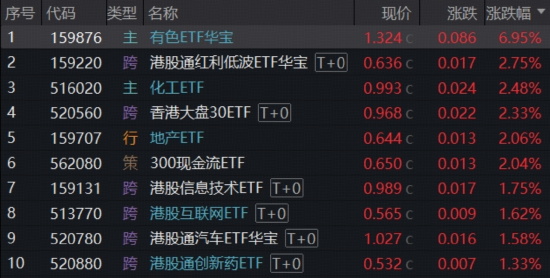
Core Viewpoint - The A-share market shows mixed performance with the Shanghai Composite Index rising by 0.27% while the ChiNext Index fell by 0.57%, driven by a "price increase" theme, particularly in resource sectors [1] Group 1: Market Performance - The overall market saw over 3,600 stocks decline, with a total trading volume of 2.97 trillion yuan [1] - The resource sector, particularly non-ferrous metals, led the market, with significant inflows of over 34.3 billion yuan into the sector [3] Group 2: ETF Performance - The Huabao Non-ferrous ETF (159876) reached a new high, with an intraday price increase of 7.35% and a closing increase of 6.95%, attracting a net subscription of 1.4 million units [3][5] - The Chemical ETF (516020) also performed well, with a closing increase of 2.48%, marking a new high since July 2022 [7] - The Hong Kong Information Technology ETF (159131) rose by 1.75%, reflecting strong performance in the semiconductor sector [10] Group 3: Commodity Prices and Economic Factors - International gold prices have reached historical highs, driven by geopolitical tensions and concerns over the independence of the Federal Reserve, leading to increased demand for safe-haven assets [2][5] - The aluminum price has surged to a nearly four-year high, with spot gold reaching a new record of $5,283 per ounce [5] - The Federal Reserve's upcoming monetary policy decisions are expected to influence market dynamics, with a dovish stance likely to support the non-ferrous metals market [5] Group 4: Sector Analysis - The chemical industry is experiencing a price surge, with a notable increase in prices for products like soda ash and nitrogen fertilizers, indicating a potential turning point for the sector [7][9] - The semiconductor sector is witnessing a price increase, with major companies like Samsung and SK Hynix raising prices significantly for memory products [10][13]






牛气冲天!抢抓“涨价行情”主线,有色ETF(159876)飙升7%!化工、芯片同步猛攻
Xin Lang Cai Jing· 2026-01-28 11:25
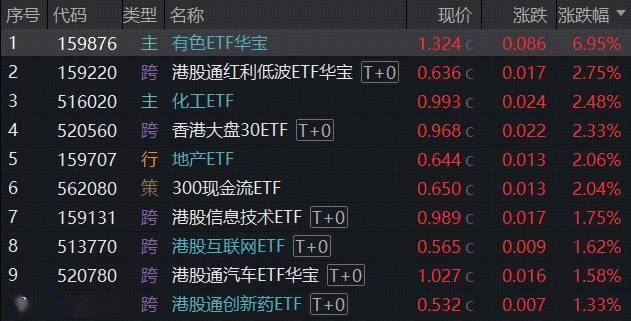
Market Overview - On January 28, A-shares showed mixed performance with the Shanghai Composite Index rising by 0.27% while the ChiNext Index fell by 0.57%. The market logic revolved around the theme of "price increases," with resource products showing strong performance, particularly in the non-ferrous metals sector [1][17]. - The total trading volume across both markets reached 2.97 trillion yuan, with over 3,600 stocks declining [1][17]. Non-Ferrous Metals Sector - The non-ferrous metals sector led the market, attracting a net inflow of over 34.3 billion yuan. Notably, 16 stocks, including China Aluminum, hit the daily limit [4][19]. - The popular non-ferrous ETF, Huabao (159876), saw its price peak at a 7.35% increase, closing up 6.95%, marking a new historical high. This ETF has attracted a net subscription of 140 million units in a single day, accumulating over 1.2 billion yuan in the past 20 days [4][19]. Chemical Sector - The chemical sector experienced a broad increase, with the chemical ETF (516020) rising by 2.48%, reaching a new high since July 2022. The ETF's price saw a peak increase of 3.2% during the trading session [7][24]. - Key stocks in the chemical sector, such as Hebang Biotechnology and Zhejiang Longsheng, hit the daily limit, while others like Satellite Chemical and Huafeng Chemical surged over 8% [7][24]. Technology Sector - The technology sector, particularly in semiconductor stocks, remained active. The Hong Kong technology ETF (159131) rose by 1.75%, continuing its upward trend [11][19]. - The semiconductor market is experiencing a price surge, with major companies like Samsung and SK Hynix significantly increasing prices for memory chips used in iPhones, with increases exceeding 80% [11][14]. Global Economic Factors - International gold prices have been hitting historical records, driven by geopolitical tensions and concerns over the independence of the Federal Reserve, leading to increased demand for safe-haven assets [2][21]. - The Federal Reserve's upcoming monetary policy decisions are anticipated to influence market dynamics, with expectations of a dovish stance potentially benefiting the non-ferrous metals market [5][21]. Policy and Future Outlook - The Chinese government is promoting the construction of zero-carbon factories across various industries, which may reshape the supply chain and production costs in the chemical sector [10]. - Analysts suggest that the chemical industry is entering a favorable period for investment, driven by supply-side constraints and increasing domestic demand as part of the "14th Five-Year Plan" [10][22].
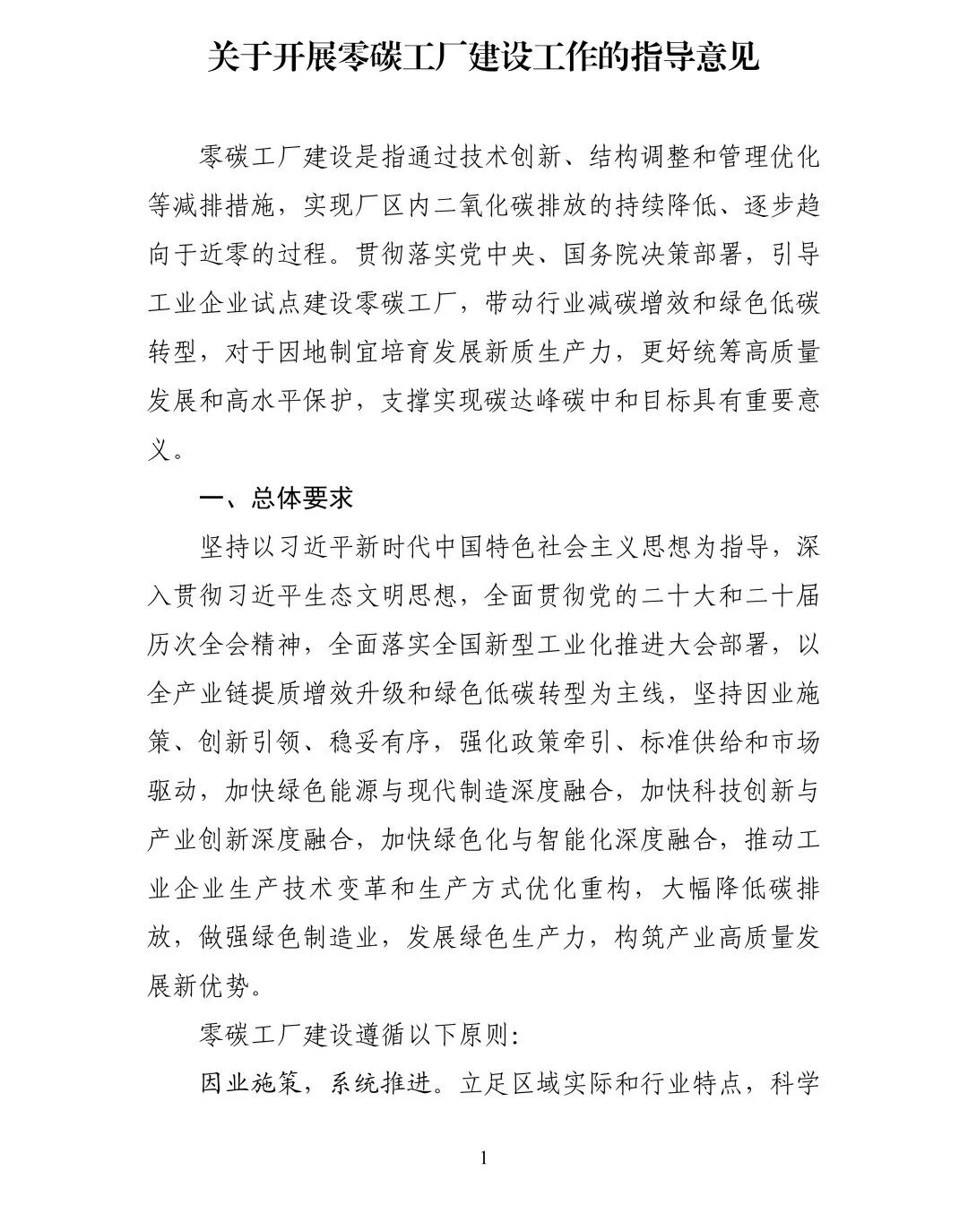
工信部、生态环境部等五部委联合下发零碳工厂建设指导意见!
Xin Lang Cai Jing· 2026-01-26 11:10
Core Viewpoint - The document outlines the guidelines for the construction of zero-carbon factories in China, emphasizing the importance of reducing carbon emissions through technological innovation, structural adjustments, and management optimization, aiming for near-zero emissions in industrial operations [1][5][21]. Group 1: Overall Requirements - The initiative is guided by Xi Jinping's thoughts on ecological civilization and aims to integrate green energy with modern manufacturing, promoting technological and industrial innovation to significantly reduce carbon emissions [6][22]. - The construction of zero-carbon factories will follow principles such as tailored strategies based on industry characteristics, innovation-driven approaches, and a focus on transparency and standardization in carbon accounting [7][23]. Group 2: Main Goals - The plan includes a phased approach, prioritizing industries with urgent decarbonization needs and lower difficulty levels, with a target to select a batch of zero-carbon factories by 2026 [8][24]. - By 2027, the initiative aims to establish zero-carbon factories in sectors like automotive, lithium batteries, photovoltaic, electronics, light industry, machinery, and computing facilities, creating an ecosystem that supports energy supply, technology research, and financial backing [9][25]. Group 3: Construction Pathways - A carbon emission accounting management system will be established to provide accurate data for zero-carbon factory construction, including direct and indirect emissions from production activities [10][26]. - The initiative encourages the development of green energy sources such as distributed solar, wind, and biomass power, promoting the use of integrated energy systems and green hydrogen applications [11][27]. - There will be a focus on enhancing energy efficiency and optimizing production processes to achieve significant reductions in carbon emissions, with a push for advanced energy-saving technologies and practices [12][28]. Group 4: Collaborative Efforts - The document promotes zero-carbon supply chain management, encouraging the procurement of green products and the adoption of low-carbon logistics to enhance collaborative decarbonization across the industry [13][29]. - The use of digital technologies such as IoT and big data will be emphasized to create smart carbon management systems, enabling precise measurement and control of energy consumption and emissions [14][30]. Group 5: Implementation Requirements - Local industrial and information departments are tasked with developing specific implementation plans for zero-carbon factory construction, fostering collaboration among government, enterprises, and markets [15][31]. - A comprehensive standard system will be established to guide the management and evaluation of zero-carbon factories, ensuring alignment with international standards and promoting transparency in carbon emissions reporting [16][32].
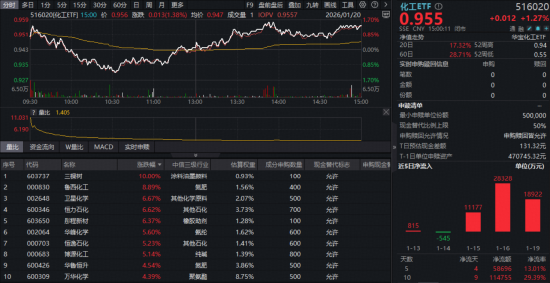
政策催化持续,化工板块迎“戴维斯双击”?化工ETF(516020)午后拉升摸高1.7%再创近3年新高!
Xin Lang Cai Jing· 2026-01-20 11:32
Group 1 - The chemical sector continues to show strong performance, with the chemical ETF (516020) reaching a closing price that marks a new high since August 2022, closing up 1.27% on January 20, 2026 [1][9] - Notable individual stocks within the sector include Sanhe Tree, which hit the daily limit, and Luxi Chemical, which surged by 8.89%, while Satellite Chemical, Hengli Petrochemical, and Tongcheng New Materials all rose over 6% [1][10] - Since the beginning of 2025, the chemical ETF has seen a cumulative increase of 54.34%, significantly outperforming major indices such as the Shanghai Composite Index (22.73%) and the CSI 300 Index (19.92%) [1][13] Group 2 - The chemical ETF has attracted significant capital inflow, with over 5.8 billion yuan in net subscriptions over the last five trading days and more than 11 billion yuan over the last ten trading days [4][12] - A recent policy from the Ministry of Industry and Information Technology aims to promote zero-carbon factory construction by 2030, which may lead to stricter regulations on new chemical projects and limit new capacity in the petrochemical sector [4][12] - Analysts suggest that the chemical industry is currently in a weak performance phase, but certain sub-sectors, such as lubricants, have exceeded expectations, indicating potential investment opportunities in glyphosate, fertilizers, and high-dividend assets [5][14] Group 3 - The chemical ETF (516020) tracks the CSI Sub-Industry Chemical Theme Index, with nearly 50% of its holdings concentrated in large-cap leading stocks like Wanhua Chemical and Salt Lake Industry, while the other half includes leading stocks in various sub-sectors [5][14] - The ETF provides a more efficient way to invest in the chemical sector, especially for those looking to capitalize on the sector's rebound [5][14]