
2nm制程

Search documents
小米玄戒O2被曝继续用台积电3nm
Guan Cha Zhe Wang· 2026-01-16 09:07
Core Viewpoint - Xiaomi is planning to adopt TSMC's N3P process for its second-generation self-developed SoC, the Xuanjie O2, instead of the latest 2nm process, and aims to expand the application of its self-developed chips beyond smartphones [1][2] Group 1: Product Development and Strategy - The Xuanjie O2 is expected to be applied in "non-smartphone" products, indicating Xiaomi's intention to broaden its chip usage [1] - The first-generation SoC, Xuanjie O1, was launched last year but was only used in a limited number of products, such as the Xiaomi 15S Pro and Xiaomi Pad 7 series [1] - Industry insiders suggest that the Xuanjie O1 served primarily to test Xiaomi's technical capabilities and market acceptance rather than to replace existing SoC suppliers like Qualcomm and MediaTek [1] Group 2: Market Competition and Challenges - Qualcomm and MediaTek are transitioning to more advanced 2nm processes for their flagship SoCs, which could weaken the market competitiveness of Xiaomi's Xuanjie O2 if it uses the N3P process [2] - TSMC's 2nm process has limited initial capacity, already allocated to major clients like Apple and Nvidia, making it difficult for Xiaomi to secure early production capacity [2] - The cost of 2nm processes is significantly higher than that of 3nm, which, combined with rising memory chip prices, has increased the overall material costs for smartphones by over 25% [2] Group 3: Pricing and Financial Implications - The launch price of the Xiaomi 17 Ultra has increased by around 500 yuan compared to its predecessor, indicating a trend of rising product prices [3] - Xiaomi's president has indicated that significant price increases are expected across the industry in the coming year, which may further pressure profit margins if higher-cost processes are adopted [3] - Xiaomi is likely to use its self-developed processors in mid-range and sub-flagship products, potentially exerting pressure on MediaTek, which primarily supplies non-flagship models [3] Group 4: Future Innovations and Investments - Xiaomi's founder has stated that by 2026, the company aims to achieve a "triple integration" of self-developed chips, operating systems, and AI models in a single product, marking a significant technological milestone [4] - Over the past five years, Xiaomi has committed approximately 105 billion yuan to core technology research and plans to invest 200 billion yuan over the next five years [4] - The company is targeting comprehensive chip coverage across its entire product line, including tablets, PCs, and automobiles, with the Xuanjie O2 leading this initiative [3][4]



消息指苹果A20芯片单颗成本280美元
Xin Lang Cai Jing· 2026-01-04 03:30
Core Viewpoint - Apple is set to launch its A20 chip with a production cost of $280, approximately 1958 RMB, which represents an 80% increase compared to the previous A19 chip, exceeding market expectations [1] Group 1: Chip Development - Samsung has released the world's first 2nm process chip, Exynos 2600, on January 3 [1] - Major manufacturers including Qualcomm, MediaTek, and Apple plan to adopt 2nm process technology in their next-generation flagship platforms [1] Group 2: Cost Implications - The shrinking of process technology is leading to increased wafer fabrication prices and rising yield pressure, which in turn is driving up the cost of System on Chip (SoC) [1]

台积电、三星2nm制程大PK 史上最贵手机芯片来了
Jing Ji Ri Bao· 2026-01-01 23:21
Core Insights - TSMC and Samsung have both advanced their process nodes to 2nm, with smartphones expected to be among the first applications, positioning TSMC as a major winner by securing contracts for the latest 2nm processors from Apple, Qualcomm, and MediaTek [1][2] - The 2nm process is anticipated to result in lower power consumption and enhanced performance, particularly in AI capabilities, but will also lead to higher costs, making 2nm chips the most expensive smartphone processors to date [1] - TSMC's 2nm technology (N2) began mass production in Q4 of last year, utilizing first-generation nanosheet transistor technology, and is set to introduce N2P technology later this year for improved performance and power efficiency [1] Company Developments - Apple is developing the A20 processor for its upcoming iPhone 18 series, which will be produced using TSMC's 2nm process [2] - Qualcomm and MediaTek are expected to release their flagship chips, Snapdragon 8 Elite Gen 6 and Dimensity 9600, respectively, using TSMC's 2nm process in the second half of this year [2] - MediaTek announced that its first flagship system-on-chip utilizing TSMC's 2nm process has completed design and is expected to enter mass production by the end of 2026 [2] - Samsung has introduced the Exynos 2600 processor, built on its own 2nm GAA process, featuring a 10-core CPU based on the latest Arm v9.3 architecture, which significantly enhances machine learning and gaming performance while reducing power consumption [2]

纳指轻微低开,台积电涨超3%续创新高
Ge Long Hui· 2025-09-23 13:41
Group 1 - U.S. stock market showed mixed results with Nasdaq down 0.04%, S&P 500 up 0.01%, and Dow Jones up 0.27% [1] - TSMC's stock rose over 3%, reaching a new high, with reports indicating a 20% price increase for the third-generation 3nm process compared to the previous generation, and a projected 50% price increase for the 2nm process to be supplied next year [1] - Boeing's stock increased by over 2% following an $8 billion order from Uzbekistan Airways, with Turkey also planning to purchase hundreds of American aircraft [1] Group 2 - Kenvue, the parent company of Tylenol, saw its stock rise over 7% after the WHO stated there is no consistent evidence linking prenatal exposure to acetaminophen with autism [1]


天玑9500单核性能逼近苹果旗舰?vivo将首发
Guan Cha Zhe Wang· 2025-09-23 03:49
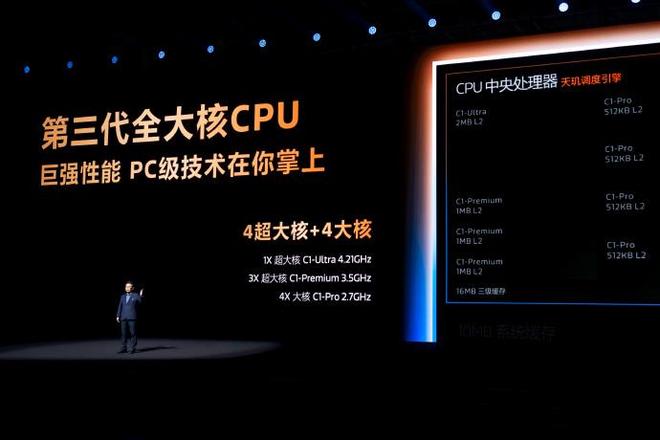
Core Viewpoint - MediaTek has launched its new flagship mobile SoC, the Dimensity 9500, which will debut in the vivo X300 series smartphones [1] Group 1: Product Features - The Dimensity 9500 utilizes TSMC's N3P process and features a full big-core CPU design, including the world's first Arm C1 series CPU cluster and G1-Ultra GPU, along with new dual NPU and ISP image processing units [1] - The CPU architecture consists of 1 C1-Ultra super core at 4.21GHz, 3 C1-Premium super cores, and 4 C1-Pro big cores, supporting 4-channel UFS4.1 flash storage [3] - Single-core performance has improved by 32% and multi-core performance by 17% compared to the previous generation, with peak power consumption for super cores reduced by 55% and multi-core peak power consumption down by 37% [3] Group 2: Performance Metrics - MediaTek's lab data shows the Dimensity 9500 achieving a GeekBench single-core score of 4007 and a multi-core score of 11217 [4] - Real-world testing by @Zealer reported a single-core score of 3610 and a multi-core score of 10765, indicating that Android flagship performance is now comparable to Apple's current flagship [4] Group 3: Market Position and Future Plans - The first smartphones featuring the Dimensity 9500 are expected to launch in Q4 2025, with vivo's X300 series and OPPO's Find X9 series confirmed to use the new chip [6] - MediaTek is negotiating with TSMC to produce some chips in the U.S. to mitigate potential tariff risks, particularly for automotive and sensitive application chips [7] - MediaTek has announced further collaboration with TSMC to be among the first to adopt TSMC's 2nm process technology, with a new SoC design expected to achieve an 18% performance increase and a 36% reduction in power consumption compared to the current N3E process [7]
三星美国厂2nm开动了
国芯网· 2025-09-02 13:20
Core Viewpoint - The competition in the semiconductor industry, particularly in the 2nm process technology, is intensifying in the United States with major players like Samsung and Intel making significant advancements and investments [3]. Group 1: Samsung's Developments - Samsung is reportedly planning to deploy personnel to establish a 2nm production line at its Texas Taylor plant starting in September, with engineers being deployed in two phases [3]. - The Texas Taylor plant was initially planned for a 4nm process but has shifted focus to 2nm due to the signing of a long-term chip supply contract worth 22.8 trillion Korean Won (approximately 16.5 billion USD) with a global company, confirmed by Tesla's CEO Elon Musk [3]. - The expected production capacity at the Taylor plant is projected to reach 16,000 to 17,000 12-inch wafers per month by the end of next year, with an investment of about 2.89 billion USD [3]. Group 2: Industry Context - The semiconductor manufacturing landscape is becoming increasingly competitive, especially with the introduction of 2nm and more advanced processes in the U.S. [3]. - TSMC has long-term plans to introduce 2nm and more advanced processes in its U.S. facilities, indicating a broader trend of technological advancement in the semiconductor sector [3].

全球科技业绩快报:联发科2Q25
Haitong Securities International· 2025-07-31 07:35
Investment Rating - The report does not explicitly state an investment rating for MediaTek, but it highlights solid performance and growth potential in AI SoC and ASIC businesses, suggesting a positive outlook for the company. Core Insights - MediaTek reported 2Q25 revenue of NTD 150.4 billion, slightly below market consensus of NTD 151.2 billion, representing a 1.9% QoQ decrease and an 18.1% YoY increase. EPS reached NTD 17.5, exceeding market expectations. The gross margin was 49.1%, up 1 percentage point QoQ, aided by a one-off contribution from a long-term supply agreement [1][5][9]. - The ASIC business is a significant growth driver, with a total addressable market (TAM) exceeding USD 40 billion. MediaTek is expanding its ASIC R&D resources and expects substantial revenue contributions starting in 2026, with a target of reaching USD 1 billion in revenue by the end of 2026 [2][6][10]. - MediaTek is actively investing in 2nm process technology, with the first 2nm chip expected to tape out in September 2023, which will enhance performance and power efficiency for both SoC and ASIC businesses [3][7][10]. - Collaboration with NVIDIA continues to deepen, with the GB10 chip entering mass production in Q3, which is expected to contribute to revenue growth [4][8][10]. - For 3Q25, MediaTek expects revenue between NTD 130.1 billion and NTD 140 billion, a QoQ decrease of 7% to 13%, but a YoY increase of 10% to 18%. The gross margin is projected at 47% [9][10]. Summary by Sections Financial Performance - 2Q25 revenue: NTD 150.4 billion, -1.9% QoQ, +18.1% YoY [1][5] - EPS: NTD 17.5, exceeding expectations [1][5] - Gross margin: 49.1%, +1 ppt QoQ [1][5] ASIC Business - Strong performance in enterprise ASIC sector with TAM over USD 40 billion [2][6] - Rapid expansion of ASIC R&D resources [2][6] - Expected revenue contributions starting in 2026, targeting USD 1 billion by end of 2026 [2][6][10] 2nm Process Development - Active investment in 2nm process technology [3][7] - First 2nm chip expected to tape out in September 2023 [3][7] Collaboration with NVIDIA - Ongoing collaboration in chip business and automotive cockpit chips [4][8] - GB10 chip to enter mass production in Q3 [4][8] Future Guidance - 3Q25 revenue guidance: NTD 130.1 billion to NTD 140 billion [9][10] - Expected gross margin: 47% [9][10]