FOMO心理

Search documents
第一批栽在黄金里的投资者,2月3日终于明白,全都输在贪字上
Sou Hu Cai Jing· 2026-02-04 17:39
Group 1 - The core viewpoint of the article highlights the volatile nature of the gold market in 2026, where some investors became wealthy overnight while others lost everything, reflecting a loss of control over human desires [1] Group 2 - The "temptation" of gold has shifted from being perceived as a guaranteed investment to a high-risk gamble, with many investors drawn in by stories of wealth on social media, leading them to invest heavily, sometimes even mortgaging their homes [3][4] Group 3 - Investors are increasingly driven by "FOMO" (fear of missing out), leading them to buy more as prices rise, despite knowing the risks, resulting in a "pyramid scheme" of investments where losses accumulate [5] - The blind worship of "experts" in the gold market, including influencers and self-proclaimed analysts, has led investors to relinquish their judgment, forgetting that no investment is without risk [6] Group 4 - The reality of gold is that it is a commodity influenced by various factors such as the dollar, interest rates, and geopolitical risks, with its perceived safe-haven status diminishing as other assets offer higher returns [8] Group 5 - To navigate the gold market, investors should set clear goals and avoid impulsive decisions, determining whether they are engaging in short-term speculation or long-term investment [9] - Diversifying investments is crucial; investors should not put all their resources into gold but rather combine it with bonds, funds, and insurance to mitigate risks [10] - Gaining knowledge and avoiding "pseudo-experts" is essential; understanding different investment tools can lead to more stable returns, such as investing in gold ETFs for smoother performance [11] Group 6 - The conclusion emphasizes that true success in the gold market comes from restraint rather than aggression, advocating for a mindset that prioritizes long-term stability over the allure of quick wealth [11]


惊魂回调不改机构“牛市心” 黄金“高空跳水”后博弈
Jin Tou Wang· 2026-02-03 06:08
Core Viewpoint - The recent sharp correction in gold prices, following a record surge, is seen as a natural market phenomenon and not an end to the bull market, as it helps relieve market pressure [1][2]. Group 1: Market Dynamics - In early 2026, the gold market experienced unprecedented volatility, with prices hitting multiple historical highs in less than three weeks, while silver surged by 200% year-on-year at its peak [2]. - Despite a drop below key support levels to $4,402 per ounce, gold prices quickly rebounded, demonstrating strong resilience [2]. - The current majority of gold buyers are not seeking short-term capital gains but are instead looking to hedge against investment risks, currency devaluation, and geopolitical uncertainties [2]. Group 2: Investor Behavior - The fear of missing out (FOMO) is driving investors who missed previous gains to re-enter the market, particularly during price corrections, which often leads to increased physical buying [2]. - Although speculative activities have surged recently, ongoing central bank purchases and solid fundamental demand continue to provide strong support for gold prices [2]. Group 3: Future Outlook - Institutional investors still have low allocations to gold, and increased investments from long-term capital such as pension funds and family offices could significantly boost gold prices [3]. - While some analysts predict gold could rise to $6,000 or even $8,000, the fundamental drivers of price increases, such as debt imbalances and geopolitical tensions, are expected to evolve slowly [3]. - The recent price correction is viewed as a reset of market sentiment, attracting more rational buyers and solidifying the foundation for future price increases [3]. Group 4: Technical Analysis - On February 3, gold showed a strong rebound, approaching the key resistance level of $4,950, with stronger resistance expected between $5,010 and $5,110 [4]. - Current technical indicators suggest that the rebound is more of a technical correction rather than a fundamental trend reversal, with short-term support levels at $4,700 and $4,545 [4]. - The $4,800 level is identified as a critical short-term threshold; if gold can maintain above this level, it may attract new short-term buying, while a drop below could lead to rapid selling pressure [4].
金银巨震后的启示:没有永远上涨的资产,只有清醒的投资理念
Sou Hu Cai Jing· 2026-02-02 06:32
Core Viewpoint - Gold and silver prices are expected to continue rising significantly in 2024-2025, driven by various factors including geopolitical tensions, central bank purchases, and industrial demand, despite recent volatility and sharp declines in prices [1][2][3]. Group 1: Price Dynamics - Gold and silver prices have recently experienced a dramatic increase, with gold prices dropping 10% in a single day and silver seeing a 30% decline, marking the highest single-day drop in 50 years [1]. - The surge in gold and silver prices is attributed to global geopolitical instability, leading to a heightened demand for safe-haven assets [1]. - Central banks are making record gold purchases to diversify their reserves, which is pushing gold prices higher [1]. Group 2: Market Psychology - The phenomenon of FOMO (Fear of Missing Out) is driving significant investment into gold and silver, reminiscent of past market behaviors seen in real estate [2][6]. - Investors are motivated by a fear of missing out on potential gains, leading to aggressive investment strategies that may not align with rational assessments of value [5][6]. Group 3: Long-term Viability - While gold and silver prices are expected to trend upward in the long term, no asset can sustain perpetual growth, and market cycles will inevitably reverse [3][4]. - Central bank demand for gold may not remain consistently strong, as they could pause purchases or even sell off holdings in response to economic pressures [4]. - Silver's price is influenced by industrial demand, which is cyclical and can lead to sharper declines during economic downturns [4]. Group 4: Investment Strategy - A prudent investment strategy suggests limiting exposure to gold and silver to no more than 10% of an overall portfolio to mitigate risks associated with market volatility [7]. - The historical lesson emphasizes the importance of not chasing market trends blindly, as this can lead to significant financial losses [6][7].
“原价100做成铜条卖150”,金银暴涨后“投资铜条”也卖爆了
Sou Hu Cai Jing· 2026-01-29 15:21
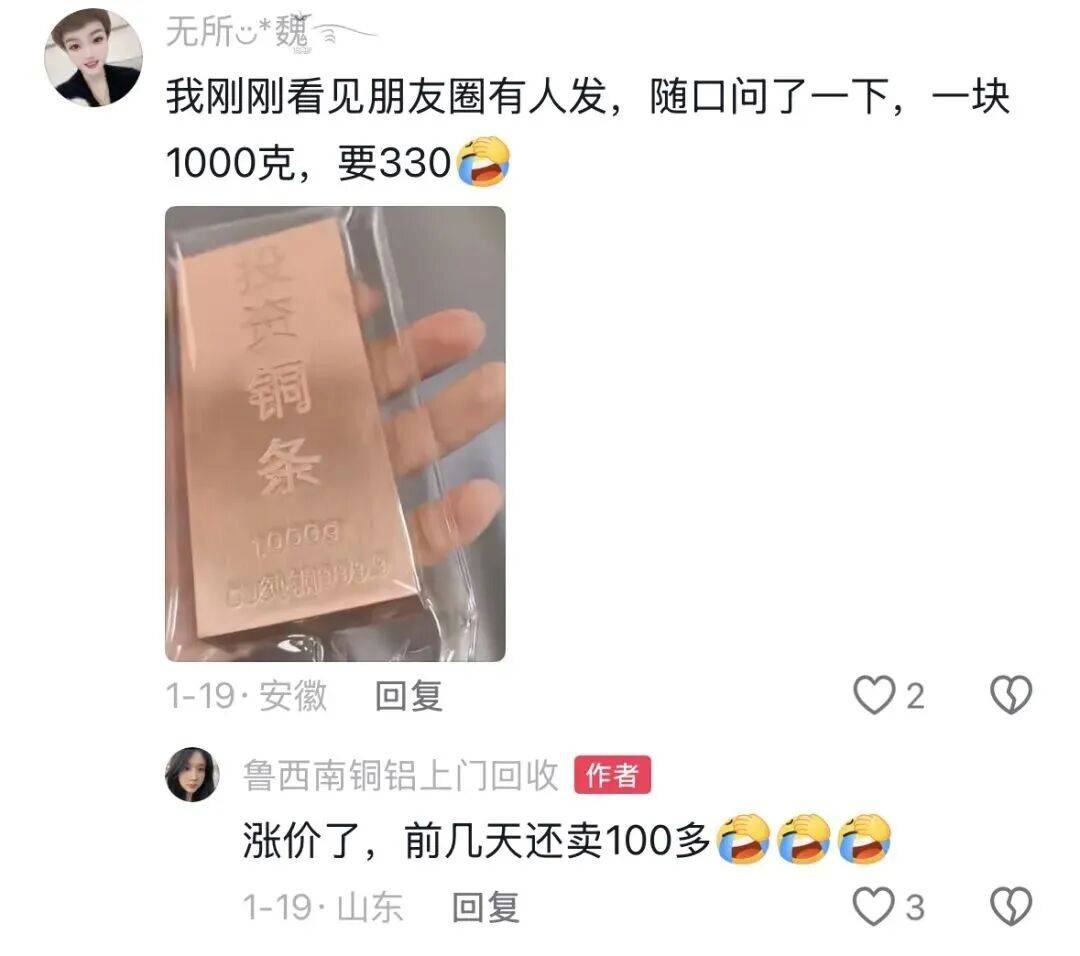
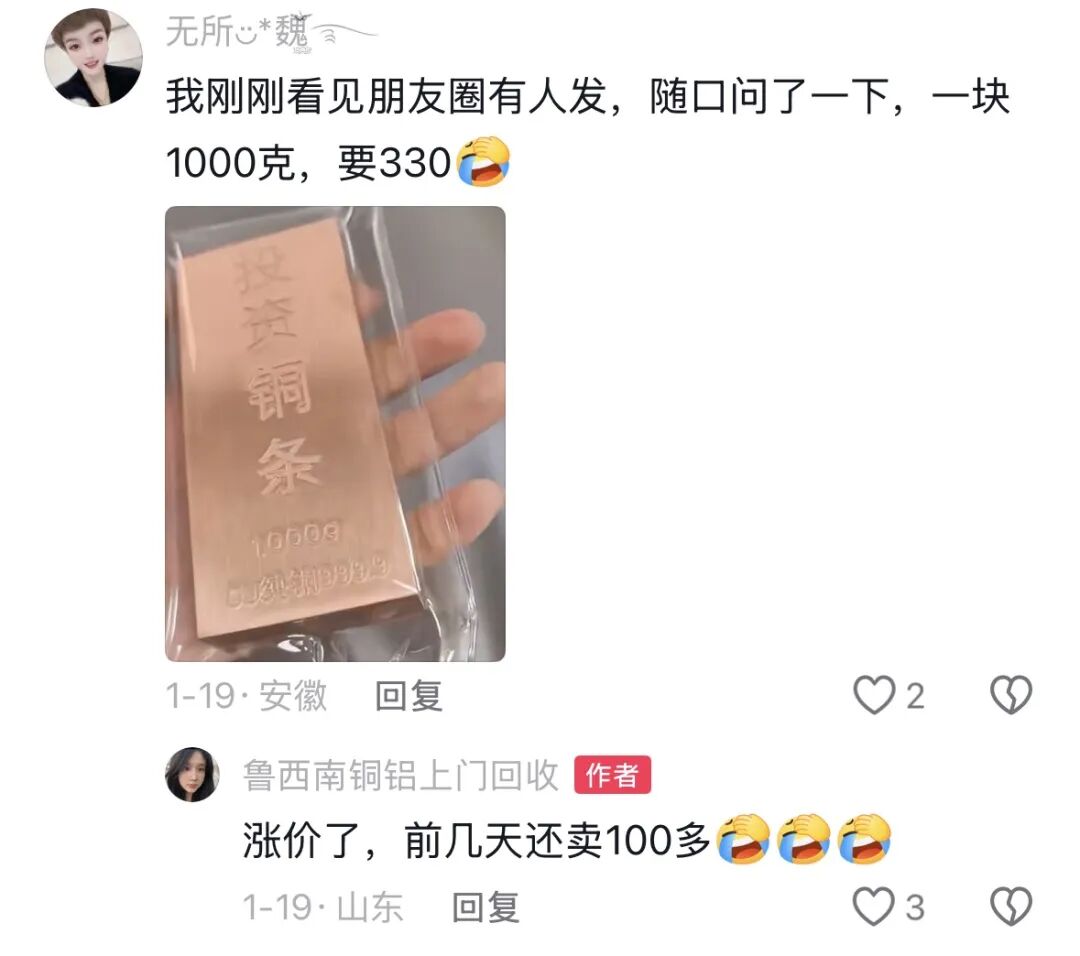
Core Viewpoint - The recent surge in gold and silver prices has led to a significant increase in the popularity of "investment copper bars," which are being marketed as a cheaper alternative to traditional precious metals [1][4][10]. Group 1: Market Dynamics - The price of investment copper bars has seen a dramatic rise, with prices increasing from 105 yuan to 300 yuan per kilogram within a short period [13][30]. - A notable increase in demand has been observed, with one vendor reporting sales of over a thousand copper bars shortly after their introduction [13][19]. - The market for investment copper bars has been characterized by a mix of speculative buying and consumer enthusiasm, despite skepticism from some observers [12][16]. Group 2: Investment Rationale - Many consumers view copper bars as a potential investment opportunity, hoping they will appreciate in value similar to silver [4][23]. - The narrative surrounding copper's future potential is bolstered by trends in renewable energy and AI, which are expected to increase copper demand significantly [24][27]. - The psychological factors driving investment decisions include fear of missing out (FOMO) on potential gains, particularly after witnessing substantial increases in gold and silver prices [39][45]. Group 3: Risks and Challenges - The investment in copper bars comes with inherent risks, including high premiums over market value and limited avenues for resale, as they are primarily sold without a buyback option [30][32]. - The physical nature of copper bars poses logistical challenges, such as storage and potential degradation over time, which could further diminish their value [33][46]. - The fundamental differences between copper and precious metals, including their market dynamics and historical value perception, suggest that copper may not serve as a reliable investment vehicle [46].
金银暴涨之后,“投资铜条”也卖爆了
3 6 Ke· 2026-01-29 00:30
Core Viewpoint - The emergence of investment copper bars, despite their unconventional nature, has gained significant attention and sales, driven by rising metal prices and speculative interest in the market [1][3][11]. Group 1: Investment Trends - The price of investment copper bars has surged from 105 RMB to 300 RMB per kilogram, reflecting high demand and speculative buying behavior [13]. - A notable trend is the comparison of copper bars to traditional investment metals like gold and silver, with some consumers believing that copper could be the next big investment opportunity [36][38]. - The market sentiment is divided, with some mocking the investment in copper bars while others actively purchase them, indicating a strong speculative interest [17][19]. Group 2: Market Dynamics - The recent ban on selling copper bars in certain markets has led to speculation that this could drive prices higher, as consumers rush to buy before potential price increases [13][22]. - E-commerce platforms have seen significant sales of copper bars, with prices around 169.99 RMB for 1000 grams, indicating a robust online market for these products [14]. - The marketing strategies employed by sellers, including comparisons to gold and silver investments, have contributed to the growing popularity of copper bars [22][27]. Group 3: Economic Factors - The rising prices of gold and silver, which have increased by 2 to 3 times over the past year, have created a psychological environment where investors are looking for alternative, lower-cost investment options like copper [34][36]. - The demand for copper is supported by industrial needs, particularly in renewable energy and electric vehicles, which require significantly more copper than traditional vehicles [38]. - Despite the apparent demand, the actual investment value of copper bars is questionable, as they are sold at a premium compared to market prices, leading to immediate losses for buyers [44][46]. Group 4: Psychological Aspects - The fear of missing out (FOMO) on potential profits from rising metal prices drives many investors to purchase copper bars, despite the high premiums and risks involved [53][59]. - The emotional impact of missing investment opportunities can lead to irrational buying behavior, as individuals seek to alleviate their anxiety over past investment decisions [54][61]. - The fundamental differences between copper and more established investment metals like gold are often overlooked by consumers, leading to misguided investment strategies [61][62].
美股异动 | 现货白银历史性进入“三位数”时代 概念股普涨
智通财经网· 2026-01-23 16:02
Group 1 - The core viewpoint of the article highlights a significant surge in silver stocks, with various companies experiencing notable gains, driven by the rising price of silver which has recently surpassed $100, marking a nearly 40% increase since the beginning of the year [1] - Silver stocks such as Coeur Mining (CDE.US), Hecla Mining (HL.US), Endeavour Silver (EXK.US), First Majestic Silver (AG.US), and Pan American Silver (PAAS.US) have all reported increases, with Pan American Silver leading with over 4% growth [1] - The increase in silver prices is attributed to investor preference for safe-haven assets, a weakening dollar, and strong industrial demand, indicating a shift in market dynamics [1] Group 2 - Analyst Ole Hansen from Saxo Bank noted that momentum has become a crucial component of the current market trend, with the fear of missing out (FOMO) playing a significant role as prices enter uncharted territory [1] - Hansen cautioned against viewing the current price surge as purely speculative, suggesting that there are underlying factors driving this increase beyond mere speculation [1]
35天,成了AI模型的斩杀线
创业邦· 2026-01-16 03:43
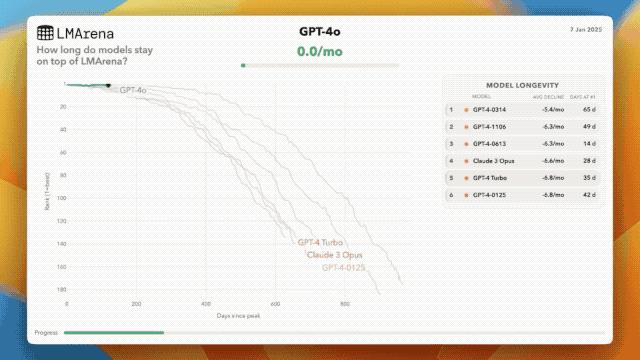
Core Insights - The article discusses the rapid evolution and competition in the AI model landscape, highlighting the transient nature of model popularity and user loyalty in the face of constant innovation and new entrants [5][6][8]. Group 1: Model Longevity and User Behavior - Top AI models can only maintain their leading position for an average of about 35 days, typically falling out of the top five within five months and out of the top ten within seven months [8]. - The decline of previously dominant models, such as OpenAI's model now ranked 56th and Claude 3 Opus at 139th, illustrates the swift obsolescence in the AI sector [8]. - User retention rates for AI applications are alarmingly low, with examples like Sora 2 showing a 30-day retention rate of just 1% and a complete drop-off by 60 days [12][14]. Group 2: Market Dynamics and User Acquisition - The AI market is characterized by a "FOMO" (Fear of Missing Out) mentality, where many users engage with AI tools briefly without developing long-term loyalty [14]. - Despite significant investment in AI applications, user retention remains poor, indicating that many users are merely exploring new tools rather than committing to any single model [14][15]. - The lack of a robust user retention strategy in many AI products contrasts with successful SaaS models, which often create a compelling ecosystem that encourages ongoing use [15][16]. Group 3: Competitive Landscape and Ecosystem Integration - The current AI landscape sees users leveraging multiple models for different tasks, as no single model can dominate all areas, leading to a collaborative approach among various AI tools [21]. - Major players like Google have established ecosystems that seamlessly integrate AI capabilities into existing platforms, enhancing user engagement and retention [21][23]. - OpenAI is attempting to counteract user churn by introducing features like personalized memory and emotional intelligence, but these efforts may not be sufficient to reverse the trend of user attrition [25][23]. Group 4: Challenges and Industry Trends - The integrity of AI model rankings is questioned due to potential manipulation, as seen in cases like Meta's Llama 4, which experienced a drastic drop in ranking after public release [28][30]. - The rise of open-source and low-cost models is reshaping the competitive landscape, with users increasingly opting for free alternatives that meet their needs [33][35]. - The article suggests that companies caught in the middle of the market, lacking both strength and affordability, face significant challenges and may struggle to survive in the current environment [35][36].

35 天,成了 AI 模型的斩杀线
3 6 Ke· 2026-01-14 23:02
Core Insights - The AI model landscape is rapidly changing, with top models only maintaining their leading positions for an average of about 35 days, and typically falling out of the top five within five months [4][6] - User loyalty in AI applications is low, with many users trying out new models without sticking to any, driven by a "FOMO" (Fear of Missing Out) mentality [10][9] - The rise of open-source and low-cost models is disrupting the industry, as free models meet most daily needs, leading users to feel they can easily switch between options [26][24] Group 1: Model Performance and User Behavior - The top AI models experience a rapid decline in rankings, with OpenAI's model dropping to 56th place and Claude 3 Opus to 139th [4][6] - User retention rates for new AI applications are alarmingly low, with some models like Sora 2 showing a 30-day retention rate of only 1% [9][10] - The lack of a strong user retention strategy in many AI products leads to a transient user base that does not convert into long-term customers [10][12] Group 2: Competitive Landscape and Market Dynamics - Major tech companies have established ecosystems that allow seamless integration of AI capabilities, giving them a competitive edge [15][17] - OpenAI is attempting to enhance user engagement through personalized features and emotional connections, but these efforts may not be sufficient to counteract user churn [19][20] - The prevalence of ranking manipulation and the emergence of cheaper alternatives are further complicating the competitive landscape for AI models [20][26]
金价狂飙难阻买入冲动,“越涨越买”背后暗藏央行FOMO焦虑
Jin Shi Shu Ju· 2025-10-20 03:15
Core Insights - Central banks continue to buy gold despite record high prices, indicating a strategic shift in their perception of gold as a key reserve asset [1][3] - The global central bank gold purchases reflect concerns over geopolitical uncertainties and the reliability of fiat currencies like the US dollar [1][3] - The US remains the country with the largest gold reserves, with approximately 8,133 tons stored in various locations [2] Group 1: Central Bank Behavior - Central banks added 19 tons of gold reserves in August, following a decrease in July, showing ongoing interest in gold despite high prices [1] - The World Gold Council noted that the record gold prices may limit the pace of central bank purchases, but this does not indicate a waning interest in gold overall [1] - Countries like Kazakhstan, Bulgaria, and El Salvador have recently joined the ranks of gold buyers, with Poland being the largest buyer this year [3] Group 2: Strategic Reasons for Gold Accumulation - Central banks are increasing gold reserves to diversify assets and mitigate risks associated with the US dollar, particularly due to concerns over the US fiscal situation [3] - Nations such as Russia are converting part of their reserves into "sanction-resistant assets," while others are exploring alternatives to reduce reliance on the dollar [3] - The trend of increasing gold reserves is expected to continue, positioning central banks as significant players in the gold market for the foreseeable future [3]
黄金疯牛高攀不起,投资者:犹豫半刻就掉队
Di Yi Cai Jing· 2025-10-14 14:09
Core Viewpoint - International gold prices have reached new highs, with futures and spot prices hitting $4,190 and $4,179 per ounce respectively, reflecting a significant upward trend since September, where gold has increased over 19% and silver by 23% [2][7]. Market Performance - The recent trading week saw gold prices surge again after a brief pause, indicating strong market momentum [1]. - Investors are experiencing a mix of fear of missing out (FOMO) and hesitation, complicating their investment decisions as they navigate the volatile market [3][5]. Investor Behavior - There is a notable trend of increased buying interest among investors, with over a million accessing gold investment products on platforms like Ant Financial on October 14 [6]. - The psychological impact of rising prices leads many investors to buy more as prices increase, despite warnings about potential volatility and risks associated with high price levels [5][6]. Institutional Outlook - Major financial institutions remain bullish on gold, with Bank of America raising its 2026 gold price target to $5,000 per ounce, indicating a potential 22% upside from current levels [7]. - Goldman Sachs has also adjusted its 2026 gold price forecast upwards, reflecting strong demand from Western ETFs and central banks [7]. Risk Factors - Despite the bullish sentiment, analysts caution that the rapid price increases may lead to profit-taking and potential price corrections in the short term [9][10]. - The precious metals market is showing signs of being overbought, with technical indicators suggesting a possible downturn [9].