火锅

Search documents
火锅行业:全面转向价值增长,地域风味及小火锅带动新增量
ZHONGTAI SECURITIES· 2026-03-01 00:30
执业证书编号:S0740522030001 Email:hect@zts.com.cn 分析师:赖思琪 火锅行业:全面转向价值增长,地域风味及小火锅带动新增量 执业证书编号:S0740525090001 Email:laisq@zts.com.cn | 上市公司数 | 128 | | --- | --- | | 行业总市值(亿元) | 44,614.24 | | 行业流通市值(亿元) | 44,003.89 | 食品饮料 证券研究报告/行业专题报告 2026 年 02 月 27 日 | 评级: 增持(维持) | 重点公司基本状况 | | | | | | | | | | | | | | --- | --- | --- | --- | --- | --- | --- | --- | --- | --- | --- | --- | --- | --- | | | 简称 | 股价 | | | EPS | | | | | PE | | | 评级 | | 分析师:何长天 | | (元) | 2023A | 2024A | 2025E | 2026E | 2027E | 2023A | 2024A | 2025E | 20 ...
餐饮业春节迎“不打烊”红利:火锅翻台率破6,奶茶单店日销超2500杯,炸鸡腿9天售上万只
Cai Jing Wang· 2026-02-25 08:35
从热点城市分布看,伴随不少年轻人选择邀请父母到工作城市团聚,"反向流动"带动除夕、初一客流向大城市集聚。 北京、深圳两地海底捞门店除夕及大年初一客流分别较去年同期增长超过18%和17%。与此同时,长沙、杭州、西 安、三亚等地海底捞的除夕预订中则显示出,不少外地顾客以"旅游+团圆"的方式过除夕。 春节返乡和旅游出行热,给在热门旅游城市、下沉市场、重点景区、交通枢纽拥有布点优势的品牌,带来足够多的机 遇。 家庭团聚带来的县域、乡镇和超一线城市的人流聚集,让不少餐饮门店的"春节不打烊"策略,实现了预期中的业绩大 涨。而品牌给加盟商的补贴、给一线员工子女的安置福利,也让产业链上的更多从业者分享到这份额外成果。 长达9天的春节假期,催化了春节返乡及出游人流增加。据华创证券引用数据显示,春节假期前两天,全国重点零售 和餐饮企业日均销售额同比增长10.6%,假期前四天同比增长8.6%;重点监测的78个商圈的假期首日客流量、营业额 分别同比提升23.2%和33.2%,前三天分别增长4.5%和4.8%。 "集团春节期间全国总营收超7000万元,客流量超百万人次。"呷哺呷哺集团方面透露,在呷哺呷哺,最受欢迎的锅底 ——印度风味咖 ...

潮汕牛肉在纽约丨家乡的广货
Nan Fang Nong Cun Bao· 2026-02-22 00:01
潮汕牛肉在纽约 丨家乡的广货_ 南方+_南方plus 大年初二晚,汕 头内海湾的夜空 被烟花次第点 亮,映得海面波 光粼粼;万架无 人机组成光点阵 列协舞,凌空拼 出清晰的"广货 行天下"五个 字,悬浮在墨色 天幕间。拥挤的 人群中,我举起 手机录下这一 幕,发给了远在 纽约的老同学阿 桂。 昨日初一,我们 刚越洋视频通 话,他略带歉意 地说:"今年回 不去了,不仅机 票涨价,汕头的 酒店更是离谱, 动辄两三千一 晚,索性就留在 美国过年了。" 阿桂是土生土长 的汕头人,大学 毕业后远赴纽约 读博、工作,一 晃已是十年。我 们隔着时差,聊 着汕头近几年的 变化——这座曾 经低调的海滨小 城,不知不觉间 已成了网红打卡 地,老市区的骑 楼修缮得古色古 香,小公园的街 巷挂满红灯笼, 而最热闹的,莫 过于遍布全城的 牛肉火锅店。 我感慨说:"我 们常去的那几家 老店,现在火得 很,外地游客排 起长队,我都得 挤着才能吃上一 口。"阿桂也回 应道:"以前在 汕头,下楼拐个 弯就有新鲜牛肉 吃,从不觉得珍 贵,到了纽约才 知道,那种本真 的鲜,花钱也难 寻。" 戴。往年春节, 阿桂总会挤破头 抢票回家,只为 吃上一口 ...


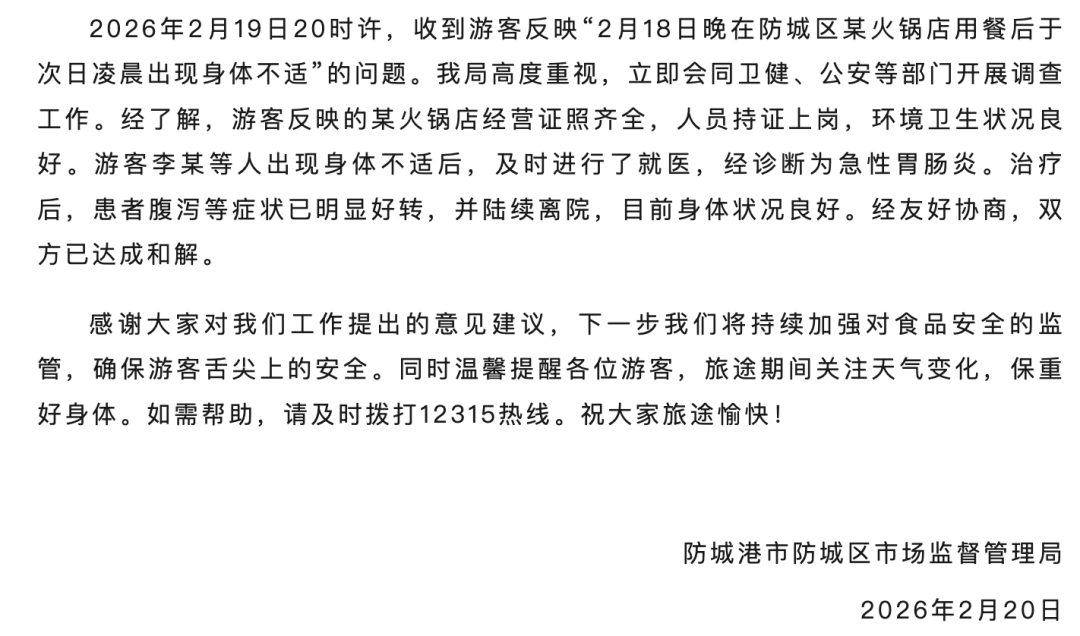
游客反映“在某火锅店用餐后出现身体不适”,防城港市防城区市监局发布情况通报
Xin Lang Cai Jing· 2026-02-21 02:48
本文转自【广西日报】; "金色防城"微信公众号截图。 经了解,游客反映的某火锅店经营证照齐全,人员持证上岗,环境卫生状况良好。游客李某等人出现身体不适后,及时进行了就医,经诊断为急性胃肠 炎。治疗后,患者腹泻等症状已明显好转,并陆续离院,目前身体状况良好。经友好协商,双方已达成和解。 感谢大家对我们工作提出的意见建议,下一步我们将持续加强对食品安全的监管,确保游客舌尖上的安全。同时温馨提醒各位游客,旅途期间关注天气变 化,保重好身体。如需帮助,请及时拨打12315热线。祝大家旅途愉快! 2月21日凌晨,广西防城港市防城区市场监督管理局发布情况通报,全文如下: 2026年2月19日20时许,收到游客反映"2月18日晚在防城区某火锅店用餐后于次日凌晨出现身体不适"的问题。我局高度重视,立即会同卫健、公安等部门 开展调查工作。 ...
2026年中国潮汕牛肉火锅行业市场政策、产业链图谱、市场规模、竞争格局及发展趋势分析:八合里综合实力稳居榜首[图]
Chan Ye Xin Xi Wang· 2026-02-21 01:14
内容概要:随着国民收入水平稳步提升,大众健康饮食意识持续觉醒,餐饮消费需求正从"吃饱吃爽"的 基础诉求,向"吃好、吃鲜、吃健康"的品质化方向深度转变,潮汕牛肉火锅凭借鲜切现宰、清汤涮煮、 轻盐少调的核心特色,精准契合低脂、原味、新鲜的主流饮食趋势,完美适配当下消费升级的市场导 向,其受众覆盖范围将持续拓宽,既深受年轻消费群体青睐,也能牢牢吸引注重养生的中老年群体,具 备极强的消费粘性,据统计,2025年我国潮汕牛肉火锅行业市场规模达505.2亿元,同比增长4.9%。 相关企业:深圳市八合里餐饮管理有限公司、广州传记潮发餐饮管理有限公司、上海左庭右院企业管理 有限公司、广州陈顺和控股有限公司、广州市和顺餐饮企业管理有限公司、杭州牛很鲜餐饮管理有限公 司、天津大吉利潮汕牛肉火锅有限公司、辽宁焯牛企业管理有限公司、四川正禾鲜餐饮管理有限公司、 北京小木船餐饮管理有限公司、无锡市炊牛餐饮管理有限公司 关键词:潮汕牛肉火锅行业市场政策、潮汕牛肉火锅行业产业链、潮汕牛肉火锅市场规模、潮汕牛肉火 锅竞争格局、潮汕牛肉火锅发展趋势 一、概述 潮汕牛肉火锅是发源于潮州、汕头、揭阳等潮汕地区的特色美食,是以鲜切牛肉为主料,搭配牛 ...

海底捞:春节前五天客流超700万人次
Xin Lang Cai Jing· 2026-02-20 11:03
Core Insights - During the Spring Festival, over 1,000 Haidilao restaurants operated normally on New Year's Eve, and over 1,200 opened on the first day of the new year, with more than 1,300 returning to normal operations from the second day onwards [1][2] - In the first five days of the Spring Festival holiday, Haidilao served over 7 million customers nationwide, with customer traffic on New Year's Eve and the first day of the new year increasing by over 10% compared to the same period last year [1][2] - The company noted a trend of "reverse flow" during the Spring Festival, where many young people chose not to return home but instead invited their parents to their work cities, leading to increased customer traffic in major cities [1][2] - In Beijing and Shenzhen, customer traffic at Haidilao restaurants on New Year's Eve and the first day of the new year grew by over 18% and 17% respectively compared to last year [1][2]
呷哺呷哺集团全品牌打造春节用餐新体验
Bei Jing Shang Bao· 2026-02-12 14:51
为保障春节期间服务品质与员工权益,呷哺呷哺提前部署运营保障工作。一方面,启用多技能通岗员 工,结合实时客流预测动态补充高峰时段人手、调整班次,同时调研员工返乡与留岗意愿,制定弹性排 班表,并给予留岗员工福利,在满足运营需求的同时兼顾员工团聚诉求。针对春节物流压力,餐厅都已 提前制定供应方案,全国中央厨房与区域仓库根据销售预测,完成核心食材的增量储备与前置备货。同 时签约备用物流伙伴,启动高峰期专属运输线路,全力保障各门店。 同时,为打造实惠便捷的欢聚用餐场景、有效激发消费活力,湊湊整合线上线下(300959)资源,推出 多重精准举措,实现线上引流、线下转化的双向联动,兼顾实惠与体验,同消费者一起欢聚过个好年。 作为集团跨界布局牛排赛道的全新品牌,呷牛排首家门店于2月6日落地北京昌平,恰逢春节消费旺季, 呷牛排针对性推出和牛团圆宴及年夜饭版欢聚牛排套餐。两款套餐均坚守百元人均消费标准,兼顾质价 比与仪式感。 北京商报讯(记者 郭缤璐)2月12日,北京商报记者了解到,为抢抓春节消费黄金期,满足家庭团聚、 亲友欢聚等多元消费需求,呷哺呷哺集团携旗下呷哺呷哺、湊湊火锅、茶米茶、呷牛排、呷哺牧场核心 品牌同步发力,以新 ...
呷哺集团春节消费矩阵成型 多品牌发力抢占新春餐饮市场
Zheng Quan Ri Bao· 2026-02-10 12:37
配套饮品板块,茶米茶推出春节限定莓果系列饮品,分别在呷哺呷哺与湊湊门店上线热饮、冰沙及甜品 款,与火锅消费场景形成搭配,提升整体消费体验。 业内人士表示,春节作为餐饮消费重要节点,品牌多矩阵、多场景布局已成为行业趋势。呷哺集团通过 主力品牌稳量、新品牌拓界、配套品类补位,形成覆盖大众火锅、中高端火锅、牛排、茶饮的春节消费 闭环。未来,依托供应链与多品牌运营优势,企业有望持续优化产品结构与消费场景,进一步提升节日 消费与日常消费的竞争力。 (文章来源:证券日报) 针对春节市场,呷哺呷哺火锅推出系列线下主题活动与线上互动玩法。活动周期覆盖春节至元宵,会员 消费及礼品卡购买可参与抽奖,品牌同步推出限定酱料礼盒,结合节日互动提升消费体验。情人节期 间,品牌上线双人套餐及配套赠品,相关产品同步上线外卖平台。此外,呷哺呷哺依托社交媒体与本地 生活平台开展打卡互动、礼品卡充值补贴等活动,并联动地方新春游园灯会推出专属优惠,实现线下引 流与消费转化。门店同步完成春节氛围布置,打造传统节日沉浸式用餐环境。 为保障春节高峰期运营,呷哺呷哺提前完成人力与供应链双重保障。企业采用通岗员工弹性排班机制, 根据客流动态调配人力,并落实留 ...
封面人物 | 张勇:海底捞再出发
Sou Hu Cai Jing· 2026-02-10 08:16
Core Viewpoint - The return of Zhang Yong as CEO of Haidilao is a significant strategic move aimed at addressing the company's recent challenges, including declining revenue and profits in 2025, and revitalizing its growth trajectory [3][10][11]. Company History and Development - Haidilao started in March 1994 with four tables in Sichuan, where founder Zhang Yong emphasized service quality as a key differentiator in a highly competitive hot pot market [4]. - The company underwent rapid expansion after its 2018 IPO, reaching 320 restaurants by mid-2018, and Zhang's net worth soared to over 500 billion [5]. - However, aggressive expansion led to operational challenges, including a significant drop in turnover rates and revenue, prompting a strategic reassessment [5][9]. Recent Challenges - In 2025, Haidilao faced a downturn, with revenue falling to 20.7033 billion, a 3.7% decrease year-on-year, and core operating profit dropping by 14.0% to 2.4081 billion [9]. - The decline was attributed to reduced turnover rates and initial adjustments in product and service innovation, highlighting the need for a more diversified approach to meet evolving consumer demands [9]. Leadership Changes - Zhang Yong stepped down as CEO in March 2022, with Yang Lijuan taking over, who implemented significant restructuring and cost-cutting measures to stabilize the company [8][10]. - Yang's leadership saw the introduction of innovative strategies and a focus on employee engagement, which helped halt the financial decline [8]. Future Strategies - With Zhang Yong's return as CEO, Haidilao aims to enhance dining experiences and service capabilities while leveraging digital operations for efficiency [10]. - The company plans to pursue a diversified business strategy, including the "Red Pomegranate Plan" for multi-brand incubation and potential acquisitions to expand its market presence [10][11]. - Analysts believe Zhang's return could improve decision-making efficiency and resource allocation, crucial for navigating the competitive landscape of the restaurant industry [11].
海底捞2026年除夕预订超5万桌,多地新店新场景迎新春
Feng Huang Wang Cai Jing· 2026-02-09 07:08
Core Insights - The company is experiencing a surge in reservations for Chinese New Year, with over 50,000 tables booked for New Year's Eve across its locations [2][5] - More than 1,000 outlets will remain open on New Year's Eve, and over 1,200 will open on the first day of the new year, indicating a strong commitment to meet customer demand during the festive season [2][8] Group 1: Customer Trends - There is a notable shift in family dining preferences, with many families opting for "reverse reunion" celebrations, bringing parents to urban areas for the holiday [4][5] - The trend of dining out for New Year's Eve is becoming more prominent, especially in popular tourist cities, where customers combine travel with family gatherings [5][6] Group 2: New Offerings - The company has introduced themed dining experiences, such as the "My Little Pony" series, to enhance the festive atmosphere and engage customers of all ages [4][7] - New store formats, including family-friendly and pet-friendly locations, are being launched to cater to diverse customer needs during the holiday season [6][8] Group 3: Operational Strategy - The company is increasing its workforce to ensure high-quality service during the busy holiday period, implementing various recruitment strategies to prepare for the influx of customers [8] - Initiatives such as employee engagement activities and family-oriented programs are being organized to foster a positive work environment and support staff during the festive season [8]