棉花种植

Search documents
USDA 棉花月度报告解读:棉花:美棉产量大幅上调,新年度供给仍偏宽松-20251117
Guo Tou Qi Huo· 2025-11-17 13:49
1. Report Industry Investment Rating No relevant content provided. 2. Core View of the Report - The November USDA report shows that the global cotton production in the 2025/26 season has been significantly increased by 523,000 tons compared to September, while the global consumption has been slightly adjusted upwards by 11,000 tons. The import and export have both been increased by 65,000 tons. The期末 inventory has been significantly increased by 607,000 tons. The report is overall bearish, and the global cotton supply remains relatively loose in the new season. In the short - to - medium term, US cotton may continue to fluctuate in a low - level range [1][2]. 3. Summary According to the Directory 3.1 2025/26 Season Supply and Demand Data Adjustments - **Production**: The global cotton production in the 2025/26 season has been significantly increased by 523,000 tons compared to September. China's production has been increased by 218,000 tons to 7.294 million tons, Brazil's by 108,000 tons, and US cotton production by 194,000 tons to 3.073 million tons due to favorable weather in Texas and an increase in yield [1]. - **Consumption**: Global consumption has been slightly adjusted upwards by 11,000 tons, with no adjustments to the data of major consuming countries. Cotton consumption remains generally stable despite the easing of Sino - US relations [1]. - **Import and Export**: Global imports have been increased by 65,000 tons, with Vietnam's imports up by 21,000 tons and China's by 44,000 tons. Global exports have also been increased by 65,000 tons, with Brazil's exports up by 44,000 tons and the US's by 43,000 tons [1]. - **期末库存**: The global期末库存 in the 2025/26 season has been significantly increased by 607,000 tons compared to September. China's期末库存 has been increased by 261,000 tons, the US's by 152,000 tons, and Brazil's by 65,000 tons [2]. 3.2 Global Cotton Supply and Demand Balance Sheet - **Production**: From 2021/22 to 2025/26 (November), the production of major cotton - producing countries such as China, Brazil, and the US has shown different trends. The total global production has increased by 174,000 tons from 2024/25 to 2025/26 (November) [4]. - **Consumption**: The total global consumption has decreased by 35,000 tons from 2024/25 to 2025/26 (November), with minor adjustments in different countries [4]. - **Import**: The total global import has increased by 212,000 tons from 2024/25 to 2025/26 (November), with significant increases in Vietnam and China [4]. - **Export**: The total global export has increased by 342,000 tons from 2024/25 to 2025/26 (November), with significant increases in Brazil and the US [4]. - **期末库存**: The total global期末库存 has increased by 315,000 tons from 2024/25 to 2025/26 (November), with increases in major countries such as China, the US, and Brazil [4].
USDA棉花月度报告解读:棉花:美棉产量大幅上调,新年度供给仍偏宽松-20251117
Guo Tou Qi Huo· 2025-11-17 12:58
Report Investment Rating No investment rating information is provided in the report. Core Viewpoints - The November 2025/26 USDA report shows a significant increase in global cotton production, while consumption remains relatively stable, resulting in a looser supply situation. The report is overall bearish, and in the medium to short term, US cotton may continue to trade in a low - range oscillation [1][2]. Summary by Related Catalogs 2025/26 Annual Supply and Demand Data Adjustments - **Production**: Global cotton production in 2025/26 was significantly increased by 523,000 tons compared to September. China's production was raised by 218,000 tons to 7.294 million tons; Brazil's by 108,000 tons; and US cotton production was sharply increased by 194,000 tons to 3.073 million tons due to favorable weather in Texas and an increase in yield per unit [1]. - **Consumption**: Global consumption was slightly increased by 11,000 tons, with no major adjustments to the data of major consuming countries. Despite the easing of Sino - US relations, overall cotton consumption remains stable [1]. - **Imports and Exports**: Global imports were increased by 65,000 tons, with Vietnam's imports up by 21,000 tons and China's by 44,000 tons. Global exports were also increased by 65,000 tons, with Brazil's exports up by 44,000 tons and the US's by 43,000 tons [1]. - **Ending Stocks**: Global ending stocks in 2025/26 were significantly increased by 607,000 tons compared to September. China's ending stocks were up by 261,000 tons, the US's by 152,000 tons, and Brazil's by 65,000 tons [2]. Global Cotton Supply - Demand Balance Sheet - **Production**: From 2021/22 to 2025/26 - 11, the total global cotton production increased from 24.894 million tons to 26.145 million tons, with a monthly increase of 523,000 tons and an annual increase of 174,000 tons in 2025/26 [4]. - **Consumption**: The total global cotton consumption increased from 25.193 million tons in 2021/22 to 25.883 million tons in 2025/26 - 11, with a monthly increase of 11,000 tons and an annual decrease of 35,000 tons in 2025/26 [4]. - **Imports**: The total global cotton imports increased from 9.344 million tons in 2021/22 to 9.581 million tons in 2025/26 - 11, with a monthly increase of 65,000 tons and an annual increase of 212,000 tons in 2025/26 [4]. - **Exports**: The total global cotton exports increased from 9.29 million tons in 2021/22 to 9.58 million tons in 2025/26 - 11, with a monthly increase of 65,000 tons and an annual increase of 342,000 tons in 2025/26 [4]. - **Ending Stocks**: The total global ending stocks increased from 15.501 million tons in 2021/22 to 16.532 million tons in 2025/26 - 11, with a monthly increase of 607,000 tons and an annual increase of 315,000 tons in 2025/26 [4].
棉系周报:基本面矛盾不大,棉价震荡为主-20251117
Yin He Qi Huo· 2025-11-17 08:39
Report Industry Investment Rating No relevant content provided. Core View of the Report - The fundamentals of the cotton market have few contradictions, and cotton prices are expected to oscillate in the short term. The supply side will see a large amount of new cotton on the market, with significant production increase in the new year but the increase may be less than expected. The demand side has average recent orders, but previous negative factors have been reflected in the market. Considering the optimistic results of recent Sino-US trade negotiations, short - term cotton prices are expected to be volatile [27][43]. Summary by Directory Part I: Domestic and International Market Analysis International Market Analysis - **US Cotton Market**: There are few changes in fundamentals, and the US cotton price is expected to oscillate within a range. As of November 7, 2025, the cumulative inspection volume of US upland cotton + Pima cotton was 963,100 tons, accounting for 30.7% of the estimated annual US cotton production, 22% slower year - on - year. The inspection progress of upland cotton and Pima cotton is slower than the same period last year. The weekly deliverable ratio is 82.6%, and the quarterly deliverable ratio is 79.5%, 2 percentage points lower year - on - year. The quarterly deliverable ratio has increased slightly month - on - month. The US cotton listing inspection is in the peak period, but the Pima cotton progress is still slow. As of September 18, the weekly signing volume of 2025/26 US upland cotton decreased by 54% week - on - week, and the weekly shipment volume increased by 14% week - on - week [8]. - **Pakistan**: As of October 15, 2025, the cumulative new cotton listing volume in the 2025/26 season reached 588,000 tons, a 22% year - on - year increase. Textile mills purchased 471,000 tons, and the unsold new cotton was 98,000 tons [8]. - **Brazil**: The 2025/26 production forecast data released by CONAB in November shows that the total cotton production in Brazil in the 2024/25 season is expected to be 4.077 million tons, remaining stable month - on - month. The planting area is stable at 2.0861 million hectares, and the yield per mu is stable at 130.3 kg. The total cotton production in the 2025/26 season is expected to be 4.028 million tons, a decrease of 3,000 tons month - on - month. The planting area is slightly reduced to 2.1371 million hectares, and the yield per mu is stable at 125.7 kg [8]. - **India**: The Cotton Association of India released the first supply - demand balance sheet for the 2025/26 season. The production is predicted to be 30.5 million bales (170 kg per bale), a decrease of 740,000 bales compared to the 2024/25 season. The consumption is expected to be 30 million bales (a decrease of 1.4 million bales from the previous season). The export is predicted to be 1.7 million bales, and the import is predicted to be 4.5 million bales, indicating that India is expected to be a net importer in the 2025/26 season. The production in all producing areas is expected to decline, with the largest reduction in Haryana and Telangana, and increases in Punjab and Andhra Pradesh [8]. - **Global**: According to the latest September global cotton production and sales forecast by USDA, the global cotton production in September was 25.62 million tons, an increase of 230,000 tons month - on - month. China's total production increased by 218,000 tons to 7.076 million tons. The total consumption increased by 184,000 tons to 25.68 million tons, and the ending inventory decreased by 168,000 tons to 15.92 million tons [8]. Domestic Market Logic Analysis - **Supply Side**: The new cotton purchase in Xinjiang is coming to an end. As of November 10, 2025, the cotton picking progress in Xinjiang was about 98.5%. The new cotton production cost is basically fixed, and the new cotton price is expected to continue to oscillate within a range. On November 13, the machine - picked cotton purchase index in Xinjiang was 6.23 yuan/kg, and the hand - picked cotton purchase index was 6.87 yuan/kg, both unchanged from the previous day. As of November 6, the cumulative picked seed cotton converted to lint cotton nationwide was 7.082 million tons, an increase of 1.657 million tons compared to the average of the past four years [27]. - **Demand Side**: As of November 6, the cumulative sales of lint cotton were 1.22 million tons, at a high level in the same period over the years, an increase of 1.01 million tons compared to the average of the past four years. As of November 13, the operating load of spinning mills in the mainstream areas was 65.6%, an increase of 0.31% from the previous week. The yarn inventory of spinning mills in the main areas was 30.2 days, a weekly increase of 0.33% [27]. Option Strategy - Volatility Trend Judgment: The HV on the previous day was 3.9092, and the volatility decreased slightly compared to the previous day. - Option Strategy Recommendation: The PCR of the main contract of Zhengzhou cotton on the previous day was 0.7094, and the volume PCR of the main contract was 0.8660. The trading volumes of both call and put options decreased today. It is recommended to wait and see [41]. Futures Trading Strategy - **Unilateral**: It is expected that the US cotton price will oscillate within a range in the future, and the Zhengzhou cotton price is also expected to oscillate. - **Arbitrage**: Wait and see [45]. Part II: Weekly Data Tracking - **Internal - External Price Difference**: The chart shows the internal - external cotton price difference and the 9 - 1 spread trend [48][49]. - **Mid - end Situation**: It includes the operating load of pure - cotton yarn mills, the load of all - cotton grey fabric mills, the yarn inventory days, and the grey fabric inventory days [52]. - **Cotton Inventory**: It includes the national cotton commercial inventory, the spinning mills' cotton industrial inventory, the reserve inventory, and the remaining amount of national reserves [54]. - **Spot - Futures Basis**: It includes the basis of cotton C32S spot - Zhengzhou cotton yarn active contract, the basis of cotton in January, May, and September, and the average basis trend of US seven - major market upland cotton [57].
棉花(纱)市场周报-20251114
Rui Da Qi Huo· 2025-11-14 09:28
Report Industry Investment Rating - Not provided in the content Core Viewpoints - This week, the price of the main Zhengzhou cotton 2601 contract decreased slightly, with a weekly decline of about 0.96%. The price of the US cotton March contract also dropped, with a weekly decline of about 0.92% [5][11]. - In the domestic market, the acquisition and processing of new cotton are progressing rapidly, and the acquisition is nearly finished. The acquisition price of cotton has increased, providing cost support. However, with the gradual issuance of import quotas and the accelerated shipment of high - grade new cotton from Brazil, the import volume in October is expected to increase month - on - month. Currently, the port inventory has reached a four - month high, with large arrivals and limited shipments [5]. - In October, China's textile and clothing exports showed a double - decline in both year - on - year and month - on - month terms, with the decline in clothing exports significantly greater than that of textiles. But there are signs of marginal improvement in domestic retail demand. Overall, the supply side continues to exert pressure, while the domestic demand shows marginal improvement, so the market is expected to maintain a volatile trend [5]. Summary According to the Directory 1. Week - on - Week Summary - **Market Review**: The price of the main Zhengzhou cotton 2601 contract decreased slightly this week, with a weekly decline of about 0.96% [5]. - **Market Outlook**: The supply side has cost support, but import volume is expected to rise, and port inventory is high. The demand side shows a decline in exports but marginal improvement in domestic retail. The market is expected to be volatile [5]. - **Trading Tips**: Monitor changes in foreign cotton prices, demand, and inventory levels [5] 2. Futures and Spot Markets - **US Cotton Market**: The price of the US cotton March contract decreased this week, with a weekly decline of about 0.92%. As of the week ending September 25, the net increase in US cotton export sales for the current year was 155,400 bales, and new sales were 158,800 bales. The international cotton spot price was 75.4 cents per pound, a decrease of 1.15 cents per pound from last week [11][15]. - **Futures Market**: The price of the Zhengzhou cotton 2601 contract decreased slightly, with a weekly decline of about 0.96%. The price of the cotton yarn futures 2601 contract decreased by about 0.78%. As of this week, the net position of the top 20 in cotton futures was - 91,423 lots, and in cotton yarn futures was - 211 lots. The number of Zhengzhou Commodity Exchange cotton futures warehouse receipts was 4,401, and cotton yarn futures warehouse receipts were 28 [21][27][31]. - **Spot Market**: As of November 14, 2025, the spot price index of cotton 3128B was 14,806 yuan per ton. The national purchase price of seed cotton 3128B was 3.2 yuan per 500 grams, and in Xinjiang, it was 3.47 yuan per 500 grams. The spot price index of Chinese cotton yarn C32S was 20,470 yuan per ton [43][46][58]. - **Imported Cotton (Yarn) Cost**: As of November 13, the sliding - duty price of imported cotton was 13,946 yuan per ton, a decrease of 150 yuan per ton from last week; the quota price of imported cotton was 12,949 yuan per ton, a decrease of 247 yuan per ton from last week. The estimated profit of imported cotton with sliding - duty was 873 yuan per ton, an increase of 149 yuan per ton from last week; the estimated profit of imported cotton with quota was 1,870 yuan per ton, an increase of 246 yuan per ton from last week [62][65]. 3. Industry Situation - **Supply Side**: At the end of September, the national commercial cotton inventory was 1.0217 million tons, a decrease of 798,500 tons or 32.34% from the previous month. As of the end of September, the in - stock industrial cotton inventory of textile enterprises was 846,000 tons, an increase of 61,000 tons year - on - year and a decrease of 46,000 tons month - on - month. In September 2025, China's total cotton import volume was about 100,000 tons, an increase of 30,000 tons month - on - month and a decrease of 20,000 tons or 16.6% year - on - year. From January to September 2025, the cumulative cotton import volume was 690,000 tons, a decrease of 1.57 million tons or 69.50% year - on - year [70][77]. - **Mid - end Industry**: As of October 15, 2025, the yarn inventory days were 25.24 days, a month - on - month increase of 1.57%; the inventory days of grey cloth were 31.43 days, a month - on - month increase of 1.00% [80]. - **Terminal Consumption**: In October 2025, China's textile and clothing export volume was 22.26 billion US dollars, a year - on - year decrease of 12.6% and a month - on - month decrease of 8.8%. Among them, textile exports were 11.258 billion US dollars, a year - on - year decrease of 9.0% and a month - on - month decrease of 5.9%; clothing exports were 11 billion US dollars, a year - on - year decrease of 16.0% and a month - on - month decrease of 11.6%. As of September 30, 2025, the cumulative retail sales of clothing, shoes, hats, needles, and textiles were 1.06127 trillion yuan, a month - on - month increase of 12.90%, and the cumulative year - on - year was 3.1%, a month - on - month increase of 6.90% [85][89]. 4. Options and Stock Market - related Markets - **Options Market**: The report shows the implied volatility of at - the - money cotton options this week, but specific data is not further explained [90]. - **Stock Market**: The report presents the price - to - earnings ratio trend of Xinong Development, but no in - depth analysis is provided [93]
跨越山海的棉花故事
人民网-国际频道 原创稿· 2025-11-10 07:42
Core Insights - The article highlights the successful implementation of a cotton technology assistance project in Benin, showcasing the journey from initial challenges to significant improvements in local cotton farming practices [1][2][3]. Group 1: Initial Challenges - Upon arrival in Benin, the project team faced extreme heat, language barriers, and cultural differences, which posed significant challenges to their mission [2]. - The local farmers were initially skeptical about adopting new farming techniques, fearing financial losses [4]. Group 2: Technical Promotion and Adoption - The project identified that Benin is the largest cotton producer in West Africa but suffers from various agricultural challenges, including poor soil quality and low mechanization [3]. - A series of detailed technical promotion plans were developed, introducing suitable cotton varieties and mechanization tailored to local conditions [3][4]. - The project utilized a trial field to demonstrate the effectiveness of new techniques, leading to increased interest and participation from local farmers [4]. Group 3: Impact of COVID-19 - The COVID-19 pandemic disrupted the project, forcing remote guidance for local farmers during critical planting periods [5][6]. - Despite the challenges, effective communication through video calls allowed for successful remote support, resulting in healthy cotton seedlings [6]. Group 4: Expansion and Training - In 2022, the project expanded its training efforts to include more regions in Benin, collaborating with local universities to enhance agricultural skills among the youth [7]. - The training programs significantly improved local farmers' skills and provided better employment opportunities, leading to increased cotton production and improved living standards [7]. Group 5: Community Engagement and Cultural Exchange - The project fostered strong relationships with local communities, exemplified by the construction of a community football field to promote social interaction and cultural exchange [8]. - The establishment of the "Friendship Football Field" served as a platform for community bonding and showcased the integration of Chinese technology and culture in local practices [8]. Group 6: Personal Connections and Future Aspirations - The project not only achieved agricultural advancements but also cultivated deep friendships between the project team and local farmers, highlighting the human aspect of international aid [9]. - The hope is expressed for the continued growth of the cotton technology initiatives in Benin, encouraging more individuals to engage in similar aid efforts [9].
棉花(纱)市场周报-20251031
Rui Da Qi Huo· 2025-10-31 08:58
1. Report Industry Investment Rating - Not provided in the content 2. Core Viewpoints of the Report - This week, the price of the main Zhengzhou Cotton 2601 contract rose slightly, with a weekly increase of about 0.41%. In the domestic market, the cotton picking and purchasing progress in Xinjiang has accelerated. However, due to the drought and high - temperature in some southern Xinjiang areas, the yield per unit of seed cotton is lower than expected, and the purchasing price continues to rise. The downstream demand has not fully started, orders are less than expected, and as the demand gradually enters the off - season, the market lacks confidence in future demand. Cotton textile enterprises mostly adopt a wait - and - see attitude and replenish inventory based on rigid demand. Overall, the cost of new cotton supports the cotton price, but the supply exerts pressure on the upside. It is expected that the cotton price will fluctuate, and attention should be paid to the economic and trade consultations [5]. - Operationally, it is recommended to take a short - term wait - and - see attitude towards the Zhengzhou Cotton 2601 contract. Future trading should focus on changes in foreign cotton prices, demand, and inventory [6]. 3. Summary According to Relevant Catalogs 3.1. Week - to - week Summary - **Market Review**: The price of the main Zhengzhou Cotton 2601 contract rose slightly this week, with a weekly increase of about 0.41% [5]. - **Market Outlook**: In the domestic market, the supply side shows that the cotton picking and purchasing in Xinjiang are accelerating. The yield per unit of seed cotton in southern Xinjiang is lower than expected, and the purchasing price is rising. The demand side indicates that downstream demand has not fully recovered, orders are insufficient, and market confidence in future demand is lacking. Cotton textile enterprises replenish inventory based on rigid demand. New cotton cost supports the price, but supply pressure restricts the upside. It is expected that the cotton price will fluctuate, and attention should be paid to economic and trade consultations [5]. - **Strategy Recommendation**: Take a short - term wait - and - see attitude towards the Zhengzhou Cotton 2601 contract. Future trading should focus on changes in foreign cotton prices, demand, and inventory [6]. 3.2. Futures and Spot Market - **Futures Market**: - The price of the December US cotton contract rose this week, with a weekly increase of about 0.90% [12]. - The price of the Zhengzhou Cotton 2601 contract rose slightly this week, with a weekly increase of about 0.41%, and the price of the cotton yarn futures 2601 contract increased by about 0.33% [23]. - As of this week, the net position of the top 20 in Zhengzhou Cotton futures was - 121,428 lots, and that in cotton yarn futures was - 120 lots [28]. - As of this week, the number of Zhengzhou Commodity Exchange cotton futures warehouse receipts was 2,414, and that of cotton yarn futures was 0 [34]. - This week, the price difference between the Zhengzhou Cotton 1 - 5 contracts was - 10 yuan/ton, and the price difference between cotton 3128B and cotton yarn C32S spot prices was 5,615 yuan/ton [37]. - This week, the basis between the cotton 3128B price index and the Zhengzhou Cotton 2601 contract was + 1,265 yuan/ton, and the basis between the cotton yarn C32S spot price and the cotton yarn futures 2601 contract was 600 yuan/ton [46]. - **Spot Market**: - As of October 31, 2025, the spot price index of cotton 3128B was 14,860 yuan/ton [41]. - As of October 31, 2025, the spot price index of Chinese cotton yarn C32S was 20,475 yuan/ton, CY index: OEC10s (rotor - spun yarn) was 14,700 yuan/ton; CY index: OEC10s (combed yarn) was 23,660 yuan/ton [52]. - As of October 30, the import cotton price with sliding - scale duty was reported at 14,202 yuan/ton, an increase of 222 yuan/ton from last week; the import cotton quota price was reported at 13,368 yuan/ton, an increase of 364 yuan/ton from last week. The import cotton yarn price index (FCY Index): port pick - up price: C21S was 20,061 yuan/ton; import cotton yarn price index (FCY Index): port pick - up price: C32S was 21,117 yuan/ton; import cotton yarn price index (FCY Index): port pick - up price: JC32S was 22,930 yuan/ton [56]. - As of October 30, the estimated profit of import cotton with sliding - scale duty was 641 yuan/ton, a decrease of 163 yuan/ton from last week; the estimated profit of import cotton with quota was 1,475 yuan/ton, a decrease of 305 yuan/ton from last week [59]. 3.3. Industry Situation - **Supply Side**: - At the end of September, the national commercial cotton inventory was 1.0217 million tons, a decrease of 798,500 tons or 32.34% from the previous month, and a decrease of 43.87%. As of the end of September, the in - stock industrial cotton inventory of textile enterprises was 846,000 tons, an increase of 61,000 tons year - on - year and a decrease of 46,000 tons month - on - month [64]. - In September 2025, China's total cotton imports were about 100,000 tons, an increase of 30,000 tons month - on - month and a decrease of 20,000 tons or 16.6% year - on - year. From January to September 2025, China's cumulative cotton imports were 690,000 tons, a decrease of 1.57 million tons or 69.50% year - on - year. In September 2025, China imported 130,000 tons of cotton yarn, the same as the previous month and an increase of 20,000 tons year - on - year [71]. - **Demand Side**: - As of October 15, 2025, the yarn inventory days were reported at 25.24 days, a month - on - month increase of 1.57%; the inventory days of grey cloth were reported at 31.43 days, a month - on - month increase of 1.00% [74]. - In September 2025, China's textile and clothing export volume was 24.4197 billion US dollars, a year - on - year decrease of 1.50% and a month - on - month decrease of 7.99%. Among them, textile exports were 11.966 billion US dollars, a year - on - year increase of 6.41% and a month - on - month decrease of 3.44%; clothing exports were 12.453 billion US dollars, a year - on - year decrease of 7.97% and a month - on - month decrease of 11.96% [79]. - As of September 30, 2025, the cumulative retail sales of clothing, shoes, hats, needles, and textiles were reported at 1.06127 trillion yuan, a month - on - month increase of 12.90%; the cumulative year - on - year growth rate was reported at 3.1%, a month - on - month increase of 6.90% [83]. 3.4. Options and Stock - related Markets - **Options Market**: The implied volatility of at - the - money cotton options this week is shown in the figure of the implied volatility of the underlying of the main cotton contract [84]. - **Stock Market**: The figure shows the price - to - earnings ratio trend of Xinjiang Nongkai Development Co., Ltd. [87]
棉花:产量增、品质好、价格稳
Qi Huo Ri Bao· 2025-10-30 01:52
Core Viewpoint - The cotton harvest in Xinjiang is nearing completion, with overall production expected to increase despite some regional shortfalls. The mechanization of cotton harvesting and processing has improved efficiency, leading to stable cotton prices and positive farmer sentiment [1][4][5]. Group 1: Cotton Production and Harvesting - The cotton picking in northern Xinjiang is almost finished, while southern Xinjiang has completed about 70% of its harvest [1]. - Some areas in southern Xinjiang, such as Xinhe County, have seen a decrease in yield by 80 kg per mu compared to last year, with actual yields around 400-420 kg per mu, below market expectations [2]. - The overall cotton production in Xinjiang is optimistic due to expanded planting areas and favorable weather conditions during the growing season [2][3]. Group 2: Cotton Quality and Pricing - The quality of cotton this year is generally good, attributed to favorable weather and the use of superior seed varieties by farmers [5][6]. - The initial purchase price for seed cotton was around 5.9 CNY/kg, with prices in northern Xinjiang currently ranging from 6.1 to 6.3 CNY/kg, and slightly higher in southern regions [5][6]. - The cotton purchasing market is stable, with no significant "holdout" behavior from farmers, and processing plants are not aggressively buying due to lower processing profits [5][6]. Group 3: Mechanization and Efficiency - The mechanization of cotton planting, harvesting, and processing has significantly increased efficiency, with nearly 100% mechanization in northern Xinjiang [4]. - Advanced technologies such as satellite navigation and drones are being utilized, improving crop management and reducing labor costs [4]. - Despite rising production costs due to increased mechanization and resource management, stable cotton prices have led to favorable overall returns for farmers [4]. Group 4: Market Dynamics - The cotton supply is expected to be relatively ample, which may exert pressure on prices, as textile companies remain cautious in their purchasing strategies [6]. - There has been a slight recovery in the cotton yarn market since October, but demand remains subdued, with most textile companies adopting a cautious approach to inventory replenishment [6].
棉花周报:供需宽松格局,盘面逢高布空-20251027
Guo Lian Qi Huo· 2025-10-27 07:01
1. Report Industry Investment Rating - The report gives a bearish outlook on the cotton industry, suggesting investors look for short - selling opportunities after the rebound of the CF2601 contract [3] 2. Core View of the Report - The cotton futures price rebounds due to the support of the seed cotton purchase price and the low commercial inventory, but there is a certain hedging pressure in the short - term. In the fourth quarter, due to the significant increase in new cotton production, the pressure of concentrated listing, and the dull demand, the price is likely to show a bearish trend [3] 3. Summary According to the Directory 3.1 Week - to - Week Core Points and Strategies - **Supply**: In the 2025/26 season, the US cotton production is expected to be 285 - 300 million tons, a year - on - year decrease of 8.2%. China's cotton production is expected to be around 750 million tons, a year - on - year increase of over 10%, with the highest expectation exceeding 800 million tons [5] - **Demand**: In the 2025/26 season, China's cotton consumption is expected to be 838 million tons, a year - on - year decrease of 1.2%. The domestic cotton yarn market is trading lightly this week, with most spinning mills making rigid purchases [5] - **Inventory**: As of October 15, the commercial cotton inventory increased by 69.85 million tons compared to the end of September, mainly due to the increase in Xinjiang's inventory. As of October 24, the raw material inventory of textile enterprises can be used for 11.17 days, up from 10.25 days last week [5] - **Warehouse Receipts**: As of October 24, the total of registered warehouse receipts and valid forecasts for Zhengzhou cotton is 12.75 million tons, up from 11.34 million tons on October 17 [5] - **Basis**: As of October 24, the Xinjiang cotton spot price is 14,650 yuan/ton, the closing price of the main CF2601 contract is 13,540 yuan/ton, and the Xinjiang cotton basis is 1,110 yuan/ton [5] - **Cost**: In 2025, the cotton planting cost per mu increased by 100 - 200 yuan compared to 2024. The total cost per mu is 2,900 - 3,200 yuan. The purchase price of machine - picked seed cotton in Xinjiang is approaching 6.5 yuan/kg, and the price of hand - picked cotton is stable at around 7.1 yuan/kg [5] - **Macro**: In the US, the number of initial jobless claims increased, and the consumer confidence index continued to decline. In China, policies to boost domestic demand are being strengthened, which is expected to support the medium - and long - term demand for domestic cotton [5] 3.2 Week - to - Week Data Charts - **Global Cotton Supply - Demand Balance Sheet**: In the 2025/26 season, global cotton production is expected to be 25.62 million tons, a year - on - year decrease of 1.3%, and consumption is expected to be 25.87 million tons, a year - on - year decrease of 0.26% [9] - **US Cotton Supply - Demand Balance Sheet**: In the 2025/26 season, US cotton production is expected to be 2.879 million tons, a year - on - year decrease of 8.2%, consumption remains unchanged at 370,000 tons, exports are expected to be 2.613 million tons, a slight year - on - year increase, and the inventory - to - consumption ratio is 26.28%, a year - on - year decrease of 3.14% [10] - **China Cotton Supply - Demand Balance Sheet (USDA)**: In the 2025/26 season, China's cotton production is expected to be 7.08 million tons, a year - on - year increase of 1.5%, consumption is expected to be 8.38 million tons, a year - on - year decrease of 1.2%, and the inventory - to - consumption ratio is 88.03%, a year - on - year decrease of 1.1% [11] - **China Cotton Supply - Demand Balance Sheet (BCO)**: In the 2025/26 season, China's cotton production is expected to be 7.42 million tons, imports are expected to increase by 13% year - on - year, consumption is expected to decline slightly year - on - year, and the inventory - to - consumption ratio is expected to increase by 3.57% year - on - year [13] - **US Cotton Weather**: As of September 26, the good - quality rate of US cotton is 47%, 16 percentage points higher than the same period last year, and the weather is unlikely to have an impact [16] - **9 - Month Xinjiang Cotton Research Conclusion**: The average yield per mu is 460 - 470 kg, the estimated production is around 750 million tons, the cotton quality is better than last year, the purchase price of seed cotton is expected to be around 6.2 yuan/kg, and the inventory of old cotton in Xinjiang is at a three - year low [25] - **Cotton Import Volume**: From January to August 2025, the cumulative cotton import volume decreased by 69.7% year - on - year, and the 2024/25 season cumulative import volume decreased by 67.17% year - on - year [26] - **Cotton Yarn Import Volume**: From January to September 2025, the cumulative cotton yarn import volume decreased by 36.2% year - on - year, and the 2024/25 season cumulative import volume decreased by 15.5% year - on - year [28] - **China's Cotton Commercial Inventory**: As of October 15, the cotton commercial inventory increased by 69.85 million tons compared to the end of September, mainly due to the increase in Xinjiang's inventory [29]
棉花周报(10.20-10.24)-20251027
Da Yue Qi Huo· 2025-10-27 05:44
Report Summary 1. Report Industry Investment Rating No information is provided in the report regarding the industry investment rating. 2. Core Viewpoints - This week, cotton continued to fluctuate and rebound. The previous price was oversold, and with the new cotton coming onto the market and China - US negotiations in progress, the bearish sentiment has eased [4]. - Currently, new cotton is about to be listed in large quantities. The previous bearish news has been gradually digested, and the purchase price of seed cotton has slightly increased. The futures main contract 01 continued to fluctuate and rebound [5]. - Bullish factors include a slight increase in the purchase price of seed cotton and a year - on - year decrease in commercial inventory [6]. - Bearish factors include ongoing trade negotiations, high export tariffs to the US, a decline in overall foreign trade orders, increased inventory, the upcoming large - scale listing of new cotton, and weak consumption during the "Golden September and Silver October" period [7]. 3. Summary by Directory 3.1 Previous Day Review - This week, cotton continued to fluctuate and rebound. The national cotton output is expected to be 728000 tons, with Xinjiang hitting a new high. According to the ICAC September report, the output and consumption in the 2025/2026 season are both 25.5 million tons. The USDA September report shows that the output in the 2025/2026 season is 25.622 million tons, consumption is 25.872 million tons, and the ending inventory is 15.925 million tons. In September, textile and clothing exports were $24.42 billion, a year - on - year decrease of 1.4%. China's cotton imports in September were 100000 tons, a year - on - year decrease of 18.7%; cotton yarn imports were 130000 tons, a year - on - year increase of 18.18%. According to the Ministry of Agriculture's October forecast for the 2025/2026 season, the output is 6.36 million tons, imports are 1.4 million tons, consumption is 7.4 million tons, and the ending inventory is 8.22 million tons [4]. 3.2 Daily Tips - New cotton is about to be listed in large quantities, and the previous bearish news has been gradually digested. The purchase price of seed cotton has slightly increased, and the futures main contract 01 continued to fluctuate and rebound [5]. 3.3 Today's Focus - Bullish factors: a slight increase in the purchase price of seed cotton and a year - on - year decrease in commercial inventory [6]. - Bearish factors: ongoing trade negotiations, high export tariffs to the US, a decline in overall foreign trade orders, increased inventory, the upcoming large - scale listing of new cotton, and weak consumption during the "Golden September and Silver October" period [7]. 3.4 Fundamental Data - **USDA Global Production and Sales Forecast (September)**: In the 2025/2026 season, the total global cotton output is expected to be 25.622 million tons, consumption is 25.872 million tons, and the ending inventory is 15.925 million tons. Different countries have different production, consumption, import, and inventory trends [13][14]. - **ICAC Global Cotton Supply - Demand Balance Sheet**: In the 2025/2026 season, the global output is 2.59 million tons, an increase of 40000 tons (+1.6%); consumption is 2.56 million tons, basically flat; the ending inventory is 1.71 million tons, an increase of 26000 tons (+1.6%); the global trade volume is 970000 tons, an increase of 36000 tons (+3.9%) [15]. - **Ministry of Agriculture's Forecast for the 2025/2026 Season**: The output is 6.36 million tons, imports are 1.4 million tons, consumption is 7.4 million tons, and the ending inventory is 8.22 million tons [4]. 3.5 Position Data No information is provided in the report regarding position data.
新疆棉田迎丰收 科技助力亩产提升
Yang Shi Wang· 2025-10-27 03:55
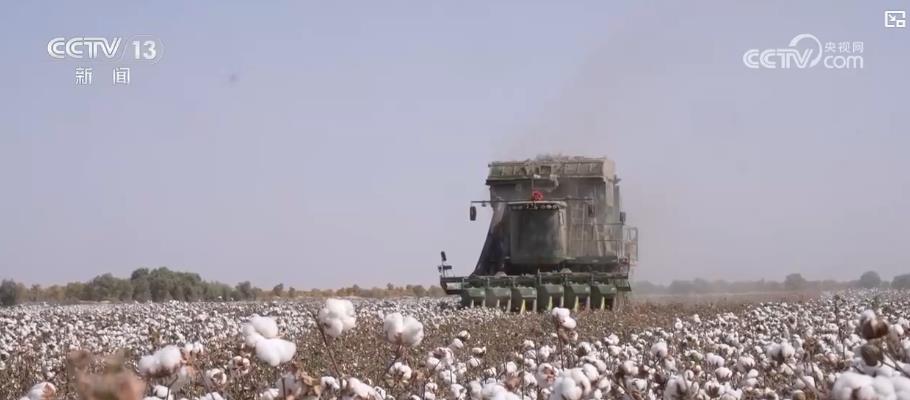
Core Insights - The cotton fields in Tumushuke City, Xinjiang, are experiencing a bountiful harvest due to the promotion of full mechanization and advanced planting techniques such as "dry sowing and wet emergence" [1][5] Group 1: Agricultural Modernization - Tumushuke City has significantly improved its cotton planting and harvesting mechanization rate, which now exceeds 93% [5] - The city has deployed over 260 cotton harvesting machines, which are expected to yield 465,000 tons of seed cotton [6] Group 2: Advanced Planting Techniques - The "dry sowing and wet emergence" technique involves laying drip irrigation tape and plastic film for sowing without winter-spring irrigation, conserving water resources and enhancing cotton yield [5][6] - Each cotton harvesting machine operates on an average area of over 200 acres per day, showcasing the efficiency of mechanized operations [3]