汽车及零部件

Search documents
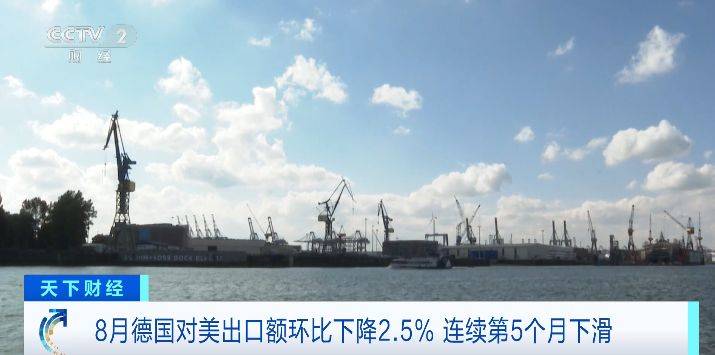
8月德国对美出口额环比下降2.5%,连续第5个月下滑
Sou Hu Cai Jing· 2025-10-10 10:38
Core Points - Germany's exports to the United States fell by 2.5% in August, marking the fifth consecutive month of decline [2][3] - The export value to the U.S. reached €10.9 billion, the lowest level since November 2021, with a year-on-year decrease of 20.1% [3] - The automotive and parts sector is a significant contributor to Germany's trade surplus with the U.S., but U.S. tariffs have pressured exports [3] Trade Situation - The German wholesale and foreign trade association indicated that the external trade situation remains severe, with stagnation persisting for several months [5] - The German federal government’s autumn economic forecast reported a 0.3% decline in GDP for Q2, with continued weak performance expected in Q3 [7] - Economic growth is projected to be modest at 0.2% for the full year of 2025, with potential acceleration to 1.3% starting in 2026, although external uncertainties from U.S. trade policies pose risks [7]

从“华南虎啸星城”看长沙发展生态| 热点面对面
Chang Sha Wan Bao· 2025-10-10 00:32
Core Viewpoint - The gathering of major enterprises in Changsha, such as BYD, Huike, Huawei, Gree, and Guangqi, is a result of the city's enhanced industrial ecosystem and regional competitiveness, reflecting a new trend of "clusterization" and "ecologization" in industrial transfer [7][8]. Group 1: Industrial Ecosystem and Competitiveness - The selection of Changsha by leading companies is driven by the region's complete industrial chain, concentration of innovation resources, and favorable business environment, rather than just cost and policy considerations [7]. - Changsha has accelerated the construction of a modern industrial system, maintaining traditional advantages while advancing into new sectors like artificial intelligence and new energy [7][8]. - The presence of major enterprises has led to a "strong chain and complementary chain" strategy, enhancing the local industrial ecosystem and attracting high-end talent [9][10]. Group 2: Impact of Major Enterprises - The concentration of the "South China Tigers" in Changsha has multi-layered impacts, including the development of supporting enterprises, enhancement of the overall industrial chain, and attraction of high-end talent [9][10]. - Leading companies are establishing collaborative innovation platforms, which facilitate the efficient transformation and application of technological achievements [9][10]. Group 3: Strategic Goals for Changsha - Changsha aims to transition from a factor-driven to an innovation-driven development model, with major enterprises playing a crucial role in forming innovation consortia and enhancing the integration of industry, academia, and research [10]. - The goal of becoming a national advanced manufacturing hub requires a shift from low-end to high-end manufacturing, with leading companies driving the technological advancement of local supporting enterprises [10]. Group 4: Factors Attracting Leading Enterprises - Changsha's advantages include rich talent resources from local universities, a robust transportation network, improved business environment, and comprehensive industrial support [11][12]. - The city has created a talent magnet by offering a favorable living environment and policies that attract young professionals [12]. - Local supply chain integration and high local matching rates for key components enhance the resilience and risk management capabilities of the industrial chain [12][13]. Group 5: Future Development Focus - Future efforts in Changsha should focus on attracting high-end talent, increasing venture capital investment, and optimizing the innovation ecosystem [15]. - Establishing government-led investment funds to support strategic emerging industries like artificial intelligence and new energy is recommended [15]. - Continuous improvement of infrastructure and soft environments, such as intellectual property protection and technology transfer mechanisms, is essential for fostering innovation [15].




中金 | 10月行业配置:超配有色、成长
中金点睛· 2025-10-09 23:56
Core Viewpoint - The market is showing strong structural characteristics, with a focus on growth sectors, and the trend of manufacturing upgrades is expected to create structural investment opportunities in the medium to long term [2][10]. Industry Performance Summary 1) Energy and Basic Materials - Non-ferrous metals continue to rise, while other cyclical products show mixed price performance. In September, the prices of thermal coal, cement index, and glass index increased by 1.3%, 0.6%, and 2.4% respectively, while prices for coking coal, coke, rebar, iron ore, and chemical indices fell by 2.2%, 1.2%, 2.0%, 0.9%, and 1.3% respectively [3]. - The Federal Reserve's 25 basis point rate cut in September aligns with market expectations, leading to a rapid increase in gold prices, while industrial metals and some minor metals (cobalt, tungsten) also saw price increases [3]. 2) Industrial Products - The energy transition supports demand for electrical equipment, and policies aimed at reducing competition are catalyzing price rebounds across various segments of the photovoltaic industry. In August, excavator domestic sales grew by 22% year-on-year, and exports increased by 13% [4]. - The new energy sector is experiencing significant growth, with wind and solar installations increasing by 72% and 65% year-on-year respectively [4]. 3) Consumer Products - The growth rate of home appliance sales has slowed, with sales of washing machines, refrigerators, and air conditioners all showing a 1% year-on-year increase in August. The textile and apparel sectors are also facing challenges in both domestic and overseas demand [5]. - The average daily room rate (ADR), occupancy rate (OCC), and revenue per available room (RevPAR) in the hotel sector all saw year-on-year declines of 0.6%, 1.5%, and 2.1% respectively [5]. 4) Technology - The strong demand for AI computing power continues to be validated, driving growth in sub-sectors such as optical modules, switches, and servers. In July, major cloud service providers adjusted their 2025 capital expenditure guidance upwards [6]. - The semiconductor industry remains robust, with global semiconductor sales increasing by 20.6% year-on-year in July, and China's semiconductor sales growing by 10.4% [6]. 5) Financials - The insurance sector saw a 9.6% year-on-year increase in premium income in August, while the total assets of insurance companies grew by approximately 17.5% year-on-year [7]. - The real estate sector remains at a low point, with a 0.5% year-on-year decline in property sales area in September, despite a slight month-on-month increase [7]. 6) Recommendations - Focus on AI computing and robotics-related industries, which are expected to remain attractive until a significant change in industry conditions occurs [8]. - Consider sectors like innovative pharmaceuticals, consumer electronics, batteries, and non-ferrous metals, which are still in a favorable supply-demand cycle [8]. - Monitor the "14th Five-Year Plan" related fields, especially as the upcoming meeting in October may provide insights into policy directions [8].

【环球财经】德国对美出口连续五个月下降
Xin Hua She· 2025-10-09 14:04
Core Insights - Germany's exports to the United States fell by 2.5% month-on-month in August, marking the fifth consecutive month of decline, primarily due to the impact of U.S. tariffs [1] - Year-on-year, exports to the U.S. decreased by 20.1%, reaching €10.9 billion, the lowest level since November 2021 [1] - Despite an increase in exports to China by 5.4% in August, it is insufficient to offset the negative effects of the tariff crisis on Germany's overall foreign trade [1] Export Performance - The German Federal Statistical Office reported a seasonally and working-day adjusted export decline of 0.5% in August [1] - The automotive and parts industry remains a significant source of surplus for Germany's exports to the U.S. [1] - The decline in exports to the U.S. is attributed to the tariffs imposed on imported cars and other goods, effective since April [1]
德国对美出口连续五个月下降
Xin Hua She· 2025-10-09 13:59
Core Viewpoint - Germany's exports to the United States have been declining for five consecutive months, primarily due to the impact of increased tariffs imposed by the U.S. [1] Export Performance - In August, Germany's exports to the U.S. decreased by 2.5% month-on-month, marking a total decline of 20.1% compared to the same month last year, reaching a low of 10.9 billion euros, the lowest level since November 2021 [1] - Seasonally and working-day adjusted data indicates a 0.5% month-on-month decline in overall German exports in August [1] Trade Relations with China - Despite the decline in exports to the U.S., Germany experienced a 5.4% month-on-month increase in exports to China in August [1] Industry Impact - The automotive and parts sector is a significant source of surplus for Germany's exports to the U.S., but the imposition of tariffs on imported cars and other goods since April has led to a continuous decline in exports to the U.S. [1] - The President of the German Wholesale and Foreign Trade Association, Dirk Jandura, stated that the external trade situation remains severe, with stagnation persisting for several months [1]
什么是出海龙头概念,涵盖哪些产业链
Sou Hu Cai Jing· 2025-10-07 01:12
Core Insights - The concept of "outbound leaders" is gaining attention among investors as more companies seek growth opportunities in overseas markets amid increasing domestic competition and globalization [1][2] - Outbound leaders are defined as industry-leading companies with early overseas business layouts, high market share, strong brand influence, and sustainable expansion capabilities [1] - These companies have typically completed technology accumulation and scale expansion domestically, possessing strong management and financial capabilities to adapt to various international market environments [1] Industry Overview - Outbound leaders span multiple key sectors, with manufacturing being a significant component, including high-end equipment, new energy devices, and automotive parts, leveraging cost-effectiveness and technological advantages to penetrate international markets [1] - The electronics and technology sectors also show strong performance, with companies in communication equipment, consumer electronics, and semiconductors participating in the global supply chain through technological innovation [1] - Digital economy-related enterprises, such as internet platforms, e-commerce services, and digital payment providers, are rapidly expanding their user base overseas by leveraging model output and technological empowerment [1] Support Services - Logistics and supply chain service providers benefit from the outbound wave, offering infrastructure support through cross-border logistics, warehousing, and comprehensive foreign trade service platforms, creating synergistic effects [2] - Professional service institutions in finance, law, and consulting assist companies in navigating challenges related to overseas compliance, exchange rate fluctuations, and cultural differences [2] Investment Perspective - For investors, focusing on outbound leaders is not only about the growth potential of individual companies but also about capturing the long-term trend of Chinese companies enhancing their position in the global value chain [2] - However, overseas operations face multiple risks, including policy changes, exchange rate volatility, and geopolitical factors, necessitating a rational assessment of companies' true competitiveness and risk resilience [2] - Investors are advised to conduct careful analysis based on industry prospects, corporate governance, and the proportion of overseas revenue to avoid blindly chasing trends [2]
“两业融合”出实招 双轮驱动谱新篇
Xin Hua Ri Bao· 2025-09-30 06:57
Core Insights - Jiangdu District is leveraging the national and local push for the integration of advanced manufacturing and modern services, utilizing high-end technology, big data, and industrial internet to enhance business connections and expand industry chains [1][4] Group 1: Industrial Foundation - Jiangdu District has a solid manufacturing base and a thriving modern service sector, making it well-positioned for deep integration trials of the two industries [2] - In 2024, the district's industrial invoiced sales are projected to reach 157.3 billion, with 87 new industrial enterprises added, bringing the total to 1,002, the highest in the city [2] - The district has seen the emergence of 26 new enterprises with invoiced sales exceeding 100 million, and 19 enterprises exceeding 1 billion [2] Group 2: Industry Clusters - Jiangdu is actively developing five major industrial clusters: high-end equipment, high-tech ships and marine engineering, automotive and components, new materials, and new-generation information technology [2] - The district is also fostering ten emerging industrial chains, including robotics, smart grids, and new energy materials, while enhancing modern logistics and technology R&D services [2] Group 3: Development Dynamics - During the 14th Five-Year Plan, Jiangdu has over 600 high-tech enterprises, leading the city in this regard [3] - The district has established 47,000 square meters of technology complexes and four provincial-level incubators, along with 59 new provincial and municipal enterprise service centers [3] Group 4: Policy Framework - Jiangdu has implemented a comprehensive policy framework to support the deep integration of advanced manufacturing and modern services, focusing on high-quality economic development [4] - The district has established a "two-industry integration" work mechanism to clarify tasks and measures for implementation [4] Group 5: Talent and Training - The district is building a reserve of manufacturing enterprises based on revenue and market share, while also identifying service enterprises that focus on R&D and marketing [5] - Regular expert training and business guidance are provided to encourage enterprises to move towards high-end, intelligent, digital, and branded development [5] Group 6: Future Outlook - Jiangdu aims to construct a high-quality and efficient "6+3" service industry system, enhancing integration across organization, services, and industries [6]
特朗普关税下,大众、博世、奥迪、保时捷等德国汽车大厂深陷裁员潮
Di Yi Cai Jing Zi Xun· 2025-09-29 11:23
Core Viewpoint - The recent announcement by the Trump administration to impose a 25% tariff on imported heavy trucks has negatively impacted the already fragile state of the German automotive industry, leading to significant job cuts and restructuring efforts among major manufacturers [2][4]. Group 1: Impact of Tariffs and Economic Conditions - The German automotive sector is struggling with weakened demand, high labor and energy costs, and increased competition from rapidly developing manufacturers, exacerbated by the U.S. tariff policies [4][5]. - Bosch, Germany's largest automotive parts supplier, announced plans to cut 13,000 jobs over the next five years, signaling a critical warning for the German industrial sector [2][9]. - The DAX index's structure is expected to undergo a fundamental shift by 2025, with the automotive and parts industry’s weight dropping from approximately 21% in 2015 to less than 10% [4]. Group 2: Job Cuts and Corporate Restructuring - Major German automotive companies, including Bosch, Continental, Schaeffler, and ZF, are implementing significant layoffs and cost-cutting measures due to ongoing pressures [5][8]. - Volkswagen plans to cut 35,000 jobs in Germany by 2030, while Bosch is set to reduce 18,500 positions, primarily in its mobility and autonomous driving divisions [8]. - The overall German automotive industry has eliminated about 55,000 jobs in the past two years, with projections indicating further job losses in the coming years [7][8]. Group 3: Economic Forecast and Recovery - A joint economic forecast from five major German economic research institutions predicts that Germany's economy will grow by only 0.2% in 2025, hindered by U.S. tariff policies and structural issues [10][11]. - The report highlights that the manufacturing sector's recovery is sluggish, with high energy and labor costs, a shortage of skilled workers, and declining competitiveness limiting growth prospects [11]. - The German government has attempted to boost confidence through increased military spending and a €100 billion "Made in Germany" investment plan, but tangible results have yet to materialize [11][12].

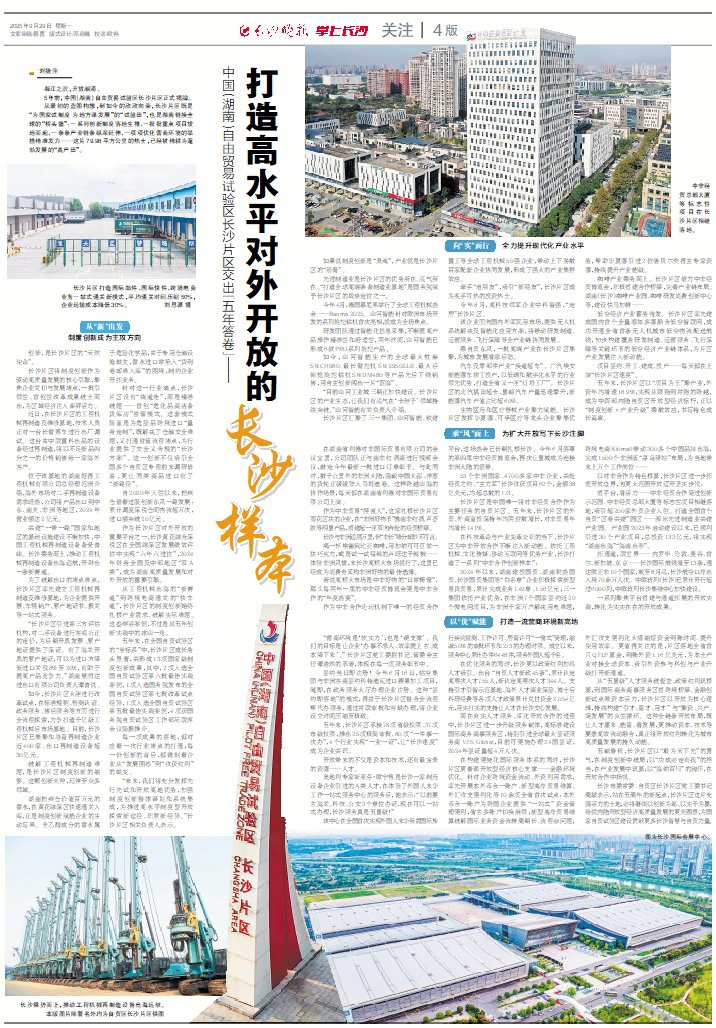
自贺长沙片区五周年答卷:打造高水平对外开放的长沙样本
Chang Sha Wan Bao· 2025-09-28 23:26
Core Viewpoint - The Changsha Free Trade Zone has evolved into a vibrant hub for innovation and economic development, focusing on institutional reforms and industry upgrades to enhance its global competitiveness [8][10][14]. Group 1: Institutional Innovation - Changsha Free Trade Zone prioritizes institutional innovation as a core driver for high-quality development, addressing enterprise concerns and development bottlenecks [10]. - The establishment of a remanufacturing and repair base for construction machinery has facilitated exports to regions like the Middle East and Africa, with projected revenues of 200 million yuan in 2024 [10][11]. - The zone has introduced a regulatory model for hazardous chemicals, enabling rapid customs clearance and addressing industry pain points, leading to significant growth in imports [13][14]. Group 2: Industry Development - Advanced manufacturing is a key strength of the Changsha Free Trade Zone, with a strategic focus on becoming a global high-end equipment manufacturing base [16]. - Major companies like SANY Group and Zoomlion are driving the development of a robust industrial cluster, enhancing competitiveness in the construction machinery sector [16][19]. - The automotive and new energy vehicle sectors are experiencing rapid growth, with GAC Aion's new energy vehicle production contributing to over 60% of the sector's output [19]. Group 3: International Trade and Cooperation - The Changsha Free Trade Zone has established itself as a vital platform for Sino-African trade, achieving an annual growth rate of 141% in trade with Africa [23][24]. - The zone has successfully hosted the China-Africa Economic and Trade Expo, attracting numerous projects and investments, with a total value exceeding 3.8 billion USD [23][24]. - The establishment of international trade routes and logistics networks has enhanced connectivity, with 13 international flight routes and over 6,000 China-Europe freight trains operated [24][25]. Group 4: Business Environment and Talent Attraction - The Changsha Free Trade Zone has implemented streamlined administrative processes, significantly reducing the time required for business registration and approvals [26][27]. - Talent attraction initiatives have led to the recognition of over 755 high-level talents, supported by substantial funding for research and development [27][28]. - Financial innovations, such as the establishment of the first QFLP fund in the province, have facilitated foreign investment and capital flow into local industries [28].
中金研究 | 本周精选:宏观、策略、银行、汽车及零部件
中金点睛· 2025-09-27 00:06
Group 1: Banking Industry - The report tracks the progress of deposit migration from the perspective of financial system liquidity, indicating that the trend of deposit migration continues, reflected in the activation of deposits and increased activity in capital markets, although the pace has slightly slowed down due to three main factors: the front-loaded fiscal and credit monetary supply in the first half of the year, increased investor divergence after the stock market rise, and a slowdown in the return of foreign exchange funds amid export deceleration [5] - The estimated potential for deposit migration remains at 5-7 trillion yuan, suggesting that this trend may continue in the medium term despite the current slowdown [5] Group 2: Macroeconomy - The "14th Five-Year Plan" is a critical period for China's financial cycle and economic transformation, with the "15th Five-Year Plan" expected to enhance supply capacity while addressing debt and demand issues arising from real estate adjustments [7] - To maintain GDP growth within a certain range, a rebalancing of supply and demand is necessary, particularly in boosting demand through debt resolution, consumption promotion, and fiscal reforms [7] - Policies aimed at stimulating demand may also benefit supply in the long term, with a focus on technological innovation and the internationalization of the renminbi amid changes in the international monetary system [8] Group 3: Strategy - In August, while A-shares, particularly the STAR Market, were strong, Hong Kong stocks remained stagnant. However, in September, A-shares entered a phase of fluctuation while Hong Kong stocks gained momentum, supported by expectations of Federal Reserve easing and AI internet developments [10] - The report discusses the potential for market leadership among the three regions (China, Hong Kong, and the US) and identifies which industries may offer greater value [10] Group 4: Automotive and Components Industry - The trend towards liquid cooling solutions in data centers is driving increased demand for liquid cooling components, with domestic automotive parts companies leveraging their capabilities in thermal management to expand into this market [14] - The rise in AI chip power consumption is accelerating the application of liquid cooling solutions, enhancing the demand for core components like quick-connect fittings (UQD) [14] - The domestic supply chain possesses cost advantages and significant potential for domestic substitution in the liquid cooling market [14]