
虚拟货币

Search documents
【首席观察】首提稳定币非法风险 13部门为何此时升级虚拟货币监管
Sou Hu Cai Jing· 2025-11-30 07:54
Core Viewpoint - The recent joint meeting of 13 departments in China marks a significant escalation in the regulation of virtual currencies, particularly focusing on stablecoins as a form of illegal financial activity, indicating a shift from risk prevention to criminalization of such activities [2][3][8]. Regulatory Focus - The meeting signals a shift in regulatory focus from "mining and speculation risks" in 2021 to "cross-border capital flows and shadow dollars" in 2025 [5][6]. - Stablecoins, particularly USDT, are identified as a major gray channel for capital outflow, with USDT accounting for approximately 90% of OTC transactions in China [6][8]. Systemic Risks - S&P downgraded USDT's stability rating to "weak," citing an increase in high-risk assets from 17% to 24%, with Bitcoin comprising 5.6% of its reserves [9][10]. - USDT's circulation has approached $184 billion, creating a "shadow dollar pool" with systemic risks due to its high volatility and low collateralization [9][10]. Shadow Banking Concerns - Tether, the issuer of USDT, is becoming akin to a "shadow central bank," with significant holdings in gold and other commodities, raising concerns about its influence on global price chains [10][11]. - The increase in Tether's gold reserves, which reached approximately 116 tons, poses structural risks for countries pursuing "de-dollarization" [10][12]. Regulatory Evolution - The regulatory approach has evolved from defining virtual currencies as illegal to explicitly categorizing stablecoins as illegal financial activities, aiming to protect capital account management and monetary sovereignty [13][14]. - The regulatory logic remains consistent: virtual currencies are illegal, stablecoins fall under this category, and their cross-border and gray uses must be curtailed to pave the way for the digital yuan (e-CNY) [14][19]. Enforcement Mechanisms - The regulatory framework will involve enhanced collaboration among various government agencies to monitor and control information and capital flows, aiming to block illegal activities [20][21]. - Criminalization of stablecoin transactions may extend to charges related to money laundering and aiding cybercrime, increasing the legal risks for individuals and institutions involved [21][22]. Global Implications - The tightening of regulations in China is expected to raise compliance pressures for institutions and increase the risks associated with gray channels for individuals [22][23]. - The global landscape for stablecoins is entering a "second phase," with heightened awareness and regulatory responses to the risks posed by these financial instruments [22][23].


央行定调稳定币违法,相比欧美中国为何走“禁止”这条路?| 马上评
Sou Hu Cai Jing· 2025-11-30 06:34
Core Viewpoint - The People's Bank of China has officially classified stablecoins as a form of virtual currency that poses risks related to money laundering and illegal financial activities, reinforcing its strict prohibition policy on virtual currencies [1][6][8]. Summary by Sections Regulatory Approach - China adopts a prohibition model to cut off the circulation of stablecoins, contrasting sharply with the regulatory frameworks being developed in Europe and the U.S. that aim to incorporate stablecoins into existing financial regulations [1][9][14]. - The Chinese government emphasizes the need to protect monetary sovereignty and prevent any form of private digital currency from undermining the central bank's authority [7][14]. Stablecoin Characteristics - Stablecoins are cryptocurrencies pegged to fiat currencies or other assets, designed to maintain price stability, and are often used for cross-border payments and asset preservation [3][4]. - The inherent anonymity of blockchain technology poses challenges for anti-money laundering efforts, making it difficult to trace transactions back to individuals [4][6]. Risks and Challenges - The use of stablecoins for illegal activities, such as money laundering and capital flight, has been highlighted by recent cases, including a significant illegal currency exchange operation involving stablecoins [5][6]. - The potential for stablecoins to create systemic risks, particularly in economies with strict capital controls, raises concerns about their impact on monetary policy and financial stability [4][6][14]. International Regulatory Landscape - The U.S. and EU are developing regulatory frameworks that balance innovation with consumer protection, while China maintains a strict ban on stablecoins [9][10][12]. - The U.S. has introduced the GENIUS Act, which provides a legal framework for stablecoin issuance and trading, while the EU's MiCA regulation establishes clear operational standards for stablecoin issuers [9][10]. Implications for Financial Innovation - China's prohibition model may hinder financial technology innovation and limit opportunities in cross-border payments and digital finance [14][16]. - The lack of a regulatory framework for stablecoins in China could push demand into unregulated areas, creating new risks [16][17]. Need for International Coordination - The cross-border nature of stablecoins necessitates international cooperation to effectively manage risks and prevent regulatory arbitrage [17]. - Establishing early warning and emergency response mechanisms at the international level is crucial to address potential systemic risks posed by stablecoins [17].

央行:继续坚持对虚拟货币的禁止性政策,持续打击虚拟货币相关非法金融活动|快讯
Sou Hu Cai Jing· 2025-11-29 10:43
Core Viewpoint - The People's Bank of China (PBOC) is intensifying efforts to combat virtual currency trading speculation and illegal activities, emphasizing that virtual currencies do not hold legal status equivalent to fiat currencies and should not circulate in the market [1] Group 1: Regulatory Actions - A meeting was held on November 28 by the PBOC to coordinate efforts against virtual currency trading speculation [1] - The PBOC highlighted that recent factors have led to a resurgence in virtual currency speculation and related illegal activities, presenting new challenges for risk prevention [1] - The meeting reaffirmed the commitment to a prohibitive policy on virtual currencies and the continuous crackdown on illegal financial activities related to them [1] Group 2: Legal and Compliance Issues - The PBOC stated that virtual currencies, including stablecoins, do not meet requirements for customer identity verification and anti-money laundering, posing risks for illegal activities such as money laundering and fundraising fraud [1] - The meeting called for enhanced collaboration among various regulatory bodies to improve regulatory policies and legal frameworks, focusing on key areas such as information flow and capital flow [1][2]
央行首次重磅定调稳定币,市场将向何处去?
Sou Hu Cai Jing· 2025-11-29 10:43
11月29日,中国人民银行官方发布文章《打击虚拟货币交易炒作工作协调机制会议召开》,对于虚拟货 币及稳定币进行了最新论述。 文章对稳定币进行了最新定调,"稳定币是虚拟货币的一种形式,目前无法有效满足客户身份识别、反 洗钱等方面的要求,存在被用于洗钱、集资诈骗、违规跨境转移资金等非法活动的风险。" 如上述文章提到的,今年以来,打着稳定币旗号的集资诈骗案件频现。深圳、北京、苏州、浙江等地金 融监管机构曾一度密集发布风险提示,警惕以"稳定币"等新兴概念为噱头的非法金融活动。蚂蚁集团、 京东等公司也曾公开辟谣涉及其公司的稳定币诈骗事件。 近几个月来,关于稳定币的讨论和事件非常活跃,以下做了不完全梳理: 今年6月,多家互联网巨头及上市公司宣布将在港申请稳定币牌照。6月18日,中国人民银行行长潘功胜 在2025陆家嘴论坛上发表主题演讲,涉及稳定币的表述为: "区块链和分布式账本等新兴技术推动央行数字货币、稳定币蓬勃发展,实现了"支付即结 算",从底层重塑传统支付体系,大幅缩短跨境支付链条,同时对金融监管也提出了巨大的 挑战。智能合约、去中心化金融等技术也将持续推动跨境支付体系的演进和发展。" 一位知名WEB 3行业律师向 ...
我国将持续打击虚拟货币相关非法金融活动
Xin Hua She· 2025-11-29 08:50
2021年中国人民银行等十部门联合发布《关于进一步防范和处置虚拟货币交易炒作风险的通知》要 求,坚决打击虚拟货币交易炒作,整顿虚拟货币乱象。 新华社北京11月29日电(记者吴雨、任军)记者11月29日从中国人民银行获悉,我国将继续坚持对 虚拟货币的禁止性政策,持续打击虚拟货币相关非法金融活动,保护人民群众财产安全。 记者了解到,中国人民银行日前召开打击虚拟货币交易炒作工作协调机制会议。会议指出,近期, 受多种因素影响,虚拟货币投机炒作有所抬头,相关违法犯罪活动时有发生,风险防控面临新形势、新 挑战。 会议强调,虚拟货币不具有与法定货币等同的法律地位,不具有法偿性,不应且不能作为货币在市 场上流通使用,虚拟货币相关业务活动属于非法金融活动。 针对稳定币,会议明确指出,目前稳定币无法有效满足客户身份识别、反洗钱等方面的要求,存在 被用于洗钱、集资诈骗、违规跨境转移资金等非法活动的风险。 会议要求各单位要深化协同配合,完善监管政策和法律依据,聚焦信息流、资金流等重点环节,加 强信息共享,进一步提升监测能力,严厉打击违法犯罪活动,维护经济金融秩序稳定。 ...
逼近9.2万美元!比特币冲高位却有10万人爆仓,是狂欢还是陷阱?
Sou Hu Cai Jing· 2025-11-28 04:13
Core Viewpoint - The cryptocurrency market experienced a dramatic event on November 28, 2025, where Bitcoin surged to a peak of $91,800, but within 24 hours, nearly 100,000 traders faced liquidation, resulting in a loss of $547 million in principal. This paradox of rising prices coinciding with significant losses raises questions about market dynamics and institutional behavior [1][3]. Group 1: Market Dynamics - Bitcoin's price rose sharply from mid-November, reaching $91,800 before a sudden drop to $86,000, showcasing volatility with over 6% fluctuation in a few hours [3][5]. - Among the 100,000 liquidated positions, 80% were long positions, indicating that most traders were betting on further price increases [3][5]. - Institutional investors have been withdrawing from Bitcoin ETFs, with $3.5 billion exiting in November alone, including $2.2 billion from the popular BlackRock IBIT fund, marking the worst redemption month since its inception [3][5][8]. Group 2: Contributing Factors - The recent Bitcoin price surge is attributed to three main factors: 1. The halving event in April reduced the daily issuance of new Bitcoins from 1,800 to 900, leading to a scarcity in supply [5][6]. 2. The outflow of ETF funds indicates a shift in institutional sentiment, with estimates suggesting that a $1 billion outflow could lead to a 3.4% price drop, yet the market continued to rise due to retail investors absorbing the risk [8][9]. 3. High leverage among retail investors has amplified risks, with those using 10x leverage facing total loss on a mere 10% price drop, leading to widespread liquidations during market volatility [9][11]. Group 3: Future Outlook - The market is currently polarized between optimistic and pessimistic views. Optimists point to Bitcoin's realized market cap exceeding $900 billion and potential price targets of $150,000 by year-end, viewing recent corrections as temporary [11][12]. - Conversely, pessimists highlight extreme fear in the market, with the fear and greed index at 15, suggesting a potential 25% drop in Bitcoin's price, alongside increasing regulatory scrutiny [11][12]. - The future price trajectory of Bitcoin will depend on two critical factors: the return of ETF funds and the regulatory environment, which remains uncertain [12].
小震,预告
Xin Lang Cai Jing· 2025-11-27 13:07
Group 1 - The US financial market experienced a rare observation period during the Thanksgiving holiday, revealing the true "risk appetite structure" globally [2] - A-shares did not follow the overnight rise of US stocks, closing mixed, while gold slightly declined and briefly fell below $4150 [2] - The 10-year US Treasury yield rose above 4%, indicating a significant market shift, while Bitcoin surpassed 91,000 yuan [2] Group 2 - The MSCI global index previously dropped nearly 4%, but the decline has now reduced to 0.4%, indicating a recovery of previously pessimistic sentiment [2] - The market is currently pricing in a rate cut in December and three cuts next year, which could lead to volatility if economic data does not align with these expectations [2] - The real risk lies not in whether the Fed will cut rates, but in whether it will meet the market's "pricing fantasy" [2] Group 3 - The upcoming Fed meeting on December 10 is expected to have significant implications for both short-term and long-term market dynamics [4] - A critical stock in China has shown signs of change, coinciding with an unusual report released by Goldman Sachs [4] - Multiple reports from Wall Street are analyzing A-shares, US stocks, and gold, questioning the sustainability of the US bull market and the narrative surrounding A-shares [4]
纪念我损失的70万
Sou Hu Cai Jing· 2025-11-24 04:46
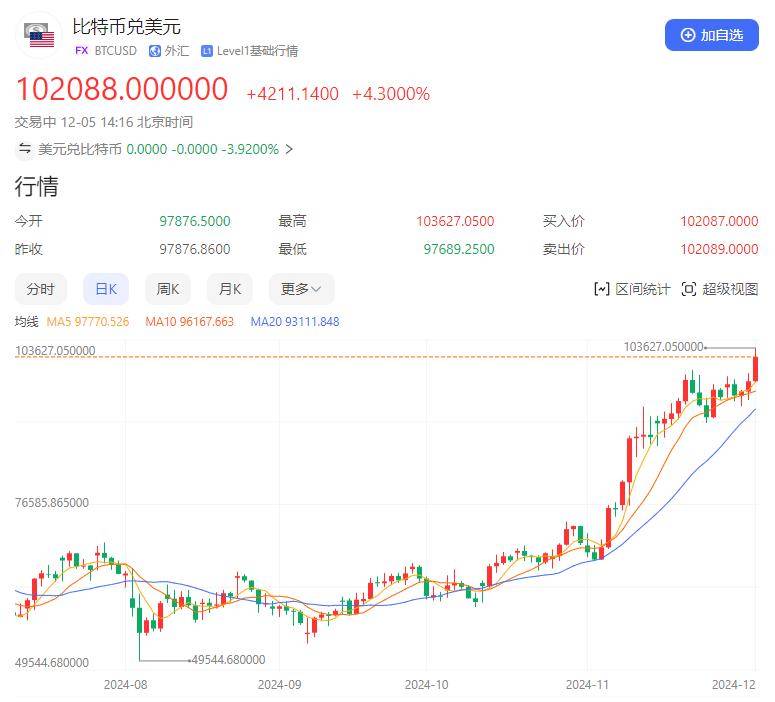
Core Viewpoint - Bitcoin has recently surged in price, reaching over $100,000 for the first time, driven by market speculation and notable endorsements, including from political figures like Trump [1][42]. Group 1: Bitcoin Price Surge - Bitcoin's price increased by nearly 40% this year, particularly after Trump's election victory [1]. - As of December 5, Bitcoin's price surpassed $100,000, equivalent to over 700,000 RMB [3]. Group 2: Historical Context and Personal Experience - The author recounts purchasing Bitcoin for approximately 4,000 RMB a decade ago, highlighting the dramatic price increase to over 50,000 RMB before selling [17][49]. - The narrative emphasizes the importance of understanding the technology and market dynamics behind Bitcoin, including its decentralized nature and the role of blockchain technology [24][34]. Group 3: Market Perception and Consensus - The value of Bitcoin is largely driven by collective belief and consensus, similar to the value of gold [21][22]. - Bitcoin's attributes, such as limited supply and divisibility, contribute to its potential as a currency [24][26]. Group 4: Regulatory Environment - The regulatory landscape for Bitcoin has evolved, with various announcements from Chinese authorities aimed at controlling its use and preventing risks [12][14]. - Despite regulatory challenges, Bitcoin has gained traction as a digital asset, with increasing recognition from individuals and some governments [38][39]. Group 5: Future Considerations - The potential for Bitcoin to become a widely accepted currency remains uncertain, as it could disrupt traditional monetary systems [45]. - The discussion reflects on the importance of maintaining an open mindset in a rapidly changing financial landscape [50].
黑天鹅突袭,亚太市场开盘集体杀跌
Zheng Quan Shi Bao· 2025-11-14 01:44
Group 1 - The Nikkei 225 index opened down 1.3% and expanded its intraday decline to 2%, with SoftBank dropping 9% [1] - The cryptocurrency market experienced significant declines, with Bitcoin falling to $98,990.7, a nearly 3% drop in 24 hours, and Ethereum dropping nearly 6% to around $3,200 [1] - The primary reason for the market sell-off is attributed to a collective hawkish stance from Federal Reserve officials [2] Group 2 - Federal Reserve officials, including San Francisco Fed President Mary Daly, emphasized the importance of maintaining the 2% inflation target, indicating it is too early to decide on interest rate cuts [2] - Cleveland Fed President Loretta Mester and St. Louis Fed President James Bullard also supported maintaining stable interest rates to apply pressure on inflation [2] - The resignation of Atlanta Fed President Raphael Bostic raised concerns about the independence of the Fed, prompting a collective response from other officials [2][3] Group 3 - Chinese securities firms noted that monthly financial data indicates a continued shift of household deposits away from banks, which is a positive signal for the market [4] - South Korea's finance minister announced measures to stabilize the currency market amid concerns over the depreciation of the Korean won [4] - Japan's Prime Minister, Fumio Kishida, indicated a shift in fiscal policy focus towards increasing government spending rather than improving public finances, which may lead to economic stimulus measures [4]
黑天鹅,突袭!
Zheng Quan Shi Bao Wang· 2025-11-14 01:30
Core Viewpoint - The significant decline in the Asia-Pacific markets is primarily attributed to a collective hawkish stance from Federal Reserve officials, which has raised concerns about future interest rate policies and market stability [2] Group 1: Market Reactions - On November 14, the Nikkei 225 index opened down 1.3%, while the Seoul Composite Index fell by 2.6%, with the Nikkei's intraday decline expanding to 2% and SoftBank dropping by 9% [1] - Cryptocurrencies also experienced a sharp decline, with Bitcoin falling to $98,990.7, a nearly 3% drop in 24 hours, Ethereum dropping close to 6% to around $3,200, and Dogecoin decreasing by nearly 4% [1] Group 2: Federal Reserve's Stance - Several Federal Reserve officials, including San Francisco Fed President Mary Daly, emphasized the importance of maintaining the 2% inflation target, indicating that it is too early to decide on potential interest rate cuts in December [2] - Cleveland Fed President Loretta Mester and St. Louis Fed President James Bullard also supported a cautious approach to rate cuts, highlighting that current inflation remains above the Fed's target [2][3] Group 3: Regional Responses - The South Korean Finance Minister announced plans to stabilize the currency market amid concerns over the depreciation of the won, indicating a need to address foreign exchange supply and demand imbalances [5] - In Japan, Prime Minister Fumio Kishida expressed a shift in fiscal policy goals, suggesting a focus on increasing government spending rather than solely improving public finances, which may lead to potential tax cuts in the future [5] Group 4: Market Insights - China Galaxy Securities noted that monthly financial data indicates a continued trend of residents moving deposits, which could signal a positive market effect worth monitoring [4]