
高技术制造业

Search documents
中经评论:减税降费精准发力,要提质更要持续
Sou Hu Cai Jing· 2025-08-03 00:07
Group 1 - The cumulative tax cuts and fee reductions in China from 2021 to the first half of this year reached 9.9 trillion yuan, expected to reach 10.5 trillion yuan by the end of this year, averaging over 2 trillion yuan annually [1] - Tax cuts and fee reductions are crucial for reducing the burden on enterprises and stimulating market vitality, allowing more funds for reinvestment and enhancing the multiplier effect of investments [1][2] - Structural tax cuts aim to allocate more resources to critical areas for national development, supporting the construction of a modern industrial system, with significant tax incentives for R&D expenditures [1] Group 2 - The manufacturing sector is a key focus of structural tax cuts, with measures like lowering VAT rates and increasing VAT refunds, contributing to the growth of manufacturing enterprises [2] - From 2021 to 2024, the sales revenue of manufacturing enterprises is expected to maintain around 29% of total enterprise sales, with high-end and high-tech manufacturing sectors showing annual growth rates of 9.6% and 10.4% respectively [2] - Tax cuts not only expand production and exchange but also enhance resource allocation efficiency and support the construction of a unified national market [2] Group 3 - The emphasis on improving the quality and efficiency of tax policies is essential, with a focus on utilizing tax data to better implement policies and support innovation and manufacturing [3] - Future tax policies should be refined to support foundational R&D and the transformation of technological achievements, particularly in emerging sectors like new energy and robotics [3] - The approach of using tax reductions to enhance enterprise efficiency and market vitality is a vital pathway for promoting high-quality economic development in China [3]
横琴上半年外贸增长101.5%,工业投资同比增长298.5%
2 1 Shi Ji Jing Ji Bao Dao· 2025-08-02 03:29
Economic Performance - The Hengqin Guangdong-Macao Deep Cooperation Zone achieved a GDP of 26.313 billion yuan in the first half of the year, with a year-on-year growth of 5.0% [1] - The secondary industry saw a decrease in added value by 34.0%, amounting to 2.466 billion yuan, while the tertiary industry increased by 12.1%, reaching 23.847 billion yuan [1] - The industrial added value above designated size declined by 9.7%, but the decline was narrowed by 13 percentage points compared to the first quarter [1] Sector Performance - The specialized equipment manufacturing industry grew by 31.6%, and high-tech manufacturing added value increased by 8.2% [1] - The service sector's added value of 23.847 billion yuan contributed 7.7 percentage points to GDP growth, with significant increases in wholesale and retail (27.3%), information transmission, software and IT services (21.9%), and leasing and business services (12.9%) [1] Consumer Market - The total retail sales of consumer goods reached 2.459 billion yuan, growing by 42.1%, with a notable increase in home appliances and audio-visual equipment retail sales by 171.7% [2] - Fixed asset investment decreased by 27.9%, but the decline was less severe than in the first quarter, with the secondary industry investment surging by 298.5% [2] - The total import and export volume reached 22.481 billion yuan, marking a significant year-on-year growth of 101.5% [2] Fiscal Performance - The general public budget revenue was 5.407 billion yuan, down by 3.0%, while expenditures increased by 20.4% to 7.801 billion yuan, with 69.2% allocated to livelihood spending [2] Foreign Investment - The number of Australian-funded entities in the cooperation zone reached 7,346, a year-on-year increase of 14.6%, accounting for 12.3% of all operating entities [3]
中国经济新看点丨地区经济发展稳中有进
Jing Ji Ri Bao· 2025-08-02 00:29
Economic Performance Overview - All 31 provinces in China have reported their economic data for the first half of the year, showing resilience and steady growth despite a complex environment, with 22 provinces achieving growth rates at or above the national average of 5.3% [1][2] - Tibet led the growth with a rate of 7.2%, while several provinces such as Gansu (6.3%), Hubei (6.2%), and Zhejiang (5.8%) also showed strong performance [2] Regional Economic Contributions - The top ten provinces by GDP in the first half of the year include Guangdong (68,725.4 billion), Jiangsu (66,967.8 billion), and Shandong (50,046 billion), with Guangdong maintaining its position as the largest economy [3] - The total import and export value of Guangdong, Jiangsu, Zhejiang, Shanghai, and Shandong accounted for 64.1% of the national total, reflecting a year-on-year growth of 4.8% [3] Policy and Investment Trends - Policies aimed at boosting domestic demand and technological upgrades have been implemented, with significant increases in equipment investment in Beijing (99% growth) and retail sales in Zhejiang showing over 60% growth in certain categories [4][5] - The manufacturing sector has seen robust growth, with high-tech manufacturing in Fujian growing by 16.8%, and significant contributions from the aerospace and electronics sectors in Jiangsu [5] Industrial Development and Innovation - In the Northeast, traditional industries are transforming, with significant growth in the manufacturing of transportation equipment in Liaoning [6] - Modern service industries are also thriving, with information technology services in Beijing growing by 11.1% [6] Future Economic Strategies - Provinces are focusing on expanding domestic demand, developing new productive forces, and enhancing reforms to ensure sustainable economic growth in the second half of the year [7][8] - Specific strategies include Guangdong's emphasis on consumption, investment, and export, and Jiangsu's focus on building a unified market and enhancing technological innovation [8][9]
地区经济发展稳中有进
Jing Ji Ri Bao· 2025-08-01 21:58
Economic Performance Overview - All 31 provinces in China have reported their economic data for the first half of the year, showing resilience and steady growth despite a complex environment, with 22 provinces achieving growth rates at or above the national average of 5.3% [1][2] - Tibet led the growth with a rate of 7.2%, while several provinces such as Gansu (6.3%), Hubei (6.2%), and Zhejiang (5.8%) also showed strong performance [2] Regional Economic Contributions - The top ten provinces by GDP in the first half of the year included Guangdong (68,725.4 billion), Jiangsu (66,967.8 billion), and Shandong (50,046 billion), with Guangdong maintaining its position as the largest economy [3] - The total import and export value of Guangdong, Jiangsu, Zhejiang, Shanghai, and Shandong accounted for 64.1% of the national total, reflecting a year-on-year growth of 4.8% [3] Policy and Investment Trends - Policies aimed at boosting domestic demand and technological upgrades have been implemented, with significant increases in equipment investment in Beijing (99% growth) and retail sales in Zhejiang showing over 60% growth in certain categories [4][5] - The manufacturing sector has seen robust growth, with provinces like Anhui and Hunan reporting increases in industrial output and profits exceeding national averages [4][5] Emerging Industries and Innovations - In the eastern region, industries such as artificial intelligence and high-tech manufacturing in provinces like Zhejiang and Fujian have shown double-digit growth [5] - The western provinces are also advancing, with Sichuan reporting substantial increases in the production of new energy vehicles and solar batteries [5] Future Economic Strategies - Provinces are focusing on expanding domestic demand, enhancing new productivity, and deepening reforms to ensure sustainable economic growth in the second half of the year [7][8] - Specific strategies include Guangdong's emphasis on consumption, investment, and exports, while Jiangsu aims to enhance its market and innovation capabilities [8][9]
国家发改委最新部署,信息量大
Sou Hu Cai Jing· 2025-08-01 14:56
Economic Policy and Investment - The National Development and Reform Commission (NDRC) has completed the allocation of 800 billion yuan for "two heavy" construction projects and 231 billion yuan for long-term special government bonds to support the replacement of consumer goods [1][3] - The central budget investment of 735 billion yuan has also been largely allocated, indicating a strong push to stabilize investment and promote consumption [3] - The NDRC plans to accelerate the establishment of new policy financial tools to encourage private enterprises to participate in major national projects [3] Consumption Promotion - The third batch of 690 billion yuan in special government bond funds for consumer goods replacement has been allocated, with plans for a fourth batch in October, aiming to meet the annual target of 300 billion yuan [4] - The replacement initiative has already driven sales exceeding 1.7 trillion yuan, with significant growth in retail sales of home appliances and new energy vehicles [4] - Future policies will focus on enhancing consumer spending, particularly for low-income groups and the elderly, while improving consumption infrastructure [4][5] Artificial Intelligence and New Economic Drivers - The State Council has approved the implementation of the "Artificial Intelligence+" initiative, which aims to integrate AI into various sectors to foster new economic growth [7] - High-tech manufacturing has seen a 9.5% increase in value added, outpacing overall industrial growth, indicating a shift towards advanced manufacturing [7][8] - The initiative will also focus on optimizing the innovation ecosystem for AI and promoting its commercial applications [7] Market Regulation and Competition - The establishment of a unified national market is progressing, with logistics costs as a percentage of GDP decreasing to 14%, the lowest recorded [10] - The NDRC plans to introduce policies to regulate market behavior, including measures against unfair competition and low-price dumping [11] - There is a focus on enhancing industry self-regulation and promoting industrial upgrades to combat issues of "involution" and market disorder [11]


7月份制造业PMI回落 经济总体产出保持扩张
Jing Ji Ri Bao· 2025-08-01 07:04
Group 1: Manufacturing Sector - In July, the Manufacturing Purchasing Managers' Index (PMI) dropped to 49.3%, a decrease of 0.4 percentage points from the previous month, indicating a contraction in manufacturing activity [1] - The new orders index for manufacturing was at 49.4%, down 0.8 percentage points from last month, reflecting weakened market demand [1] - Despite the short-term slowdown, the production index remained at 50.5%, indicating expansion for three consecutive months [1] Group 2: Non-Manufacturing Sector - The Non-Manufacturing Business Activity Index was at 50.1%, down 0.4 percentage points from the previous month, but still above the critical point [4] - The construction sector experienced a slowdown, with the business activity index at 50.6%, a decrease of 2.2 percentage points [4] - Service sector activity remained stable, with the business activity index at 50%, a slight decline of 0.1 percentage points [4] Group 3: Price Trends - The main raw materials purchasing price index rose to 51.5%, an increase of 3.1 percentage points, marking the first rise above the critical point since March [2] - The ex-factory price index was at 48.3%, up 2.1 percentage points, indicating an overall improvement in manufacturing market prices [2] Group 4: Business Expectations - Manufacturing enterprises showed optimism for future market conditions, with the production and business activity expectation index at 52.6%, an increase of 0.6 percentage points from last month [3] - Non-manufacturing enterprises maintained a stable optimistic outlook, with the business activity expectation index at 55.8%, up 0.2 percentage points [4]
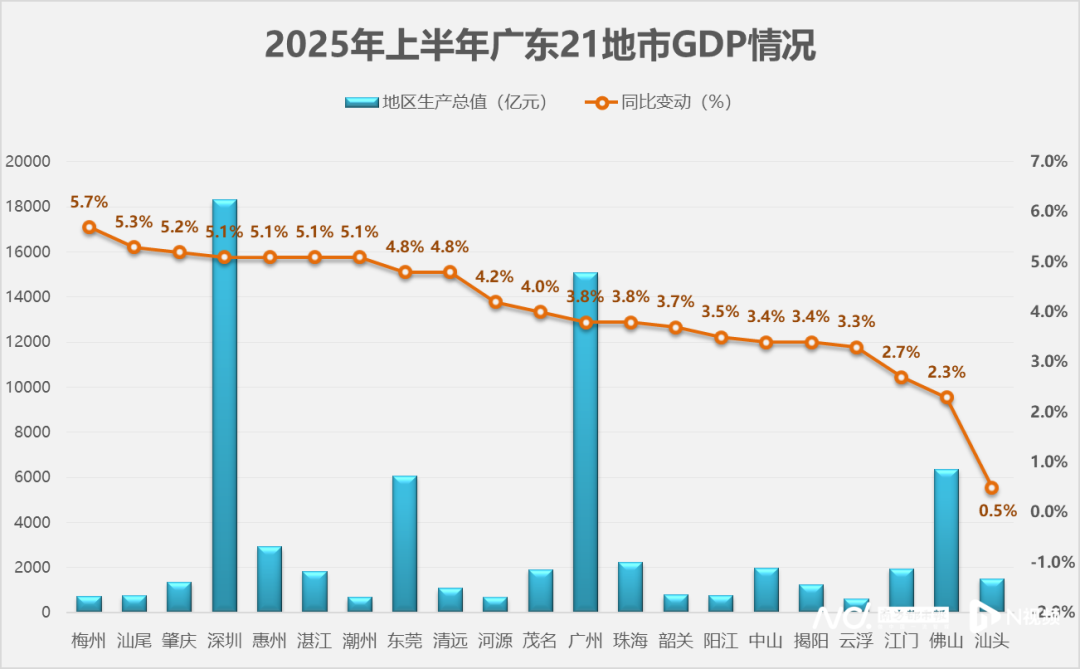
广东21地市,上半年GDP出炉!深圳总量领跑
Nan Fang Du Shi Bao· 2025-08-01 03:35
Economic Overview - As of July 31, all 21 cities in Guangdong have released their economic "half-year reports" for 2025, with Shenzhen, Guangzhou, Foshan, Dongguan, and Huizhou maintaining a leading position, each exceeding a GDP of 1.5 trillion yuan in the first half of the year [1] - The overall GDP growth rate for the province is 4.2%, with Meizhou leading at 5.7%, followed by Shanwei at 5.2% and Zhaoqing at 5.2% [1] Industrial Growth - Nine cities reported industrial growth rates exceeding the provincial average of 4.0%, with Huizhou and Zhanjiang showing remarkable performance, both exceeding 10% growth in industrial added value [3][6] - Huizhou's industrial added value grew by 11.2%, with advanced manufacturing and high-tech manufacturing increasing by 11.2% and 15.3%, respectively [6] - Zhanjiang's industrial added value increased by 10.2%, with significant contributions from key industrial enterprises, leading to a GDP growth from 3% to 5.1% [6] New Growth Drivers - New energy industries are driving industrial growth across various cities, with Zhaoqing's advanced manufacturing growing by 17.6% and Dongguan's advanced and high-tech manufacturing increasing by 7.5% and 9.1%, respectively [7] - Shenzhen's production of civilian drones, industrial robots, and 3D printing equipment saw substantial increases of 59.0%, 38.0%, and 35.8% [7] Investment Trends - Industrial investment in cities like Maoming, Guangzhou, and Shanwei is robust, with Maoming's industrial investment growing by 34.5% and advanced manufacturing investment soaring by 90.2% [8] - Infrastructure investment is also on the rise, with several cities reporting double-digit growth rates, particularly Chaozhou at 36.4% [8] Foreign Trade - Shenzhen leads the province in foreign trade, with a total import and export value of 2.17 trillion yuan, accounting for nearly half of the province's total [10] - Zhaoqing's foreign trade grew by 16.7%, the highest in the province, with significant increases in exports to Belt and Road countries [13] Income Disparity - Rural residents' income growth outpaces that of urban residents, with several cities reporting rural income growth rates above 6% [15] - The income disparity between urban and rural residents is narrowing, with Guangzhou's ratio improving from 2.01:1 to 1.96:1 [16] Consumer Market Recovery - The consumer market is recovering, with Guangzhou's retail sales reaching 561.12 billion yuan, a year-on-year increase of 5.9% [17] - Huizhou and Zhuhai also reported retail sales growth of 5.5% and 5.0%, respectively, with significant increases in specific categories such as home appliances [17]
经济总体产出保持扩张
Jing Ji Ri Bao· 2025-08-01 01:47
Economic Overview - The overall economic output in China continues to expand, despite fluctuations due to extreme weather conditions and a weak demand side [2][4]. Manufacturing Sector - In July, the Manufacturing Purchasing Managers' Index (PMI) dropped to 49.3%, a decrease of 0.4 percentage points from the previous month, indicating a contraction in manufacturing activity [2]. - The new orders index for manufacturing was at 49.4%, down 0.8 percentage points, while the production index remained at 50.5%, indicating continued expansion for three consecutive months [2]. - High-tech manufacturing and equipment manufacturing PMIs were 50.6% and 50.3%, respectively, both above the critical point, showing sustained growth in these sectors [2]. Price Trends - The purchasing price index for major raw materials rose to 51.5%, marking the first increase above the critical point since March, while the factory price index was at 48.3% [3]. - Industries such as petroleum, coal, and black metal processing saw significant improvements in their purchasing and factory price indices [3]. Business Activity in Non-Manufacturing Sector - The non-manufacturing business activity index was at 50.1%, down 0.4 percentage points, but still above the critical point [5]. - The construction sector experienced a slowdown, with its business activity index at 50.6%, a decrease of 2.2 percentage points [5]. - Service sector activity remained stable, with a business activity index of 50%, slightly down by 0.1 percentage points [5]. Future Outlook - Manufacturing enterprises maintain a positive outlook, with the production and business activity expectation index rising to 52.6%, an increase of 0.6 percentage points from the previous month [4]. - Non-manufacturing enterprises also show stable optimism, with a business activity expectation index of 55.8%, up 0.2 percentage points [5].
媒体报道 | 这场会议释放的信号事关中国经济大局
Yang Shi Xin Wen· 2025-08-01 00:58
Group 1 - The core viewpoint of the Central Political Bureau meeting on July 30 is the assessment of the current economic situation and the deployment of economic work for the second half of the year, emphasizing both immediate needs and long-term strategies [1][2] - The meeting highlighted that China's economy is showing strong vitality and resilience, with GDP growth of 5.3% year-on-year, surpassing expectations, and positive performance in consumption, investment, and foreign trade [1][2] - The meeting's language shifted from "the economy shows a favorable trend" to "consolidate and expand the economic recovery," indicating a stronger confirmation of the recovery momentum [3] Group 2 - The meeting reiterated the importance of "stabilizing employment, enterprises, markets, and expectations," reflecting continuity and stability in policy while emphasizing flexibility and foresight [4] - The macroeconomic policy framework for the second half of the year is characterized by "sustained efforts and timely increases," indicating ongoing implementation of existing policies and the introduction of new measures as needed [4] - Specific monetary and fiscal policies will focus on more proactive fiscal measures and moderately loose monetary policies, with an emphasis on effective implementation to maximize policy effects [5] Group 3 - Key areas for structural monetary policy support include technology innovation, boosting consumption, small and micro enterprises, and stabilizing foreign trade, addressing real challenges in the economy [5] - The meeting also emphasized the need to expand commodity consumption and cultivate new growth points in service consumption, reflecting a commitment to economic stability and quality improvement [5] - The focus on breaking the "involution" phenomenon includes deepening reforms and promoting a unified national market, highlighting a pragmatic and targeted approach to policy [6] Group 4 - The meeting stressed the importance of stabilizing foreign trade and foreign investment, with plans to support export enterprises facing challenges and optimize export tax rebate policies [7] - The discussion included the formulation of the 15th Five-Year Plan, marking a critical period for achieving significant breakthroughs in modernization and strategic tasks [7] - The meeting acknowledged the complex changes in the development environment, emphasizing the need for strategic determination and confidence in overcoming challenges [7]
逐“新”向“高” 动能澎湃
Shan Xi Ri Bao· 2025-08-01 00:57
Group 1: Economic Growth and Innovation - The economy of Shaanxi is showing continuous enhancement in "new power," with high-tech manufacturing investment increasing by 20.1% year-on-year, accelerating by 16.3 percentage points compared to the first quarter [1] - The added value of strategic emerging industries grew by 7.5% year-on-year, surpassing the GDP growth rate by 2 percentage points, indicating a stronger driving force of technological innovation in economic development [1] - Shaanxi has achieved significant innovation milestones, including setting a world record for silicon solar cell conversion efficiency and overcoming core technology challenges in high-power laser fields [2] Group 2: Industrial Development - The new energy and digital creative industries in Shaanxi grew by 16.8% and 9.7% year-on-year, respectively, with the combined output value of the passenger vehicle (new energy) and commercial vehicle (heavy truck) industries reaching 316.944 billion yuan, accounting for 27.66% of the total output value of 34 industrial chains in the province [3] - Shaanxi is in a critical phase of structural adjustment and transformation, actively building a tiered development pattern for industrial chains, focusing on strategic emerging industries and future key sectors [3] Group 3: Private Sector Growth - In the first half of the year, Shaanxi added 3,952 new "five above" enterprises, a year-on-year increase of 18.1%, with the private economy's added value reaching 837.48 billion yuan, accounting for 49.8% of GDP, an increase of 0.3 percentage points compared to the same period last year [5] - Private investment in the province grew by 13.8% year-on-year, making up 43.5% of total investment, which is an increase of 1.9 percentage points from the previous year [5] - The growth of the private sector is attributed to technological innovation, digital transformation, and upgrading of business models, showcasing the resilience and dynamism of private enterprises in Shaanxi [5]