光模块

Search documents
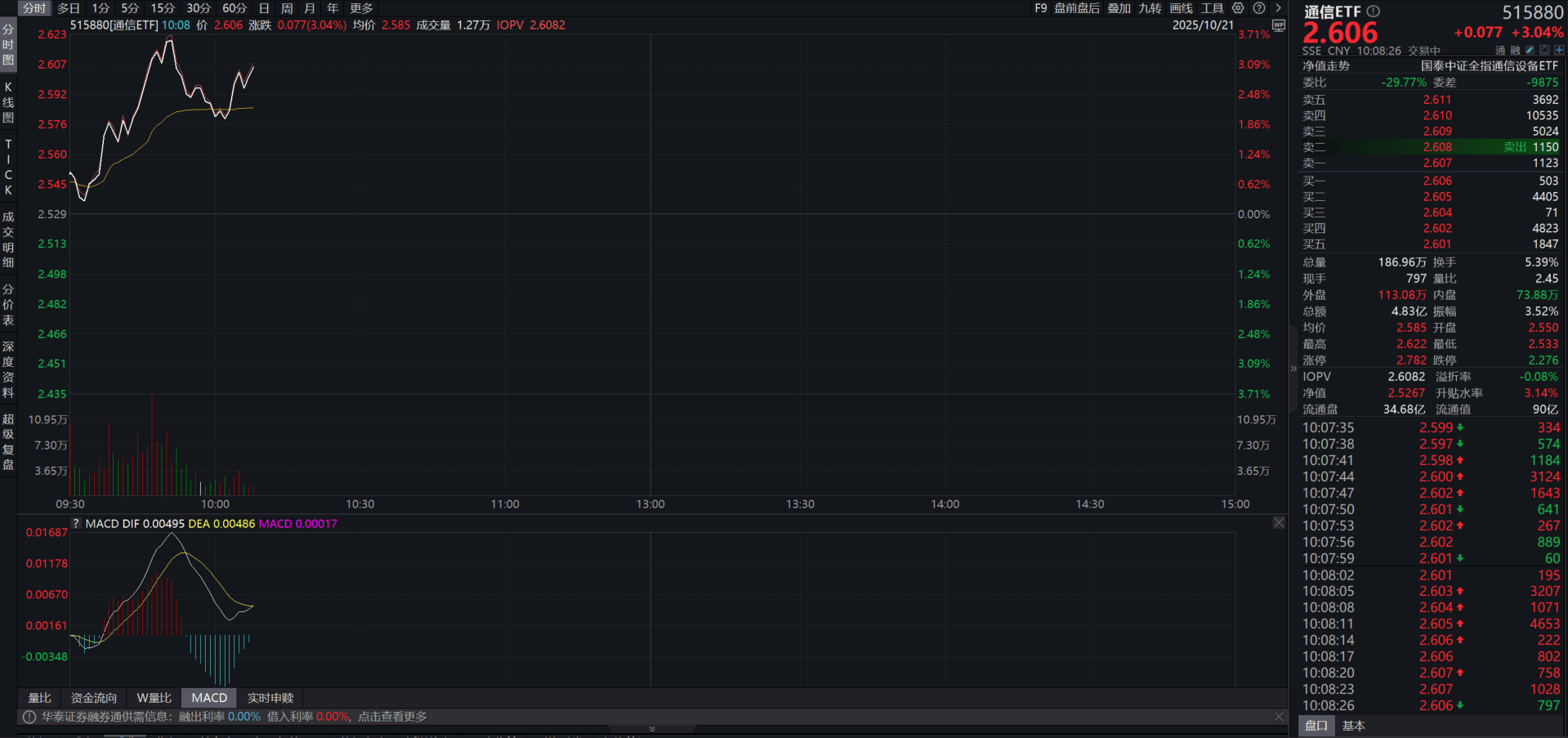
1.6T光模块加单,通信ETF(515880)涨超3%,光模块占比近50%
Sou Hu Cai Jing· 2025-10-21 02:32
Core Viewpoint - Nvidia's Rubin shipment expectations for 2026 have been raised, with a total demand for 1.6T modules expected to reach 15 million, indicating a strong and sustained high demand cycle for optical modules driven by AI computing power [1] Group 1: Market Demand and Supply - The demand for 1.6T optical modules is expected to increase significantly, benefiting leading companies and enhancing their profit forecasts [1] - North American cloud service providers (CSPs) plan to increase capital expenditures to over $370 billion by FY2025, a 40% year-on-year increase, which will directly benefit the optical module and IDC sectors [2] - The market for 100G+ optical modules is projected to grow significantly, with estimated market sizes of $14.4 billion, $24.4 billion, and $32.7 billion for 2025, 2026, and 2027 respectively, reflecting year-on-year growth rates of 54%, 69%, and 34% [3] Group 2: AI and Infrastructure Investment - The AI investment wave is expected to create structural opportunities in the market, with a focus on optical modules, which account for nearly 50% of the communication ETF [4] - Domestic cloud service providers in China are expected to invest over 450 billion yuan in AI computing power by 2025, accelerating the industrialization of domestic super-node computing clusters [2] - The communication ETF (515880) has seen a rise of over 3%, indicating potential opportunities for gradual investment [4] Group 3: Future Outlook - The AI infrastructure investment is anticipated to continue growing, with significant room for expansion, supported by strong performance and valuation [10] - The optical module market is expected to maintain a high level of prosperity due to ongoing investments in computing infrastructure both domestically and internationally [10] - The leading companies in the A-share market are positioned to benefit from the increasing demand for components from major chip manufacturers like Nvidia and Oracle [9]

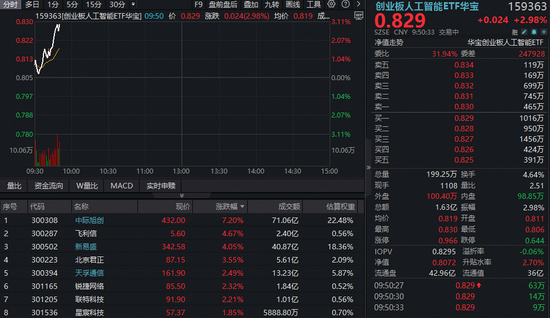
光模块需求放量驱动,中际旭创炸裂五连涨,高“光”创业板人工智能ETF(159363)续涨超3%
Xin Lang Ji Jin· 2025-10-21 02:13
Core Insights - The AI index on the ChiNext board, which includes over 51% optical modules, has seen a rise of over 2% as of October 21, with leading stocks like Zhongji Xuchuang increasing by over 7% [1] - The demand for optical modules is expected to surge, with projections indicating that the shipment of 1.6T optical modules could increase from 8 million to over 20 million by 2026 [1][3] - The first ChiNext AI ETF (159363) has a significant allocation towards computing power and AI applications, with over 70% of its holdings focused on computing power [4] Market Performance - The ChiNext AI ETF (159363) has a market size exceeding 3.4 billion, with an average daily trading volume of over 800 million in the past month, making it the largest and most liquid ETF tracking the ChiNext AI index [4] - Stocks like Feilixin and Xinyi Sheng have also shown positive performance, with increases of 4.3% and 2.9% respectively [1] Industry Outlook - The optical module market is experiencing rapid growth driven by the demand for AI computing power, with price changes reflecting technological advancements and cost control [3] - Leading companies in the optical module sector are expected to maintain strong profitability and competitive advantages due to global data center construction and upgrades [3] - Analysts suggest that the valuation of leading optical module companies still has room for upward adjustment, especially with the increasing demand for high-speed optical modules and the penetration of silicon photonics solutions [3]

“1%光谷”链入世界AI版图 ——东湖综保区崛起光模块集群的实践启思
Chang Jiang Ri Bao· 2025-10-21 01:50
Core Insights - The article highlights the rapid growth and strategic positioning of the optical module industry in China, particularly in Wuhan's East Lake Comprehensive Bonded Zone, which is becoming a key player in the AI era [2][3][4]. Industry Overview - The global optical module market is projected to reach $15 billion by 2025, with a compound annual growth rate (CAGR) of 18% [3]. - The demand for optical modules has surged due to the AI boom, with companies like Guangxun Technology experiencing significant revenue growth, reporting a 68.59% year-on-year increase in the first half of the year [3][4]. Company Developments - Guangxun Technology's high-end optical device production base has been operational since May last year, adding over 3,000 employees and continuously increasing production capacity [2][5]. - EnDatong, another key player, is expanding its production capacity for 800G and 1.6T optical modules following a strategic financing round of 500 million yuan [4][7]. Competitive Landscape - The competition in the optical module market is intensifying, with companies racing to enhance production speed and capacity. Guangxun Technology's production line was designed and operational within 17 months [5]. - Chinese manufacturers dominate the global optical module market, with seven out of the top ten companies being Chinese, including Guangxun Technology and Huagong Technology [7][8]. Strategic Initiatives - The East Lake Comprehensive Bonded Zone is fostering a unique ecosystem that combines state-owned enterprises, private companies, and returnee entrepreneurs, creating a self-evolving innovation system [8][9]. - The zone is also enhancing its role from a passive landlord to an active partner in industry development, ensuring that infrastructure and resources are aligned with the needs of leading companies [9][10]. Future Outlook - The region is expected to continue its rapid growth, with a projected import and export value exceeding 80 billion yuan in 2024, marking a 101% increase [10][11]. - Ongoing policy support aims to bolster the development of high-end optical chips and modules, positioning the East Lake area as a critical manufacturing base for global AI infrastructure [11].
英伟达Rubin出货预期上调,关注通信ETF(515880)
Mei Ri Jing Ji Xin Wen· 2025-10-21 01:16
Group 1 - The core viewpoint indicates that the demand for AI computing power is expected to increase, with leading companies potentially raising their total demand forecast for 2026 to 15 million units, reflecting a strong and sustainable growth cycle in the optical module sector driven by AI computing power [1] - The upcoming release of Google's Gemini 3 series on October 22 is anticipated to catalyze market activity, with Gemini 3.0 expected to surpass the current top model, Gemini 2.5 Pro, in multiple dimensions, optimizing latency and cost control for faster and more economical AI services [1] - North American cloud service providers (CSPs) are projected to increase capital expenditures significantly, with a forecast of over $370 billion for the 2025 fiscal year, representing a 40% year-on-year growth, which will directly benefit the optical module and IDC sectors [2] Group 2 - Oracle's recent quarterly report shows a remaining performance obligation (RPO) of $455 billion, an increase of $317 billion from the previous quarter, indicating a strong commitment to AI investments with a projected capital expenditure of $35 billion for the 2026 fiscal year [2] - Domestic cloud service providers in China are also ramping up AI investments, with expected expenditures exceeding 450 billion yuan by 2025, alongside accelerated industrialization of domestic super-node computing clusters [2] - The artificial intelligence industry is experiencing rapid growth, with significant infrastructure investments and mature business models overseas, while domestic GPU production is increasing, contributing to sustained strength in computing power [2]

上证早知道|国家统计局,发布重磅数据!又一千亿级大市场,要来了!朱雀三号,进入首飞关键准备阶段
Shang Hai Zheng Quan Bao· 2025-10-20 23:10
Economic Overview - The National Bureau of Statistics reported that the GDP for the first three quarters reached 10,150.36 billion yuan, with a year-on-year growth of 5.2%, accelerating by 0.2 and 0.4 percentage points compared to the full year of 2024 and the same period in 2024 respectively, indicating a stable economic performance with a solid foundation for achieving annual targets [2][5]. Industry Insights - China is approaching a large-scale retirement phase for power batteries, with the domestic market for battery recycling expected to exceed 100 billion yuan by 2030 [3][5]. - The Ministry of Industry and Information Technology held a meeting emphasizing the need for cement industry backbone enterprises to strictly implement capacity replacement policies by the end of 2025 [5]. - The "Wind Energy Beijing Declaration 2.0" was released at the 2025 Beijing International Wind Energy Conference, stating that during the 14th Five-Year Plan period, China's annual new wind power installation should not be less than 120 million kilowatts, with offshore wind power installations not less than 15 million kilowatts [5]. Company Performance - Zhuhai Huajun Technology reported a significant increase in revenue and net profit for the first three quarters, with revenue of 3.903 billion yuan, up 66.53%, and net profit of 492 million yuan, up 142.19% [10]. - Ningde Times reported a net profit of 18.5 billion yuan for the third quarter, a year-on-year increase of 41%, with revenue of 104.19 billion yuan, up 12.9% [12]. - Longsheng Technology's third-quarter revenue was 586 million yuan, a slight increase of 0.48%, while net profit grew by 109.83% to 106 million yuan [12]. Market Trends - The demand for 1.6T optical modules has been continuously revised upward, with total demand expected to increase from 1,000 million to 2,000 million units due to the rapid growth in AI training and inference network bandwidth requirements [11]. - The semiconductor sector saw significant net subscriptions in ETFs, with semiconductor-themed ETFs and non-bank financial ETFs attracting net subscriptions of 33.3 billion yuan and 18.6 billion yuan, respectively [6]. Strategic Developments - Dazhu CNC's strong performance is attributed to the growing demand for high-tech PCB products, particularly in AI computing and automotive electronics [10]. - The company plans to expand its production capacity for high-speed interconnect products to meet the diverse needs of domestic and international clients in data center construction and AI applications [14].




需求不断释放,坚定看好光模块板块
2025-10-20 14:49
Summary of Conference Call Notes Industry Overview - The conference call focuses on the optical module industry, highlighting the impact of AI computing demand on market dynamics and growth potential [1][2][3]. Key Points and Arguments 1. **AI Computing Demand Surge**: The demand for optical modules is driven by a significant increase in AI computing needs, with leading companies raising their 2026 demand forecast for 1.6T optical modules from 7-10 million units to 20 million units, indicating potential for further upward revisions [1][3]. 2. **Competitive Landscape**: At the OCP conference, there is intense competition between CPU and pluggable optical module solutions. The Taiwanese supply chain favors CPU, while the mainland supply chain leans towards CPC/NCC solutions. The training end is sensitive to latency, making CPU more impactful, whereas the inference end prioritizes cost-performance [1][4]. 3. **Growth of GPU Clusters**: The rapid development of large-scale GPU clusters, exemplified by Meta's clear timeline, is expected to further drive demand for AI computing hardware, including optical modules [1][5]. 4. **Strong Financial Performance**: The optical module industry has consistently exceeded market expectations since 2023, with revenue and profit growth. Leading companies have reported significant quarterly net profit increases, suggesting a need for reevaluation of their valuations in the AI era [1][6]. 5. **Optimistic Outlook for 1.6T Optical Modules**: The development outlook for 1.6T optical modules is very positive, with a significantly shortened iteration cycle compared to previous upgrades. This benefits leading manufacturers like Zhongji Xuchuang [1][7]. 6. **Long-term Potential of CPU Technology**: While CPU technology has substantial long-term potential, its short-term impact on pluggable optical module manufacturers is limited. Companies like Xuchuang and Xinyi Sheng are expected to find new business opportunities through internal coupling packaging and silicon photonic chip design [1][8]. 7. **Stock Price vs. Fundamentals**: Current stock price weakness is primarily driven by trading factors rather than deteriorating fundamentals. Companies like Xuchuang and Xinyi Sheng are performing well in the context of 800G and 1.6T introductions, with a favorable outlook for the entire industry chain [2][9]. Additional Important Insights - The optical module industry's valuation is currently seen as reasonable or even low, with leading companies projected to have a valuation of around 12 times by 2026 based on adjusted demand forecasts [1][6]. - Domestic manufacturers are gaining opportunities in the CW light source market as it replaces EML, indicating a shift in the supply chain dynamics [1][7].
通信板块当前观点汇报
2025-10-20 14:49
Summary of Conference Call on Communication Sector Industry Overview - The communication sector is currently experiencing a mixed performance, with short-term excess returns expected from optical modules and the North American computing chain, but absolute returns require more driving changes [1][2] - The operator segment is characterized by defensive attributes, showing low earnings volatility, while the broader wireless industry and edge AI products are impacted by US-China trade tensions, leading to a slight decline in exports in Q3, although year-on-year growth remains positive [1][3] Key Insights and Arguments - **Optical Module Demand**: The demand for optical modules is substantial, with 800G demand reaching 40-45 million units and 1.6T demand at 20 million units, indicating a supply shortage and limited price reductions expected [1][9] - **Growth Projections**: The industry is expected to see significant growth through 2026, with new demand anticipated to be very high, and the outlook is increasingly clear for the medium to long term [1][10] - **North American Computing Chain**: The North American computing chain is projected to reach new highs by the end of Q3, and if positive trends continue, the outlook for 2026 and beyond will be more optimistic [4][13] - **Investment Value**: The AI and North American computing chains are considered to have strong investment value based on certainty, valuation, and short-term growth potential, suggesting continued investment in these areas [7] Additional Important Points - **Supply Chain Preparations**: In a supply-demand imbalance, order guidance for the end of this year and into next year may be released early to allow supply chains to prepare for long-cycle materials [4][12] - **Ruby Architecture**: The Ruby-related industry chain is beginning to prepare for increased demand in 2026, with cloud vendors starting to place orders for 1.6T modules [8] - **Market Activity in October**: October is typically an active month for the optical module market, coinciding with the release of Q3 earnings from North American computing companies, which may provide optimistic guidance and product upgrades [11] Conclusion - The communication sector, particularly the optical module market and North American computing chain, is poised for growth despite current challenges. The demand for optical modules is robust, and the industry is preparing for significant future orders, indicating a positive outlook for the coming years [1][10][12]
ETF日报:结合基本面和社融走弱的大背景,目前点位的债券仍有配置价值。建议逢调整适当配置十年国债ETF
Xin Lang Ji Jin· 2025-10-20 12:52
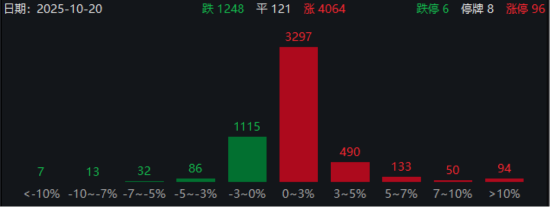
Market Overview - The Shanghai Composite Index rose by 0.63% to close at 3863.89 points, while the Shenzhen Component Index increased by 0.98% to 12813.21 points, with a noticeable decrease in trading volume, totaling only 1.75 trillion yuan, marking a two-month low [1] - The market saw over 4000 stocks rise, led by the telecommunications and coal sectors, while the non-ferrous metals sector faced declines due to gold and silver price corrections [1] Economic Data - Recent economic data for Q3 showed declines in investment, real estate, and consumption, indicating a weakening economic backdrop [1] - Fixed asset investment growth unexpectedly dropped to -0.5%, heavily impacted by real estate investment [4] Hong Kong Market Dynamics - The Hong Kong stock market opened higher and maintained a strong position, closing up 2.42% at 25858.83 points, following constructive discussions between Chinese and U.S. officials regarding trade relations [3] - The technology sector continues to show strong momentum, supported by fundamentals, while external liquidity remains favorable with continued inflows from foreign and southbound funds [3] Sector Performance - The communication ETF rose by 3.39%, and the AI sector within the ChiNext board saw a 3.70% increase, driven by positive demand forecasts from leading companies like NVIDIA [6] - The ongoing high demand cycle for optical modules is supported by supply constraints and price resilience, benefiting leading companies in the sector [7] Investment Recommendations - Investors are encouraged to focus on the Hong Kong Stock Connect 50 ETF and the Hong Kong Technology ETF, as favorable factors are expected to accumulate in Q4 [4] - The bond market is showing signs of returning bullish sentiment, with long-term bond yields stabilizing around 1.8% [5] Future Outlook - The outlook for the Hong Kong market remains positive, with potential upward movement driven by technological advancements, easing trade tensions, and improved external liquidity [4] - The dividend-focused investment strategy is highlighted as having significant value, especially in light of new policies encouraging dividend distributions among state-owned enterprises [10]
硬科技反攻,光模块领跑,高“光”159363放量冲击7%!港股不甘示弱,香港大盘30ETF、港股互联网ETF联袂拉涨
Xin Lang Ji Jin· 2025-10-20 11:55
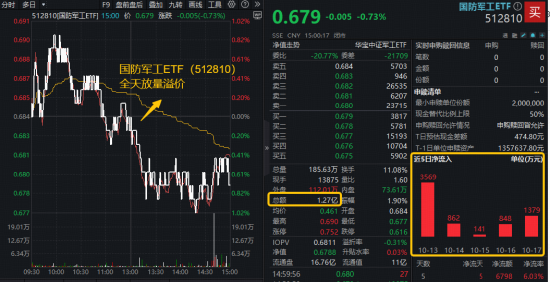
Market Overview - Technology stocks rebounded significantly, with the ChiNext Index rising by 1.98% and the Shenzhen Component Index increasing by 0.98% [1] - The Shanghai Composite Index also saw a rise of 0.63%, while trading volume in A-shares dropped to 1.75 trillion yuan, the lowest since August 8 [1] - The market is experiencing a "see-saw" effect between banking and technology sectors, with the top bank ETF achieving a record high in fund size, surpassing 20 billion yuan [1] Defense and Military Sector - Indonesia confirmed its procurement plan for the J-10 fighter jet, boosting confidence in the defense and military sector [2] - China Aviation Securities predicts a continued recovery in the third-quarter reports for the defense and military sector [2] - The defense and military ETF has attracted over 73 million yuan in inflows over six consecutive days, indicating strong interest from investors [1][2] AI and Technology Hardware - The demand for 1.6T optical modules has been revised upwards, leading to a strong performance in the optical module market [6][8] - The AI sector is experiencing a resurgence, with significant gains in related stocks, including a nearly 8% increase in Zhongji Xuchuang [6] - The leading AI ETF saw a trading volume increase of over 70%, reflecting heightened investor interest [1][6] Hong Kong Market Dynamics - The Hong Kong market saw a collective rebound, with the Hang Seng Index and Hang Seng Tech Index rising by 2.42% and 3%, respectively [1][4] - The Hong Kong Large Cap 30 ETF, which tracks the Hang Seng China (Hong Kong-listed) 30 Index, has been attracting significant capital inflows since its launch [4][11] - The ETF's strategy combines high-growth technology stocks with high-dividend yield stocks, appealing to a broad range of investors [4][16] Investment Sentiment - There is a notable increase in foreign capital inflows into Chinese technology stocks, with significant purchases from prominent investment firms [14][22] - The overall sentiment in the Hong Kong market remains optimistic, driven by AI advancements and favorable macroeconomic conditions [21][22] - Analysts suggest focusing on sectors with high earnings growth and low valuations, such as consumer discretionary and public utilities [15]
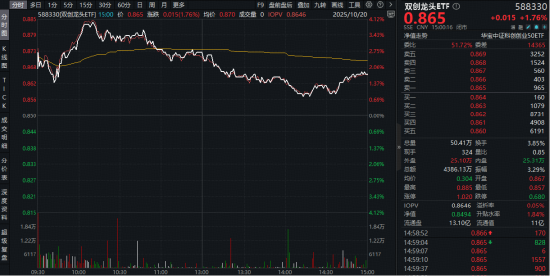
CPO持续强势,新易盛年内拉升300%!双创龙头ETF(588330)盘中上探4%,机构:A股有效突破还得靠科技引领
Xin Lang Ji Jin· 2025-10-20 11:52
Core Viewpoint - The A-share market showed a collective increase, with the ChiNext Index rising nearly 2% and the STAR Market also performing well, indicating a strong interest in hard technology sectors, particularly through the Double Innovation Leader ETF (588330) which saw a peak increase of 4% during the day [1][3]. Group 1: Market Performance - The Double Innovation Leader ETF (588330) experienced a trading volume of 43.86 million yuan, reflecting active market participation [1]. - Key stocks in the ETF, such as Zhongji Xuchuang and Tianfu Communication, saw significant gains, with increases of over 7% and 4% respectively [3]. Group 2: Sector Highlights - In the optical module sector, companies like New Yisheng and Zhongji Xuchuang have seen year-to-date increases of over 300% and 227% respectively, driven by strong demand from overseas clients [3][5]. - The semiconductor sector is highlighted by Cambricon's third-quarter revenue growth exceeding 23 times, indicating robust performance and a favorable outlook for domestic AI chip production [5]. - The electric equipment sector is supported by a new action plan from the National Development and Reform Commission aimed at doubling the service capacity of electric vehicle charging facilities by 2027, which is expected to bolster infrastructure development [5]. Group 3: Investment Strategy - Investing in broad-based indices like the Double Innovation Leader ETF allows for risk diversification across various technology sectors, mitigating the volatility associated with individual stocks [6]. - The ETF captures multiple high-growth sectors, including new energy and semiconductors, providing a strategic entry point for investors looking to capitalize on the technology growth trend in China [7].