现代服务业

Search documents
十五五”如何发力 深圳市长提了“五个着力
2 1 Shi Ji Jing Ji Bao Dao· 2025-12-18 09:27
21世纪经济报道记者 陈思琦 深圳报道 具体来看,深圳规上工业总产值、工业增加值从2022年开始保持全国城市"双第一";"十四五"期间,深 圳固定资产投资总额可达4.5万亿元、约为"十三五"的1.5倍;社会消费品零售总额从2020年的8664亿元 增加到2024年的1.06万亿元;外贸进出口总额从2020年的3.05万亿元增加到2024年的4.5万亿元,跃居全 国城市首位;来源于深圳辖区的一般公共预算收入预计连续五年保持在万亿元以上。 从经济结构看,"十四五"前四年,深圳战略性新兴产业增加值年均增长10%以上、占GDP比重提高到 42.3%。 具体来看,深圳建成投产11个百亿级大型工业项目,先进制造业和高技术制造业增加值占规上工业比重 分别达68.2%、58.2%;集成电路、工业机器人、智能手机等39种工业产品产量占全国比重超10%;现代 服务业增加值占服务业比重提高至76.5%;国家级专精特新"小巨人"企业数量达1333家、跃居全国城市 首位;境内外上市企业592家、瞪羚企业215家、独角兽企业42家,均位居全国前列。 "十四五"期间,深圳科技创新亦取得重大突破,创造多个"首位"。总体来看,深圳全社会研发投 ...
“十五五”如何发力 深圳市长提了“五个着力”
2 1 Shi Ji Jing Ji Bao Dao· 2025-12-18 09:16
Economic Growth - Shenzhen's GDP increased from 2.78 trillion yuan in 2020 to 3.68 trillion yuan in 2024, with an average annual growth rate of 5.5%, leading among first-tier cities [1][2] - Fixed asset investment during the "14th Five-Year Plan" is expected to reach 4.5 trillion yuan, approximately 1.5 times that of the "13th Five-Year Plan" [2] - Retail sales of consumer goods rose from 866.4 billion yuan in 2020 to 1.06 trillion yuan in 2024 [2] - Foreign trade import and export volume increased from 3.05 trillion yuan in 2020 to 4.5 trillion yuan in 2024, ranking first among cities in the country [2] Industrial and Technological Development - Shenzhen maintained the top position in national cities for industrial output and added value since 2022 [2] - The added value of strategic emerging industries grew by over 10% annually, accounting for 42.3% of GDP [2] - R&D investment increased from 151.08 billion yuan in 2020 to 245.31 billion yuan in 2024, with an annual growth rate of 12.9% [3] - Shenzhen ranked first in the number of national specialized and innovative "little giant" enterprises, totaling 1,333 [3] Infrastructure and Urban Quality - Significant improvements in urban quality, particularly in transportation, with major projects like the Ganshen High-speed Railway and the Shenzhen-Zhongshan Link [5] - The airport passenger throughput is expected to exceed 65 million this year, and metro operation mileage surpassed 600 kilometers [5] - Social welfare expenditures reached 1.6 trillion yuan, accounting for nearly 70% of fiscal spending [5] Future Development Strategies - Shenzhen aims to expand domestic demand comprehensively and enhance effective investment [7] - The city plans to cultivate new productive forces and become a hub for innovation and advanced manufacturing [8] - Emphasis on deepening reform and opening up, particularly in the Guangdong-Hong Kong-Macao Greater Bay Area [8] - Focus on high-quality urban development and improving public services to ensure equitable benefits for citizens [8]

海南封关启航:中国最大自贸港的三重跃迁?
Jing Ji Guan Cha Bao· 2025-12-18 08:56
Group 1: Core Changes in Trade and Economy - The launch of the customs closure operation in Hainan signifies a new phase in the construction of the Hainan Free Trade Port, enhancing China's overall openness [1][2] - The core policy features of the customs closure include "one line open, two lines controlled, and island-wide freedom," which will significantly improve the level of trade liberalization and facilitation [2] - Hainan is set to become one of the most open customs special supervision areas in China, transforming into an unprecedented "processing base" and "logistics hub" [2] Group 2: Impact on Enterprises and Consumers - Companies will benefit from cheaper and more efficient imports of raw materials, components, and high-end equipment, fostering high value-added industries such as processing manufacturing and cross-border e-commerce [2] - Consumers will experience a wider variety of imported goods and price advantages, with the potential for continued benefits from tourism shopping and duty-free policies [2] Group 3: Economic Structure Optimization - The customs closure will accelerate the optimization of Hainan's industrial structure and economic development model, moving away from heavy reliance on tourism and real estate [4][5] - New emerging industries such as modern services, high-tech industries, cross-border finance, and digital economy are expected to flourish due to the facilitation of trade and investment [4] - The transition towards a more diversified and high-end economy will enhance Hainan's resilience and internal growth momentum [5] Group 4: Governance and Regulatory Challenges - The customs closure operation will test the governance system and regulatory capabilities, requiring the establishment of an efficient and transparent regulatory framework aligned with international standards [6][7] - There is a need for improved legislative, enforcement, and risk prevention measures to ensure the smooth operation of the new policies [6] - Hainan's experience in implementing these changes could serve as a model for other regions in advancing institutional openness [3][7]
人民日报:“加快建设具有世界影响力的中国特色自由贸易港”
Ren Min Ri Bao· 2025-12-18 04:08
Core Viewpoint - The official launch of the Hainan Free Trade Port marks a significant milestone in China's reform and opening-up strategy, aiming to establish Hainan as a leading gateway for international trade and investment, reflecting the country's commitment to high-level openness and innovation [4][5][9]. Group 1: Historical Context and Development - The establishment of the Hainan Free Trade Port is a culmination of decades of reform, starting from the creation of the Hainan Economic Special Zone in 1988 to the announcement of the Free Trade Port concept by President Xi Jinping in 2018 [6][15]. - The date of December 18, 2025, is symbolically significant as it coincides with the anniversary of the Third Plenary Session of the 11th Central Committee, which initiated China's reform and opening-up [5][6]. Group 2: Strategic Goals and Vision - The strategic goal is to make Hainan a significant portal for China's new era of opening-up, emphasizing the need for a systematic approach to reform and innovation [9][15]. - Hainan's development is aligned with the "14th Five-Year Plan" and is included in the central economic work conference's key tasks for the upcoming year, highlighting its importance in national economic strategy [7][9]. Group 3: Economic Impact and Growth - Hainan's trade volume has seen substantial growth, with total imports and exports increasing from 933.3 billion yuan in 2020 to 2,778.9 billion yuan in 2024, marking a significant leap in economic activity [18]. - The four main industries in Hainan—tourism, modern services, high-tech industries, and tropical agriculture—accounted for 67.2% of the regional GDP in the first three quarters of the year, reflecting a 14.2 percentage point increase since 2020 [18]. Group 4: Policy Innovations and Implementation - The Hainan Free Trade Port is characterized by a "one line open, two lines controlled, and free within the island" policy framework, facilitating a more liberalized and convenient trade environment [23]. - The port has implemented various innovative policies, such as tax exemptions for international shipping and streamlined customs procedures, to enhance its competitiveness as an international shipping hub [23][24]. Group 5: International Cooperation and Investment - Hainan aims to attract global investment, with over 1,025 billion yuan in actual foreign investment and significant growth in overseas direct investment, indicating a robust international interest [19]. - The port's strategic location and unique policies position it as a critical player in global trade, enhancing China's role in promoting multilateralism and open trade [19][34].
1—11月中国财政收入同比增长0.8%
Zhong Guo Xin Wen Wang· 2025-12-18 01:51
Group 1: Fiscal Revenue - From January to November, China's general public budget revenue reached 200,516 billion RMB, showing a year-on-year growth of 0.8% [1] - Tax revenue amounted to 164,814 billion RMB, with a year-on-year increase of 1.8%, while non-tax revenue was 35,702 billion RMB, reflecting a decline of 3.7% [1] - The growth rate of general public budget revenue remained consistent with that of January to October [1] Group 2: Tax Revenue Breakdown - Domestic value-added tax and domestic consumption tax grew by 3.9% and 2.5% respectively, indicating stable growth [1] - Corporate income tax increased by 1.7%, while personal income tax saw a significant rise of 11.5%, maintaining the same growth rate as in the previous months [1] - Sectors such as equipment manufacturing and modern services showed strong tax performance, with computer and communication equipment manufacturing tax revenue up by 14.1%, and electrical machinery and equipment manufacturing tax revenue up by 7.9% [1] Group 3: Fiscal Expenditure - National general public budget expenditure reached 248,538 billion RMB, reflecting a year-on-year growth of 1.4% [2] - Key areas of expenditure included social security and employment (up 8.1%), education (up 4.4%), health (up 4.7%), and science and technology (up 7.9%) [2] - Government fund budget revenue was 40.3 billion RMB, down 4.9%, while government fund budget expenditure was 92.1 billion RMB, up 13.7% [2] Group 4: Debt and Funding - The increase in expenditure was attributed to accelerated use of bond funds, with local government special bonds and other financial instruments contributing to a total expenditure of 51.5 billion RMB [2]
前11个月全国一般公共预算支出同比增长1.4% 有效托底民生支撑发展
Jing Ji Ri Bao· 2025-12-17 23:58
财政部12月17日发布统计数据显示,今年前11个月,全国一般公共预算收入20.05万亿元,同比增长 0.8%,增幅与前10个月持平;全国一般公共预算支出24.85万亿元,同比增长1.4%。 支出方面,各级财政部门认真落实更加积极的财政政策,加大支出强度,优化支出结构,持续加强对重 点领域的支出保障。 前11个月,重点领域支出得到保障。其中,社会保障和就业支出增长8.1%,教育支出增长4.4%,卫生 健康支出增长4.7%,科学技术支出增长7.9%,节能环保支出增长6.6%,文化旅游体育与传媒支出增长 1.3%。李旭红认为,教育、社会保障和就业、科学技术等关键领域支出增速高于整体支出水平,有效 托底民生、支撑发展。 同时,前11个月,全国政府性基金预算收入4.03万亿元,同比下降4.9%;全国政府性基金预算支出9.21 万亿元,增长13.7%,主要是各级财政持续加快债券资金使用,地方政府专项债券、超长期特别国债、 中央金融机构注资特别国债等资金共支出5.15万亿元。李旭红分析,政府债券资金加快落地,有效带动 了投资增长,助力补短板、强弱项。 中央财经大学财税学院教授白彦锋认为,全国一般公共预算收入稳步增长,凸显出 ...
前11月税收收入继续增长 装备制造、现代服务业表现良好
Zheng Quan Shi Bao· 2025-12-17 19:16
Group 1 - The national general public budget revenue for the first 11 months of the year reached 20.05 trillion yuan, with a growth rate of 0.8%, maintaining the same growth rate as the previous 10 months [1] - Tax revenue amounted to 16.48 trillion yuan, growing by 1.8%, with an increase of 0.1 percentage points compared to the first 10 months [1] - The domestic value-added tax and domestic consumption tax grew by 3.9% and 2.5% respectively, while personal income tax increased by 11.5%, consistent with the growth rate from the first 10 months [1] Group 2 - The performance of personal income tax has been notably strong, likely due to the active capital market and increased wealth effect, with capital market-related tax revenues also seeing significant growth [2] - Corporate income tax revenue reached 402.34 billion yuan, with a year-on-year growth of 1.7%, indicating a recovery in corporate earnings supported by various factors [2] - The equipment manufacturing and modern service industries showed strong tax revenue performance, with the computer and communication equipment manufacturing sector growing by 14.1% and the electrical machinery sector by 7.9% [2] Group 3 - The manufacturing sector continues to play a stabilizing role, with tax revenue from manufacturing maintaining a stable share of around 30% [3] - High-tech industry sales revenue increased by 14.7%, with smart device manufacturing sales growing by 28.2%, reflecting rapid growth in innovation-driven sectors [3] - General public budget expenditure for the first 11 months reached 24.85 trillion yuan, growing by 1.4%, with significant spending in social security and employment, education, and health sectors [3]
海南全岛封关 购物、就业攻略请收好
Yang Shi Xin Wen· 2025-12-17 15:17
Core Viewpoint - Hainan Free Trade Port will officially start full island closure on December 18, 2025, aiming to enhance trade facilitation and establish itself as an international tourism consumption center while continuing the duty-free shopping policy and expanding the product list to meet changing consumer demands [1]. Policy Upgrades for Residents - The duty-free shopping policy for residents has been upgraded since November 1, allowing residents to purchase "immediate purchase and pick-up" items without limit on the number of purchases within a calendar year, provided they have at least one record of leaving the island [4][2]. - The "immediate purchase and pick-up" items are limited to 15 categories, including cosmetics, perfumes, clothing, and bags, with a single item price cap of 20,000 yuan, and an annual duty-free shopping limit of 100,000 yuan per person [6]. Integration of Duty-Free and Other Industries - The integration of duty-free shopping with tourism, culture, and entertainment industries is expected to deepen, promoting diverse consumption forms and creating more job opportunities in Hainan [9]. Talent Attraction and Business Environment - Hainan Free Trade Port offers incentives for attracting talent in key sectors such as tourism, modern services, high-tech industries, and agriculture, including personal income tax exemptions for high-income individuals [11]. - The corporate income tax for encouraged industries in Hainan is capped at 15%, significantly lower than the mainland average, providing a favorable environment for entrepreneurs [17]. - The streamlined process for starting a business allows entrepreneurs to begin operations with a written commitment to meet relevant requirements, reducing bureaucratic hurdles [15]. Future Opportunities - The opening of Hainan as a duty-free zone is expected to create a "national flow entry" for industries like cross-border e-commerce, high-end manufacturing, and logistics, leading to increased job opportunities and a demand for skilled labor [19]. - The policies implemented in Hainan are seen as a model for high-level opening up and can serve as a reference for other regions in China [21].

证券交易印花税大增70.7%!前11月财政数据透露出资本市场活力信号
Zheng Quan Shi Bao· 2025-12-17 13:24
Group 1 - The core viewpoint of the articles highlights the stability in China's fiscal revenue and expenditure for the first eleven months of 2025, with a slight increase in tax revenues and a focus on social welfare spending [1][3][4] - National general public budget revenue reached 20.05 trillion yuan, with a year-on-year growth of 0.8%, maintaining the same growth rate as the previous ten months [1] - Tax revenue amounted to 16.48 trillion yuan, showing a growth of 1.8%, with domestic value-added tax and domestic consumption tax increasing by 3.9% and 2.5% respectively [1][2] Group 2 - Personal income tax showed a notable increase of 11.5%, attributed to the active performance of the capital market and the resulting wealth effect [2] - Corporate income tax revenue reached 402.34 billion yuan, with a year-on-year growth of 1.7%, indicating a recovery in corporate earnings supported by various economic factors [2][3] - The manufacturing sector continues to play a crucial role, with tax revenue from this sector stabilizing around 30% of total tax revenue, and high-tech industries experiencing a sales revenue growth of 14.7% [3] Group 3 - General public budget expenditure for the first eleven months was 24.85 trillion yuan, reflecting a year-on-year increase of 1.4%, with significant allocations towards social security, education, and health care [3] - The government fund budget revenue decreased by 4.9% to 4.03 trillion yuan, while expenditures increased by 13.7% to 9.21 trillion yuan, driven by accelerated use of bond funds [3] - Central government allocated 500 billion yuan to support local government debt, which is expected to inject new momentum into economic development [4]
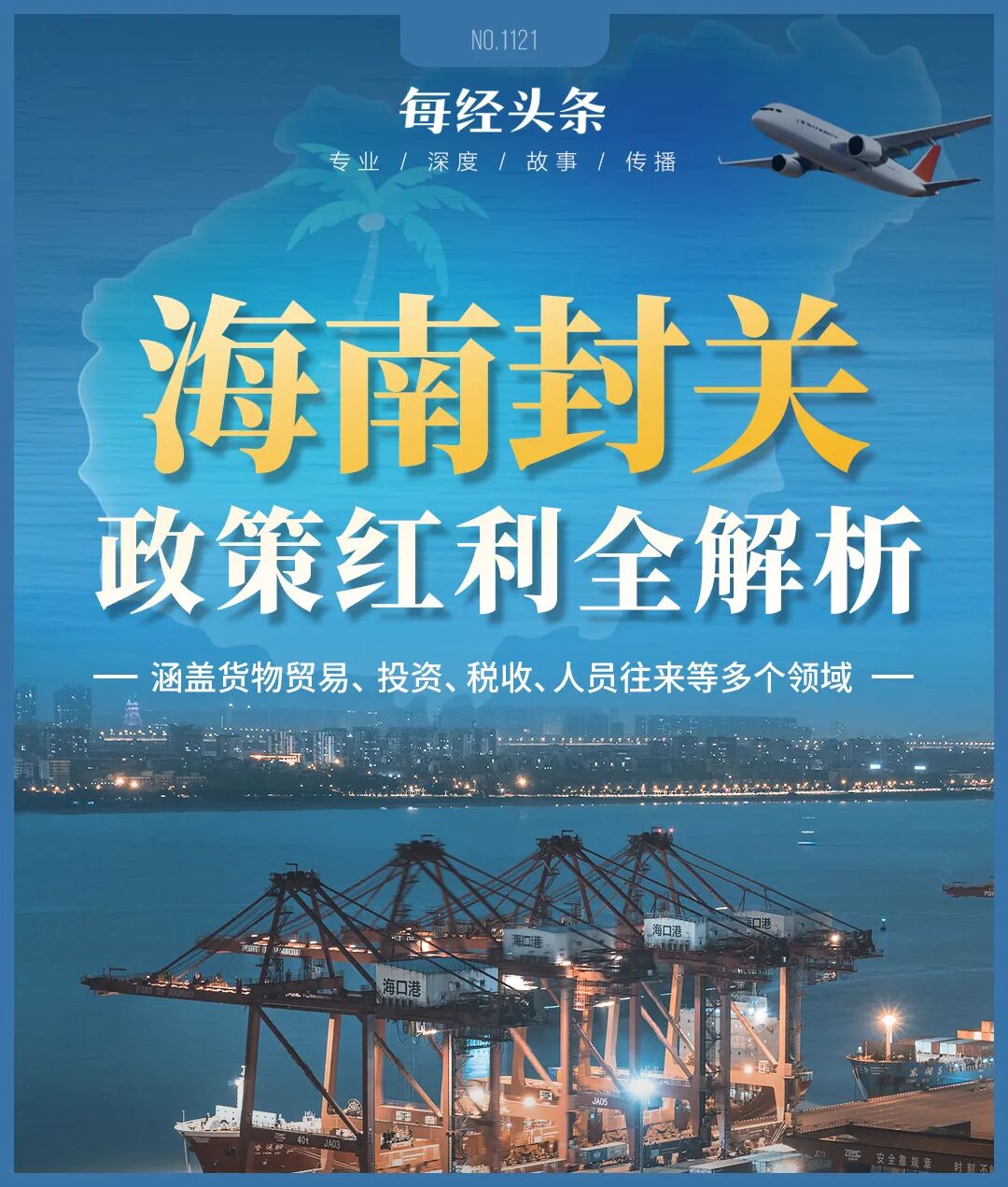
海南封关政策红利全解析:零关税、低个税、投资准入放宽、跨境资金自由、创业扶持……
Mei Ri Jing Ji Xin Wen· 2025-12-17 11:19
Core Viewpoint - The Hainan Free Trade Port will officially start its full island closure operation on December 18, 2025, marking a significant milestone in China's reform and opening-up process, with policies aimed at higher levels of openness to the world [3][4]. Policy Changes - The closure operation represents a systematic and institutional upgrade, significantly enhancing the "zero tariff" level, optimizing processing and value-added tax exemptions, improving the investment environment, and facilitating entry and exit from Hainan [4]. - The "zero tariff" policy will expand from 1,900 tax items to approximately 6,600 tax items, covering about 74% of all product tax items, an increase of nearly 53 percentage points compared to before the closure [9][13]. Tax Incentives - The low tax rate policy, known as the "two 15%" policy, allows qualifying enterprises to be taxed at a reduced rate of 15% on corporate income tax, significantly lowering operational costs [14]. - Individuals classified as high-end or urgently needed talents working in Hainan can also benefit from personal income tax reductions, with any income tax burden exceeding 15% being exempted [19][21]. Comparison with Other Free Trade Ports - Hainan Free Trade Port differs from other international free trade ports like Singapore and Dubai by remaining within China's customs territory, allowing for domestic circulation of goods and easier access for mainland residents [23][24]. - Hainan's unique advantages include its vast market potential, being the largest free trade port globally at 33,900 square kilometers, and a focus on developing a modern industrial system centered on tourism, modern services, high-tech industries, and tropical agriculture [23][24]. Industry Development Focus - Post-closure, Hainan will prioritize the development of tourism, modern services, high-tech industries, and tropical agriculture, while also enhancing high-end shopping, healthcare, and international education sectors [26]. - The digital economy is expected to be a key industry, supported by significant infrastructure developments, including the establishment of the largest data center in Hainan and the world's first commercial underwater data center [27].