生物燃料

Search documents
EPA批准小型炼厂生物燃料豁免申请
Zhong Guo Hua Gong Bao· 2025-09-02 02:41
Core Viewpoint - The U.S. Environmental Protection Agency (EPA) has approved a majority of the backlog of small refinery exemptions for biofuel regulations, raising concerns in the biofuel industry about potential demand impacts [1] Group 1: EPA Approval Details - The EPA approved 63 full exemptions and 77 partial exemptions, while rejecting 28 applications, clearing a backlog of 204 pending applications since 2016 [1] - The approved exemptions correspond to approximately 5.34 billion Renewable Identification Numbers (RINs), which are compliance indicators for the U.S. biofuel blending policy [1] - Only 1.39 billion of the RINs have actual compliance value and can still be used for compliance purposes [1] Group 2: Industry Reactions - Growth Energy, representing the ethanol industry, has urged the EPA to balance the blending responsibilities by increasing obligations on other refineries, a process referred to as "responsibility redistribution" [1] - The CEO of Growth Energy, Emily Skor, emphasized the need for the EPA to redistribute every gallon of exempted volume to mitigate the potentially devastating impact on biofuel demand [1] Group 3: Market Impact - Following the announcement, the price of renewable fuel credits related to ethanol blending surged to over $1.16 per credit, up from $1.07 on the previous Thursday [1]
海新能科:生物燃料领域供需政策双驱动,上半年实现生物航煤业务突破
Zheng Quan Shi Bao Wang· 2025-09-01 00:58
Core Viewpoint - The company reported a significant decrease in revenue for the first half of 2025, but showed improvement in net profit loss, indicating a potential recovery trajectory in its operations and product lines [1]. Financial Performance - The company achieved operating revenue of 983 million yuan, a year-on-year decrease of 21.57% [1]. - The net profit attributable to shareholders was -35.38 million yuan, reflecting a year-on-year reduction in losses by 89.15% [1]. - Revenue from environmental materials and chemical products reached 477 million yuan, a year-on-year increase of 2.18%, with a gross margin improvement of 8.54 percentage points compared to the previous year [1]. - The hydrocarbon-based biodiesel business generated revenue of 454 million yuan, with gross margins remaining stable compared to the same period last year [1]. Product Development and Market Expansion - The company successfully launched a 200,000-ton/year biodiesel isomerization project, adding approximately 160,000 tons/year of biojet fuel capacity, with an 80% yield [2]. - The company began supplying biojet fuel to the China National Aviation Fuel Group, marking its entry into the domestic aviation sector [2]. - The company aims to establish strategic partnerships with biojet fuel demanders and implement domestic applications of second-generation bioenergy [2]. Operational Improvements - The company invested 47.99 million yuan in R&D, obtaining 11 patent authorizations, including 2 invention patents and 9 utility model patents [3]. - The company optimized its procurement system to ensure raw material supply and improve operational efficiency [3]. - The high-congealing device at Shandong Sanju achieved a historical maximum monthly load in June, leading to significant reductions in energy costs [3]. Market Trends and Regulatory Environment - The global biofuel market is experiencing stable growth, with a notable increase in demand for sustainable aviation fuel (SAF) [2]. - The EU's Renewable Energy Directive (REDIII) is expected to enhance overall demand for biofuels [4]. - The company has applied for inclusion in the SAF export whitelist, which will facilitate product exports [4]. - The European Commission initiated anti-dumping investigations on biodiesel from China, resulting in tariffs ranging from 10.0% to 35.6%, while biojet fuel remains unaffected [4]. - The company is actively expanding its non-EU market presence, achieving significant sales growth in these regions [4].

开源证券-卓越新能-688196-公司信息更新报告:天然脂肪醇放量带动毛利提升,未来新增项目落地持续推动公司成长-250831
Xin Lang Cai Jing· 2025-08-31 15:55
Group 1 - The company's revenue for H1 2025 was 1.312 billion yuan, a year-on-year decrease of 32.12%, while the net profit attributable to shareholders was 117 million yuan, an increase of 16.01% [1] - In Q2 2025, the company reported revenue of 603 million yuan, down 43.34% year-on-year and 14.96% quarter-on-quarter, with a net profit of 56.05 million yuan, a decrease of 22.3% year-on-year and 8.58% quarter-on-quarter [1] - The company's high-margin natural fatty alcohol project contributed to a gross margin increase of 3.83 percentage points year-on-year despite a decline in biodiesel sales [1] Group 2 - The price of biodiesel in China as of August 29, 2025, was 1,175 USD/ton, reflecting a 22% increase compared to the same period in 2024, indicating a steady growth trend in biodiesel prices [2] - The price of medium-chain fatty alcohol reached 24,600 yuan/ton as of August 29, 2025, up 42% year-on-year, driven by stable palm oil production and increasing demand in the downstream personal care sector [2] - The company benefits from cost advantages by using waste oils from palm oil processing to produce fatty alcohol, positioning it well to capitalize on rising fatty alcohol prices [2] Group 3 - The company is advancing its overseas base construction, with a 100,000 tons/year HVO/SAF production line in China entering the pipeline installation phase [3] - In Singapore, the company plans to build a 200,000 tons/year biodiesel capacity, starting with an initial phase of 100,000 tons/year [3] - The company has completed land exploration and is designing construction plans for a 300,000 tons/year biodiesel project in Thailand, with future plans for biodiesel projects in Saudi Arabia [3]

退市5年,龙力生物案判决出炉!1618名投资者获赔超2.7亿元
券商中国· 2025-08-27 01:39
Core Viewpoint - The court ruling on the securities fraud liability dispute involving Shandong Longli Biological Technology Co., Ltd. (Longli Bio) has concluded after five years post-delisting, with 1,618 investors claiming a total of 274 million yuan in investment loss and additional legal fees [1][2][3]. Group 1: Court Ruling and Financial Implications - The Jinan Intermediate People's Court ruled that the 1,618 plaintiffs are entitled to a total of 274 million yuan in investment loss claims and 809,000 yuan in legal fees, with five representative plaintiffs also entitled to 80,600 yuan in notification fees [1][3]. - Defendant Cheng Shaobo is jointly liable for the debts owed to the plaintiffs, while other defendants will bear joint liability within a certain proportion [1][3]. - Guolian Minsheng Securities is liable for 5% of the plaintiffs' losses, while Lixin Accounting Firm is liable for 30% of the losses [1][3]. Group 2: Background and Context - Longli Bio was listed on the Shenzhen Stock Exchange on July 28, 2011, and was once known as the "first stock of biofuels" [2]. - The company was placed under risk warning in January 2018 and was officially delisted in July 2020 due to significant fraudulent activities, including profit inflation from 2015 to mid-2017 [2][3]. - The China Securities Regulatory Commission (CSRC) previously identified Longli Bio for systematic fraud, resulting in fines totaling 3.38 million yuan against 18 responsible parties [2]. Group 3: Legal Proceedings and Future Outlook - The collective lawsuit initiated by over 1,600 investors against Longli Bio and associated parties has taken three years to reach a verdict [3]. - Following the ruling, Guolian Minsheng announced the potential for appeals, indicating that the final judgment remains uncertain [4]. - The company maintains a stable financial status, asserting that the lawsuit's financial implications will not significantly affect its current or future profits [4].


引能仕、凸版印刷拟从废纸提取生物乙醇
Zhong Guo Hua Gong Bao· 2025-08-26 02:28
Core Viewpoint - The collaboration between YN Energy Holdings and Toppan Printing Holdings aims to extract bioethanol from waste paper, promoting resource recycling and providing a stable supply of bioethanol for decarbonization fuel [1] Group 1: Project Details - The verification experiment is set to begin in the first half of 2027 [1] - The project will take place at the Fuji factory of Nippon Paper Industries, which will establish waste paper processing and recycling facilities [1] - The facility is designed to process 1 to 3 tons of waste paper daily, extracting approximately 300 liters of bioethanol [1] Group 2: Technical and Commercial Outlook - Plastic components in the waste paper will be removed, and the remaining paper fibers will undergo fermentation [1] - The commercial viability of the technology is expected to be realized after the fiscal year 2030 [1] - Bioethanol produced can be utilized as automotive fuel or as a raw material for sustainable aviation fuel (SAF) [1]
一图看懂香港中华煤气(0003.HK)2025年中期业绩
Ge Long Hui· 2025-08-21 00:18
Core Insights - The company reported stable gas sales and a 3% increase in after-tax operating profit for the first half of 2025, reaching 4 billion RMB [15][16][30] - The renewable energy segment showed a 6% profit growth, with significant increases in solar power generation and energy storage contracts [12][57][60] - The company is expanding its hydrogen energy initiatives, with projects aimed at producing green hydrogen and establishing charging stations [26][29][82] Utility Business - Gas sales volume remained stable, with a slight increase in price differential of 0.04 RMB per cubic meter [9][30] - The water business showed robust performance, with an 8% profit increase, driven by expansion into community and rural projects [10][44] - The company secured long-term gas supply contracts totaling 15 billion cubic meters per year, enhancing its supply chain stability [11][41] Growth Business - The renewable energy sector, particularly solar power, saw a 44% increase in generation, with a total of 1.18 billion kWh produced [12][57] - The company is actively pursuing strategic partnerships and financing, raising 450 million USD for its extended business initiatives [50][53] - The advanced biofuels segment is expanding, with a new joint venture aimed at producing green methanol and sustainable aviation fuel (SAF) [14][97] Financial Overview - The company declared an interim dividend of 0.12 HKD per share, reflecting a stable financial position [15] - The net profit attributable to shareholders for the first half of 2025 was 2.96 billion HKD, marking a 3% increase [16][19] - Capital expenditures for the first half of 2025 were reported at 2.5 billion HKD, down from 3.3 billion HKD in the previous year [22] Environmental and Social Governance (ESG) - The company achieved an MSCI rating of AA, indicating strong performance in sustainability practices [100] - It has been recognized as a leader in the gas utility sector for three consecutive years in the Sustainable Development Yearbook [100]


研判2025!中国生物乙醇行业产业链全景、发展现状、竞争格局及发展趋势分析:非粮转型与高端应用拓展,生物乙醇产业迈向高质量发展[图]
Chan Ye Xin Xi Wang· 2025-08-20 01:12
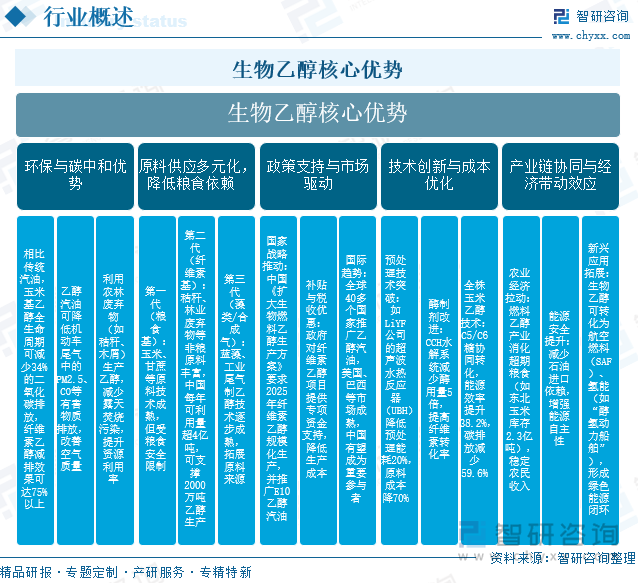
Core Insights - Bioethanol is a renewable energy produced from biomass, playing a significant role in transportation and industry due to its environmental benefits, diverse raw materials, policy support, and continuous technological innovation [1][3][7] - The industry is transitioning from food-based to non-food raw materials, focusing on carbon neutrality and high-end applications, supported by a series of national policies [1][7][19] Industry Overview - Bioethanol is produced through fermentation and distillation, primarily used as a gasoline additive or alternative fuel [2][3] - The core advantages of bioethanol include its environmental benefits, diverse raw materials, policy support, and ongoing technological innovations [3][5] Policy Analysis - The Chinese government has introduced several policies to support the bioethanol industry, emphasizing its role in energy transition and carbon reduction [7][9] - Key policies include the "14th Five-Year Plan for Bioeconomic Development" and the "14th Five-Year Plan for Renewable Energy Development," which provide strong support for high-quality development in the bioethanol sector [7][9] Industry Chain - The bioethanol industry chain in China includes upstream raw materials (corn, cassava, straw), midstream production processes, and downstream applications [10][12] - Fuel ethanol accounts for over 70% of downstream demand, primarily used in transportation, while industrial and medical ethanol also contribute to the market [10][12] Current Development Status - China is the fifth-largest bioethanol producer globally, with a projected production of 10.41 million tons in 2024 [17] - The industry faces challenges from the promotion of E10 gasoline and the increasing market share of coal-based ethanol, which may limit growth in traditional bioethanol production [17][19] Competitive Landscape - The bioethanol industry in China is characterized by an "oligopoly with coexistence of small and medium enterprises" [19] - Leading companies include Guotou Bio, COFCO Technology, and Hongzhan Distillery, with Guotou Bio holding approximately 29% market share [19] Development Trends - The industry is moving towards non-food raw materials, high-end applications, and integrated layouts, with cellulose ethanol technology breakthroughs driving down costs [21][23] - The demand for aviation biofuels and bio-based materials is expected to grow significantly, with annual growth rates exceeding 30% in high-end markets [21][23]
2025H1生物燃料总结:SAF出口渠道打通,生物柴油和UCO开拓东南亚市场
Changjiang Securities· 2025-08-18 05:14
Investment Rating - The report maintains a "Positive" investment rating for the industry [11]. Core Insights - In the first half of 2025, China's total exports of HVO and SAF reached 338,400 tons, a year-on-year increase of 8.06%, with domestic SAF export channels successfully opened [2][6]. - Biodiesel exports fell to 381,000 tons, a decrease of 42.4% year-on-year, primarily due to anti-dumping tariffs [7][17]. - UCO exports totaled 1,262,000 tons, down 10.5% year-on-year, with Singapore replacing the U.S. as the largest export destination [8][31]. - The report suggests monitoring overseas policies and demand changes, anticipating more supportive domestic policies to be implemented [9][43]. Summary by Sections SAF & HVO - In H1 2025, China's SAF export channels were successfully opened, with a total export volume of 338,400 tons, marking an 8.06% increase year-on-year. Jiangsu Province exported 14,900 tons of SAF to Belgium and Spain in June, likely from the Jiaao Environmental Lianyungang factory [6][16]. - Domestic SAF exports require approval from four government departments, and Jiaao Environmental received a license for 372,400 tons of bio-jet fuel, indicating a positive trend for future SAF exports [6][16]. Biodiesel - Biodiesel exports in H1 2025 were 381,000 tons, down 42.4% year-on-year, mainly due to anti-dumping tariffs imposed by the EU [7][17]. - Major export partners included Malaysia (141,000 tons), Singapore (98,700 tons), and the Netherlands (70,000 tons), with significant increases in exports to Malaysia and Singapore, likely for blending with marine fuel [7][22]. - The average export price for biodiesel was $1,103 per ton, a slight increase of 2.0% year-on-year, while total export value dropped by 40.6% to $3.02 billion [17]. UCO - UCO exports in H1 2025 were 1,262,000 tons, a decrease of 10.5% year-on-year, attributed to increased domestic SAF production and the cancellation of export tax rebates [8][29]. - The average export price for UCO was $1,048 per ton, up 17.9% year-on-year, driven by the EU's mandatory blending policy for SAF [8][29]. - Singapore became the largest export destination for UCO, with exports to the U.S. declining significantly due to high tariffs [31][35]. Market Outlook - The report emphasizes the need to track overseas policy changes and anticipates more domestic supportive policies to be implemented [9][43]. - The U.S. market faces significant uncertainty due to fluctuating tariff policies, while the EU's blending ratio requirements for SAF are expected to boost China's SAF industry [43]. - In Singapore, the demand for clean alternative fuels is projected to increase due to new carbon quota regulations for the shipping industry [43]. Investment Recommendations - The industry is viewed positively due to its reliance on waste oils as raw materials, with several companies producing qualified SAF and obtaining airworthiness certification. The report recommends focusing on raw material suppliers and processing companies like Zhuoyue New Energy [9][47].

卓越新能(688196):生物柴油龙头 双碳背景下的绿色能源先锋
Xin Lang Cai Jing· 2025-08-14 02:34
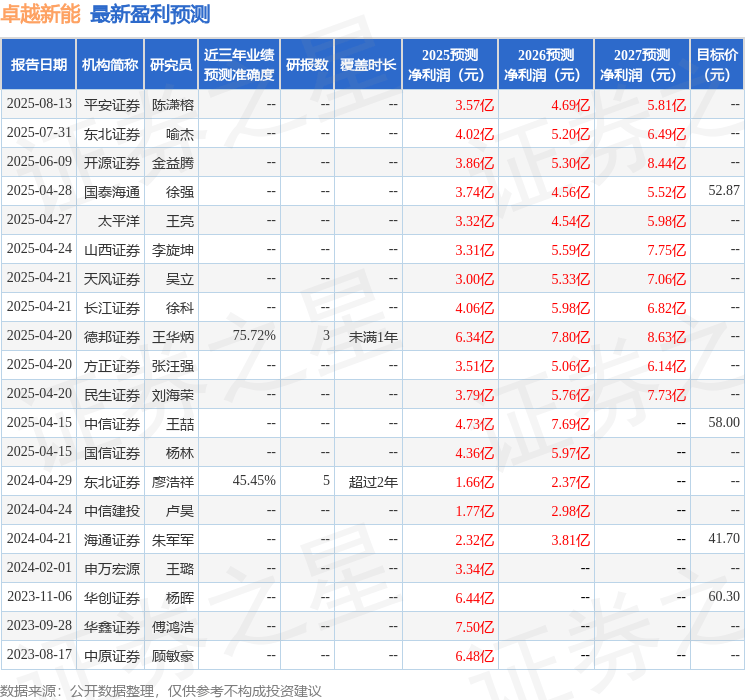
Company Level - Zhuoyue New Energy is the first domestic company specializing in the research and production of biodiesel from waste oils, and it is a leading enterprise in ester-based biodiesel production [1] - The company demonstrates investment value due to three main reasons: 1) Long-term industry-leading performance and maintained profitability despite extreme tariff policies, with strong cost control and supplier management [1] 2) Continuous expansion of domestic and overseas production capacity, with current ester-based capacity near 500,000 tons and potential expansion to nearly 1.3 million tons [1] 3) External negative impacts are diminishing, with better-than-expected effects from EU anti-dumping duties, and the establishment of overseas biodiesel bases will provide a larger base for non-tax sales [1] Industry Level - The biofuel industry has significant growth prospects and investment opportunities due to: 1) Domestic and international policies driving demand growth, with the EU being the largest consumer of biodiesel and China’s largest export market [2] 2) Profit opportunities from carbon pricing and marginal cost improvements, as the economic viability of biodiesel is expected to increase with the advancement of carbon market policies [2] Profit Forecast and Investment Rating - Revenue projections for the company from 2025 to 2027 are expected to reach 4.807 billion, 7.304 billion, and 8.529 billion yuan, with year-on-year growth rates of 34.9%, 51.9%, and 16.8% respectively [3] - Net profit forecasts for the same period are 360 million, 619 million, and 774 million yuan, with growth rates of 141.6%, 71.8%, and 25.2% respectively [3] - The company is rated as "buy" due to strong overseas sales channel expansion, stable biodiesel prices, and significant growth potential from production capacity expansion [3] Stock Price Catalysts - Catalysts for stock price include the commissioning of new domestic and overseas production capacity, a decrease in raw oil costs, and accelerated demand growth driven by domestic policies [4]
信达证券:首次覆盖卓越新能给予买入评级
Sou Hu Cai Jing· 2025-08-14 01:01
Company Overview -卓越新能 is the first domestic company specializing in the research and production of biodiesel from waste oils, and it is a leading enterprise in ester-based biodiesel production in China [2][3] - The company has maintained profitability despite extreme tariff policies, showcasing superior cost control, supplier management, and sales channel expansion capabilities [2][3] - The company currently has ester-based production capacity of nearly 500,000 tons, with plans to expand biodiesel production to approximately 1.3 million tons [2][3] Industry Outlook - The biodiesel industry has significant growth potential, driven by domestic and international policy support, with the EU being the largest consumer of biodiesel globally [3] - The demand for biodiesel is expected to increase as carbon pricing and marginal cost improvements create profitability opportunities [3] - The company can mitigate the impact of EU anti-dumping duties by exporting to high-demand regions outside the EU and establishing production facilities in non-tax regions [3] Financial Projections - The company is projected to achieve revenues of 4.807 billion, 7.304 billion, and 8.529 billion yuan from 2025 to 2027, with year-on-year growth rates of 34.9%, 51.9%, and 16.8% respectively [4] - Net profits for the same period are expected to be 360 million, 619 million, and 774 million yuan, with growth rates of 141.6%, 71.8%, and 25.2% respectively [4] - The estimated EPS for 2025, 2026, and 2027 are 3.00, 5.15, and 6.45 yuan per share, with corresponding PE ratios of 15.37, 8.95, and 7.15 [4] Catalysts for Stock Price - New production capacity coming online both domestically and internationally [5] - Decrease in raw material costs [5] - Acceleration of demand growth driven by domestic policies [5]