可再生能源

Search documents
“特朗普这一法案,会使中国主导地位无懈可击”
Sou Hu Cai Jing· 2025-08-04 09:51
Core Viewpoint - The "Big and Beautiful" tax reform signed by President Trump has eliminated several clean energy incentives, exacerbating the financial difficulties faced by the renewable energy sector in the U.S. [1] Group 1: Impact on Clean Energy Industry - The cancellation of clean energy tax credits, including those for electric vehicles, has led to a perception that the U.S. clean energy industry is entering a "darkest hour" [1] - A study from Princeton University indicates that under the "Big and Beautiful" act, U.S. greenhouse gas emissions could increase by 470 million tons of CO2 equivalent by 2035 compared to previous policies [1] - The U.S. clean energy generation growth from 2025 to 2035 is projected to be only 57% to 62% of what it would have been under prior policies [1] Group 2: Regulatory Environment - Trump's administration has shown no intention of fostering a sustainable clean energy sector, instead opting for stricter regulations [2] - Following the signing of the tax reform, Trump ordered the Treasury Department to issue guidance to terminate taxpayer subsidies for "unreliable energy" [2] - The "Big and Beautiful" act expands restrictions on foreign entities, potentially complicating supply chains for solar, battery, and electric vehicle sectors that rely on Chinese inputs [4] Group 3: Economic Implications - Analysts predict that the "Big and Beautiful" act will lead to increased energy prices and household bills in the U.S. [5] - Even without additional harmful policies, wholesale electricity prices are expected to rise by 25% by 2030 and 74% by 2035 [5] - The first half of the year saw utility companies requesting $29 billion in rate increases, a significant rise from the previous year [5]

AES(AES) - 2025 Q2 - Earnings Call Transcript
2025-08-01 15:00
Financial Data and Key Metrics Changes - Adjusted EBITDA for Q2 2025 was $681 million, up from $658 million in the previous year, reflecting growth driven by new renewables projects and cost reductions [22][24] - Adjusted EPS increased by 34% to $0.51 per share compared to $0.38 in the prior year, supported by higher U.S. renewable tax attributes [23][24] Business Line Data and Key Metrics Changes - The Renewables Strategic Business Unit (SBU) saw adjusted EBITDA of $240 million, a 56% increase year-over-year, attributed to 3.2 gigawatts of new projects added to the portfolio [8][24] - The Utilities SBU experienced lower adjusted pretax contributions due to planned outages and the sell-down of AES Ohio, but significant growth is expected driven by new investments [25][28] - The Energy Infrastructure SBU's lower EBITDA was primarily due to prior year recognition of the Warrior Run coal PPA monetization and the transition of Chile renewables to the Renewables segment [25][26] Market Data and Key Metrics Changes - The U.S. electricity market is experiencing rapid demand growth, with a significant shift towards renewables and energy storage expected over the next five years [6][16] - AES has a backlog of 12 gigawatts of signed Power Purchase Agreements (PPAs), with 4.1 gigawatts international and 7.9 gigawatts in the U.S., positioning the company well against U.S. policy changes [11][12] Company Strategy and Development Direction - AES aims to maintain flexibility in its business model by providing electric energy and capacity that meet market demands, focusing on renewables and energy storage [7][16] - The company is executing the largest investment program in the history of its U.S. utilities, with a planned investment of approximately $1.4 billion in 2025 [19][21] - AES is positioned as a leading provider of renewables to data center companies, with over 11 gigawatts of agreements signed to date [16][39] Management's Comments on Operating Environment and Future Outlook - Management expressed confidence in achieving 2025 guidance and long-term growth targets, citing a resilient business model and a strong backlog of projects [4][38] - The company anticipates strong demand for electricity driven by data center growth, requiring over 600 terawatt hours of additional power by the end of the decade [16][18] - Management noted that recent U.S. policy changes are largely inconsequential to the majority of their business, including their operating portfolio and international operations [10][12] Other Important Information - AES has implemented a supply chain strategy that mitigates risks from U.S. policy changes and tariffs, ensuring that major equipment is sourced from U.S.-based suppliers [14][15] - The company is focused on maintaining a triple investment grade rating while continuing to pay dividends and invest in growth [32][34] Q&A Session Summary Question: Can you discuss the project online timing for the rest of the year and its impact on EPS and EBITDA recognition? - Management confirmed that most of the remaining 1.3 gigawatts will be commissioned in the third quarter, with full confidence in meeting the timeline [43][44] Question: How does the company view its current valuation compared to private markets? - Management believes the company has been consistently undervalued and highlighted the strength of its backlog and execution capabilities [48][49] Question: What is the company's outlook on safe harboring risks from potential executive orders? - Management expressed confidence in their robust position, noting that most projects are not exposed to new treasury guidance and have safe harbor protections [57][59] Question: How is the demand for electricity evolving in the utility sector? - Management reported strong interest and demand, particularly in their utilities, with significant data center demand contributing to growth [62] Question: Can you provide details on the PPAs signed in the quarter? - Management indicated that all new PPAs signed were with data center customers, with a significant portion being solar plus batteries [68] Question: What is the company's strategy regarding gas generation for data centers? - Management stated that they are capable of building gas plants if required by customers, while continuing to focus on renewables [99][100] Question: Is there potential for consolidation in the renewable industry due to policy uncertainty? - Management acknowledged that smaller developers may face challenges, creating opportunities for AES to acquire assets or advanced stage projects [101][102]

金十图示:2025年08月01日(周五)新闻联播今日要点
news flash· 2025-08-01 13:20
Group 1: Macroeconomic Policies - The macroeconomic policies in China will continue to exert force and timely adjustments will be made to consolidate and expand the economic recovery momentum [4] - The National Development and Reform Commission plans to accelerate the construction progress of "two重" projects and central budget investment projects [4] - A fourth batch of 69 billion yuan for consumer goods replacement will be allocated in October, ensuring orderly and balanced fund usage until the end of the year [4] Group 2: Renewable Energy and Manufacturing - In the first half of the year, newly installed renewable energy capacity accounted for over 90% of total new installations, with a year-on-year growth of 99.3% [7] - The electronic information manufacturing industry saw a year-on-year increase of 11.1% in added value, outperforming the overall industrial growth by 4.7 percentage points [6] Group 3: Film Industry - The box office for the summer film season in 2025 has exceeded 6 billion yuan, with the anti-war film "Nanjing Photo Studio" leading the box office [8] Group 4: Service Trade - In the first quarter of 2025, Asia's service trade exports grew by 9% year-on-year, with China showing significant performance in global transport service exports, which increased by 31% [10] - China's tourism revenue also saw a remarkable year-on-year growth of 96% during the same period [10]

申银万国期货早间策略-20250801
Shen Yin Wan Guo Qi Huo· 2025-08-01 04:00
Report Industry Investment Rating - No information provided in the documents Core Viewpoints - The A-share market has a high investment cost-performance ratio in the long term. The CSI 500 and CSI 1000 are more supported by science and innovation policies, and their high growth potential may bring higher returns. The SSE 50 and CSI 300 have more defensive value in the current macro environment. The proportion of medium and long-term funds in the capital market is expected to gradually increase, which is conducive to reducing stock market volatility. Currently, policy signals are clear, and valuations are starting to recover, but the fundamentals have not been verified [2] Summary by Relevant Catalogs I. Futures Market 1. Futures Contracts - **IF Contracts**: The closing prices of IF contracts decreased, with the current month, next month, next quarter, and the quarter after the next quarter falling by 20.00, 20.80, 16.40, and 18.20 respectively. The trading volumes were 23,577.00, 53,170.00, 12,168.00, and 3,531.00, and the open interest decreased by 4,718.00, 7,721.00, increased by 562.00, and increased by 685.00 respectively [1] - **IH Contracts**: The closing prices of IH contracts decreased, with the current month, next month, next quarter, and the quarter after the next quarter falling by 16.40, 17.00, 17.20, and 15.40 respectively. The trading volumes were 12,022.00, 30,341.00, 4,009.00, and 855.00, and the open interest decreased by 599.00, 2,625.00, 72.00, and 155.00 respectively [1] - **IC Contracts**: The closing prices of IC contracts decreased slightly, with the current month, next month, next quarter, and the quarter after the next quarter falling by 1.40, 1.80, 2.00, and 3.80 respectively. The trading volumes were 21,529.00, 39,078.00, 11,549.00, and 4,777.00, and the open interest decreased by 2,979.00, 2,797.00, 128.00, and increased by 1,671.00 respectively [1] - **IM Contracts**: The closing prices of IM contracts increased slightly, with the current month, next month, next quarter, and the quarter after the next quarter rising by 2.00, 2.20, 0.80, and 0.60 respectively. The trading volumes were 32,877.00, 98,231.00, 21,466.00, and 6,839.00, and the open interest decreased by 3,636.00, 8,546.00, 339.00, and increased by 1,231.00 respectively [1] 2. Inter - month Spreads - The inter - month spreads of IF, IH, IC, and IM contracts changed, with the current values of IF next month - IF current month, IH next month - IH current month, IC next month - IC current month, and IM next month - IM current month being - 6.80, 1.20, - 45.20, and - 62.40 respectively, compared to the previous values of - 5.80, 1.20, - 43.60, and - 57.20 [1] II. Spot Market 1. Major Indexes - **CSI 300 Index**: The index decreased by 0.53%, with a previous value of 4,127.16, a trading volume of 27.359 billion lots, and a total trading value of 430.446 billion yuan [1] - **SSE 50 Index**: The index decreased by 0.60%, with a previous value of 2,795.51, a trading volume of 5.169 billion lots, and a total trading value of 114.043 billion yuan [1] - **CSI 500 Index**: The index increased by 0.10%, with a previous value of 6,299.59, a trading volume of 23.706 billion lots, and a total trading value of 304.368 billion yuan [1] - **CSI 1000 Index**: The index increased by 0.08%, with a previous value of 6,706.61, a trading volume of 26.4 billion lots, and a total trading value of 363.14 billion yuan [1] 2. Industry Indexes - Different industries showed different trends. For example, the energy, raw materials, industry, and optional consumption sectors decreased by 1.10%, 0.59%, 1.21%, and 1.48% respectively. The main consumption, medical and health, real estate and finance, and information technology sectors decreased by 1.65%, 0.30%, 0.32%, and increased by 1.43% respectively. The telecommunications and public utilities sectors decreased by 0.53% and 0.70% respectively [1] III. Basis - The basis of IF, IH, IC, and IM contracts relative to their corresponding spot indexes changed compared to the previous two days. For example, the basis of IF current month - CSI 300 was - 4.36, compared to - 2.04 two days ago [1] IV. Other Indexes 1. Domestic Indexes - The Shanghai Composite Index decreased by 0.33%, the Shenzhen Component Index decreased by 0.22%, the Small and Medium - sized Board Index increased by 0.28%, and the ChiNext Index decreased by 0.23% [1] 2. International Indexes - The Hang Seng Index decreased by 1.09%, the Nikkei 225 decreased by 0.88%, the S&P 500 increased by 0.40%, and the DAX Index decreased by 0.32% [1] V. Macro Information - A batch of new regulations came into effect on August 1st, including the Hong Kong "Stablecoin Ordinance", the "Measures for the Administration of Anti - Money Laundering and Counter - Terrorist Financing of Precious Metals and Gemstone Institutions", etc. The US will resume imposing so - called "reciprocal tariffs" on August 1st. The State Council Executive Meeting approved the "Opinions on Deeply Implementing the 'Artificial Intelligence +' Initiative" and deployed loan interest subsidy policies. The July China Manufacturing PMI was 49.3%, a seasonal decrease of 0.4 percentage points. The National Development and Reform Commission emphasized work in nine aspects for the second half of the year [2] VI. Industry Information - The National Healthcare Security Administration formulated a new pricing mechanism for newly launched drugs and added more than 100 price items related to medical new technologies. The National Energy Administration is formulating policies for high - power charging facilities construction. In the first half of the year, the country's renewable energy new installed capacity was 268 million kilowatts, a year - on - year increase of 99.3%. The financial regulatory authority required urban commercial medical insurance to highlight its inclusive nature [2]
截至6月底全国太阳能发电装机11亿千瓦
Zhong Guo Xin Wen Wang· 2025-08-01 01:08
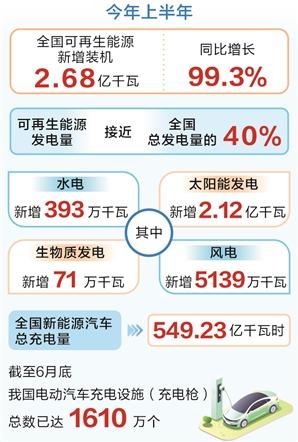
Core Insights - In the first half of this year, China's renewable energy generation accounted for nearly 40% of the total national power generation, surpassing the combined electricity consumption of the tertiary industry and urban-rural residents [1] Renewable Energy Generation - The total renewable energy generation reached 1,799.3 billion kWh, a year-on-year increase of 15.6%, representing approximately 39.7% of the total power generation [1] - Wind and solar power generation combined reached 1,147.8 billion kWh, with a year-on-year growth of 27.4%, making up 23.7% of the total electricity consumption, an increase of 4.4 percentage points compared to the same period last year [1] - The increase in wind and solar generation was 247 billion kWh compared to the same period last year, exceeding the overall increase in electricity consumption [1] Installed Capacity - The installed capacity of renewable energy continued to achieve breakthroughs, with an addition of 268 million kW in the first half of the year, a year-on-year increase of 99.3%, accounting for 91.5% of the total new installed capacity [1] - As of the end of June, the total installed capacity of renewable energy reached 2,159 million kW, a year-on-year increase of 30.6%, representing 59.2% of China's total installed capacity [1] - The breakdown of installed capacity includes 440 million kW for hydropower, 573 million kW for wind power, 1,100 million kW for solar power, and 47 million kW for biomass power [1]

上半年我国能源供应充足结构优化 能源投资"向绿向新"聚集
Zhong Guo Zheng Quan Bao· 2025-08-01 00:01
Core Insights - The overall energy supply in China is sufficient and the supply-demand situation is generally relaxed, supporting economic recovery [1][2] - Renewable energy development has reached new heights, with significant growth in installed capacity and investment [3][4] Energy Supply and Demand - National energy consumption has maintained growth, with electricity consumption growth stabilizing at 5.4% in June [2] - Natural gas demand has slightly increased, while coal consumption has decreased due to warmer winter weather and increased renewable energy output [2] Renewable Energy Development - New energy installations have doubled compared to the same period last year, with non-fossil energy generation capacity exceeding 60% for the first time [2][4] - Renewable energy accounted for 91.5% of new installed capacity, with a total of 268 million kilowatts added in the first half of the year, a 99.3% year-on-year increase [4][5] Investment in Energy Infrastructure - Investment in key energy projects exceeded 1.5 trillion yuan, a 21.6% increase year-on-year, with significant contributions from private enterprises [3][4] - Investment in renewable energy generation has also seen rapid growth, particularly in distributed solar and offshore wind projects [3][4] Charging Infrastructure Development - As of June 30, the total number of electric vehicle charging facilities reached 16.1 million, with a coverage rate of 97.08% in counties and 80.02% in towns [6][7] - The total charging volume for new energy vehicles reached 54.923 billion kilowatt-hours in the first half of the year [7] Summer Peak Power Supply - The overall power supply during the summer peak is expected to be secure, with a projected load exceeding 1.55 billion kilowatts [7]
上半年 可再生能源新增装机同比增99.3%
Ren Min Ri Bao Hai Wai Ban· 2025-07-31 23:47
Core Insights - The article highlights the significant growth in renewable energy capacity in China during the first half of the year, with a total of 268 million kilowatts added, representing a year-on-year increase of 99.3% and accounting for approximately 91.5% of the new installed capacity [1] Renewable Energy Capacity - Renewable energy continues to dominate new installations, nearing 60% of the total installed capacity in the country [1] - As of June 30, the total installed capacity of renewable energy reached 2.159 billion kilowatts, a year-on-year increase of 30.6%, making up about 59.2% of China's total installed capacity [1] - Breakdown of installed capacity includes: - Hydropower: 440 million kilowatts - Wind power: 573 million kilowatts - Solar power: 1.1 billion kilowatts - Biomass power: 47 million kilowatts [1] Renewable Energy Generation - Renewable energy generation accounts for nearly 40% of the total electricity generation in the country, surpassing the combined electricity consumption of the tertiary industry and urban and rural residents [1] - In the first half of the year, renewable energy generation reached 1,799.3 billion kilowatt-hours, a year-on-year increase of 15.6%, representing approximately 39.7% of total electricity generation [1]
今年上半年全国绿证交易规模翻倍;宁德时代称固态电池距商业化还有段距离
Mei Ri Jing Ji Xin Wen· 2025-07-31 23:22
Group 1 - The National Energy Administration reported that the trading scale of green certificates in the first half of the year doubled year-on-year, with a total of 1.371 billion certificates issued [1] - The average price of green certificates reached 5 yuan per certificate in the first half of the year, with a peak of 6.5 yuan in June, marking a 4.4 times increase from the lowest price this year [1] - The data indicates a shift from an administrative-driven renewable energy consumption mechanism to a market-driven approach, laying a crucial institutional foundation for achieving carbon neutrality goals and global green trade integration [1] Group 2 - CATL has invested over 10 years in solid-state battery research and has formed a leading R&D team in the industry [2] - While the scientific issues in the solid-state battery sector have been largely resolved, engineering challenges and supply chain maturity still hinder commercialization [2] - The focus on R&D has created a technological moat that supports future advancements in electric vehicle range and applications in energy storage and aviation [2] Group 3 - Hewei Electric announced that it does not currently have HVDC (High Voltage Direct Current) products, despite market rumors suggesting otherwise [3] - The company's stock experienced significant volatility, with a cumulative price deviation exceeding 20% over three consecutive trading days, reflecting market sensitivity to HVDC-related themes [3] - HVDC technology is crucial for long-distance power transmission and is in high demand due to the global surge in renewable energy infrastructure [3]


上半年我国能源供应充足结构优化
Zhong Guo Zheng Quan Bao· 2025-07-31 21:02
Core Insights - The overall energy supply in China is sufficient and the demand-supply situation is generally relaxed, supporting economic recovery [1][2] - Renewable energy development has reached new heights, with significant growth in installed capacity and investment in green energy projects [2][3] Energy Supply and Demand - National energy consumption has shown growth, with electricity consumption growth stabilizing at 4.7% in April, 4.4% in May, and 5.4% in June [1] - Natural gas demand has slightly increased, primarily driven by urban gas consumption, while coal consumption has decreased due to warmer winter weather and increased renewable energy output [1] Renewable Energy Growth - The installed capacity of renewable energy has rapidly increased, with non-fossil energy generation capacity surpassing 60% for the first time by the end of May [2] - In the first half of the year, the newly installed capacity of wind and solar power doubled compared to the same period last year, with renewable energy accounting for 91.5% of new installations [3][5] Investment in Energy Infrastructure - Investment in energy infrastructure projects exceeded 1.5 trillion yuan, a year-on-year increase of 21.6%, with private sector investment growing rapidly [2][3] - Investment in hydrogen energy projects has doubled, and investment in charging infrastructure has increased by nearly 70% [2][3] Charging Infrastructure Development - As of June 30, the total number of electric vehicle charging facilities reached 16.1 million, with a coverage rate of 97.08% in counties and 80.02% in townships [3][4] - The total charging volume for new energy vehicles reached 54.923 billion kWh in the first half of the year [3] Power Supply Assurance - The power supply during the peak summer demand period is expected to be secure, with a projected load exceeding 1.55 billion kW [4]