创新药

Search documents
招银国际:中国医药业板块行情或将分化 关注个股机会
智通财经网· 2025-12-09 06:25
Group 1 - The MSCI China Healthcare Index has increased by 62.8% from the beginning of 2025 to November 21, outperforming the MSCI China Index by 32.2% [1] - The recent pullback in the pharmaceutical sector, with the MSCI China Healthcare Index declining by 8% from early October to November 21, is attributed to profit-taking by investors and high valuations of some innovative drug companies [1] - Despite the significant recovery in industry valuations, the pharmaceutical sector is expected to face challenges in achieving widespread growth in 2026, although there are opportunities for valuation and performance recovery in specific stocks such as medical services, pharmaceuticals, and CXO companies [1] Group 2 - As of October 2025, the upfront payments for Chinese innovative drug license-out transactions have reached $6.3 billion, a 53% year-over-year increase, surpassing the total for 2024 [2] - The interest from multinational corporations (MNCs) in Chinese innovative pipelines has increased, with 20% of the number and 39% of the value of top MNC's transactions in China occurring in the first nine months of 2025 [2] - The trend of Chinese innovative drugs going abroad is expected to continue into 2026, with a focus on the overseas clinical advancement of authorized pipelines due to higher certainty and potential for stock price catalysts [2] Group 3 - The demand for pharmaceutical research and development has begun to recover in 2025, with a 444% year-over-year increase in financing for Chinese innovative drugs in Q3 2025 [3] - Global innovative drug financing also showed positive growth in Q3 2025, increasing by 8.6% [3] - Chinese CXO companies, deeply involved in the global pharmaceutical R&D supply chain, are experiencing growth in global demand, as evidenced by WuXi AppTec's orders increasing by 41.2% year-over-year as of September 30 [3] Group 4 - The acceleration of centralized procurement for medical devices has continued in 2023, leading to significant performance differentiation across various segments [4] - In high-value consumables, the impact of centralized procurement is diminishing, with orthopedics entering a "post-procurement" recovery phase [4] - The medical device sector is experiencing a temporary high demand driven by equipment updates, with a 30% year-over-year increase in the bidding market for Q3 2025 [4] - The in vitro diagnostics (IVD) market is facing challenges due to centralized procurement and cost control measures, resulting in a year-over-year decline of 5% in the domestic IVD market in the first half of 2025 [4]

港股通创新药高开低走,520880跌逾1%,场内溢价快速拉高,低吸资金涌动
Xin Lang Cai Jing· 2025-12-09 06:20
Group 1 - The Hong Kong Stock Connect Innovative Drug ETF (520880) has decreased by 1.09%, with the latest price at 0.546 yuan and a turnover rate of 8.58% [1] - The ETF closely tracks the Hang Seng Hong Kong Stock Connect Innovative Drug Selected Index, which includes companies involved in the research, development, and production of innovative drugs [1] - The latest scale of the ETF reached 2.124 billion yuan, with a total of 3.860 billion shares, reflecting an increase of 0.088 billion yuan over the past month [1] Group 2 - Notable stock performances within the index include Kangzheng Pharmaceutical up by 1.17%, China Biopharmaceutical up by 1.03%, and CSPC Pharmaceutical up by 0.27%, while Kangfang Biotech down by 3.38%, 3SBio down by 3.36%, and Innovent Biologics down by 2.63% [1] - The ETF has seen a net inflow of 56.4796 million yuan as of the previous trading day, with a total of 60.919 million yuan raised over the past week [1]
港股科技ETF(513020)近20日净流入超2.4亿元,科技板块引领作用显著
Mei Ri Jing Ji Xin Wen· 2025-12-09 06:11
Core Viewpoint - The Hong Kong stock technology sector is expected to maintain strong momentum driven by the acceleration of computing power layout and AI application developments, with significant investment opportunities in internet heavyweight assets [1] Group 1: Technology Sector Insights - The technology sector is showing a strong leading role, with major players accelerating their computing power strategies [1] - Recent developments in AI applications, such as the unexpected success of Doubao mobile assistant and Kuaishou's new model focusing on multimodal creation, are creating competitive dynamics [1] - OpenAI is set to release GPT-5.2, which is anticipated to boost the AI application sector [1] Group 2: Media and Gaming Sector Outlook - Although the media sector has underperformed in the short term, there is a long-term positive outlook due to the potential explosion of open-source large models and the reshaping of application patterns [1] - The gaming sector's valuations are entering a favorable zone, presenting potential investment opportunities [1] Group 3: ETF and Index Performance - The Hong Kong Technology ETF (513020) tracks the Hong Kong Stock Connect Technology Index (931573), which includes core assets in internet, innovative pharmaceuticals, and new energy vehicles, reflecting a diversified technology industry characteristic [1] - The Hong Kong Stock Connect Technology Index has outperformed the Hang Seng Technology Index, with a cumulative return of 256.46% from the base date at the end of 2014 to October 2025, exceeding the Hang Seng Technology Index's return of 96.94% by nearly 160% [1]
刚刚,利好来袭!盘中,直线猛拉!
Zhong Guo Ji Jin Bao· 2025-12-09 05:13
Market Overview - The A-share market showed mixed performance with the Shanghai Composite Index down 0.13% at 3918.83 points, while the Shenzhen Component rose 0.09% and the ChiNext Index increased by 1.07% [1][2] Trading Volume - The trading volume in the Shanghai and Shenzhen markets reached 1.26 trillion yuan, a decrease of 34.7 billion yuan compared to the previous trading day [2] Sector Performance - The CPO (光模块) sector continued to rise, with significant gains in innovative pharmaceuticals, consumer electronics, and retail stocks, while precious metals and real estate sectors lagged [2][6] CPO Sector - The CPO concept stocks achieved a four-day consecutive rise, with notable increases in companies like 中际旭创 (Zhongji Xuchuang) up 6.94% to 609.58 yuan per share, reaching a market cap of 677.3 billion yuan [6][7] - Other companies in the CPO sector, such as 新易盛 (Xinyi Sheng) and 天孚通信 (Tianfu Communication), also saw substantial gains [6] Innovative Pharmaceuticals - The innovative pharmaceutical sector was active, with 海创药业 (Haichuang Pharmaceutical) rising over 13% and 昭衍新药 (Zhaoyan Pharmaceutical) increasing over 8% [8][9] - The National Medical Insurance Drug List for 2025 added 114 new drugs, with a success rate of 88%, significantly higher than the previous year's 76% [9] Consumer Electronics - The consumer electronics sector showed strong performance, with 达华智能 (Dahua Intelligent) hitting the daily limit up of 10% and 福蓉科技 (Furong Technology) also reaching the limit [11][12] - The launch of Google's "AndroidXR" themed smart glasses Project Aura is expected to impact the market positively [12] Retail Sector - The retail sector saw a significant surge, with multiple stocks like 中央商场 (Central Plaza) and 永辉超市 (Yonghui Supermarket) hitting the daily limit up [14][15] - The Ministry of Commerce announced plans to enhance new consumption scenarios, which may further boost the retail sector [15] Nvidia Supply Chain - The Nvidia supply chain concept stocks experienced substantial increases, with 恒信东方 (Hengxin Dongfang) and 鸿博股份 (Hongbo Shares) recording significant gains [17][18] - Nvidia is set to re-enter the Chinese market, allowing sales of its H200 AI chips under specific conditions [18] Fujian Sector - The Fujian sector remained active, with 安记食品 (Anji Food) achieving a six-day consecutive rise, reflecting strong local economic initiatives [19]



刚刚,利好来袭!盘中,直线猛拉!
中国基金报· 2025-12-09 05:04
Market Overview - The A-share market showed mixed performance on December 9, with the Shanghai Composite Index down 0.13% at 3918.83 points, while the Shenzhen Component rose 0.09% and the ChiNext Index increased by 1.07% [2] - The total trading volume in the Shanghai and Shenzhen markets was 1.26 trillion yuan, a decrease of 34.7 billion yuan compared to the previous trading day, with 1738 stocks rising and 3555 stocks falling [4] Sector Performance - The optical module (CPO) sector continued to rise, along with innovative pharmaceuticals, consumer electronics, and retail stocks, while precious metals and real estate sectors lagged [5] - The CPO concept achieved a four-day consecutive rise, with stocks like Zhongji Xuchuang and Tianfu Communication reaching new highs [10] - The innovative pharmaceutical sector was active, with Hai Chuang Pharmaceutical rising over 13% and Zhao Yan New Drug increasing over 8% [18] - The consumer electronics sector saw significant activity, with stocks like Dahua Intelligent and Furuon Technology hitting the daily limit [22] - The commercial retail sector experienced a strong surge, with multiple stocks such as Central Plaza and Yonghui Supermarket reaching the daily limit [27] Notable Stocks - Zhongji Xuchuang rose by 6.94% to 609.58 yuan per share, with a market capitalization of 677.3 billion yuan [11] - Hai Chuang Pharmaceutical reached 53.75 yuan per share, up 13.13%, with a market capitalization of 5.3 billion yuan [19] - Dahua Intelligent recorded a 9.96% increase to 7.84 yuan per share, with a market capitalization of 8.7 billion yuan [24] - Central Plaza saw a 10.03% rise to 4.06 yuan per share, with a market capitalization of 4.6 billion yuan [28] News Impact - The National Medical Insurance Drug List for 2025 was released, adding 114 new drugs, with a success rate of 88%, significantly higher than the previous year's 76% [20] - Google's recent launch of the AndroidXR-themed smart glasses in collaboration with XREAL is expected to impact the consumer electronics market [25] - The U.S. government announced that NVIDIA would be allowed to sell its H200 AI chips to China, which may influence the semiconductor sector [34]



生物医药行业:2025年医保及首版商保目录公布,中国药品价格登记系统上线,助力创新药发展
Ping An Securities· 2025-12-09 04:53
Investment Rating - The industry investment rating is "Outperform the Market," indicating that the industry index is expected to perform better than the market by more than 5% over the next six months [36]. Core Insights - The 2025 National Basic Medical Insurance, Maternity Insurance, and Work Injury Insurance Drug List, along with the first version of the Commercial Health Insurance Innovative Drug List, was released on December 7, 2025. This adjustment includes 114 new drugs, of which 50 are classified as Class 1 innovative drugs [3]. - The newly launched Chinese Drug Price Registration System aims to facilitate the global pricing system for innovative drugs and attract high-quality foreign drugs to the Chinese market, benefiting patients [4][5]. - The innovative drug sector is expected to continue its rise, with recommendations to focus on companies with rich pipeline layouts, high-potential innovative drugs, and leading technology platforms [11]. Summary by Sections Industry Developments - The 2025 drug list adjustment marks the eighth update since the establishment of the National Medical Insurance Bureau, reflecting ongoing efforts to enhance drug accessibility and innovation in China [3]. - The Chinese Drug Price Registration System, launched on December 2, 2025, allows pharmaceutical companies to independently declare drug prices, promoting a more transparent and globalized pricing structure [4][5]. Company Highlights - Yino Pharmaceutical has rapidly emerged in the metabolic disease treatment field since its establishment in 2014, with its core product, Isupreglutide α, receiving approval as a Class 1 innovative drug and entering commercialization [7]. Investment Strategy - The report suggests focusing on companies with diverse pipelines, such as Heng Rui Medicine, BeiGene, and China National Pharmaceutical Group, as well as those with high-potential innovative drugs like Sanofi and Kaiyin Technology [11]. - It also highlights the importance of companies with leading technology platforms, such as Dongcheng Pharmaceutical and WuXi AppTec, as well as upstream companies benefiting from overseas expansion [11]. Market Performance - The pharmaceutical sector experienced a decline of 0.74% last week, ranking 19th among 28 industries, while the Shanghai and Shenzhen 300 Index rose by 1.28% [14][24]. - As of December 5, 2025, the pharmaceutical sector's valuation stands at 29.30 times (TTM), with a premium of 17.46% over the overall A-share market [27].
中信建投:看好“跨年行情”的五个理由
Sou Hu Cai Jing· 2025-12-09 04:39
Group 1 - The core viewpoint of the article emphasizes the anticipation of a year-end market rally in A-shares, analyzed from five perspectives: fundamentals, policies, capital, valuations, and technicals [1] Group 2 - Fundamentals have not shown significant improvement yet [1] - Policy measures continue to be implemented, with a focus on maintaining stability and enhancing quality and efficiency in economic work, alongside more proactive fiscal and moderately loose monetary policies [1] - Incremental capital is gradually entering the market, with participation from various sources including individual investors, state-owned enterprises, and northbound funds [1] Group 3 - Valuations indicate that there may still be upward potential, with the risk premium of the entire A-share market at 54.01% as of December 8, 2025, remaining above the opportunity threshold [1] - The technical analysis shows that the Shanghai Composite Index has broken through the resistance line formed by the highs of 2007 and 2015, which may now serve as a support line for the current market trend [1] Group 4 - Investment strategies suggested include: (1) focusing on growth over dividends; (2) prioritizing sectors such as technology (overseas computing power, consumer electronics, edge computing, robotics, gaming, domestic computing power), lithium batteries (solid-state batteries, energy storage), non-ferrous metals, and innovative pharmaceuticals; (3) considering counter-cyclical buying in the aforementioned sectors during significant market declines [1]

利好突袭!大涨
Zhong Guo Ji Jin Bao· 2025-12-09 04:37
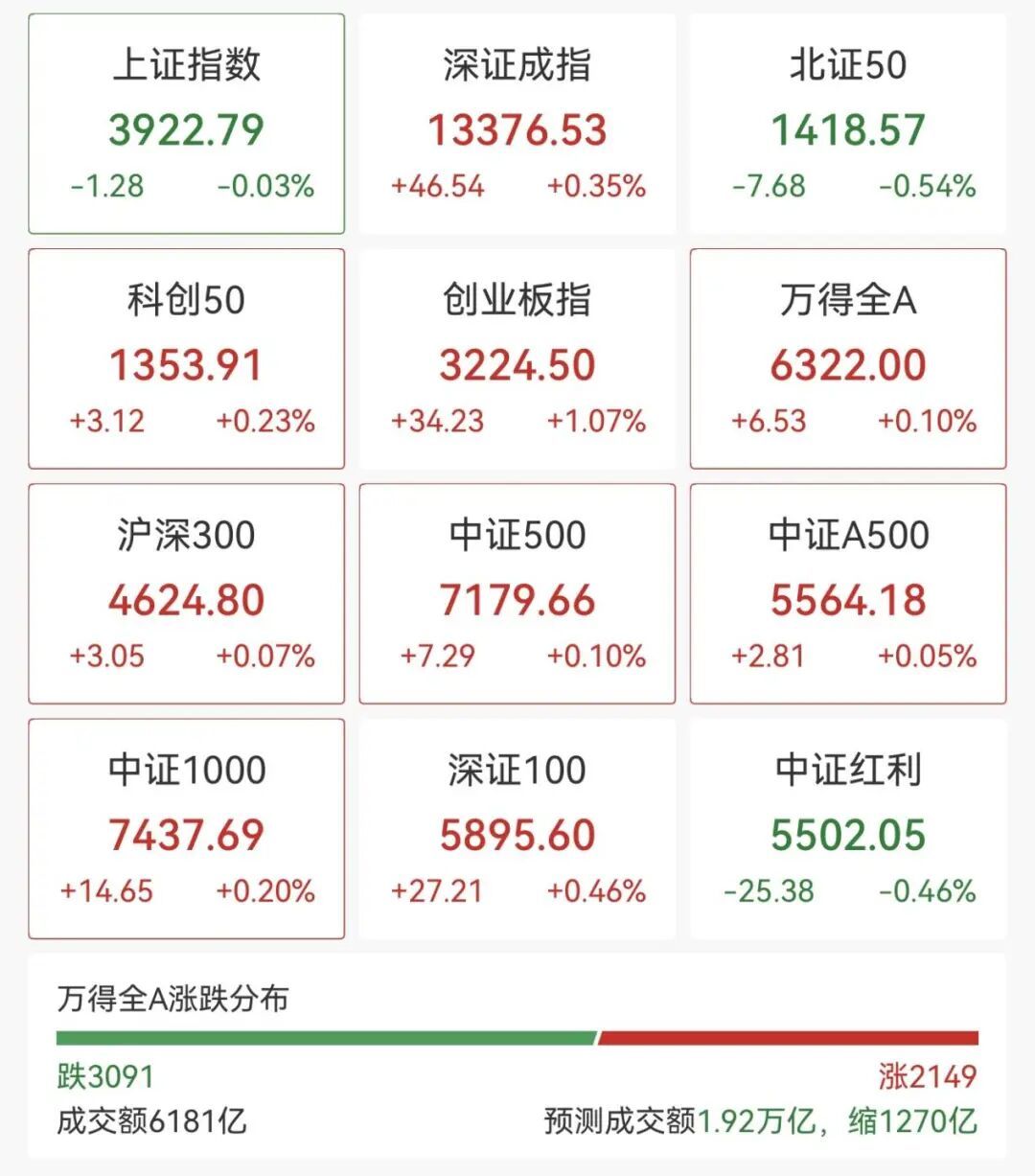
| 跌3091 | 涨2149 | | --- | --- | | 成交额6181亿 | 预测成交额1.92万亿,缩1270亿 | 12月9日开盘,A股市场震荡拉升,创业板指涨逾1%,沪指跌0.03%,深成指涨0.35%。 | 上证指数 | 深证成指 | 北证50 | | --- | --- | --- | | 3922.79 | 13376.53 | 1418.57 | | -1.28 -0.03% | +46.54 +0.35% | -7.68 -0.54% | | 科创50 | 创业板指 | 万得全A | | 1353.91 | 3224.50 | 6322.00 | | +3.12 +0.23% | +34.23 +1.07% | +6.53 +0.10% | | 沪深300 | 中证500 | 中证A500 | | 4624.80 | 7179.66 | 5564.18 | | +3.05 +0.07% | +7.29 +0.10% | +2.81 +0.05% | | 中证1000 | 深证100 | 中证红利 | | 7437.69 | 5895.60 | 5502.05 | | +14.65 ...
你还相信光吗?
猛兽派选股· 2025-12-09 04:35
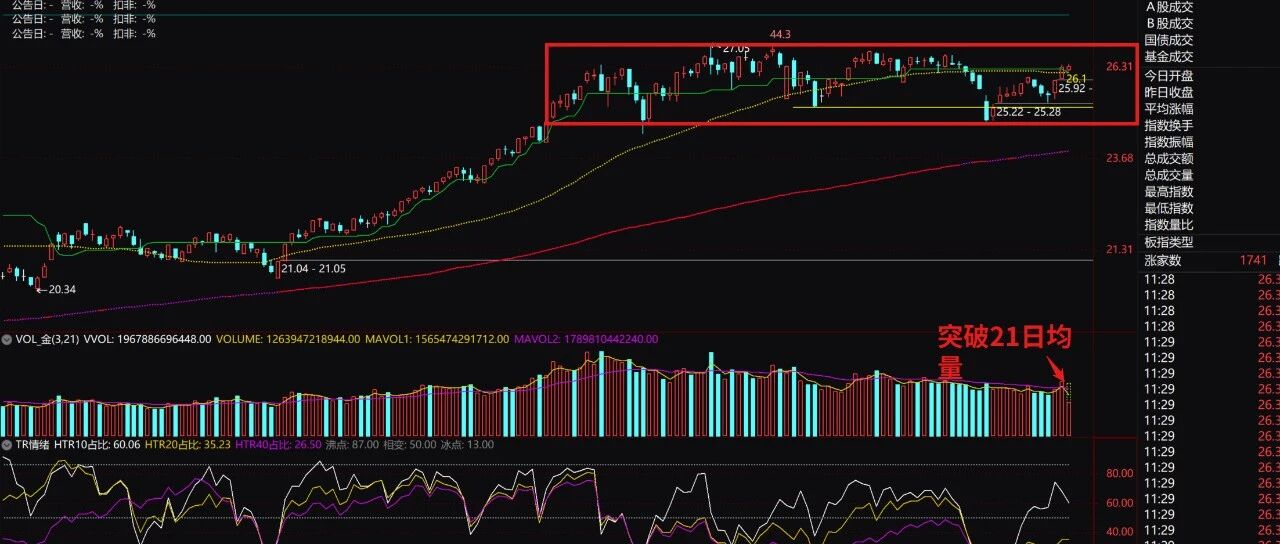
Group 1 - The strongest branch of computing power has formed a VCP structure with optical connections and PCBs, and optical connections have made breakthroughs [1] - If the market index continues to rise, the leading sectors will likely be computing power equipment followed by power equipment, with power equipment experiencing a later and less sufficient pullback [3] - The average stock price index has recently confirmed a situation where the lower limit of the pullback space has been identified, but it is uncertain if the adjustment structure has ended, with the possibility of the box continuing to expand to the right [5] Group 2 - The trading volume has recently broken through the 21-day average volume, initially satisfying the conditions for a momentum reversal, but the price box may not break through immediately [5] - The reliance on small-cap junk stocks for market rallies is unlikely, and attention should be on hard technology, innovative pharmaceuticals, as well as the support levels of insurance and banking sectors [5] - The performance of brokerage firms has been weak, indicating that they may struggle to achieve significant results, despite being favored by retail investors, as institutions show little interest [5]
利好突袭!大涨!
中国基金报· 2025-12-09 04:15
板块上来看,创新药概念股表现活跃,CPO、电子元器件、互联网等板块涨幅居前;而贵金属、海南自贸港、房地产等震荡调整。 一起来看下最新的市场情况及资讯。 12月9日开盘,A股市场震荡拉升,创业板指涨逾1%,沪指跌0.03%,深成指涨0.35%。 | 上证指数 | 深证成指 | 北证50 | | --- | --- | --- | | 3922.79 | 13376.53 | 1418.57 | | -1.28 -0.03% | +46.54 +0.35% | -7.68 -0.54% | | 科创50 | 创业板指 | 万得全A | | 1353.91 | 3224.50 | 6322.00 | | +3.12 +0.23% | +34.23 +1.07% | +6.53 +0.10% | | 沪深300 | 中证500 | 中证A500 | | 4624.80 | 7179.66 | 5564.18 | | +3.05 +0.07% | +7.29 +0.10% | +2.81 +0.05% | | 中证1000 | 深证100 | 中证红利 | | 7437.69 | 5895.60 | 5502.05 | ...