
光伏

Search documents
容量电价+资产证券化,独立储能投资拐点来了
高工锂电· 2026-02-08 12:11
Core Viewpoint - The large-scale investment in independent energy storage has officially begun, driven by the recognition of storage capacity value in the national pricing mechanism, marking a significant breakthrough in economic viability and asset securitization for independent storage stations [3][5]. Group 1: Policy Developments - On January 30, 2026, the National Development and Reform Commission and the National Energy Administration issued a notice that includes independent storage in the generation-side capacity pricing mechanism, enhancing the revenue certainty of independent storage assets [3]. - The 136 Document has removed mandatory storage requirements, allowing market-driven decisions regarding storage, and has established independent storage as a market entity capable of generating revenue through multiple channels [4][5]. - The 114 Document further optimizes the capacity pricing mechanism, aligning storage capacity pricing with coal power, thus recognizing independent storage's capacity value for the first time [5]. Group 2: Market Dynamics - In 2025, independent storage installations reached a record high of 62.24 GW/183 GWh, with independent storage accounting for 35.43 GW, or 56.6% of the total new installations, indicating a shift from policy-driven to value-driven growth in the storage industry [4]. - The introduction of capacity pricing and asset securitization is expected to drive large-scale development of independent storage by 2026, as these mechanisms provide a stable revenue foundation and open funding channels [3][6]. Group 3: Asset Securitization - The first asset-backed security (ABS) for independent storage was accepted by the Shanghai Stock Exchange, marking a significant step towards the standardization of independent storage in financial markets [7]. - The successful issuance of this ABS could transform the investment logic and valuation paradigm for storage, shifting from reliance on policy subsidies to a model anchored in long-term operational revenue [7][9]. - The acceleration of asset securitization in the renewable energy sector, including independent storage, is seen as a solution to the industry's challenges related to heavy assets and long investment cycles [8]. Group 4: Global Investment Trends - Global capital is increasingly seeking stable, tangible assets, with independent storage being likened to real estate in the AI era due to its strong demand and revenue certainty [10][12]. - Major investment firms are ramping up their investments in renewable energy projects, with a focus on energy, grid, and infrastructure assets, as these are viewed as low-risk and high-return opportunities [11][13]. - The trend of capital influx into independent storage is expected to accelerate in 2026, driven by both domestic and international investments, further solidifying its status as an income-generating infrastructure asset [13].

明冠新材终止投建肥东县太阳能背板及功能性膜生产基地项目
Bei Jing Shang Bao· 2026-02-08 11:34
Core Viewpoint - The company has decided to terminate the investment in the solar backsheet and functional film production base project due to emerging overcapacity and intensified price competition in the photovoltaic industry, leading to a forecast of widespread losses in 2024 and 2025 [1][2] Group 1: Project Termination - The company's board has approved the termination of the solar backsheet and functional film production base project, which had an estimated total investment of 5 billion yuan [1] - A wholly-owned subsidiary was established for the project with a registered capital of 100 million yuan [1] - The decision to terminate the project will be submitted for approval at the company's shareholders' meeting [1] Group 2: Industry Context - The photovoltaic industry has shown signs of overcapacity since the fourth quarter of 2023, leading to increased competition and declining profitability for packaging materials [1] - The management's analysis indicates that the industry is in a cyclical adjustment phase, with expected losses in 2024 and 2025 due to intensified competition [1] - The company has reached an agreement with the local government to terminate the project without any claims or liabilities from either party [2]

电力设备新能源 2026 年 2 月投资策略:太空光伏前景广阔,全球科技巨头持续扩大 AI 资本开支
Guoxin Securities· 2026-02-08 11:33
Group 1: Solar Power and Space Photovoltaics - The potential for space photovoltaics is significant, with Elon Musk announcing plans for SpaceX and Tesla to achieve 100GW/year solar capacity each over the next three years, specifically for space AI data centers and Starlink satellites [1][79] - Several domestic solar companies are actively engaging in the space photovoltaic business and collaborating with commercial aerospace firms, suggesting a focus on leading component companies such as Maiwei Co., JinkoSolar, JunDa Co., and Dongfang Risheng [1][79] Group 2: AI Capital Expenditure and AIDC Power Equipment - Major tech giants are significantly increasing their capital expenditures for 2026, with Amazon expected to reach approximately $200 billion (up over 50%), Google between $175 billion and $185 billion (up 91%-102%), and Meta between $115 billion and $135 billion (up 59%-87%) [2][25] - The AIDC power equipment sector is anticipated to benefit from this surge in capital expenditure, with a focus on companies like Jinpan Technology, Xinte Electric, Hewei Electric, Shenghong Co., and Zhongheng Electric [2][25] Group 3: Solid-State Battery Industry - The solid-state battery industry is advancing, with strategic partnerships formed between Enjie Co. and Guoxuan High-Tech, and advancements in equipment from companies like XianDao Intelligent and Lianying Laser [3][64] - The application side is also progressing, with the first prototype of a solid-state battery vehicle from China FAW and plans from Geely to complete the first battery pack by 2026 [3][64] Group 4: Energy Storage Demand - Global energy storage demand is expected to grow steadily, with projections for 2026 indicating a global energy storage installation demand of 455GWh, a year-on-year increase of 40% [3] - Key companies to watch in this sector include CATL, Yiwei Lithium Energy, Deye Co., Hewei Electric, Shenghong Co., and Kelu Electronics [3] Group 5: Wind Power Industry - The domestic wind power sector is projected to see a 10%-20% increase in new installations for 2026, supported by saturated orders and stable pricing [4][49] - Key companies in the wind power sector include Goldwind Technology, Taisen Wind Energy, Sany Renewable Energy, and others [4][50] Group 6: Investment Recommendations - Investment opportunities are highlighted in areas such as controlled nuclear fusion, green hydrogen, and ammonia industries, as well as the expansion of AIDC power equipment demand and the recovery of the grid equipment sector [4] - The report suggests monitoring the progress of solid-state battery industrialization and the impact of lithium material price increases on profitability [4] Group 7: Company Earnings Forecasts - Earnings forecasts for key companies indicate a positive outlook, with companies like KeliKe, DeliJia, Pinggao Electric, and Sifang Co. expected to show improved earnings per share (EPS) and price-to-earnings (PE) ratios for 2026 [5]
量化周报:三维择时框架进入谨慎状态-20260208
Guolian Minsheng Securities· 2026-02-08 11:29
Timing Perspective - The three-dimensional timing framework has entered a cautious state, indicating a judgment of oscillating decline due to a downward trend in liquidity and an upward trend in divergence[5] - The Shanghai Composite Index has repeatedly tested the demand line without breaking through, suggesting that while the upward trend remains, market volume is significantly shrinking[5] Sector Rotation - The communication equipment index saw a substantial inflow of 208% over the past week, while the oil and gas industry had a 630% inflow over the past month[27] - The ETF hot trend strategy has achieved a return of 54.82% since 2025, outperforming the Shanghai Composite Index by 33.27%[28] All-Weather Allocation - The high-volatility version of the all-weather strategy has an annualized return of 11.8% with a maximum drawdown of 3.6% and a Sharpe ratio of 2.3[59] - Since 2026, the high-volatility and low-volatility versions have returns of 2.3% and 0.9%, respectively[59] Factor Tracking - The market is currently characterized by a "high value, high leverage, high volatility" style, with the value factor achieving a positive return of 1.48% this week[61] - The liquidity shock factor has shown strong performance with a multi-head excess return of 1.56% over the past week[66] Risk Warning - Quantitative conclusions are based on historical statistics, and future market environment changes may lead to potential invalidation of these conclusions[69]
突发!300亿固态电池概念股实控人拟变更为安徽省国资委
Xin Lang Cai Jing· 2026-02-08 11:04
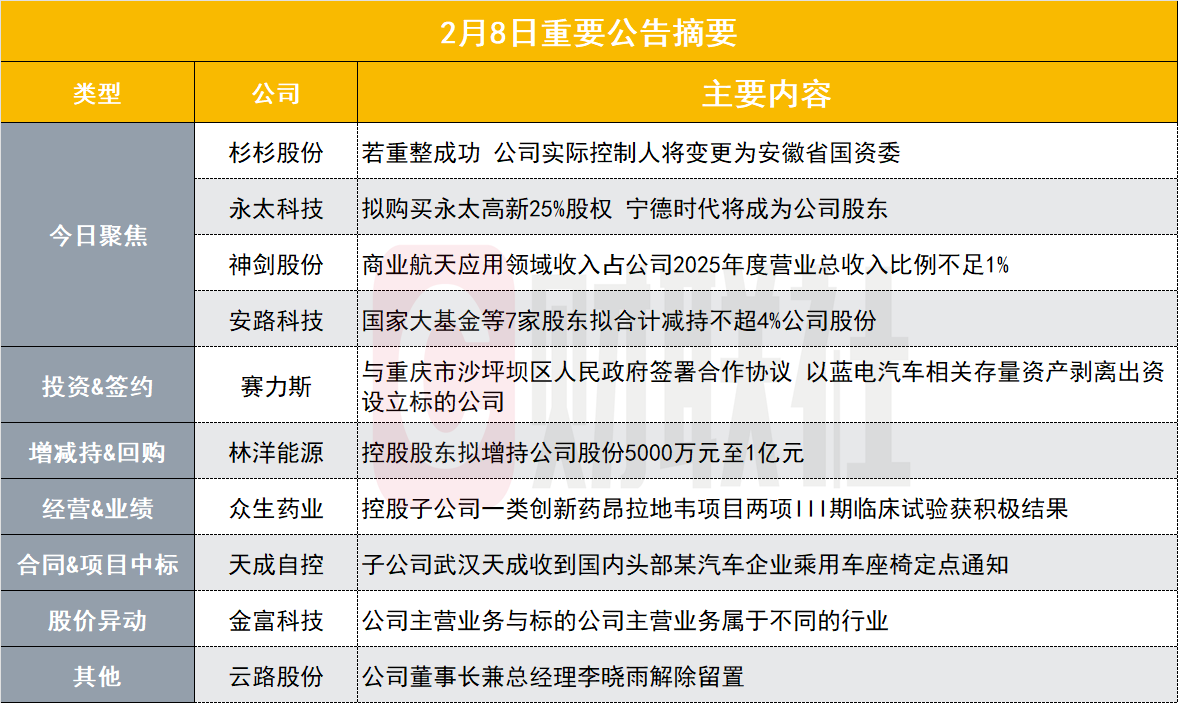
Company Announcements - Shanshan Co., Ltd. will change its actual controller to the Anhui Provincial State-owned Assets Supervision and Administration Commission if the restructuring is successful [2] - Yongtai Technology plans to acquire a 25% stake in Yongtai High-tech from Ningde Times, making Ningde Times a shareholder [2] - Shenjian Co., Ltd. reported that revenue from its commercial aerospace application will account for less than 1% of its total revenue in 2025 [3] - Anlu Technology's major shareholders, including the National Big Fund, plan to collectively reduce their holdings by no more than 4% [4] Investments & Contracts - Saisir signed a cooperation agreement with the Chongqing Shapingba District People's Government to establish a target company by divesting related assets [5] - Mingguan New Materials decided to terminate the investment agreement for a solar backsheet and functional film production base project due to market conditions [5] Share Buybacks & Reductions - Linyang Energy's controlling shareholder plans to increase its stake in the company by 50 million to 100 million yuan [8] Operations & Performance - Zhongsheng Pharmaceutical's subsidiary achieved positive results in two Phase III clinical trials for its innovative drug, Anladiwei [8] Contracts & Project Awards - Tiancheng Control's subsidiary received a notification to supply passenger car seats to a leading domestic automotive company, with a project lifecycle worth 2.3 billion yuan [9] Stock Price Movements - Jinfutec announced that its main business differs from the target company's, which may pose operational and integration challenges [10] Other - Yunlu Co., Ltd.'s chairman and general manager, Li Xiaoyu, has had his detention lifted and is resuming normal duties [11]





海内外同步催化驱动太空光伏景气度向上,优选高市占率设备厂及核心材料企业
Orient Securities· 2026-02-08 10:43
Investment Rating - The industry investment rating is "Positive (Maintain)" [5] Core Viewpoints - The space photovoltaic sector is experiencing upward momentum driven by both domestic and international factors, with significant opportunities for leading equipment manufacturers and core material companies in China [2][7] - The market potential for space photovoltaics is substantial, with projections indicating a possible scale of 8GW annually if 80,000 satellites are launched each year, translating to a market space of approximately 8 trillion yuan [7] - China's photovoltaic industry chain is robust, with leading equipment manufacturers like Maiwei and Aotwei expected to capture incremental orders, while core material manufacturers are also poised for growth due to increasing demand from overseas clients [7] Summary by Sections Investment Suggestions and Targets - Investment suggestion emphasizes the strong growth potential in the space photovoltaic sector, recommending attention to domestic leading equipment manufacturers and core material producers [3] - Key equipment manufacturers to watch include Aotwei (688516), Maiwei (300751), and Jiejia Weichuang (300724) [3] - Core material companies recommended include Dongfang Risen (300118), Junda Co. (002865), and Foster (603806) [3] Industry Dynamics - High capital expenditures from domestic and international cloud service providers are expected to drive demand for electrical equipment [7] - The "14th Five-Year Plan" outlines significant investments in green energy applications, positioning new energy technologies as a cornerstone for carbon reduction [7] - The National Grid's investment plan of 4 trillion yuan is anticipated to resonate positively across domestic and international power grid sectors [7]
新华财经周报:2月2日至2月8日
Xin Lang Cai Jing· 2026-02-08 10:17
Key Points - The 2026 Central Document No. 1 emphasizes the importance of rural revitalization and agricultural modernization as a foundation for China's modernization [1] - The People's Bank of China and eight other departments reiterated that virtual currency-related activities are illegal financial activities, strictly prohibiting them within the country [2] - The construction of a low-altitude economic standard system is being promoted, focusing on five core areas including low-altitude aircraft and safety regulation [2] - The International Energy Agency predicts that renewable energy and nuclear power will provide half of the world's electricity by 2030 [1] - The first national standard for prepared dishes will focus on food safety and nutritional health [1] Domestic News - The 2026 Central Document No. 1, released on February 3, outlines strategies for agricultural modernization and rural revitalization, aiming to enhance policy effectiveness and ensure food security [1] - The People's Bank of China held a meeting to improve financial mechanisms and support key sectors such as technology finance and green finance [3] - The National Health Commission is soliciting public opinions on national standards for the safety of prepared dishes, detailing definitions and requirements [3] - The Ministry of Finance announced a "zero tariff" policy for imported goods purchased by residents in Hainan Free Trade Port, effective immediately [4] Industry Developments - The electronic information manufacturing industry in China is expected to see a 10.6% increase in value-added output in 2025, with stable export performance [5] - The China Electricity Council reported that renewable energy sources will account for 80.2% of new power generation capacity in 2025 [6] - The automotive industry is establishing guidelines for the safe cross-border flow of automotive data to enhance data management and security [6] - The service trade in China is projected to grow steadily, with total imports and exports reaching 80,823.1 billion yuan in 2025, a 7.4% increase year-on-year [8]
明冠新材:终止投资建设肥东县太阳能背板及功能性膜生产基地项目
Jin Rong Jie· 2026-02-08 09:11
Group 1 - The company has decided to terminate the investment in the solar backsheet and functional film production base project in Feidong County, with a total planned investment of 5 billion yuan [1] - A wholly-owned subsidiary, Mingguan New Materials (Hefei) Co., Ltd., was established with a registered capital of 100 million yuan to implement the project [1] - The decision to terminate the project was made during the fifth board meeting on February 6, 2026, due to overcapacity in the photovoltaic industry and intensified price competition [1] Group 2 - The photovoltaic industry is currently undergoing an adjustment cycle, with expected widespread losses in 2024 and 2025 [1] - The management team noted that the increasing competition within the industry is leading to a gradual decline in profitability for photovoltaic packaging materials [1] - Continuing with the project would increase the overall operational costs for the company [1]
明冠新材(688560.SH)终止太阳能背板及功能性膜生产基地项目投资协议
智通财经网· 2026-02-08 08:41
Core Viewpoint - The company has decided to terminate the investment in the solar backsheet and functional film production base project in Feidong County due to declining profitability in the photovoltaic packaging materials sector and anticipated intensified competition by 2025 [1] Group 1: Project Termination - The company's board has agreed to terminate the project, pending approval from the shareholders' meeting [1] - The decision was made after careful analysis of market changes and the impact of industry competition on profitability [1] - The company reached an amicable agreement with the Feidong County government to terminate the project without any claims or liabilities from either party [1] Group 2: Market Conditions - The industry is experiencing increasing competition, leading to a gradual decline in profitability for photovoltaic packaging materials [1] - By 2025, the competition is expected to become more intense, and there is no clear indication of improvement in the cyclical adjustments within the industry [1] - Continuing with the project would likely increase the company's overall operational costs [1]
明冠新材:终止明冠合肥背板、胶膜及功能性膜项目
Ge Long Hui· 2026-02-08 08:30
Core Viewpoint - The photovoltaic industry is experiencing signs of overcapacity and intensified price competition, leading to an industry adjustment cycle with expected widespread losses in 2024 and 2025. The company has decided to terminate the Mingguan Hefei project due to declining profitability and rising operational costs associated with ongoing industry competition [1]. Group 1: Industry Overview - The photovoltaic industry is entering a period of overcapacity, with increased price competition among products [1]. - The industry is expected to face widespread losses in 2024 and 2025 due to intensified competition and cyclical adjustments [1]. Group 2: Company Actions - The company has reached an agreement with the Hefei Dong government to terminate the Mingguan Hefei project, which includes the production of solar backplanes and functional films [1]. - The decision to terminate the project was made after careful analysis of market changes and the potential for increased operational costs if the project continued [1]. Group 3: Project Details - The Mingguan Hefei project was initially approved with a total investment of 5 billion yuan, planned to be implemented in two phases, with the first phase aimed at producing 300 million square meters of solar backplanes and 200 million square meters of functional films [2]. - As of now, the project has not commenced equipment installation, and the company has incurred costs related to preliminary project activities totaling approximately 1.63 million yuan [3].