
油气

Search documents
大跌!A股冲高回落
Guo Ji Jin Rong Bao· 2025-08-21 07:54
Market Overview - The A-share market experienced fluctuations with mixed performance across the three major indices, with the Shanghai Composite Index rising by 0.13% while the Shenzhen Component and ChiNext indices fell by 0.06% and 0.47% respectively [1] - The total trading volume in the Shanghai and Shenzhen markets reached 2.42 trillion yuan, an increase of 158 billion yuan compared to the previous trading day, marking the seventh consecutive day of trading volume exceeding 2 trillion yuan [1] Sector Performance - Digital currency concept stocks saw a collective surge, with several stocks, including Yuyin Co., hitting the daily limit [1] - Oil and gas stocks performed actively, with Zhun Oil Co. also reaching the daily limit [1] - Banking stocks showed resilience, with Agricultural Bank of China and Postal Savings Bank of China both achieving historical highs [1] - Conversely, high-priced stocks experienced significant declines, with multiple stocks, including Feilong Co., hitting the daily limit down [1] - Sectors such as telecommunications, diversified finance, oil and gas, and fertilizers and pesticides saw notable gains, while sectors like liquid cooling servers, PCB, optical modules, and PEEK materials generally weakened [1]

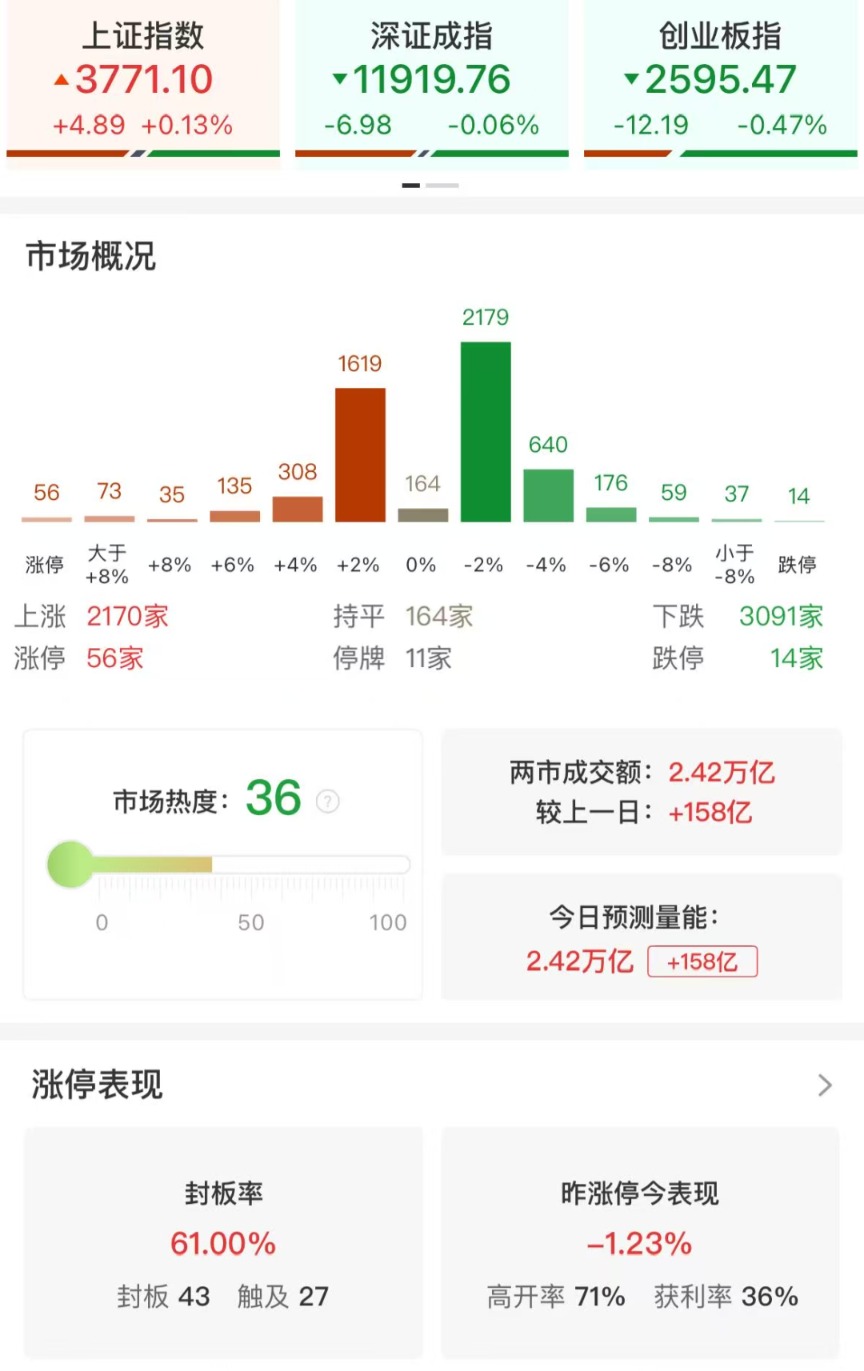
市场全天震荡调整,三大指数涨跌不一,高位股集体大跌
Feng Huang Wang Cai Jing· 2025-08-21 07:12
Market Overview - The market experienced fluctuations with mixed performance across major indices, where the Shanghai Composite Index rose by 0.13%, while the Shenzhen Component Index and the ChiNext Index fell by 0.06% and 0.47% respectively [1] - The total trading volume in the Shanghai and Shenzhen markets reached 2.42 trillion yuan, an increase of 158 billion yuan compared to the previous trading day, marking the seventh consecutive day with trading volume exceeding 2 trillion yuan [1][4] Index Performance - The Shanghai Composite Index closed at 3771.10, with a slight increase of 0.13% [2] - The Shenzhen Component Index ended at 11919.76, down by 0.06% [2] - The ChiNext Index recorded a decline of 0.47%, closing at 2595.47 [2] Sector Performance - Notable sectors that performed well included oil and gas, digital currency, beauty care, and banking, with significant gains observed in digital currency stocks and oil and gas stocks [3] - Conversely, sectors that faced declines included rare earth permanent magnets, PEEK materials, liquid cooling servers, and CPO [3] Stock Movement - Over 3000 stocks in the market experienced declines, indicating a broad-based sell-off [2] - Digital currency stocks saw a collective surge, with several stocks hitting the daily limit up, while high-priced stocks faced significant drops, with some hitting the daily limit down [2]

浙江大宗与伦交所集团深化合作,强化大宗商品资源配置功能
Refinitiv路孚特· 2025-08-21 06:02
Core Viewpoint - Zhejiang International Bulk Commodity Trading Center, known as "Zhejiang Dazong," has evolved into a leading local trading venue in China, focusing on national strategies and compliance while enhancing its role in the allocation of bulk commodity resources [1][2]. Group 1: Development and Collaboration - Established in May 2015, Zhejiang Dazong is a significant platform for the allocation of bulk commodity resources and a key promoter of the integrated oil and gas trading market in the Yangtze River Delta [1]. - Since August 2023, Zhejiang Dazong has deepened its collaboration with the London Stock Exchange Group (LSEG) in areas such as data, products, and conferences, with its price index products now available on the LSEG platform [1]. - The launch of a dedicated page on the LSEG Workspace financial terminal in January 2024 will provide global users with efficient access to key index product information, enhancing the international dissemination of Chinese oil and gas prices [1][2]. Group 2: Price Index Products - The "Zhoushan Price," officially known as "China Zhoushan Fuel Oil Bonded Ship Supply Quotation," is the first RMB quotation product in the domestic bonded ship fuel market based on the Shanghai Futures Exchange prices, becoming a global benchmark [2]. - The "LNG Price" reflects the actual supply and demand situation in Zhejiang Province's LNG market, while the "Storage Price" includes comprehensive storage prices and available commercial storage capacity in Zhoushan, aiding stakeholders in the energy and chemical storage market [2]. - Zhejiang Dazong is committed to continuously improving its price index system and enhancing international cooperation to strengthen its role in the allocation of bulk commodity resources [2]. Group 3: Price Index Codes - The following are the price index codes available for users to access on the LSEG Workspace terminal: - 0ZMELSFBA: China Zhoushan Low Sulfur Fuel Oil Bonded Ship Supply Quotation (Daily) - 0ZMEHSFBA: China Zhoushan High Sulfur Fuel Oil Bonded Ship Supply Quotation (Daily) - 0ZMELNGP: Zhejiang Region LNG Consumption Price (Daily) - 0ZMEWCPI: Zhoushan Oil Product Storage Comprehensive Price Index (Monthly) - 0ZMEWCPST: Zhoushan Storage Comprehensive Price (Short-term 1-3 months) (Monthly) - 0ZMEWCPLT: Zhoushan Storage Comprehensive Price (Long-term 6-12 months) (Monthly) - 0ZMEWCPSTG: Zhoushan Available Commercial Storage Capacity (Monthly) [4].

沪指再创年内新高 数字货币概念股集体大涨
Sou Hu Cai Jing· 2025-08-21 05:44
Market Overview - The A-share market experienced fluctuations in the morning session, with the ChiNext index rebounding from a low point, while the Shanghai Composite Index slightly increased, reaching a new high for the year [1] - The total trading volume in the Shanghai and Shenzhen markets was 1.57 trillion, an increase of 59.1 billion compared to the previous trading day [1] Sector Performance - Digital currency concept stocks saw a collective surge, with multiple stocks, including Yuyin Co., hitting the daily limit [3] - Oil and gas stocks showed strong fluctuations, with Zhun Oil Co. also reaching the daily limit [3] - Storage chip concept stocks were active in parts, with Zhaoyi Innovation hitting the daily limit [3] - In contrast, AI hardware stocks, particularly liquid-cooled servers, experienced significant declines, with Feilong Co. hitting the daily limit down [3] - The sectors with the highest gains included digital currency, oil and gas, software development, and beauty care, while the sectors with the largest declines included liquid-cooled servers, PCB, PEEK materials, and rare earth permanent magnets [3] Index Performance - By the end of the trading session, the Shanghai Composite Index rose by 0.35%, the Shenzhen Component Index increased by 0.45%, and the ChiNext Index gained 0.21% [3]
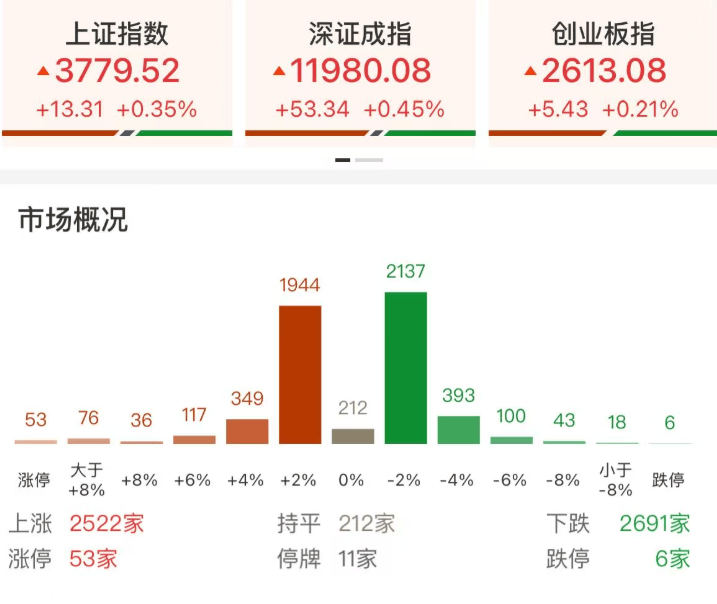
利好突袭!这类股 直线大涨!
Zhong Guo Ji Jin Bao· 2025-08-21 05:06
Market Overview - The Shanghai Composite Index is approaching 3800 points, with all three major indices closing higher, indicating a positive market sentiment [2][3] - The trading volume in the Shanghai and Shenzhen markets exceeded 1.5 trillion yuan, an increase of approximately 591 billion yuan compared to the previous trading day [2] Sector Performance - The semiconductor sector experienced significant gains, with storage chip concepts continuing to rise, leading to stocks like Zhaoyi Innovation and Demingli hitting the daily limit [4][6] - The oil and gas sector also saw a notable increase, with PetroChina-related indices rising sharply, and stocks such as Junyou Co. and Xinjin Power hitting the daily limit [8][10] Notable Stocks - Semiconductor stocks such as Shengke Communication-U and Demingli saw increases of 10.36% and 10.01% respectively, with total market capitalizations of 502 billion yuan and 229 billion yuan [5] - The stock of Cambrian Technology reached a new high of 1052.28 yuan per share, marking a year-to-date increase of 59.92% [6] AI and Robotics - The humanoid robot sector received positive news with a record order of 10,000 units signed by Tiantai Robotics, marking a significant milestone in the industry [14] - The new generation of integrated control solutions for robots was introduced by Junsheng Electronics, which combines multiple control systems into one [15] Healthcare Sector - The AI healthcare sector saw substantial gains, with Dingdang Health rising by 21.25% and Ping An Good Doctor increasing by over 12% [16][17]

大消费爆发,助力沪指冲击3800点!
Sou Hu Cai Jing· 2025-08-21 05:03
Market Overview - A-shares exhibited a mixed performance with the Shanghai Composite Index fluctuating around the 3800-point mark, continuing its strong momentum to reach a ten-year high, while the ChiNext Index showed weak oscillation after a brief recovery [1] - The Hong Kong market failed to maintain its previous day's rebound, with all three major indices opening lower, particularly affected by heavyweight tech stocks [1] Key Index Performance - The Shanghai Composite Index rose by 0.35% to 3779.52 points, the Shenzhen Component increased by 0.45%, and the ChiNext Index slightly gained 0.21%. The STAR 50 Index was boosted by the semiconductor sector, rising by 0.96% [1] - The total market turnover reached 1.59 trillion yuan, indicating active trading [1] - In Hong Kong, the Hang Seng Index fell by 0.10% to 25140.96 points, with the Hang Seng Tech Index down by 0.51% and the H-shares Index down by 0.32% [1] Industry Hotspots and Driving Logic - A-shares are experiencing a rotation between policy-sensitive sectors and technology themes, with digital currency and cross-border payment sectors seeing a surge due to expectations from the Federal Reserve's meeting minutes [2] - The storage chip sector is gaining attention as funds continue to explore undervalued tech themes, while the oil and gas sector is benefiting from international energy price fluctuations and state-owned enterprise research [2] - Consumer sectors such as agriculture, forestry, animal husbandry, and beauty care are active, reflecting market expectations for consumption recovery and policy support [2] Underperforming Sectors and Driving Logic - The previously leading AI hardware sector is undergoing a collective pullback, with some stocks experiencing declines exceeding 7%, indicating market caution towards high-valuation tech themes [3] - The renewable energy-related sectors, including electric and mechanical equipment, are showing weakness, reflecting market divergence regarding growth sectors [3] - Major tech stocks are generally underperforming due to concerns over global liquidity changes and earnings divergence, with some heavyweight tech stocks dropping over 2% [3] Investment Strategy Recommendations - Short-term focus should be on policy catalysts and industrial upgrades, with A-shares emphasizing digital currency and storage chips, as well as resource sectors like oil and gas that have recovery potential [4] - Consumer sectors such as agriculture, beauty care, and consumer electronics should be considered for their valuation recovery potential, while avoiding high-valuation stocks at risk of pullback [4] - In the Hong Kong market, attention should be on policy-benefiting pharmaceutical stocks and infrastructure chains, with energy sectors providing defensive positioning [4] Operational Suggestions - It is advisable to grasp the rhythm of sector rotation, prioritizing stocks with strong earnings certainty and high alignment with valuation and policy [5] - Caution is advised regarding high-volatility thematic stocks lacking fundamental support, which may face short-term pullback risks [5]
利好突袭!这类股,直线大涨!
Zhong Guo Ji Jin Bao· 2025-08-21 04:54
【导读】上证指数逼近3800点,芯片股集体"霸屏",寒武纪续创新高;中石油系指数大涨;具身智能再现利 好消息 今天是8月21日星期四,基金君继续和你一起关注上午的市场行情和最新资讯! 8月21日上午,A股市场呈现高开震荡格局,上证指数逼近3800点,三大股指集体收涨,但市场分化明显,跨 境支付、存储芯片、多元金融等板块表现活跃,而覆铜板、PEEK材料等板块回调。 上午市场交投活跃度持续提升,沪深两市交易额突破1.5万亿元,较昨日放量近600亿元。 上证指数逼近3800点 三大股指集体收涨 截至午间收盘,上证指数报3779.52点,涨0.35%,深证成指涨0.45%,创业板指涨0.21%, 沪深两市半日成交额突破1.5万亿元,达15674亿元,较上个交易日增加591亿元。 个股涨跌互现,市场共2525只个股上涨,54只个股涨停,2693只个股下跌。 芯片爆发!寒武纪续创新高 半导体板块大涨,存储芯片概念板块持续走高,兆易创新(603986)、德明利(001309)双双涨停。 | 序号 | 名称 | 现价 | 涨跌幅 ▼ | 总市值 | 年初至今 | | --- | --- | --- | --- | --- | ...



午报:沪指半日涨0.35% 数字货币概念股集体大涨
2 1 Shi Ji Jing Ji Bao Dao· 2025-08-21 04:49
Market Overview - The market experienced fluctuations with the Shanghai Composite Index slightly rising and the ChiNext Index rebounding after hitting a low [2] - The total trading volume in the Shanghai and Shenzhen markets reached 1.57 trillion yuan by midday [2] Index Performance - By the close of the morning session, the Shanghai Composite Index increased by 0.35%, the Shenzhen Component Index rose by 0.45%, and the ChiNext Index gained 0.21% [2] Sector Highlights - Digital currency stocks saw a collective surge, with multiple stocks, including Yuyin Co., hitting the daily limit [2] - Oil and gas stocks showed strong performance, with Zhun Oil Co. also reaching the daily limit [2] - Storage chip concept stocks were partially active, with Zhaoyi Innovation hitting the daily limit [2] Declining Sectors - AI hardware stocks, particularly liquid cooling servers, experienced significant declines, with Feilong Co. hitting the daily limit down [2] - The sectors with the highest gains included digital currency, oil and gas, software development, and beauty care, while the sectors with the largest declines included liquid cooling servers, PCB, PEEK materials, and rare earth permanent magnets [2]
利好突袭!这类股,直线大涨!
中国基金报· 2025-08-21 04:46
Market Overview - The Shanghai Composite Index is approaching 3800 points, with all three major indices closing higher, indicating a positive market sentiment [3][4]. - The trading volume in the Shanghai and Shenzhen markets exceeded 1.5 trillion yuan, an increase of approximately 600 billion yuan compared to the previous day [2][7]. Semiconductor Sector - The semiconductor sector experienced a significant surge, with companies like Cambrian Technology reaching new highs [8]. - Notable stocks in the semiconductor space include: - Shengke Communication-U: Current price 122.50 yuan, up 10.36%, market cap 50.2 billion yuan, year-to-date increase 45.83% [11]. - Demingli: Current price 100.71 yuan, up 10.01%, market cap 22.9 billion yuan, year-to-date increase 62.08% [11]. - Zhaoyi Innovation: Current price 139.71 yuan, up 10.00%, market cap 92.8 billion yuan, year-to-date increase 31.18% [11]. - Cambrian Technology's stock price reached a peak of 1080.18 yuan per share, closing at 1052.28 yuan [12]. Oil and Gas Sector - The oil and gas sector saw a notable rise, with the PetroChina index experiencing significant gains [15]. - Key performers in this sector include: - Zhun Oil Co.: Current price 8.10 yuan, up 10.05%, market cap 2.1 billion yuan, year-to-date increase 64.30% [16]. - Xinjin Power: Current price 5.72 yuan, up 8.95%, market cap 4.3 billion yuan, year-to-date increase 97.24% [16]. - The sector's growth is supported by government initiatives to enhance energy supply capabilities and increase domestic oil and gas exploration [17]. Robotics and AI Sector - The humanoid robotics sector is witnessing significant developments, with TianTai Robotics announcing a landmark order of 10,000 units, marking the largest single order in the industry [26]. - Additionally, Junsheng Electronics introduced an integrated control solution for humanoid robots, enhancing operational efficiency [26]. Healthcare Sector - The AI healthcare sector is experiencing substantial growth, with stocks like Dingdang Health rising by 21.25% and Ping An Good Doctor increasing by over 12% [27][28].

午报三大指数均小幅上涨,数字货币概念股集体爆发,液冷服务器方向陷入调整
Sou Hu Cai Jing· 2025-08-21 04:38
Market Overview - The market experienced fluctuations with the Shanghai Composite Index slightly up by 0.35% and the Shenzhen Component Index up by 0.45% [1] - The total trading volume in the Shanghai and Shenzhen markets reached 1.57 trillion yuan, an increase of 591 billion yuan compared to the previous trading day [1] - Digital currency concept stocks surged, with multiple stocks hitting the daily limit, including Yuyin Co., which saw a 10.05% increase [1][8] Sector Performance - The digital currency sector led the gains, with stocks like Sanwei Xinan, New Morning Technology, and Zhongyou Capital also hitting the daily limit [1][8] - The oil and gas sector showed strength, with Zhun Oil Co. hitting the daily limit and other companies like Keli Co. and Beiken Energy also performing well [4][5] - The storage chip sector was active, with stocks like Zhaoyi Innovation and Demingli hitting the daily limit, driven by increasing demand for high-value DRAM products [5][7] Company Highlights - TianTai Robotics signed a historic order for 10,000 humanoid robots, marking the largest single order in the humanoid robot industry [20] - The beauty care sector saw significant gains, with companies like Jieya Co. and Huaxi Biological experiencing notable increases in stock prices [3][19] - The semiconductor industry is expected to benefit from the rise of AI applications, pushing domestic chip manufacturers towards technological upgrades [10]



