
高技术制造业

Search documents
制造业PMI连续2月回升,下半年走势如何?
第一财经· 2025-06-30 03:52
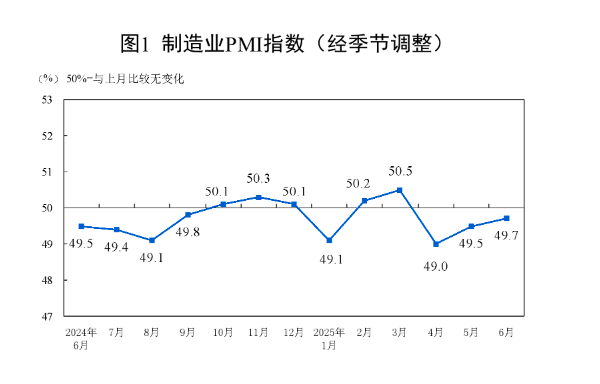
本文字数:2337,阅读时长大约4分钟 作者 | 第一财经 祝嫣然 今年二季度,受到美国关税政策变化的影响,制造业运行短期有所波动,但我国经济展现出了较强的 韧性,在短期放缓后迅速回稳。 国家统计局6月30日发布的6月份制造业采购经理指数(PMI)为49.7%,比上月上升0.2个百分点, 连续两个月回升,制造业景气水平继续改善。非制造业商务活动指数为50.5%,比上月上升0.2个百 分点。 中国物流与采购联合会特约分析师张立群表示,6月份PMI指数小幅回升,表明一系列增量政策的效 果继续显现。订单类指数回升反映扩大内需政策效果有所显现;生产指数、采购量指数上升反映企业 生产经营活动有回暖趋势。同时应注意到PMI指数仍处荣枯线下,生产经营活动预期指数仍在下降, 反映需求不足的企业占比仍在扩大,市场引导的需求收缩对制造业生产投资的制约仍然突出。 2025.06. 30 张立群强调,当前宏观经济政策逆周期调节与市场引导的需求收缩正处相互角力的关键阶段,必须坚 持不懈持续加大扩内需各项政策力度,特别要显著加强政府公共产品投资力度,扩大投资规模,有效 有力带动制造业企业订单显著增加,带动制造业生产投资持续活跃。 产需指 ...

49.7%、50.5%,改善、扩张!从6月份“指数”透视中国经济发展亮点
Yang Shi Wang· 2025-06-30 03:51
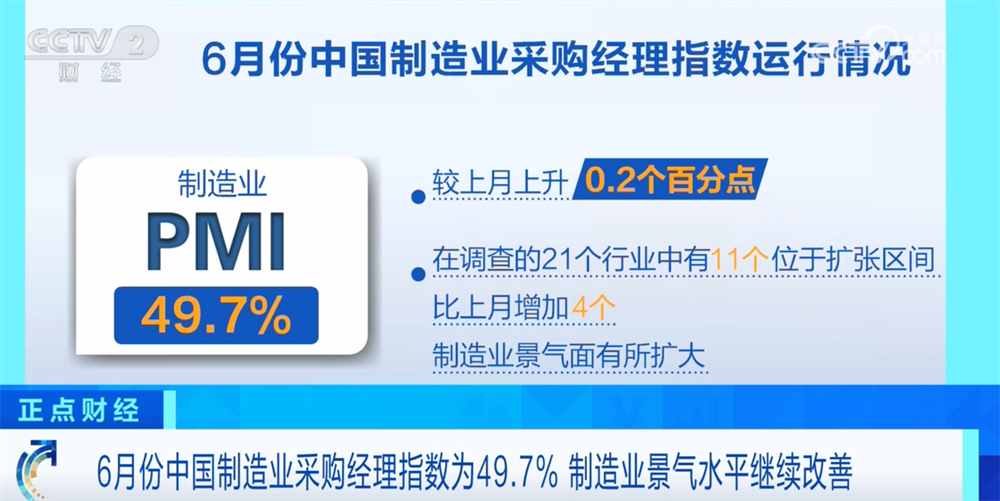
Group 1 - The manufacturing Purchasing Managers' Index (PMI) in China for June is reported at 49.7%, indicating a 0.2 percentage point increase from the previous month, suggesting continued improvement in manufacturing sentiment [1] - Among the 21 surveyed industries, 11 are in the expansion zone, an increase of 4 from the previous month, reflecting a broader improvement in manufacturing conditions [3] - The production index and new orders index stand at 51% and 50.2%, respectively, both showing increases of 0.3 and 0.4 percentage points from last month, indicating a recovery in production activities and market demand [3] Group 2 - Key sectors such as equipment manufacturing, high-tech manufacturing, and consumer goods have maintained PMIs in the expansion zone for two consecutive months, with production and new orders indices above 53% [5] - The PMI for high-energy-consuming industries, while still below the critical point, has shown signs of recovery this month [5] - The overall manufacturing PMI and its sub-indices reflect a rebound trend, indicating that internal economic momentum is gradually being released and resilience in economic growth is strengthening [7] Group 3 - The non-manufacturing business activity index for June is reported at 50.5%, a 0.2 percentage point increase from the previous month, indicating continued expansion in the non-manufacturing sector [8] - The service sector's performance remains stable, with financial services, capital market services, and insurance industries showing business activity indices above 60%, indicating rapid growth in these areas [8] - The construction sector, particularly civil engineering, has seen a significant rebound, with business activity indices remaining above 55% for three consecutive months, reflecting robust progress in infrastructure projects [8][10]
制造业PMI连续2月回升,下半年走势如何
Di Yi Cai Jing· 2025-06-30 02:41
Core Viewpoint - The manufacturing PMI index in June shows a slight recovery, indicating the effectiveness of a series of incremental policies, despite ongoing challenges in demand and production activities [1][4][11]. Manufacturing Sector - The manufacturing PMI for June is reported at 49.7%, up 0.2 percentage points from the previous month, marking two consecutive months of improvement [1]. - The new orders index has returned to the expansion zone at 50.2%, increasing by 0.4 percentage points after two months below 50% [4]. - The production index stands at 51%, reflecting stable expansion in production activities, with a 0.3 percentage point increase from last month [5]. - The procurement volume index has also returned to the expansion zone at 50.2%, up 2.6 percentage points [5]. - Large enterprises show a PMI of 51.2%, indicating accelerated expansion, while medium and small enterprises remain below the critical point at 48.6% and 47.3%, respectively [7]. Price Trends - In June, both the purchasing price index and the factory price index have stabilized, with the purchasing price index at 48.4% and the factory price index at 46.2%, both up 1.5 percentage points from the previous month [6]. Non-Manufacturing Sector - The non-manufacturing business activity index is at 50.5%, reflecting continued expansion, with a 0.2 percentage point increase [11]. - The construction industry shows a business activity index of 52.8%, up 1.8 percentage points, indicating a recovery in construction activities [12]. Future Outlook - The manufacturing sector is expected to maintain a steady growth trend in the second half of the year, supported by ongoing policy measures aimed at boosting domestic demand and stabilizing external trade [8].
刚刚发布,49.7%!
中国基金报· 2025-06-30 02:16
Group 1: Manufacturing PMI Overview - In June, the Manufacturing Purchasing Managers' Index (PMI) was 49.7%, an increase of 0.2 percentage points from the previous month, indicating continued improvement in manufacturing sentiment [2][22]. - The production index was 51.0%, up 0.3 percentage points, suggesting accelerated production activities in the manufacturing sector [6][23]. - The new orders index reached 50.2%, rising by 0.4 percentage points, reflecting an improvement in market demand for manufactured goods [7][23]. Group 2: Enterprise Size Analysis - Large enterprises reported a PMI of 51.2%, up 0.5 percentage points, remaining above the critical point, indicating robust performance [4][24]. - Medium-sized enterprises had a PMI of 48.6%, an increase of 1.1 percentage points, but still below the critical threshold [4][24]. - Small enterprises saw a decline in PMI to 47.3%, down 2.0 percentage points, indicating weaker performance [4][24]. Group 3: Non-Manufacturing PMI Overview - The Non-Manufacturing Business Activity Index was 50.5%, an increase of 0.2 percentage points, indicating continued expansion in the non-manufacturing sector [11][26]. - The construction sector's business activity index rose to 52.8%, up 1.8 percentage points, reflecting a recovery in construction activities [13][26]. - The service sector's business activity index was 50.1%, slightly down by 0.1 percentage points, indicating stability but with some sectors experiencing reduced activity [13][26]. Group 4: Comprehensive PMI Insights - The Comprehensive PMI Output Index was 50.7%, an increase of 0.3 percentage points, indicating an overall acceleration in production and business activities across sectors [21][27]. - The manufacturing production index and non-manufacturing business activity index contributed to this comprehensive index, standing at 51.0% and 50.5% respectively [27].

国家统计局:6月制造业PMI继续回升,制造业景气面有所扩大
Guo Jia Tong Ji Ju· 2025-06-30 01:36
Group 1: Manufacturing Purchasing Managers Index (PMI) - In June, the manufacturing PMI rose to 49.7%, with 11 out of 21 surveyed industries in the expansion zone, an increase of 4 from the previous month, indicating an overall expansion in manufacturing sentiment [2] - The production index and new orders index were at 51.0% and 50.2%, respectively, both showing improvements of 0.3 and 0.4 percentage points, suggesting accelerated production activities and improved market demand [2] - Large enterprises reported a PMI of 51.2%, up 0.5 percentage points, indicating significant support for the manufacturing sector, while small enterprises saw a decline in PMI to 47.3%, down 2.0 percentage points [3] Group 2: Non-Manufacturing Business Activity Index - The non-manufacturing business activity index reached 50.5%, an increase of 0.2 percentage points, indicating continued expansion in the non-manufacturing sector [4] - The construction industry showed a notable increase with a business activity index of 52.8%, up 1.8 percentage points, reflecting a recovery in construction activities, particularly in civil engineering [4] - The business activity expectation index for the non-manufacturing sector was at 56.0%, indicating optimism among service industry enterprises regarding future developments [4] Group 3: Comprehensive PMI Output Index - The comprehensive PMI output index rose to 50.7%, an increase of 0.3 percentage points, indicating an acceleration in overall production and business activities across enterprises [5] - The manufacturing production index and non-manufacturing business activity index contributed to the comprehensive PMI output index, standing at 51.0% and 50.5%, respectively [5]
国家统计局服务业调查中心高级统计师赵庆河解读2025年6月中国采购经理指数
Guo Jia Tong Ji Ju· 2025-06-30 01:35
Group 1: Manufacturing PMI Insights - The manufacturing Purchasing Managers' Index (PMI) rose to 49.7% in June, with 11 out of 21 surveyed industries in the expansion zone, an increase of 4 industries from the previous month, indicating an overall improvement in manufacturing sentiment [2][3] - The production index and new orders index were at 51.0% and 50.2%, respectively, both showing increases of 0.3 and 0.4 percentage points from the previous month, suggesting accelerated production activities and improved market demand [3] - The purchasing volume index increased to 50.2%, up by 2.6 percentage points, reflecting enhanced procurement willingness among enterprises due to the recovery in production and demand [3] Group 2: Price Index Trends - The main raw material purchase price index and factory price index rose to 48.4% and 46.2%, respectively, both up by 1.5 percentage points, indicating an overall improvement in manufacturing market price levels [3] - The increase in prices was influenced by rising international crude oil prices, particularly affecting the petroleum and coal industries, while the black metal smelting and processing industries saw a decline in price indices due to falling iron ore prices and insufficient terminal demand [3] Group 3: Enterprise Size and Industry Performance - Large enterprises reported a PMI of 51.2%, up by 0.5 percentage points, indicating significant support for the overall manufacturing sector, while medium-sized enterprises saw a PMI of 48.6%, an increase of 1.1 percentage points, showing improved sentiment [4] - The equipment manufacturing, high-tech manufacturing, and consumer goods industries all maintained PMIs above 50, indicating continued expansion, with equipment manufacturing showing particularly strong activity with production and new orders indices above 53.0 [4] Group 4: Non-Manufacturing Sector Insights - The non-manufacturing business activity index rose to 50.5%, up by 0.2 percentage points, indicating continued expansion in the non-manufacturing sector [5] - The service sector's business activity index was stable at 50.1%, with certain industries like telecommunications and financial services showing strong growth, while consumer-related sectors experienced a decline in activity [5] - The construction sector's business activity index increased to 52.8%, up by 1.8 percentage points, reflecting a recovery in construction activities, particularly in civil engineering [5] Group 5: Comprehensive PMI Overview - The comprehensive PMI output index rose to 50.7%, up by 0.3 percentage points, indicating an acceleration in overall production and business activities across enterprises [6] - The manufacturing production index and non-manufacturing business activity index contributed to this increase, standing at 51.0% and 50.5%, respectively [6]
1—5月份规上工业企业实现利润同比下降1.1%:关税成本叠加内需不足
Sou Hu Cai Jing· 2025-06-27 10:36
Core Insights - The profits of industrial enterprises above designated size in China decreased by 1.1% year-on-year from January to May 2025, with a significant drop of 9.1% in May alone, marking the largest decline since October of the previous year [2][3] Group 1: Profit Trends - The manufacturing sector's profit growth rate increased by 5.4% year-on-year from January to May, outperforming the overall profit growth rate of industrial enterprises by 6.5 percentage points [2] - State-owned enterprises experienced a profit decline of 7.4%, while private enterprises saw a profit increase of 3.4% during the same period [4] Group 2: Factors Influencing Profitability - The decline in profits is attributed to external environmental shocks, continuous decreases in the Producer Price Index (PPI), and insufficient domestic demand [3] - The average collection period for accounts receivable exceeded 70 days, indicating significant asset turnover pressure within the industrial sector [3] Group 3: Impact of Tariffs - State-owned enterprises were more adversely affected by tariffs compared to private enterprises, with state-owned profits declining by 18.1% in May [3][4] - The rising costs due to tariffs have eroded profits, as some enterprises bear the tariff costs themselves, while others face supply chain adjustment costs [6] Group 4: Sector-Specific Performance - The profits of the large equipment manufacturing sector surged by 60%-120%, driven by new production capabilities and supportive policies [2] - Downstream industries such as entertainment products, textiles, and food manufacturing faced significant profit declines of -27.0%, -18.3%, and -7.0% respectively in May [6]

长三角5月“成绩单”:上海社零累计负增长一年后首转正,安徽工业领跑
2 1 Shi Ji Jing Ji Bao Dao· 2025-06-24 10:06
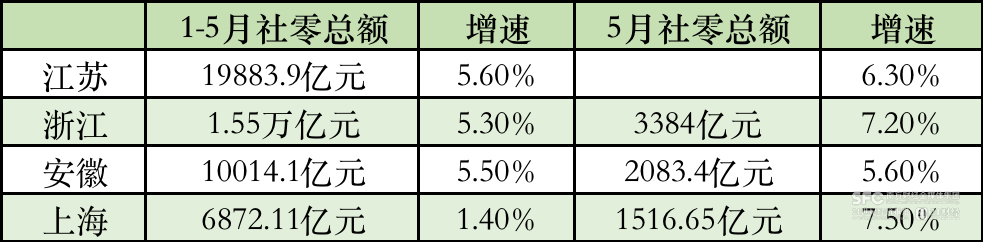
Economic Performance in the Yangtze River Delta - The fixed asset investment in Shanghai, Zhejiang, and Anhui showed positive year-on-year growth from January to May, although Jiangsu's investment decreased by 1.4% due to a decline in real estate development investment [1][8] - In terms of industrial performance, Anhui led the Yangtze River Delta with the highest growth rate in industrial added value in May, driven by the high-end and digital transformation of manufacturing [1][10] - The retail sales of consumer goods in Jiangsu, Zhejiang, and Anhui all grew by over 5% from January to May, while Shanghai's retail sales only increased by 1.4%, primarily due to a decline in restaurant income [1][2][3] Fixed Asset Investment - Shanghai's fixed asset investment grew by 6.2%, while Zhejiang and Anhui saw increases of 1.9% and 0.2%, respectively [6][7] - Jiangsu's fixed asset investment decline was mainly attributed to a 15.3% drop in real estate development investment, despite an 8.7% increase in infrastructure investment [8][7] Industrial Growth - The industrial added value for large-scale industries in Anhui, Jiangsu, and Zhejiang grew by 8.4%, 7.7%, and 7.6%, respectively, with Shanghai's industrial output increasing by 4.8% [9][10] - High-tech manufacturing significantly contributed to Anhui's industrial growth, with a 29.3% increase in May, accounting for 17.6% of the province's industrial added value [10] Consumer Market Dynamics - The consumer market in Jiangsu benefited from the "old-for-new" policy, with significant growth in retail sales of home appliances and other categories [5] - Shanghai's retail sales saw a turnaround in cumulative growth for the first time in a year, indicating a potential recovery in consumer spending [4][3]
河南新能源汽车产业链持续高速增长
Zhong Guo Chan Ye Jing Ji Xin Xi Wang· 2025-06-24 00:17
新能源汽车产业链持续高速增长。5月份,全省汽车制造业、电气机械和器材制造业增加值分别增长 26.7%和20.3%,分别高于全省规上工业增加值增速19.3个百分点和12.9个百分点;全省锂离子电池、新 能源汽车产量分别增长99.1%和20.0%。 投资方面,数据显示,河南工业投资增势强劲。1-5月,河南工业投资增长29.5%,比1-4月加快2.9个百 分点,增速创2022年4月以来新高。其中,制造业投资增长30.8%,比1-4月加快2.8个百分点。 此外,两新政策效应持续释放。5月份,在大规模设备更新等政策措施带动下,河南限额以上单位机电 产品及设备类商品零售额增长46.1%;在消费品以旧换新等政策措施带动下,全省限额以上单位计算机 及其配套产品、智能手机、可穿戴智能设备、家用电器和音像器材类、新能源汽车零售额分别增长1.7 倍、1.6倍、86.1%、47.3%和27.0%。 近日,河南省统计局公布5月份河南省经济运行情况,全省经济延续稳中向好发展态势,工业生产保持 较快增长,投资、消费增速略有加快,主要指标增速均持续高于全国平均水平。 数据显示,5月份,河南全省规上工业增加值同比增长7.4%,高于全国1.6个 ...
广东科技上市军团领跑全国
Zhong Guo Xin Wen Wang· 2025-06-23 07:41
(活力中国调研行)广东科技上市军团领跑全国 中新网广州6月23日电(记者 郭军 程景伟)2025年"活力中国调研行"广东主题采访情况介绍会23日在广州 举行。据广东省委金融办二级巡视员刘凯文介绍,截至今年一季度,广东高技术制造业、先进制造业中 长期贷款余额分别为1.3万亿元、1.6万亿元;科技保险保额1.43万亿元,同比增长63.9%;科创板、创业 板上市公司408家,首发募集资金累计3312亿元,稳居全国第一。 近年来,广东金融系统通过实施金融"三大工程"(金融固本强基工程、科技金融矩阵工程、金融生态常 青工程),坚持引导金融要素服务科技"四个面向",推动广东形成"科技—产业—金融"良性循环,为广 东加快建设现代化产业体系注入金融动能,全力支撑科技创新引领新质生产力发展。 刘凯文表示,近两年,广东系统化完善金融支持科技创新政策,先后以省政府名义出台发展科技金融的 《关于加快推进科技金融深度融合助力科技型企业创新发展的实施意见》(科金15条)和《关于高质量发 展资本市场助力广东现代化建设的若干措施》。其中,《若干措施》出台7大方面28条举措,提出构建 和科技创新相适应的科技金融体系,加速培育新质生产力。 目前 ...