
信息传输

Search documents
A股市值突破123万亿元,科创业绩提供硬支撑
Huan Qiu Wang· 2026-01-11 02:20
Group 1 - The core viewpoint of the report indicates that the Chinese capital market has shown strong recovery momentum and resilient growth, with the total number of A-share listed companies reaching 5,469 and total market capitalization rising to 123 trillion yuan by the end of 2025 [1] - In 2025, 116 new companies were listed, while the total market capitalization of the existing 5,353 companies grew by 22.5% year-on-year, reflecting a significant recovery in market sentiment [1] - The average price-to-book ratio of A-share companies increased from 3.3 at the beginning of the year to 4.4, indicating a steady rise in market valuation [3] Group 2 - High-tech enterprises, particularly in manufacturing, scientific research, and technical services, demonstrated remarkable market performance, with total market capitalization increasing by 33.3% and 32.1% respectively, contributing to a 4.2 percentage point and 0.1 percentage point increase in their share of A-share market capitalization [3] - Nearly half of the listed companies in manufacturing and scientific research and technical services achieved a net asset return rate greater than 5%, showcasing strong overall performance [3] - The introduction of new regulations and guidelines has institutionalized market capitalization management, enhancing the proactive planning awareness of listed companies and reflecting national strategic directions [4] Group 3 - The governance structure of listed companies has been continuously improved, with over 98% of companies holding annual shareholder meetings by June 30, and more than 70% of boards consisting of 7 or 9 members [5] - Over 99% of companies disclosed their 2024 audit reports and internal control audit reports as required, with a non-qualified opinion rate exceeding 96% [5] - The steady growth of the A-share market capitalization to 123 trillion yuan and the over 20% growth of existing companies' market capitalization are seen as results of market sentiment recovery and the resonance of corporate profitability with national economic transformation [5]



A股科技型企业整体业绩为估值提供支撑——上市公司市值稳步抬升
Jing Ji Ri Bao· 2026-01-10 21:56
Core Insights - The report indicates that by the end of 2025, there will be 5,469 listed companies in China's A-share market with a total market capitalization of 123 trillion yuan, reflecting a 22.5% year-on-year growth in the market capitalization of existing companies [1] Group 1: Market Performance - The average price-to-book ratio of listed companies increased from 3.3 at the beginning of the year to 4.4 by the end of 2025, indicating a steady rise in overall market valuation [2] - High-tech industries, particularly manufacturing and scientific research, saw significant market capitalization growth, with total market values increasing by 33.3% and 32.1% respectively [2] - Nearly half of the listed companies in manufacturing and scientific research sectors achieved a net asset return rate greater than 5% in 2025, supporting the valuation of technology-driven enterprises [2] Group 2: Policy and Strategic Direction - The report highlights that the market capitalization performance reflects national strategic directions, with notable growth in emerging industries such as integrated circuits, artificial intelligence, and high-end manufacturing [3] - Regulatory policies have become more systematic and precise, enhancing the tools available for companies to manage their market value, including mergers and acquisitions, cash dividends, and share buybacks [3] - Companies are increasingly proactive in managing their market value through regular dividends, share buybacks, and improved investor relations, which helps to enhance market expectations and long-term investment confidence [3] Group 3: Corporate Governance - Over 98% of companies held their annual shareholder meetings before June 30, and more than 70% of boards consist of 7 or 9 members, indicating a trend towards improved corporate governance [4] - The attendance rate of directors at board meetings exceeds 95% for over 96% of companies, and the quality of audit reports is high, with over 99% of companies disclosing their 2024 audit reports without reservations [4] - The governance report suggests a positive trend in corporate governance, with a focus on addressing deeper issues such as related party transactions and internal supervision effectiveness [5]
大位科技:股票交易异常波动
2 1 Shi Ji Jing Ji Bao Dao· 2026-01-09 10:02
Core Viewpoint - The stock of the company experienced an abnormal trading fluctuation with a cumulative price increase of over 20% over three consecutive trading days, but the company's operations remain normal and there are no significant changes in its main business [1] Company Summary - The company primarily provides services such as bandwidth leasing, cabinet leasing, and IP address leasing through standardized data centers [1] - The controlling shareholder and actual controller of the company do not have any significant matters affecting the abnormal stock trading, including major asset restructuring, share issuance, or significant business cooperation [1] - No media reports or market rumors requiring clarification or response have been identified by the company [1] - During the period of abnormal stock trading, the company's directors and senior management did not buy or sell company shares [1] Financial Metrics - As of January 8, 2026, the latest rolling price-to-earnings (P/E) ratio for the company's industry, "Information Transmission, Software and Information Technology Services," is 47.01 times, and the price-to-book (P/B) ratio is 3.76 times [1] - The company's latest rolling P/E ratio is 299.27 times, and the latest P/B ratio is 18.39 times, significantly higher than the industry average [1] - For the third quarter of 2025, the company's net profit attributable to shareholders was -30.14 million yuan, and the net profit after deducting non-recurring gains and losses was -33.14 million yuan, indicating that the main business remains in a loss position [1]

盘点500亿市值“大模型第一股”商业版图
Sou Hu Cai Jing· 2026-01-09 05:40
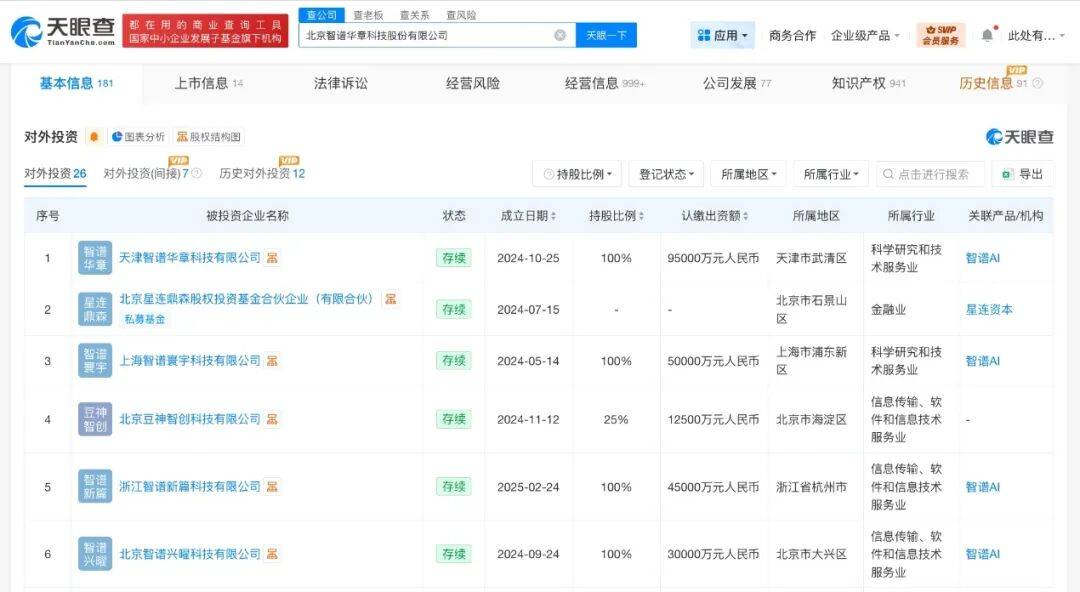
Core Viewpoint - Beijing Zhiyu Huazhang Technology Co., Ltd. has been listed on the Hong Kong Stock Exchange, marking it as the world's first publicly traded company focused on General Artificial Intelligence (AGI) foundational models, with its listing being a significant milestone for China in the AI sector [1]. Company Information - Beijing Zhiyu Huazhang Technology Co., Ltd. was established in June 2019, with a registered capital of approximately 40.28 million RMB [1]. - The company is involved in various activities including the development of AI foundational software, application software, data processing and storage support services, IT consulting, and big data services [1]. - The legal representative of the company is Liu Debing, and the shareholders include Tang Jie, Li Juanzi, and Shanghai Feiyu Technology Co., Ltd. [1]. Market Performance - On its first trading day, the company's stock opened at 120 HKD per share, resulting in a market capitalization of 52.828 billion HKD [1]. Investment and Holdings - The company directly holds stakes in 26 enterprises, with 24 of them currently in operation, including Tianjin Zhiyu Huazhang Technology Co., Ltd. and Beijing Doushen Zhichuang Technology Co., Ltd. [1].
中上协:2025年上市公司平均市净率从年初3.3增长至4.4,市场整体估值稳步抬升
Xin Lang Cai Jing· 2026-01-05 11:50
Core Insights - The report by the China Listed Companies Association highlights the transition of China's market value management system from advocacy to institutionalization and practice by 2025, reflecting national strategic guidance and a more systematic policy approach [1][3] Market Performance - As of December 31, 2025, the Shanghai Composite Index increased from 3351.76 points at the beginning of the year to 3968.84 points, representing an 18.4% year-on-year growth [1][3] - The total number of A-share listed companies reached 5469, with a total market capitalization of 123 trillion yuan, including 116 new listings in 2025 [1][3] - The total market capitalization of existing companies (5353 companies listed before January 1, 2025) grew by 22.5% year-on-year [1][3] - The average price-to-book ratio of A-share listed companies rose from 3.3 at the beginning of the year to 4.4 by year-end [1][3] - The proportion of A-shares in public funds increased by 2.4 percentage points, indicating investor recognition of China's high-quality economic transformation and technological innovation [1][3] Industry Insights - Technology-driven industries saw significant market value increases, with the total market capitalization of high-tech enterprises in manufacturing and scientific research and technical services growing by 33.3% and 32.1% respectively, increasing their share of A-share market capitalization by 4.2 and 0.1 percentage points [2][4] - Nearly half of the listed companies in manufacturing and scientific research and technical services achieved a return on equity (ROE) greater than 5% in 2025, providing support for valuations [2][4] - Public funds showed increased investment in information transmission, software, and information technology services, with a 0.6 percentage point rise in fund allocation to these sectors by the third quarter of 2025 [2][4] - Private technology innovation companies performed actively, with an overall market capitalization growth of 37.0%, raising their share of A-share market capitalization from 33.6% at the beginning of the year to 37.5% [2][4] - State-owned companies accounted for nearly 50% of A-share market capitalization [2][4]
中上协发布丨2025年A股上市公司市值表现报告:5469家A股上市公司总市值123万亿元
Xin Lang Cai Jing· 2026-01-05 09:37
Overall Market Performance - In 2025, the A-share market saw a significant increase, with the Shanghai Composite Index rising from 3351.76 points at the beginning of the year to 3968.84 points by year-end, reflecting an 18.4% year-on-year growth [4][18] - The total number of A-share listed companies reached 5469 by the end of 2025, with a total market capitalization of 123 trillion yuan, marking a 22.5% increase for existing companies compared to the previous year [4][18] - The average price-to-book ratio of A-share companies increased from 3.3 at the beginning of the year to 4.4 by year-end, indicating a steady rise in market valuation [4][18] Industry Performance - Technology-driven industries, particularly high-tech manufacturing and scientific research, experienced substantial market capitalization growth, with total market values increasing by 33.3% and 32.1% respectively [5][18] - Nearly half of the listed companies in manufacturing and scientific research sectors reported a return on equity (ROE) greater than 5%, providing a solid foundation for valuation support [5][18] - Private technology companies showed remarkable performance, with an overall market capitalization growth of 37.0%, increasing their share of the A-share market from 33.6% to 37.5% [5][18] Company-Specific Performance - The top 150 companies by absolute market capitalization growth included major players such as Agricultural Bank of China, Industrial Fulian, and Contemporary Amperex Technology, indicating strong performance across various sectors [20] - The financial sector, represented by companies like Agricultural Bank and Industrial Bank, played a significant role in the overall market growth, reflecting investor confidence in the banking industry [21] - Companies in the manufacturing sector, such as Industrial Fulian and Contemporary Amperex Technology, demonstrated significant market value increases, highlighting the sector's contribution to the overall market performance [21]






去年前11月广州规上服务业营收同比增长7.9%
Guang Zhou Ri Bao· 2026-01-05 02:31
Core Insights - Guangzhou's service industry achieved a revenue of 20,021.31 billion yuan from January to November 2025, reflecting a year-on-year growth of 7.9% [2] - The digital development wave positions Guangzhou as a leader, with the information transmission, software, and IT services sector generating a revenue of 5,645.826 billion yuan, up by 8.1% year-on-year [2] - The scientific research and technical services sector reported a revenue of 1,576.01 billion yuan, marking an 8.3% increase, with professional technical services in energy infrastructure and rail transit driving a significant revenue of 1,159.82 billion yuan, up by 8.6% [2] - The cultural arts, sports, travel agencies, and related services sectors saw remarkable growth, with year-on-year increases of 25.7%, 11.9%, and 10.2% respectively, highlighting new growth points in service consumption [2]
粤开宏观:税收增速与经济增速的非同步性:当前中国税收低增长的原因、影响及应对
Yuekai Securities· 2026-01-04 23:42
Group 1: Tax Revenue Trends - Since 2013, China's tax revenue growth has consistently lagged behind GDP growth, indicating a downward trend in tax revenue[2] - Tax revenue as a percentage of GDP has declined from 18.7% in 2012 to 13.0% in 2024, marking the lowest level since 2001[15] - The average annual growth rate of tax revenue from 2013 to 2023 is only 4.4%, significantly lower than the 20.3% from 2005 to 2012[20] Group 2: Economic Factors Influencing Tax Revenue - The shift in China's economic development from supply shortages to demand insufficiency has significantly impacted tax revenue growth[22] - The transition from real estate-driven growth to new productive forces has created a mismatch between tax sources and revenue, leading to a decline in tax revenue growth[25] - The reliance on tax cuts and fee reductions has hindered the effectiveness of fiscal policies, resulting in a weak tax base expansion effect[30] Group 3: Structural Challenges - The tax system's design, characterized by overlapping taxation, exacerbates revenue volatility, especially during economic downturns[32] - The progressive nature of certain taxes can amplify revenue fluctuations, causing tax revenue to decline faster than economic value during downturns[34] - The existing tax structure has not adapted to the evolving economic landscape, particularly in the service and digital economy sectors, leading to further revenue challenges[28]
深挖潜能扩内需优供给 拓展经济增长新空间
Xin Lang Cai Jing· 2025-12-30 20:11
Core Viewpoint - The central economic work meeting emphasizes expanding domestic demand as a primary strategy for economic growth in 2026, highlighting the importance of optimizing supply and implementing targeted policies to enhance quality and efficiency [1][2]. Group 1: Economic Strategy - The focus on expanding domestic demand is a long-term commitment rather than a short-term emergency measure, necessitating more proactive macroeconomic policies [2][3]. - The shift towards demand-side strategies aims to balance supply and demand contradictions, with an emphasis on high-quality development and nurturing new growth drivers [1][2]. Group 2: Specific Measures - Encouraging consumer spending is prioritized, with plans to enhance residents' income and provide incentives to boost consumption capacity [3][5]. - The implementation of policies such as optimizing "two new" policies and "two heavy" projects, along with issuing long-term special bonds, are crucial for expanding domestic demand [3][4]. Group 3: Regional Focus - Sichuan Province - Sichuan aims to leverage its demand potential and enhance economic growth by focusing on effective demand and stabilizing the economy through various initiatives [5][6]. - The province has maintained a stable economic growth rate between 5.3% and 6.1% over the past six quarters, with industrial output and service sectors showing positive growth [6][7]. Group 4: Market Expansion - Strategies include increasing domestic market demand, enhancing external market sales, and attracting foreign investment to stimulate economic activity [8][9]. - The province's trade balance shows a significant "deficit," indicating a need to boost the export of local products and attract more external consumers [8][9].
中国城市综合发展指标2024:杭州成都等11准一线城市各领风骚
Xin Lang Cai Jing· 2025-12-30 09:45
北京2025年12月24日 /美通社/ -- 以下为中国网采访云河都市研究院院长周牧之的报道: 继国家发改委发展战略和规划司与云河都市研究院共同编制的《中国城市综合发展指标2016》发布之 后,云河都市研究院持续对全国297个地级及以上城市进行经济、社会、环境三大维度的综合评价,连 续第九年发布《中国城市综合发展指标》,对中国城市发展的成就和课题进行分析和展望。本篇作为 《中国城市综合发展指标2024》发布的第二篇,在展示制造业辐射力、IT辐射力、科技辐射力三大排名 前十城市的同时,剖析准一线城市的发展特色。 《中国城市综合发展指标2024》综合排名北京稳居榜首,上海第2位、深圳第3位、广州第4位。该综合 排名的偏差值是经济、社会、环境三个大项偏差值的总和,为300。《中国城市综合发展指标》(以下 简称《指标》)将偏差值在200以上城市定义为一线城市,以上四个城市表现卓越,偏差值超过200,是 为一线城市。 准一线11城市各放异彩 准一线11城市的GDP全国占比高达19.8%,超过一线4城市全国占比的12.7%。然而从全国市值前100企 业占比来看,准一线11城市为12.1%,只有一线4城市的78.4%的不到 ...