电气

Search documents
新股孖展统计 | 8月26日
智通财经网· 2025-08-26 10:06
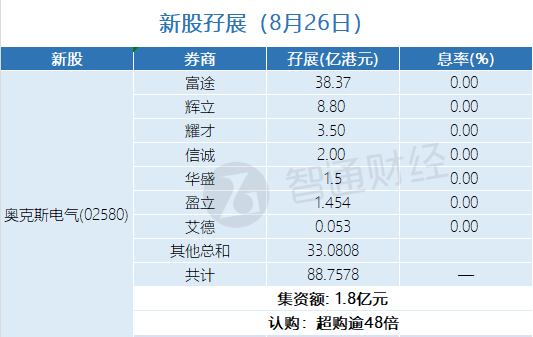
Group 1 - The core point of the news is that Aux Electric (02580) is currently in the process of an IPO, with significant interest from brokers leading to a substantial oversubscription [1][2]. - As of August 26, brokers including Futu, Huatai, and Yao Cai have collectively lent 85.7578 billion HKD to Aux Electric, indicating an oversubscription rate exceeding 48 times [1][2]. - The total amount raised in the IPO is reported to be 1.8 billion HKD, reflecting strong market demand for the shares [2]. Group 2 - The breakdown of the funds lent by various brokers includes Futu with 38.37 billion HKD, Huatai with 8.80 billion HKD, and Yao Cai with 3.50 billion HKD, among others [2]. - The total amount from other brokers sums up to 33.0808 billion HKD, contributing to the overall lending amount [2]. - The high level of oversubscription suggests a strong investor confidence in Aux Electric's market potential [1][2].

盛帮股份:8月22日召开董事会会议
Mei Ri Jing Ji Xin Wen· 2025-08-25 10:00
Company Overview - Shengbang Co., Ltd. (SZ 301233) announced its fifth board meeting on August 22, 2025, where it reviewed the 2025 semi-annual report and related documents [1] - As of the report, Shengbang's market capitalization is 3.2 billion yuan [1] Revenue Composition - For the year 2024, Shengbang's revenue composition is as follows: - Automotive industry: 50.92% - Electrical sector: 36.19% - Aviation sector: 6.15% - Oil industry: 5.36% - Other businesses: 1.39% [1]
奥克斯电气(02580.HK)8月25日起招股 发售价将为每股16.00-17.42港元
Ge Long Hui· 2025-08-24 22:48
Core Viewpoint - Aokis Electric (02580.HK) plans to globally offer approximately 207 million shares, subject to adjustments based on the exercise of the over-allotment option [1] Group 1: Offering Details - The company will offer 10.3582 million shares in Hong Kong and approximately 197 million shares internationally [1] - The subscription period is set from August 25 to August 28, 2025, with the expected pricing date on August 29, 2025 [1] - The offering price is expected to be between HKD 16.00 and HKD 17.42 per share, with a trading unit of 200 shares [1] Group 2: Underwriting and Trading - CICC (China International Capital Corporation) is the sole sponsor for the offering [1] - The shares are anticipated to commence trading on the Hong Kong Stock Exchange on September 2, 2025 [1]
今年上半年广东经济运行情况分析报告发布 粤新设经营主体超150万户
Shen Zhen Shang Bao· 2025-08-21 23:20
Economic Overview - Guangdong's economy showed overall recovery in the first half of the year, driven by new productivity and active market dynamics [1][2] - The implementation of proactive macro policies is expected to continue improving supply and demand, leading to stable economic growth for the year [1] Key Industries Performance - Major industries such as electronics, electrical equipment, and automotive sectors all experienced growth rates exceeding 7% [1] - Advanced manufacturing and high-tech manufacturing value-added increased by 5.9% and 6.0% respectively, accounting for 55.4% and 33.0% of the industrial value-added above designated size [1] Market Activity - Over 1.5 million new business entities were established in the province, marking an 8.1% year-on-year increase [2] - Industrial electricity consumption grew by 4.1%, with June showing an 8.4% increase, indicating enhanced market activity [2] - The manufacturing Purchasing Managers' Index (PMI) rebounded in June, returning to the expansion zone, reflecting improved business expectations [2] Contribution of Market Entities - The vibrant market entities are crucial for Guangdong's economic foundation, with large enterprises leading industrial upgrades and technological innovation, while small and medium-sized enterprises inject flexibility and vitality into the market [2]
粤新设经营主体超150万户
Sou Hu Cai Jing· 2025-08-21 23:16
Economic Overview - Guangdong's economy showed overall recovery in the first half of the year, driven by new productivity and active market dynamics [1][2] - The implementation of proactive macro policies is expected to continue improving supply and demand, leading to stable economic growth for the year [1] Key Industries Performance - Major industries such as electronics, electrical equipment, and automotive sectors all experienced growth rates exceeding 7% [1] - Advanced manufacturing and high-tech manufacturing value-added increased by 5.9% and 6.0% respectively, accounting for 55.4% and 33.0% of the industrial value-added above designated size [1] Market Activity - Over 1.5 million new business entities were established in the province, marking an 8.1% year-on-year increase [2] - Industrial electricity consumption grew by 4.1%, with June showing an 8.4% increase, indicating enhanced market activity [2] - The manufacturing Purchasing Managers' Index (PMI) rebounded in June, returning to the expansion zone, reflecting improved business expectations [2] Contribution of Market Entities - The vibrant market entities are crucial for Guangdong's economic foundation, with large enterprises leading industrial upgrades and technological innovation, while small and medium-sized enterprises inject flexibility and vitality into the market [2]
马来西亚二季度经济增长稳健
Jing Ji Ri Bao· 2025-08-20 23:11
Economic Growth - Malaysia's GDP grew by 4.4% year-on-year in Q2, maintaining a steady growth trend despite a complex external environment, slightly below the earlier forecast of 4.5% but above market expectations of 4.3% [1] - Seasonally adjusted GDP increased by 2.1% quarter-on-quarter, significantly higher than the 0.7% growth in Q1, indicating economic resilience [1] Domestic Demand - Strong domestic demand was a key driver of economic growth, with household consumption rising by 5.3% year-on-year and public consumption increasing by 6.4% in Q2 [1] - Government policies, such as raising minimum wages and adjusting civil servant salaries, enhanced consumer purchasing power, contributing to a thriving consumption market [1] - Private and public investments grew by 10.2% and 6.8%, respectively, further supporting economic expansion [1] Sector Performance - The services sector grew by 5.1% year-on-year, driven by active performance in wholesale and retail, as well as food and beverage sub-sectors [2] - Manufacturing sector growth slowed but still achieved a 3.7% year-on-year increase, with electrical, electronic, and optical products showing sustained growth [2] - Agriculture and construction sectors also reported growth rates of 2.1% and 12.1%, respectively [2] Labor Market - Total employment in Malaysia increased by 2.9% year-on-year, reaching 16.86 million, with an unemployment rate stable at 3%, down 5.7% from the previous year [2] - Labor force participation rate rose to 70.8%, indicating a robust labor market that supports household consumption and sustainable economic growth [2] Trade Performance - Despite challenges, Malaysia's trade performance showed some highlights, with a significant 72.6% drop in net exports due to reduced commodity exports, particularly in mining [2] - Strong performance in electrical and electronic product exports partially offset the overall decline in exports [2] - Malaysia's important position in regional supply chains and trade cooperation with other countries provided some buffer against export market pressures [2] Inflation and Monetary Policy - Malaysia's inflation remained moderate in Q2, with the overall inflation rate decreasing from 1.5% in Q1 to 1.3%, and core inflation holding steady at 1.8% [3] - The decline in fuel prices and a slowdown in food price increases were the main reasons for the drop in inflation rates, providing stability for consumer purchasing power and room for monetary policy adjustments [3] - The central bank expects overall inflation to remain moderate, ranging between 1.5% and 2.3% for the year [3] Future Outlook - Analysts predict that Malaysia's economy may face challenges in the second half of the year, with potential further slowdown in exports [3] - However, continued domestic demand growth and stable investment activities are expected to provide some support for the economy [3] - The recovery of the tourism sector and the advancement of infrastructure projects are anticipated to inject new momentum into the economy [3]
好盈科技成立20年拟上市,董事长张捷及董事刘友辉合计控制71%表决权
Sou Hu Cai Jing· 2025-08-07 09:42
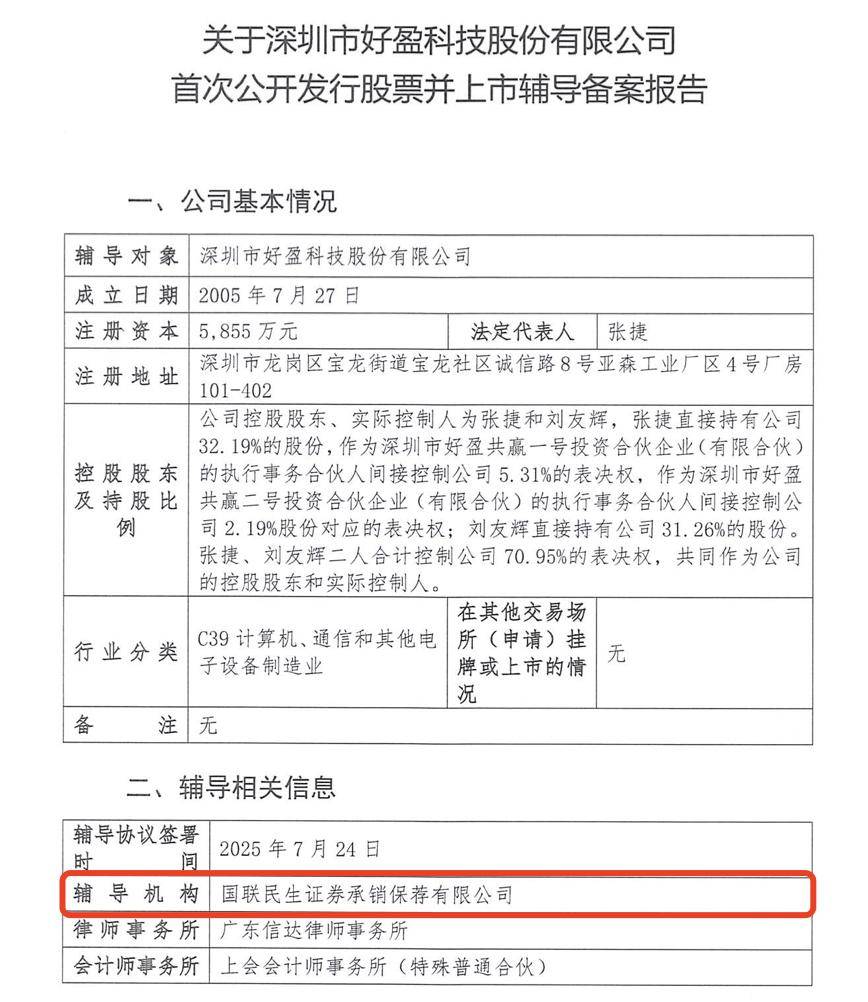
Company Overview - Shenzhen Haoying Technology Co., Ltd. was established on July 27, 2005, with a registered capital of 5.855 million yuan [1][3][6] - The company is located at No. 4, Yasen Industrial Plant, Chengxin Road, Baolong Community, Longgang District, Shenzhen [1][3][6] - The company specializes in the research, manufacturing, and sales of high-power density brushless power systems, with applications in industrial and agricultural drones, high-end remote-controlled models, and electric personal mobility equipment [6] Shareholding Structure - The controlling shareholders and actual controllers of the company are Zhang Jie and Liu Youhui, with Zhang Jie directly holding 32.19% of the shares [1][3][6] - Zhang Jie indirectly controls 5.31% of the voting rights through Shenzhen Haoying Gongying No. 1 Investment Partnership (Limited Partnership) and 2.19% through Shenzhen Haoying Gongying No. 2 Investment Partnership (Limited Partnership) [1][3][6] - Liu Youhui directly holds 31.26% of the shares, resulting in Zhang Jie and Liu Youhui collectively controlling 70.95% of the voting rights [1][3][6] IPO Guidance and Projects - The company initiated its IPO guidance on December 26, 2024, with Haitong Securities Co., Ltd. as the guidance institution [2][4] - The main fundraising projects include the construction of a high-end power system intelligent industrial park, upgrading the research and development center, and supplementing working capital [4] - The planned site for the industrial park and R&D center is located in Longgang District, Shenzhen, covering an area of 20,780 square meters, although the company has not yet obtained ownership of the land [4]
出口角度看产业升级 - 宏观陈述
2025-08-05 15:42
Summary of Conference Call Records Industry Overview - The records focus on the **high-end industry in China**, particularly its development, challenges, and the impact of internal competition (involution) on industrial upgrading [1][5][15]. Key Points and Arguments 1. **Structural Policies**: China has implemented structural easing policies to guide funds towards high-end industries, resulting in significant growth in industrial loans for high-tech sectors, while support for the real estate sector remains weak [3][2]. 2. **Economic Challenges**: The Chinese economy faces weak overall demand, leading to low capacity utilization rates, particularly in high-end industries, which are even lower than traditional industries [5][6]. 3. **Involution Impact**: Involution has led to price reductions as companies compete for orders, which can suppress further development of high-end industries if driven by insufficient demand rather than economies of scale [6][7]. 4. **Export Trends**: Over the past decade, the export share of high-end industries such as computers, pharmaceuticals, and electrical equipment has significantly increased, while traditional industries like rubber and textiles have seen a decline [8][10]. 5. **High vs. Low Growth Groups**: High-growth groups (emerging industries) have shown strong performance in fixed asset investment and industrial value added, but their export growth has lagged behind low-growth groups (traditional industries) in recent years due to involution [10][9]. 6. **Quality Indicators**: Total Factor Productivity (TFP) is used as a quality measure, indicating that a decline in the export delivery value as a proportion of revenue correlates with stronger TFP [11][4]. 7. **Future Directions**: High-end manufacturing is not the endpoint of industrial upgrading; the next level involves research and development, branding, and high-value-added services [12][13]. 8. **Need for Anti-Involution Policies**: To counteract the negative effects of involution, policies promoting demand and improving capacity utilization are essential for healthy economic development [15][16]. Additional Important Content - **Price Dynamics**: Price decreases should be analyzed to determine their causes; if due to demand insufficiency, they may hinder industrial upgrading [7]. - **Labor Market Effects**: Anti-involution policies should also address labor market issues, as stagnant wage growth can lead to reduced consumer spending on higher-quality goods, further impacting industrial upgrading [16]. - **Evaluation of Policies**: The effectiveness of anti-involution policies can be assessed through macroeconomic indicators such as profit changes, inflation levels, and the speed of industrial upgrading [17].
深圳市宇顺电子股份有限公司股票交易异常波动暨风险提示公告
Shang Hai Zheng Quan Bao· 2025-08-04 19:40
Core Viewpoint - Shenzhen Yushun Electronics Co., Ltd. is facing significant financial challenges, including negative net profits and a risk of delisting due to its financial performance, prompting the company to undertake a major asset restructuring to improve its asset quality and profitability [2][10]. Group 1: Financial Performance - The company reported a negative net profit for the fiscal year 2024, with the net profit after deducting non-recurring gains and losses also being negative, and operating revenue falling below 300 million yuan [2][10]. - As of August 4, 2025, the company's price-to-book ratio was 25.85 times, significantly higher than the industry average of 3.81 times, indicating a substantial deviation in valuation metrics compared to comparable companies [12]. Group 2: Stock Trading and Risks - The company's stock experienced abnormal trading fluctuations, with a cumulative price increase deviation exceeding 12% over three consecutive trading days [4]. - Starting May 6, 2025, the Shenzhen Stock Exchange implemented a delisting risk warning for the company's stock due to its financial performance, with potential termination of listing if certain conditions are met in 2025 [2][10]. Group 3: Asset Restructuring - The company is in the process of a significant asset restructuring, which involves acquiring 100% equity of several technology firms to enhance its asset quality and profitability [11]. - The restructuring is currently in the approval stage and carries various risks, including potential suspension or termination of the transaction, funding and debt repayment risks, and goodwill impairment risks [2][11]. Group 4: Market Comparison - The company’s current static price-to-earnings ratio and price-to-book ratio are significantly higher than those of comparable companies in the industry, such as Helitai and OFILM, which may indicate overvaluation [12]. - Investors are advised to be aware of the risks associated with the stock market and to make informed investment decisions based on the company's disclosed information [3][12].

长沙3人获得“优秀中国特色社会主义事业建设者”称号
Chang Sha Wan Bao· 2025-07-29 11:32
Core Points - The sixth National Excellent Non-Public Economic Person Award Ceremony was held, recognizing 100 individuals for their contributions to the socialist cause with Chinese characteristics [1] - Four non-public economic figures from Hunan received the award, showcasing the vitality and responsibility of the Hunan business community in the development of the non-public economy [1] Group 1: Individual Achievements - Chen Bang, Chairman of Aier Eye Hospital Group, has led the company to become a global benchmark in ophthalmology, establishing a comprehensive medical education and research platform and investing approximately 2.135 billion yuan in public welfare projects [2] - Yan Zhou, founder of Mingming Hen Mang, has expanded the brand to over 16,000 stores nationwide, creating over 120,000 jobs and donating nearly 13 million yuan for disaster relief and children's welfare [2] - Wang Xinliang, founder of Jiachang Bianfan, has focused on ecological quality food and community service, contributing 981,000 yuan to various social causes while also being recognized as a national advanced individual business owner [3] Group 2: Economic Context - Non-public economy is a crucial source of national tax revenue, a key player in technological innovation, and an important force for sustainable economic development [3] - The local government has implemented seven major actions to promote the healthy development of the non-public economy, with Changsha ranking in the top ten nationally for three consecutive years in terms of business environment [4] - In Q1 2025, the added value of Changsha's private economy reached 241.19 billion yuan, growing by 5.1% year-on-year, accounting for 65% of the regional GDP [4]