
科研服务

Search documents
服务手册发布!中央企业开放134个中试验证平台
Xin Hua She· 2025-09-17 05:18
Core Viewpoint - The State-owned Assets Supervision and Administration Commission (SASAC) of the State Council officially released the "Central Enterprise Pilot Verification Platform External Service Manual (2025 Edition)" to promote the shared use of pilot verification services among central enterprises [1] Group 1: Platform Overview - The manual opens 134 pilot verification platforms and 291 service projects, covering various industrial technology fields such as resource development, energy utilization, manufacturing engineering, information networks, advanced materials, life health, green environmental protection, and public safety [1] - The pilot verification platform serves as a comprehensive support platform for intermediate testing during the transition of scientific research results from laboratory development to large-scale industrial production [1] Group 2: Industry Impact - By publishing industry qualifications, capability parameters, and contact information, central enterprises can better connect with the upstream and downstream service needs of the industry chain and the pilot needs of large, medium, and small enterprises [1] - This initiative is expected to enhance the efficiency of technology transfer across the entire society and accelerate the cultivation of new productive forces [1]
服务手册发布! 中央企业开放134个中试验证平台
Xin Hua She· 2025-09-17 00:32
Core Viewpoint - The State-owned Assets Supervision and Administration Commission (SASAC) of the State Council officially released the "Service Manual for the Open Sharing of Central Enterprises' Pilot Verification Platform (2025 Edition)" on September 17, aiming to promote the shared use of pilot verification services among central enterprises [1] Group 1: Overview of the Pilot Verification Platform - The manual opens up 134 pilot verification platforms and 291 service items, covering various industrial technology fields such as resource development, energy utilization, manufacturing engineering, information networks, advanced materials, life health, green environmental protection, and public safety [1] - The pilot verification platform serves as a comprehensive support platform for intermediate testing during the transition of scientific research achievements from laboratory development to large-scale industrial production [1] Group 2: Industry Impact - By publishing industry qualifications, capability parameters, and contact information, central enterprises can better connect with the upstream and downstream of the industrial chain and meet the pilot needs of large, medium, and small enterprises [1] - This initiative is expected to enhance the efficiency of technology achievement transformation across the entire society and accelerate the cultivation of new productive forces [1]
创新好成果如何加速走向“生产线”
Ren Min Ri Bao· 2025-09-15 02:13
Group 1 - The core viewpoint emphasizes the importance of transforming scientific and technological achievements from universities into practical productivity to foster new quality productivity [6][7] - The establishment of regional technology transfer centers aims to facilitate the conversion of academic innovations into market-ready products [7][10] - Various regions are implementing separate management systems for job-related scientific achievements, granting universities and research institutions more autonomy in managing their technological assets [10][12] Group 2 - A significant barrier to technology transfer is the complex asset management procedures and unclear ownership rights, which discourage researchers from pursuing commercialization [8][9] - The need for a robust incentive mechanism for researchers is highlighted, suggesting that technology transfer should be integrated into performance evaluations and promotions [11][12] - There is a mismatch between the outputs of academic research and the needs of enterprises, indicating a need for better alignment between research and market demands [12][13] Group 3 - The establishment of pilot programs to clarify intellectual property rights has shown promise in attracting significant investment for technology commercialization [9][10] - The lack of mid-stage testing platforms hinders the transition from laboratory research to market-ready products, necessitating increased support for these facilities [15][16] - Government initiatives are underway to promote the development of mid-stage testing service platforms, with specific targets set for the number of platforms by 2028 [17] Group 4 - The shortage of specialized talent in technology transfer is a critical issue, with calls for the development of a professional workforce capable of bridging the gap between research and industry [19][20] - Collaborative efforts between universities and external technology transfer platforms are essential for enhancing the effectiveness of technology commercialization [22][23] - Recommendations include establishing clear career paths and compensation structures for technology transfer professionals to attract and retain talent in this field [22][23]

国务院批复:同意!
券商中国· 2025-09-11 11:15
Core Viewpoint - The State Council of China has approved a comprehensive reform pilot plan for market-oriented allocation of factors in ten regions, aiming to enhance the efficiency of resource allocation and promote a high-level socialist market economy [2][3]. Group 1: Pilot Regions and Implementation - The pilot regions include Beijing's urban sub-center, key cities in southern Jiangsu, Hangzhou-Ningbo-Wenzhou, Hefei metropolitan area, Fuzhou-Xiamen-Quanzhou, Zhengzhou, Changsha-Zhuzhou-Xiangtan, nine cities in the Guangdong-Hong Kong-Macao Greater Bay Area, Chongqing, and Chengdu [2][3]. - The implementation of the plan is expected to break down institutional barriers that hinder the free flow and efficient allocation of factors, ensuring equal legal protection for various ownership economies [2][3]. Group 2: Technology Factor Allocation - The plan emphasizes the need to streamline the technology transfer chain and promote the construction of an international technology innovation center in Beijing [6][7]. - It encourages the integration of technology and capital factors, supporting financial institutions to provide more financial products for technology transfer [7][8]. Group 3: Land Factor Allocation - The reform includes exploring land management system reforms and encouraging the use of long-term leases and flexible supply methods for industrial land [8][9]. - It aims to revitalize idle land and low-efficiency construction land through market-oriented methods, enhancing the efficiency of land use [9][10]. Group 4: Human Resource Flow - The plan seeks to facilitate the social mobility of labor and talent by broadening the recognition of foreign professional qualifications and supporting high-level talent recruitment [10][11]. - It aims to stimulate innovation and entrepreneurship among talents by allowing flexible compensation structures [10][11]. Group 5: Data Factor Circulation - The plan proposes to improve the public data sharing mechanism and expand the application scenarios for data development [11][12]. - It emphasizes the establishment of a data circulation and trading system, promoting the integration of public and social data [12][13]. Group 6: Capital Factor Support for the Real Economy - The plan aims to increase effective financial service supply while preventing risks, supporting the development of a digital inclusive finance database [13][14]. - It encourages higher levels of financial openness and cooperation, facilitating cross-border financial services [13][14]. Group 7: Resource and Environmental Market System - The plan includes constructing a green factor trading mechanism and exploring the realization of ecological product value [14][15]. - It aims to enhance the market-oriented allocation of resource factors while ensuring ecological protection [14][15]. Group 8: Overall Efficiency of Factor Allocation - The plan focuses on enhancing the collaborative allocation efficiency of various factors, particularly in emerging industries and services [15][16]. - It aims to create a fairer and more vibrant market environment by optimizing resource allocation efficiency and maximizing benefits [15][16].
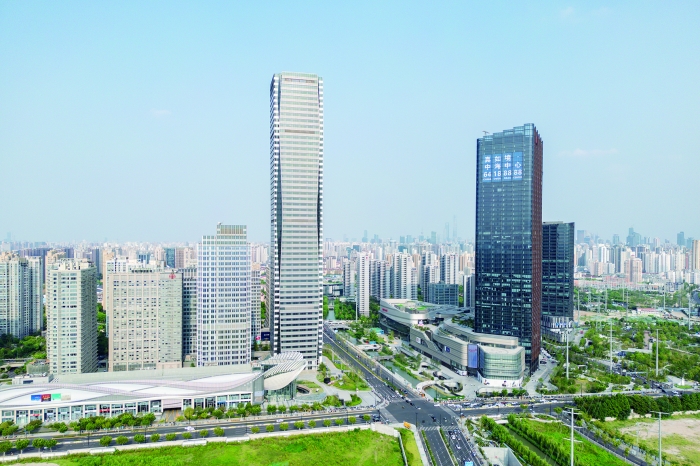
构建跨区域科创共同体 上海普陀:全面融入沿沪宁产业创新带建设
Shang Hai Zheng Quan Bao· 2025-09-10 18:48
Core Viewpoint - The article emphasizes the strategic development of the Yangtze River Delta region, particularly the "Huhuning Industrial Innovation Belt," which connects major cities and enhances regional collaboration in technology and industry [1][2]. Group 1: Development Initiatives - The "Huhuning Industrial Innovation Belt" has been a focus since the 2019 national plan, with ongoing efforts to deepen its development through various governmental strategies [2]. - The Shanghai Putuo District has initiated a cooperation proposal to strengthen cross-regional collaboration in technology innovation and industrial development along the Huhuning belt [1][2]. Group 2: Resource and Demand Coordination - In 2023, Putuo District collaborated with eight cities along the Huhuning belt to compile three lists of resources, demands, and cooperation opportunities, identifying 310 key resources and 294 technical needs [4]. - An online platform called "Huhuning Collaborative Innovation Market" was launched, facilitating technology transactions that generated over 8 million yuan in revenue [4]. Group 3: Innovation and Technology Development - The establishment of the Wuning Innovation Community in Putuo District aims to leverage local scientific resources to drive innovation across the Yangtze River Delta [5]. - The Shanghai Chemical Research Institute has successfully developed a technology for the preparation of Carbon-13, breaking foreign monopolies and contributing to the biomedical sector [5]. Group 4: Future Plans and Investment Strategies - Looking ahead to the "14th Five-Year Plan," Putuo District aims to enhance long-term planning and focus on integrating industry, innovation, and market services [5]. - The district plans to utilize the Huhuning Industrial Fund Matrix to attract government and industrial capital, promoting efficient flow of key production factors such as technology, finance, and talent across cities [5].
科研“下书架” 成果“上货架” ——“龙子湖科创路演”打造河南科技成果转化“超级IP”
He Nan Ri Bao· 2025-09-07 23:33
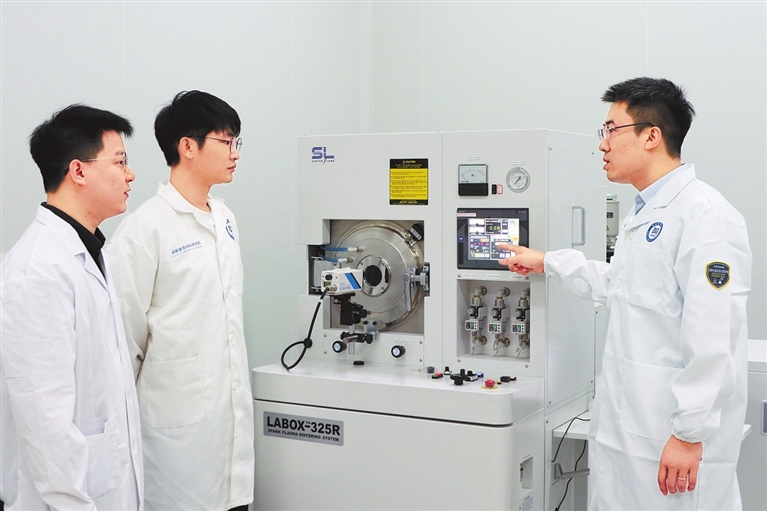
Core Viewpoint - The "Longzi Lake Science and Technology Innovation Roadshow" in Henan Province aims to accelerate the transformation of scientific research achievements into productive forces, addressing the challenges of integrating technology with the economy and promoting deep collaboration between scientific innovation and industrial innovation [8][11][12]. Group 1: Event Overview - The "Longzi Lake Science and Technology Innovation Roadshow" attracted over 400 participants, exceeding the expected attendance of 200, indicating strong interest in accelerating the transformation of scientific achievements [8]. - The event serves as a platform for researchers and investors to connect, facilitating the transition of scientific innovations from laboratories to production lines [6][11]. Group 2: Achievements and Progress - Since its launch, the roadshow has promoted 464 cutting-edge technological achievements and organized 85 high-quality projects for presentation, leading to 37 key project signings [12]. - The self-healing anti-corrosion coating technology developed by the Chemical Research Institute has gained significant attention and is moving towards commercialization after being showcased at the roadshow [10][11]. Group 3: Mechanisms for Innovation - The Henan Academy of Sciences has established a mechanism that aligns industry needs with research capabilities, focusing on solving real-world problems faced by enterprises [14][16]. - The Academy has initiated a collaborative approach, involving enterprises in defining technological challenges and working closely with research teams to develop solutions [14][17]. Group 4: Ecosystem Development - The establishment of the Central Plains Technology City Seed Fund, with a scale of 200 million yuan, aims to support early-stage technology companies and facilitate the commercialization of research outcomes [18]. - The Academy is working on creating a comprehensive service system for the entire lifecycle of technology transfer, enhancing the ecosystem for innovation and productivity in Henan [19][21].
行业周报:创新药产业链迎来明确拐点,重点推荐板块性机会-20250907
KAIYUAN SECURITIES· 2025-09-07 09:46
Investment Rating - The investment rating for the pharmaceutical and biotechnology industry is "Positive" (maintained) [2] Core Insights - The industry is experiencing a clear turning point, entering a new upward cycle due to the continuous support for innovative drugs and the recovery of overseas demand [7][24] - The CXO sector is expected to see a gradual recovery in operating performance, with a recommendation to actively invest in this direction [6][16] - The performance of leading CXO companies is improving, with significant growth in revenue and net profit expected in the first half of 2025 [14][17] Summary by Sections CXO Sector - The CXO industry has shown a recovery trend, with total revenue of 24 core companies reaching approximately 592.2 billion yuan, a year-on-year increase of about 16.6% in the first half of 2025 [14] - Leading CXO companies like WuXi AppTec and WuXi Biologics are experiencing significant improvements in their performance, with net profit growth of 62.7% [14][17] - The demand for ADC and weight-loss industry chains is strong, contributing to the robust growth of companies like WuXi AppTec and WuXi AppTec [17] Life Sciences Upstream - The life sciences upstream sector is witnessing a clear turning point, with most companies showing significant performance improvement [24] - Bioreagent companies are experiencing steady growth in conventional business, while unconventional business impacts are largely cleared [24] - Chemical reagents are maintaining high growth, with companies like Haoyuan Pharmaceutical and Bid Pharma exceeding revenue and net profit expectations [24] Recommended and Benefiting Companies - Recommended companies in the pharmaceutical and biotechnology sector include: Heng Rui Medicine, East China Medicine, Sanofi, and others [8] - In the CXO sector, recommended companies include WuXi AppTec, WuXi Biologics, and others [8] - In the research service sector, recommended companies include Bid Pharma, Baipusai, and others [8]



“香江学者计划”和“澳门青年学者计划”获选结果公布 广东29名博士后入选
Nan Fang Ri Bao Wang Luo Ban· 2025-09-05 08:02
Group 1 - The "Xiangjiang Scholars Program" and "Macau Young Scholars Program" have selected 29 postdoctoral candidates from Guangdong for 2025, with 26 in the Bay Area project and 3 receiving central funding [1][2] - Notable universities such as South China University of Technology, Sun Yat-sen University, Guangdong University of Technology, and Southern Medical University have the highest number of selections [1] - New entries from cities like Foshan, Dongguan, Zhanjiang, and Hengqin have been achieved, with Zhanjiang having 3 selections, marking the first entries from the eastern, western, and northern regions of Guangdong [1] Group 2 - The first year of the project has shown significant results, with a strong willingness for cooperation among the three regions, and a high demand from Hong Kong and Macau universities [2] - A total of 399 postdoctoral project positions were proposed this year, covering well-known universities in Hong Kong and Macau, with Guangdong accounting for over one-third of the national applications at 343 [2] - The selected postdoctoral projects align with key disciplines in Hong Kong and Macau, focusing on advanced manufacturing, medicine, artificial intelligence, and integrated circuits, which together represent over 80% of the projects [2]
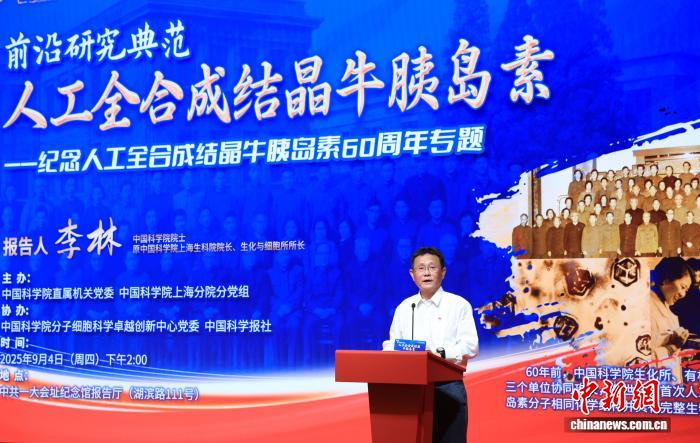
【中国新闻网】中国科学院举办纪念人工全合成结晶牛胰岛素60周年专场活动
Zhong Guo Xin Wen Wang· 2025-09-05 01:52
Core Viewpoint - The 60th anniversary of the artificial total synthesis of crystalline bovine insulin is celebrated as a significant milestone in life sciences, marking a leap in understanding the essence of life and showcasing the innovative spirit of Chinese scientists [2][3]. Group 1: Historical Significance - The artificial total synthesis of crystalline bovine insulin is recognized as a milestone following the first artificial synthesis of an organic molecule, urea, in 1828, highlighting its eternal significance in the history of life sciences [2]. - The project was officially initiated in December 1958, three years after the first determination of the primary structure of insulin, under a national secret research program code-named "601," indicating it as the primary task of the 1960s [2]. Group 2: Scientific Achievement - In September 1965, a collaborative effort among the Chinese Academy of Sciences' Biochemistry Research Institute, the Organic Chemistry Research Institute, and Peking University led to the world's first artificial synthesis of a protein with the same chemical structure and complete biological activity as the natural molecule—crystalline bovine insulin [2][3]. Group 3: Inspirational Messages - The process of synthesizing artificial crystalline bovine insulin reflects the innovative confidence and scientific ambition of Chinese scientists to challenge the frontiers of life sciences [3]. - The event emphasized the connection between scientific exploration and revolutionary exploration, showcasing the shared spirit of great achievements in both fields [3]. Group 4: Call to Action - Current scientists are encouraged to learn from the team behind the artificial total synthesis of crystalline bovine insulin, aiming to reach new heights in technology and contribute significantly to the nation [5].
中国城市观|城市转型中的禅城样本
2 1 Shi Ji Jing Ji Bao Dao· 2025-09-05 00:12
Core Viewpoint - The article highlights the transformation of Chancheng District in Foshan, which has become a leader in high-quality economic development amidst the city's transition from extensive growth to quality enhancement [1][3]. Group 1: Economic Transformation - Chancheng has recognized the need for economic transformation and has developed a strategy to upgrade from a "central urban area" to an "urban center," focusing on building four centers: urban manufacturing, industrial services, commercial consumption, and Lingnan culture [3][4]. - The district's GDP reached 1.3 trillion yuan, and it has a population of nearly 10 million, necessitating the upgrade of traditional industries and the cultivation of new growth drivers [3][4]. Group 2: Resource Optimization - Chancheng faces challenges in optimizing land resources for new enterprises, as many startups leave after their initial phase due to a lack of land [6][7]. - The "collective land transfer to national land" system innovation aims to reduce institutional costs and enhance land use efficiency, allowing for better resource allocation [6][7]. Group 3: Service Industry Development - The district has introduced a strategy of "Foshan manufacturing, Chancheng services," focusing on developing a production service center to support the upgrade of the manufacturing sector [9][10]. - Chancheng is enhancing its commercial service offerings to meet the growing demand for high-end services, which has been historically underserved [10]. Group 4: Cultural and Urban Development - The district is integrating culture with urban renewal and consumption innovation, aiming to create a "modern urban culture" and attract high-end talent [10][12]. - Chancheng's development practices emphasize the importance of innovation and a supportive environment for education, research, and public services as key to urban competitiveness [13][14]. Group 5: Governance and Market Dynamics - The article discusses the shift in government roles from being a project leader to a facilitator of market dynamics, promoting a "platform city" concept that encourages collaboration among various stakeholders [14][15]. - Chancheng's approach aligns with national strategies for building a unified market, optimizing resource allocation, and enhancing government functions to support market efficiency [15].