石油

Search documents
墨西哥国家石油公司(Pemex)公布第四季度净亏损 862 万美元
Xin Lang Cai Jing· 2026-02-27 17:01
专题:聚焦美股2025年第四季度财报 墨西哥国有能源公司墨西哥国家石油公司(Pemex) 周五向墨西哥证券交易所提交的文件显示,该公 司去年第四季度实现净亏损 1.5523 亿比索(合 862 万美元),营收为3624.5 亿比索。 新浪合作大平台期货开户 安全快捷有保障 责任编辑:郭明煜 墨西哥国有能源公司墨西哥国家石油公司(Pemex) 周五向墨西哥证券交易所提交的文件显示,该公 司去年第四季度实现净亏损 1.5523 亿比索(合 862 万美元),营收为3624.5 亿比索。 新浪合作大平台期货开户 安全快捷有保障 责任编辑:郭明煜 专题:聚焦美股2025年第四季度财报 ...
伊朗局势扰动石油市场:油价100美元/桶是预警还是虚惊?
2 1 Shi Ji Jing Ji Bao Dao· 2026-02-27 16:32
Group 1: Oil Market Dynamics - The ongoing negotiations between the US and Iran are causing fluctuations in the oil market, with reports indicating significant progress in talks, leading to a slight decline in Brent and US crude oil prices on February 26 [1] - The market is currently caught between expectations of a global supply surplus and geopolitical tensions surrounding Iran, which have increased risk premiums [2] - If a deal is reached between the US and Iran, oil prices could see a significant drop due to the current oversupply situation in the global oil market [2][3] Group 2: OPEC+ Production Decisions - OPEC+ is considering increasing oil production by 137,000 barrels per day in April, which could impact market dynamics and allow member countries to regain market share [3] - Despite expectations of a supply surplus, OPEC+ predicts strong oil demand, forecasting a daily average demand of 106.52 million barrels by 2026, which supports the case for production increases [3] Group 3: Price Projections and Risks - In extreme scenarios, if negotiations fail and Iran disrupts the Strait of Hormuz, oil prices could surge, potentially exceeding $100 per barrel due to significant supply disruptions [5][6] - Current oil prices have seen a cumulative increase of nearly 20% this year, driven by geopolitical tensions, while the market also faces concerns of oversupply [4][8] - The International Energy Agency (IEA) and the US Energy Information Administration (EIA) both project significant supply surpluses in the coming years, indicating that without geopolitical disruptions, oil prices may face downward pressure [7][8]
墨西哥国家石油公司(Pemex)预计2026年到期债务规模为134亿美元。
Xin Lang Cai Jing· 2026-02-27 16:25
墨西哥国家石油公司(Pemex)预计2026年到期债务规模为134亿美元。 来源:滚动播报 ...
盘后,两桩大事!
Xin Lang Cai Jing· 2026-02-27 16:07
Group 1 - The U.S. and Iran are on the brink of conflict, with heightened tensions following failed negotiations and threats from Iranian leadership regarding uranium enrichment activities [1] - If a military conflict occurs, it could disrupt oil supplies through the Strait of Hormuz, significantly impacting international oil prices and causing instability in the Middle East [1] - A potential quick conflict may have a limited impact on the A-share market, while a full-scale war could have deeper implications [1] Group 2 - The China Securities Regulatory Commission (CSRC) held a meeting with eight foreign investment institutions to discuss investment opportunities [2] - The focus is on the "14th Five-Year Plan," which aims to develop six future industries, reform the investment and financing system, and support differentiated development for foreign investments [3] - The overall strategy emphasizes prioritizing technology, future industries, IPO reforms, and attracting foreign capital [4] Group 3 - The small metals sector has seen explosive growth, with tungsten prices rising by 66% and ammonium paratungstate reaching a historical high of 1.1 million yuan per ton [5] - The U.S. plans to utilize AI models to set reference prices for key minerals, increasing market attention on strategic metals like germanium, gallium, antimony, and tungsten [5] - The surge in small metals prices has also positively impacted related chemical sectors, such as phosphorus chemicals and TDI [5] Group 4 - The demand for computing power in China has surged, with domestic large model token usage exceeding that of the U.S. for several weeks, highlighting rapid growth in AI inference demand [6] - European cloud service providers are entering a price increase cycle, with some services seeing price hikes of up to 38%, further driving the demand for domestic computing power [6] - The overall industry is entering a "full-chain inflation" cycle, with high certainty in performance for sectors benefiting from tight supply and demand [7] Group 5 - The commercial space industry is approaching a peak launch period, with multiple reusable rockets set to launch in March, supported by ongoing development of the Hainan commercial space launch site [7] - Over 20 provinces in China have outlined plans for the commercial space industry, with increasing capital inflow and record financing in the private rocket sector [7] - The space photovoltaic sector is also showing signs of recovery, closely linked to the expansion of related overseas companies [7]
俄伊石油暗战升级:1美元贴水背后的生死竞逐,中国稳坐能源棋局核心!
Sou Hu Cai Jing· 2026-02-27 15:53
Core Viewpoint - The energy market is witnessing a fierce competition between Russia and Iran as they vie for China's significant oil consumption, leading to a "price tug-of-war" in oil pricing [1] Group 1: Market Dynamics - India's oil imports from Russia have drastically decreased, with February's imports dropping over 40% compared to January, averaging only 600,000 barrels per day, which is a quarter of peak levels and half of last year's end figures [3] - The oil that was previously directed to India is now being redirected to China, where Iranian oil has already established a strong presence [3] - Russia has reduced its Urals crude oil price to a discount of $12 per barrel compared to Brent, down from a $10 discount in January, indicating a strategic price cut to capture market share [3] - Iran's light crude oil discount has increased from $8 to $11 per barrel, reflecting the competitive pressure from Russia [3] Group 2: Economic Implications - Russia is facing a potential stagflation by 2026, struggling with growth and inflation, making oil exports crucial for its fiscal stability [5] - The Kremlin is heavily reliant on oil exports to maintain financial stability amidst rising military expenditures and domestic economic challenges [5] - Iran's economy is under severe strain due to long-term sanctions, leading to a desperate need for oil revenue, with China being its primary customer [5] Group 3: Strategic Positioning - China is leveraging the competitive pricing between Russia and Iran to secure energy supplies at lower costs, which is beneficial for its manufacturing sector [7] - The price differences, while seemingly minor, accumulate significant economic benefits for China, enhancing its energy security and economic development [7] - The ongoing competition between Russia and Iran for China's market is indicative of the strategic importance of energy resources in global geopolitics [7]

美伊紧张局势加剧之际,阿联酋和沙特趁机扩大石油出口
Xin Lang Cai Jing· 2026-02-27 15:50
Core Viewpoint - Oil prices are trading above $72 per barrel, nearing the highest level since July of the previous year, amid concerns over potential disruptions in oil supply from the Middle East due to U.S. actions against Iran [1][3][4]. Group 1: Oil Supply and Production - ADNOC plans to increase exports of its flagship Murban crude oil in April, indicating a response from major Middle Eastern exporters to market concerns about U.S. strikes potentially disrupting regional oil supplies [1][4]. - ADNOC has provided additional quantities of crude oil to its partners in the onshore oil fields, although the exact increase in Murban crude supply remains unclear [4]. - Two onshore oil fields are expected to shut down in May for maintenance, which will affect export supply during that period [4]. Group 2: Geopolitical Context - U.S. President Donald Trump is considering military action against Iran to compel its leaders to negotiate limits on Tehran's nuclear program, with significant military forces recently gathered in the Middle East [1][3]. - Indirect talks between the U.S. and Iran took place in Geneva, with analysts noting that geopolitical risk premiums have accumulated in oil prices due to fears of conflict disrupting oil supplies through the Strait of Hormuz [1][3]. Group 3: Market Reactions and OPEC+ - The increase in Murban crude supply has put pressure on spot crude oil premiums, with the premium for April shipments dropping to less than $2 per barrel above Dubai quotes [5]. - Key members of the OPEC+ alliance, including Saudi Arabia and the UAE, are set to meet, with indications that they may consider a slight increase in oil production by 137,000 barrels per day in April after pausing their production increase plans in the first quarter [5].
印度在美国压力下俄罗斯石油进口放缓,转购沙特原油
Xin Lang Cai Jing· 2026-02-27 15:16
Core Insights - India's crude oil imports reached a historical high in February, driven by refiners purchasing Saudi oil to replace Russian oil affected by Western sanctions, indicating a shift in supply dynamics due to U.S. pressure [1][3] Group 1: Import Dynamics - The average daily crude oil import volume for India in February was 5.3 million barrels, surpassing the previous record of 5.26 million barrels set in March 2025 [1][3] - The total import figures for February are not final and may fluctuate based on the actual unloading of expected shipments by the end of the month [1][3] Group 2: Supply Sources - Russia's average daily crude oil supply to India in February was 1.12 million barrels, marking the lowest monthly inflow since the end of 2022, with Saudi Arabia compensating for this shortfall [2][4] - Saudi Arabia's supply to India is expected to exceed 1 million barrels per day by the end of February, significantly higher than the historical normal level of approximately 700,000 barrels per day [2][4] Group 3: Refinery Operations - Supported by the surge in Saudi oil supply, India's refinery crude processing volume is projected to remain near the historical high of 5.67 million barrels per day set in February of the previous year [2][4]
Jump in oil prices may reflect worry about Iran delays on nuclear deal, analyst says
MarketWatch· 2026-02-27 15:07
Core Viewpoint - Oil prices are increasing, recovering from previous losses, as market concerns grow over delays in reaching a deal regarding Tehran's nuclear ambitions [1] Group 1 - Oil prices were climbing on Friday, indicating a rebound from earlier losses [1] - Market sentiment is becoming increasingly nervous due to uncertainties surrounding negotiations related to Iran's nuclear program [1]
白银急涨5%,国际油价涨超3%,我驻以使馆紧急提醒:非必要不外出
2 1 Shi Ji Jing Ji Bao Dao· 2026-02-27 14:49
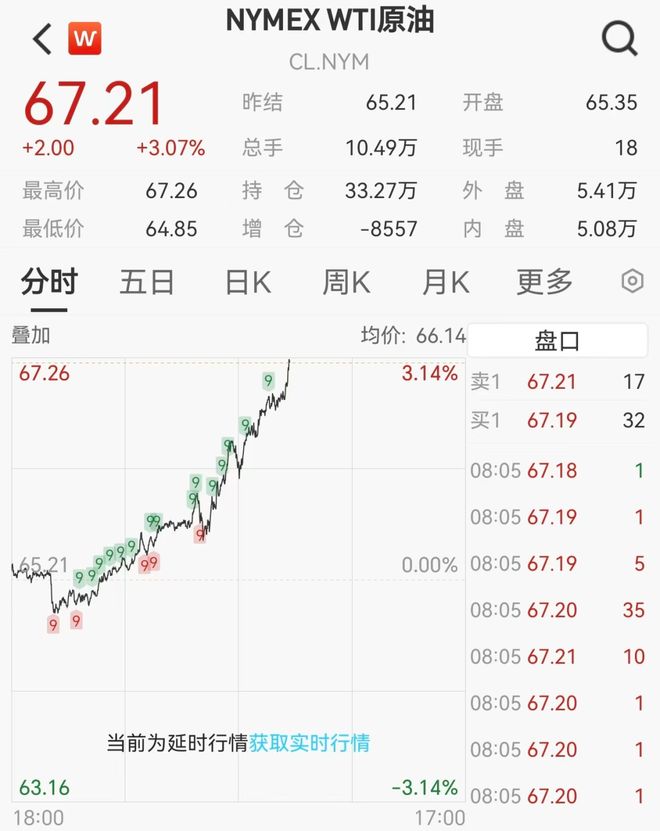
Core Viewpoint - International oil prices have seen a significant increase, with WTI and Brent crude oil rising over 3% as of February 27, indicating a strong market response to geopolitical tensions, particularly between the U.S. and Iran [1][7]. Oil Price Movements - As of February 27, WTI crude oil closed at $65.21, opening at $65.35, with a peak of $67.26 and a low of $64.85, reflecting a 3.07% increase [2]. - Domestic fuel futures also experienced a rise, with the main SC crude oil futures contract increasing by over 4% [1]. Geopolitical Influences - The current rise in oil prices is primarily driven by geopolitical tensions, particularly the escalating situation between the U.S. and Iran, which has led to a cumulative increase of approximately $10 per barrel for Brent crude [7]. - Analysts suggest that if a diplomatic agreement is reached between the U.S. and Iran, oil prices could see a significant decline [7]. Supply and Demand Dynamics - The oil market is facing a potential oversupply situation, with the International Energy Agency (IEA) projecting a surplus of 3.73 million barrels per day by 2026, which is about 4% of global demand [12]. - The U.S. Energy Information Administration (EIA) estimates a daily global supply surplus of 3.04 million barrels this year [12]. OPEC+ Production Decisions - OPEC+ is considering increasing oil production by 137,000 barrels per day in April, which could impact market dynamics and pricing as demand peaks in summer [8]. - The potential for increased production is linked to the recent rise in oil prices, which have surpassed the psychological thresholds for OPEC+ member countries [8]. Extreme Scenarios - In extreme scenarios, if tensions escalate and Iran disrupts the Strait of Hormuz, oil prices could surge, potentially exceeding $100 per barrel [10]. - However, global strategic oil reserves may mitigate the impact of supply disruptions, suggesting that a sustained price spike would require significant and prolonged supply interruptions [10].
一周热榜精选:美伊谈判后火药桶倒计时?“小作文”导致AI恐慌抛售
Jin Shi Shu Ju· 2026-02-27 14:37
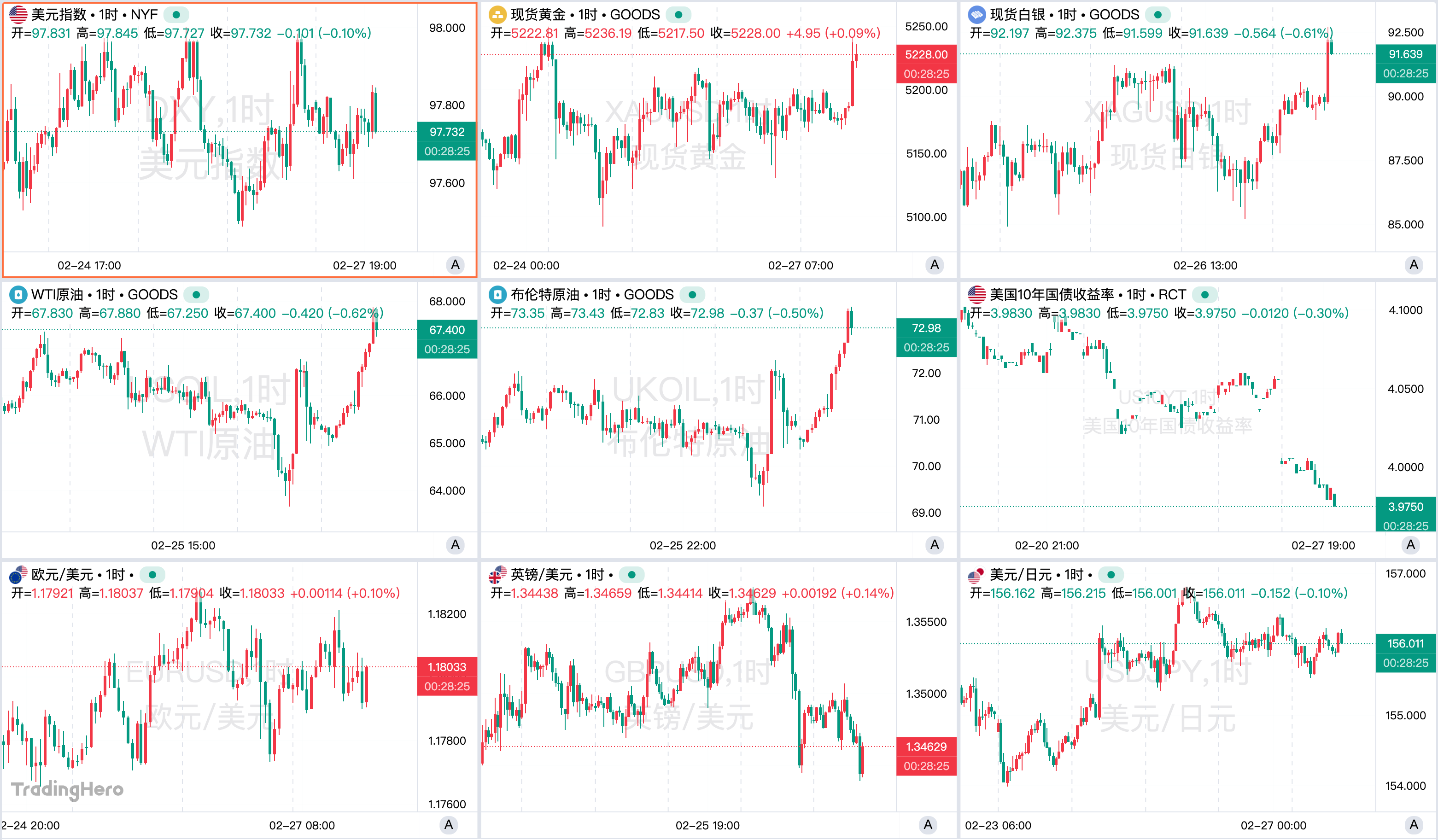
Market Overview - The US dollar index experienced fluctuations due to the Supreme Court's overturning of Trump's tariff policy and the introduction of new import taxes, leading to a lack of clear direction [1] - Gold prices saw a return above $5200, reaching a three-week high, but later dropped significantly due to profit-taking and a stabilizing dollar [1] - International oil prices faced pressure after a brief rise, influenced by positive developments in US-Iran negotiations and OPEC+ production expectations [1] Stock Market Movements - US stock markets showed significant volatility, with financial and software stocks leading declines due to AI concerns and tariff risks [2] - Tech stocks rebounded briefly on strong earnings expectations but faced renewed caution following Nvidia's earnings report, leading to increased sector rotation [2] Investment Bank Insights - UBS predicts gold prices may rise to $6200 in the coming months due to Fed rate cut expectations and geopolitical risks [5] - Morgan Stanley forecasts gold prices could reach $6300 per ounce by the end of 2026, while Goldman Sachs expects a gradual increase to $5400 by year-end [5] - Citigroup is bullish on copper prices, projecting a rise to $14,000 per ton in the next three months [5] Major Events - The US initiated the emergency evacuation of personnel from Israel amid escalating tensions, following significant diplomatic negotiations in Geneva involving multiple parties [6][7] - Trump's State of the Union address was the longest in history, focusing on economic performance and upcoming midterm elections, while criticizing Democrats [8][9] - The Supreme Court's ruling against Trump's tariff measures led to a shift in the administration's trade strategy, with new tariffs being implemented [10][11] Nvidia's Financial Performance - Nvidia reported record earnings for Q4 2026, with revenue of $68.127 billion, a 73% year-over-year increase, and net income of $42.96 billion, up 94% [12] - Despite strong earnings, Nvidia's stock saw a significant drop, reflecting market volatility and concerns over supply chain issues [13][14] Federal Reserve Policy Outlook - Market expectations for Fed rate cuts have shifted, with a decrease in the likelihood of cuts in June, reflecting a more cautious approach to monetary policy [15][16] - Fed officials expressed concerns about inflation and the labor market, indicating a reluctance to adjust policies hastily [15][16] Real Estate Developments - Shanghai introduced new housing policies aimed at meeting housing demand and stabilizing the market, effective February 26 [19] Zimbabwe's Lithium Export Suspension - Zimbabwe announced a suspension of all lithium ore and concentrate exports to strengthen mineral regulation, impacting several listed companies with operations in the region [20] Geopolitical Tensions - Pakistan's defense minister announced intentions to engage in open warfare against Afghanistan following border conflicts, escalating regional tensions [21] Meta and AMD Partnership - Meta entered a significant partnership with AMD for AI chip procurement, with a deal potentially worth between $60 billion and over $100 billion, highlighting the competitive landscape in AI infrastructure [22] Global Debt Trends - Global debt reached a record $348 trillion in 2025, driven primarily by government spending, with significant contributions from the US, China, and the Eurozone [23]