超市零售

Search documents
当选择只剩下“Yes” or “No”:看看我们如何被硬折扣“PUA”
3 6 Ke· 2025-08-22 01:52
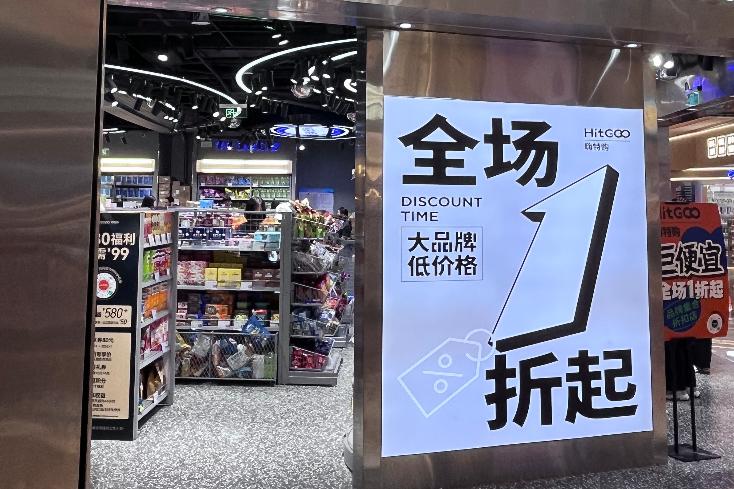
Core Viewpoint - The article discusses how discount stores manipulate consumer behavior through pricing strategies and store layouts, effectively transforming shoppers into efficient purchasing machines, while also raising questions about consumer autonomy in decision-making [4][5][16]. Group 1: Consumer Behavior Manipulation - Discount stores attract consumers with extreme low prices, creating a sense of trust and dependency [5]. - The use of cardboard shelves not only reduces operational costs but also creates a "warehouse" pressure that aligns with consumers' desire to save money during economic downturns [5][19]. - Consumers' shopping behavior is subtly influenced by store layouts, guiding them through a predetermined path that encourages quicker purchasing decisions [9][10]. Group 2: Limited Choices and Decision Simplification - Discount stores often limit the number of SKUs (Stock Keeping Units) to between 1,000 and 2,000, focusing on high-purchase-rate items, which reduces consumer choice and simplifies decision-making [10]. - The reduction in product variety leads to a phenomenon where 73% of consumers will opt for the cheapest available option when familiar brands are unavailable [10][15]. - Consumers experience increased indecision when returning to standard supermarkets, with hesitation times increasing by 2.8 times and a 37% decrease in price tolerance for non-discount items [15]. Group 3: Psychological Implications of Discount Shopping - The article questions whether the perceived self-discipline in frugal shopping is genuinely self-imposed or a result of external manipulation by discount stores [16]. - The hard discount model effectively recovers decision-making power from consumers while making them feel they are benefiting from the low prices [16][17]. - The article emphasizes that true freedom in consumer choice involves not just the content of purchases but also the breadth and quality of options available [19].


9月降息概率大降!美联储释放鹰派信号
Zheng Quan Shi Bao· 2025-08-22 00:17
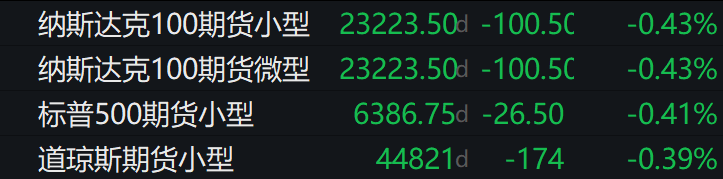
Market Overview - On August 21, U.S. stock indices collectively declined, with the S&P 500 down 0.4%, the Dow Jones down 0.34%, and the Nasdaq down 0.34%, marking five consecutive declines for the S&P 500 and three for the Nasdaq [1][5] - The market is focused on the upcoming Jackson Hole global central bank conference, where Federal Reserve Chairman Jerome Powell is expected to deliver a key speech regarding future monetary policy [2][3] Federal Reserve Insights - Federal Reserve officials, including Cleveland Fed President Loretta Mester, Atlanta Fed President Raphael Bostic, and Kansas City Fed President Esther George, have expressed cautious signals, emphasizing that monetary policy should rely on data and are not in a hurry to cut rates [2][3] - Mester stated that current inflation levels remain too high and have been on the rise over the past year, indicating no reason to lower rates at this time [2] - Bostic believes that the current federal funds rate target range of 4.25%-4.5% is slightly tight and acknowledges significant uncertainty regarding the need for rate cuts [3] Economic Indicators - According to S&P Global, the U.S. manufacturing PMI expanded at its fastest pace in over three years due to stronger demand, contributing to a composite PMI that reached its highest level of the year in August [2] - This expansion has intensified ongoing inflationary pressures, as companies are increasingly passing on rising costs to customers [2] Walmart Financial Performance - Walmart reported second-quarter revenue of $177.4 billion, exceeding analyst expectations of $176.16 billion, but adjusted earnings per share of $0.68 fell short of the expected $0.74, marking the first time in three years that profits did not meet expectations [6] - Walmart raised its full-year sales growth forecast to between 3.75% and 4.75%, up from the previous estimate of 3% to 4% [6] Chinese Stocks Performance - The Nasdaq Golden Dragon China Index rose by 1.35%, with notable gains in several Chinese companies such as XPeng Motors, which saw a nearly 12% increase, and NIO, which rose over 9% [7] - XPeng Motors reported a significant revenue increase of 125.3% year-over-year for Q2 2025, driven by a record high delivery volume of 103,200 vehicles, a 241.6% increase compared to the same period last year [7]


沃尔玛利润三年来首次逊于预期,称关税成本持续上升,上调全年销售指引
美股IPO· 2025-08-21 23:30
Core Viewpoint - Walmart's second-quarter earnings fell short of expectations for the first time in three years, primarily due to rising costs from tariffs, despite strong revenue growth and an optimistic outlook for future sales and earnings [1][3][7]. Financial Performance - Walmart reported second-quarter revenue of $177.4 billion, exceeding analyst expectations of $176.16 billion [4]. - Adjusted earnings per share were $0.68, below the expected $0.74, marking the first time in three years that earnings did not meet projections [5][12]. - The company raised its net sales growth forecast for fiscal 2026 from 3%-4% to 3.75%-4.75%, and slightly adjusted its earnings per share forecast to $2.52-$2.62 [6]. E-commerce Growth - Walmart's e-commerce sales grew by 25% globally and 26% in the U.S., with grocery and other product sales via store delivery increasing nearly 50% [10]. - The CEO highlighted that revenue growth is driven by innovation and execution, with a focus on enhancing digital experiences for customers [10]. Tariff Impact and Cost Management - The company is facing ongoing tariff pressures, which have led to increased costs. Walmart is managing these impacts on a product-by-product basis, absorbing some costs while passing others onto consumers [11]. - Approximately 50 products have seen price increases due to tariffs, including items like frying pans and jeans [11]. Membership Store Performance - Sam's Club reported same-store sales growth of 5.9%, surpassing analyst expectations of 5.2% [13]. - The net profit for Walmart in the second quarter rose to $7.03 billion, or $0.88 per share, significantly higher than the previous year's $4.5 billion or $0.56 per share [12].
永辉超市2025年中报简析:净利润同比下降187.38%
Zheng Quan Zhi Xing· 2025-08-21 22:32
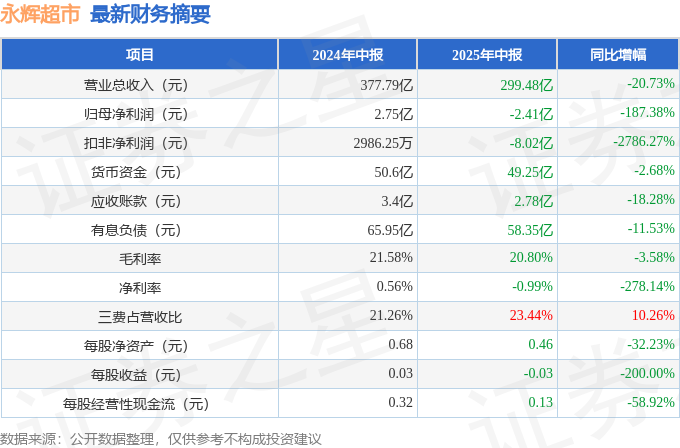
Core Viewpoint - Yonghui Supermarket (601933) reported a significant decline in financial performance for the first half of 2025, with a net profit drop of 187.38% and total revenue decreasing by 20.73% compared to the previous year [1] Financial Performance Summary - Total revenue for the first half of 2025 was 29.948 billion yuan, down 20.73% from 37.779 billion yuan in 2024 [1] - The net profit attributable to shareholders was -241 million yuan, a decrease of 187.38% from a profit of 275 million yuan in 2024 [1] - Gross margin fell to 20.8%, down 3.58% year-on-year, while net margin turned negative at -0.99%, a decline of 278.14% [1] - Total expenses (selling, administrative, and financial) reached 7.02 billion yuan, accounting for 23.44% of revenue, an increase of 10.26% year-on-year [1] - Earnings per share dropped to -0.03 yuan, a decrease of 200% compared to 0.03 yuan in 2024 [1] Key Financial Changes - Significant changes in financial items included a 64.92% decrease in trading financial assets due to the redemption of wealth management products [3] - Inventory decreased by 41.42% due to a reduction in store numbers and seasonal factors [3] - Long-term borrowings increased due to new borrowings, while lease liabilities decreased by 30.88% due to fewer stores [3] - The company closed 227 unprofitable stores, contributing to a 20.73% drop in revenue [4] Cash Flow Analysis - Net cash flow from operating activities decreased by 58.92%, attributed to declining revenue and gross profit [4] - Net cash flow from investing activities increased by 197.02% due to the recovery of wealth management products [4] - Net cash flow from financing activities saw a slight increase of 6.55% as rent payments decreased due to store closures [5] Business Model and Market Position - The company's historical return on invested capital (ROIC) has been weak, with a median of 4.95% over the past decade [6] - The business model relies heavily on marketing, necessitating a deeper analysis of the underlying drivers [6] - Analysts project a continued negative performance for 2025, with expected losses of 4.92 billion yuan and an average earnings per share of -0.06 yuan [6] Fund Holdings - Major funds holding Yonghui Supermarket shares have reduced their positions, indicating a lack of confidence in the company's recovery [7] - The largest fund, Jia Shi New Consumption Stock A, has a scale of 1.937 billion yuan and has seen a 13.68% increase in value over the past year [7]
京东折扣超市全国首店开业 引爆全城消费热情
Sou Hu Cai Jing· 2025-08-21 16:22
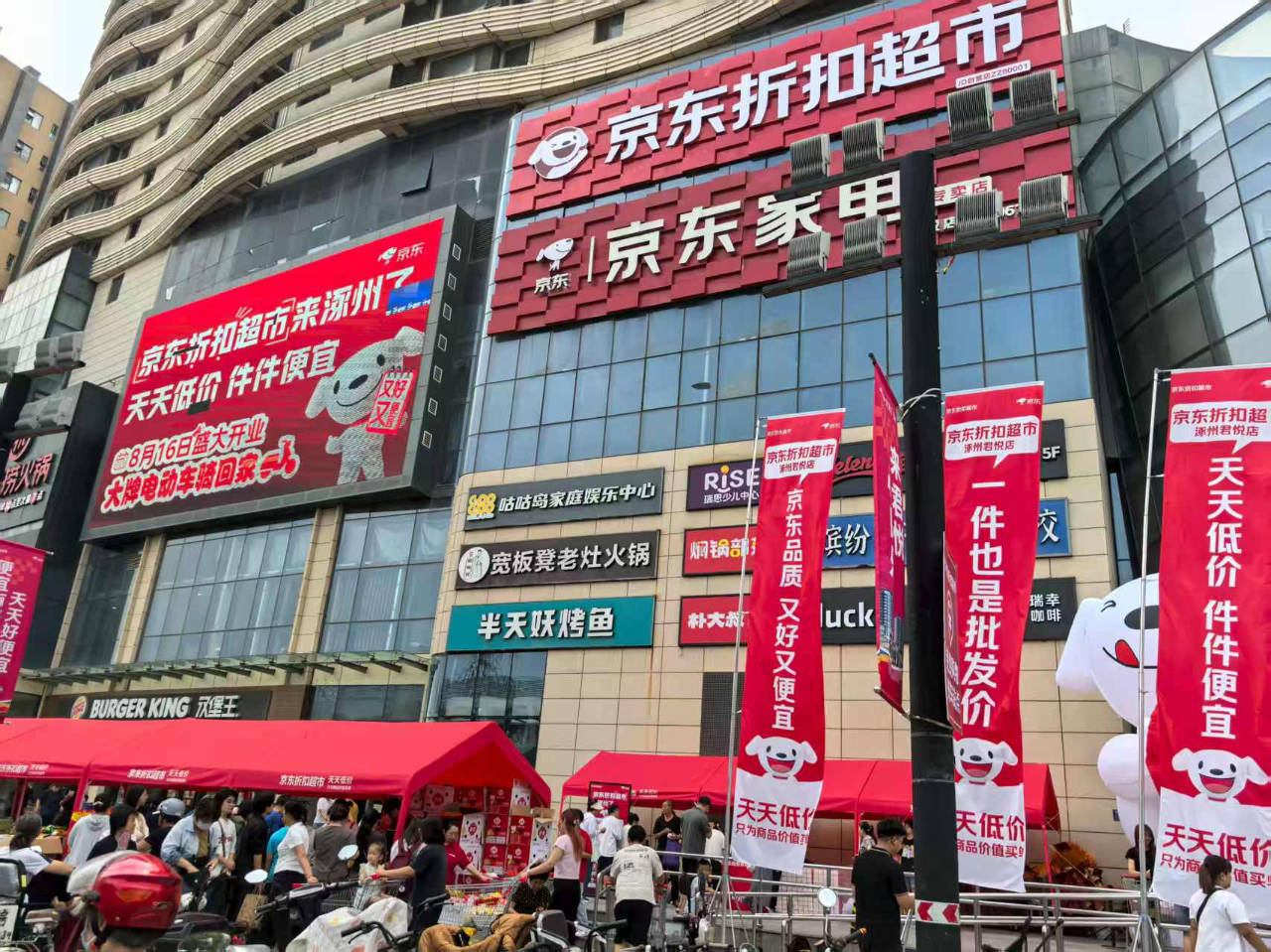
Core Insights - JD's discount supermarket opened its first store in Zhuozhou, Hebei, attracting nearly 60,000 visitors on the first day, which is about 1/10 of the local population [12][5][21] - The store features a wide range of affordable products, with prices such as 9.9 yuan for 30 eggs and 5.99 yuan per jin for fresh pork, appealing to cost-conscious consumers [8][9][21] - The supermarket emphasizes a sustainable low-price strategy, supported by JD's strong supply chain capabilities, allowing for consistent pricing below market rates [23][24][29] Customer Experience - The store spans over 5,000 square meters and offers more than 5,000 SKUs, providing a one-stop shopping experience for customers [15][20] - Customers reported satisfaction with the pricing and product variety, with many items prominently displayed at low prices [9][10][21] - The store implements a transparent shopping environment, with detailed price tags and product origins clearly marked [18][19] Operational Strategy - JD's discount supermarket leverages its supply chain efficiency to maintain long-term low prices, avoiding reliance on temporary promotions [23][25][29] - The store's location near a logistics hub enhances supply chain responsiveness and operational efficiency [23] - JD collaborates with brands to develop exclusive products, further reducing costs for consumers [23][26]

口岸经济4.0:罗湖建起深港互联“超级节点”|何以新罗湖
2 1 Shi Ji Jing Ji Bao Dao· 2025-08-21 15:52
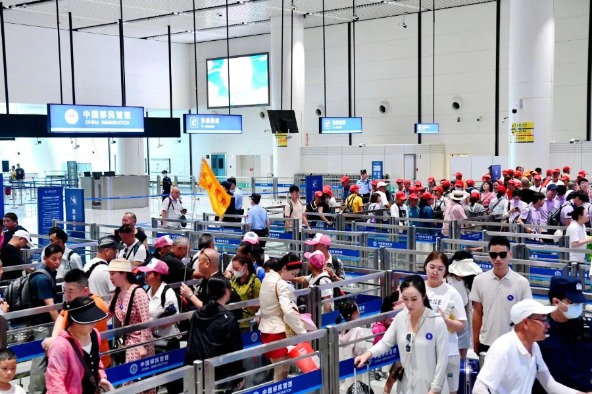
Core Insights - The article highlights the increasing cross-border flow of people between Hong Kong and Shenzhen, particularly through the Luohu and Liantang ports, which has led to new economic opportunities in the region [1][2][4] Group 1: Cross-Border Traffic and Economic Opportunities - In the first half of the year, over 33.7 million travelers passed through the Luohu port, making it the busiest port in Shenzhen [1] - The Luohu district is becoming a primary destination for Hong Kong residents, with approximately 30% of the overall foot traffic in local shopping centers coming from Hong Kong visitors [4] - The establishment of the "B1" land plot near Luohu port aims to create a 300,000 square meter health industry park, enhancing the region's industrial structure [2][12] Group 2: Consumer Behavior and Preferences - Hong Kong residents are expanding their consumption patterns in Shenzhen beyond dining to include shopping and healthcare services [4][6] - The newly opened Yitian Holiday Plaza has attracted Hong Kong customers with diverse dining options, accounting for 40% of its offerings [4] - The demand for high-quality shopping and family-friendly activities is growing among Hong Kong visitors, indicating a shift in their lifestyle preferences [6][8] Group 3: Healthcare Integration - The number of Hong Kong patients seeking medical services in Shenzhen has significantly increased, with an average of 4,500 Hong Kong patients visiting the Luohu District People's Hospital monthly [7][10] - A recent survey indicated that 60% of Hong Kong residents have utilized medical services in mainland China, a tenfold increase since 2011 [8] - The Luohu District People's Hospital has become a designated medical institution for cross-border drug and medical device use, facilitating quicker access to new treatments for patients [10][11] Group 4: Strategic Development and Collaboration - The development of the Northern Metropolis in Hong Kong aims to enhance economic collaboration with Shenzhen, focusing on trade, finance, and emerging industries [12][13] - The integration of industries between Hong Kong and Luohu is being actively promoted, with plans to establish a cross-border cooperation platform for traditional and Western medicine [10][16] - The ongoing upgrades of industrial zones and the establishment of a health industry park reflect a strategic alignment in industrial direction between Hong Kong and Luohu [14][16]
8月上海永辉“胖东来模式”调改再添三家首店,覆盖宝山、奉贤、松江
Sou Hu Cai Jing· 2025-08-21 15:52
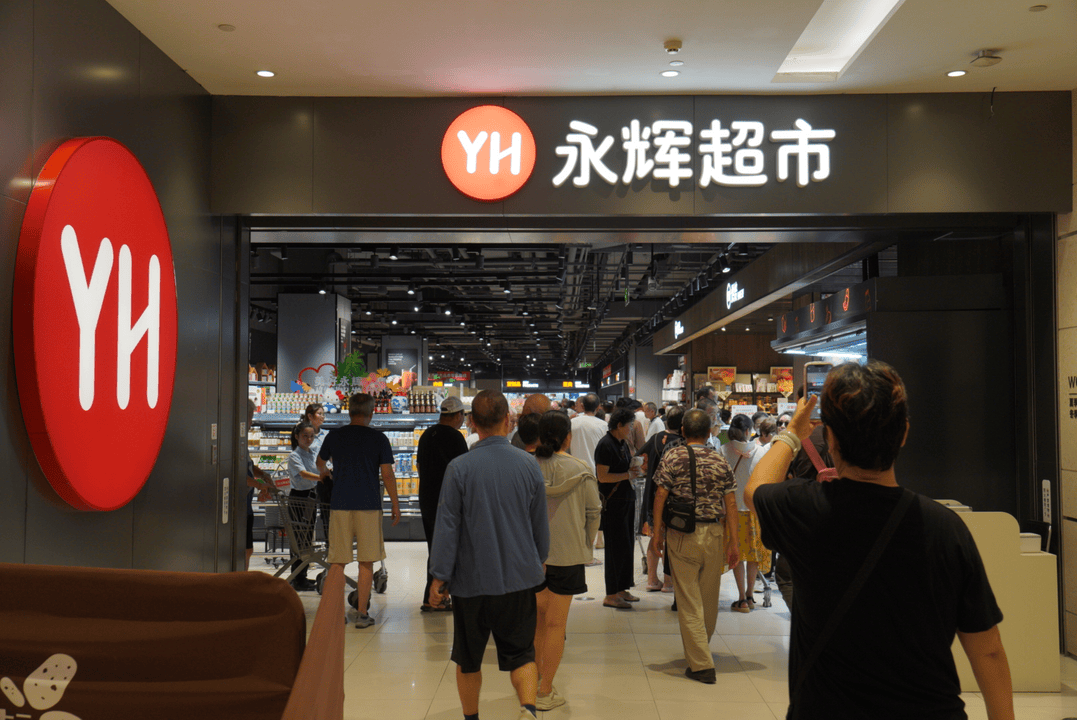
Core Insights - Yonghui Supermarket is continuing to implement the "Fat Donglai Model" in Shanghai, with three new stores set to open in August, increasing the total number of "Fat Yonghui" stores in the city to 10 [1][21] Store Openings - The three new stores are located in Baoshan, Fengxian, and Songjiang districts, with openings scheduled for August 21, 22, and 28 respectively [1] - The expansion aims to enhance service coverage in key areas such as Jinshan, Minhang, Pujiang, Qingpu, Baoshan, Fengxian, and Songjiang [1] Product Structure and Upgrades - The new stores have undergone significant upgrades, including a reduction in SKUs by nearly 80%, with the product structure now meeting 80% of the Fat Donglai standards [2][3] - The proportion of imported products has increased to 20% [2][3] Culinary Offerings - The new stores feature expanded bakery and deli sections, with a professional chef team preparing a variety of fresh dishes, including local specialties and popular items from Fat Donglai suppliers [5] - A diverse range of ready-to-eat options is available, catering to younger consumers [5] Private Label and Quality Products - The stores include a dedicated private label section showcasing high-quality products, including cooking oils, snacks, and household items, emphasizing value and quality [6] - New products, such as a microcapsule enzyme laundry detergent, have gained popularity among consumers [6] Seasonal Promotions - The stores are launching seasonal promotions featuring fresh produce from Xinjiang, with an expected procurement of over 10,000 tons of high-quality fruits [8][10] - The first batch of fresh seafood, including live crabs, is also being introduced, with a total procurement plan of approximately 1,300 tons [12][14] Customer Experience Enhancements - The redesigned stores focus on improving the shopping experience by optimizing layout and providing various customer conveniences, such as rest areas and specialized services [15][17] - Strict freshness management practices are in place, ensuring high-quality products are available [19] Employment and Community Impact - The opening of the three stores has created nearly 180 new jobs, reflecting Yonghui's commitment to community engagement and employee welfare [19][21]
永辉超市,半年闭店227家
2 1 Shi Ji Jing Ji Bao Dao· 2025-08-21 15:46
Core Viewpoint - Yonghui Supermarket continues to struggle despite ongoing store closures and adjustments, reporting significant revenue decline and net losses in the first half of 2025 [2][3][4]. Financial Performance - In the first half of 2025, Yonghui Supermarket achieved revenue of 29.948 billion yuan, a year-on-year decrease of 20.73%, with a net loss attributable to shareholders of 241 million yuan [3][5]. - The company has incurred total losses exceeding 9.5 billion yuan over the past four years, although the loss amount is showing signs of narrowing [4][5]. - The comprehensive gross margin for the reporting period was 20.80%, down 0.78% from the previous year [5]. Strategic Adjustments - The revenue decline is attributed to the company's deep strategic transformation initiated in the second half of 2024, which includes closing long-term loss-making stores and undergoing store adjustments [5][6]. - Yonghui Supermarket closed 227 loss-making stores during the reporting period, incurring costs related to leasing and employee compensation [5][6]. Management Outlook - The management remains pessimistic about the overall revenue for the year, expecting it to be lower than in 2024 due to the high number of store closures [6]. - However, they anticipate significant sales growth in the second half of the year as the remaining operational stores undergo steady transformation [6]. Online Business Performance - The online business generated revenue of 5.49 billion yuan, accounting for 18.33% of total revenue, but it still operates at a loss despite a reduction in losses compared to the previous year [6][7]. - The company is exploring various innovative models for its online channels, including an O2O (online-to-offline) model [6][7]. Store Transformation Efforts - Yonghui Supermarket is focusing on a transformation strategy inspired by the "Fat Donglai model," emphasizing quality retail [7][8]. - As of August 15, 2025, the company had completed adjustments on 160 stores, with plans to reach 200 by the end of September [7][8]. Market Perception - Analysts express skepticism about the effectiveness of Yonghui's transformation efforts, noting that while the company has adopted some successful strategies, it still lacks strong brand recognition compared to competitors [8][9]. - Following the release of the mid-year report, Yonghui's stock price fell to 4.93 yuan per share, reflecting market concerns [9].
沃尔玛中国2026财年第二季度净销售额同比增长30.1%
Cai Jing Wang· 2025-08-21 15:11
Core Insights - Walmart reported its Q2 results for the fiscal year 2026, showing total revenue of $177.4 billion, a year-over-year increase of 4.8% (5.6% growth when excluding currency fluctuations) [1] - Adjusted operating income for the second quarter was $8 billion, reflecting a 0.4% year-over-year growth [1] Revenue Performance - Walmart China achieved net sales of $5.8 billion in Q2, marking a significant year-over-year growth of 30.1% [1] - Comparable sales in Walmart China increased by 21.5%, while e-commerce net sales grew by 39%, with e-commerce sales accounting for over 50% of total sales [1] Membership and Store Expansion - Sam's Club continued to show strong growth, with double-digit growth in transaction volume [1] - Over the past 12 months, Sam's Club added 8 new stores, including 2 new stores in the current quarter [1] Profitability and Efficiency - The gross margin decreased due to changes in business mix, but strong sales growth, changes in business mix, and improved operational efficiency led to a decrease in operating expense ratio and an increase in operating profit [1]
滚动更新丨美股三大指数集体低开,小鹏汽车涨超5%
Di Yi Cai Jing· 2025-08-21 13:40
Group 1 - Major U.S. stock indices opened lower, with the Dow Jones down 0.4%, S&P 500 down 0.27%, and Nasdaq down 0.3% [2] - Walmart's stock fell over 3% after reporting Q2 earnings that missed expectations, with revenue of $177.4 billion, a year-on-year increase of 4.8%, and adjusted EPS of $0.68 [3] - Xpeng Motors' stock rose over 5%, supported by CEO He Xiaopeng's purchase of 3.1 million shares at an average price of HKD 80.49 [2][3] Group 2 - The U.S. initial jobless claims for the previous week were reported at 235,000, up from 224,000 [2] - The U.S. plans to impose tariffs of up to 15% on a range of EU goods, including automobiles, pharmaceuticals, semiconductors, and timber [2] - The EU will eliminate tariffs on all U.S. industrial goods and provide preferential market access for U.S. agricultural products [2]