
啤酒

Search documents
食品饮料行业周报:季报表现分化,关注经营质量-20251025
Shenwan Hongyuan Securities· 2025-10-25 15:04
Investment Rating - The report maintains a "Buy" rating for key companies in the food and beverage sector, particularly focusing on high dividend stocks and those with long-term competitive advantages [3][11][12]. Core Insights - The food and beverage industry is currently experiencing a mixed performance, with some high-growth companies like Dongpeng Beverage showing strong results, while overall demand remains subdued [3][7]. - The liquor sector, particularly high-end liquor, is expected to undergo a bottoming process, with inventory clearance taking longer than anticipated. The report suggests that stock price recovery may precede fundamental improvements [3][8]. - The report emphasizes the importance of identifying structural opportunities within food companies, recommending a focus on leading firms with strong dividend yields and growth potential [3][7]. Summary by Sections 1. Weekly Insights on Food and Beverage - The food and beverage sector saw a decline of 0.95% last week, underperforming the broader market by 3.83 percentage points [6]. - The liquor segment specifically faced a drop of 1.12%, with major brands like Moutai and Wuliangye experiencing price adjustments [6][8]. 2. Market Performance of Food and Beverage Sectors - The report indicates that various sub-sectors within food and beverage have underperformed relative to the benchmark index, with the liquor sector lagging by 4.60 percentage points [46]. 3. Key Company Updates - Yanjing Beer reported a total revenue of 13.43 billion yuan for the first three quarters of 2025, reflecting a year-on-year growth of 4.57% [11]. - Dongpeng Beverage achieved a revenue of 16.844 billion yuan in the first three quarters, marking a significant year-on-year increase of 34.93% [12]. - Jin Zai Foods reported a revenue of 1.808 billion yuan for the first three quarters, showing a modest growth of 2.05% [13]. 4. Liquor Sector Analysis - Moutai's bottle price is currently at 1730 yuan, down 20 yuan week-on-week, while Wuliangye remains stable at approximately 830 yuan [8][29]. - The report anticipates continued pressure on liquor sales leading into the 2026 Spring Festival due to high inventory levels and weak consumer demand [8]. 5. Consumer Goods Sector Insights - The report highlights the resilience of dairy companies like Yili, which are expected to benefit from declining costs and improving supply-demand dynamics [9]. - The snack and beverage segments are noted for their structural growth opportunities, with recommendations for companies like Unified Enterprises and Yanjing Beer [9].






净利润增长超37%,燕京啤酒靠什么?
和讯· 2025-10-25 02:52
Core Viewpoint - The beer industry in China is facing pressure from weak consumer demand, leading major companies to shift focus from volume growth to price increases and premium product offerings [2] Group 1: Industry Performance - In the first eight months of 2025, China's beer production from large enterprises was 26.83 million kiloliters, a slight decrease of 0.2% year-on-year [2] - Yanjing Beer reported a beer sales volume of 3.4952 million kiloliters from January to September 2025, a year-on-year increase of 1.39%, with revenue reaching 13.433 billion yuan, up 4.57% [3] - The company's net profit for the same period was 1.770 billion yuan, reflecting a significant year-on-year growth of 37.45% [3] Group 2: Company Financials - Yanjing Beer achieved a revenue of 4.875 billion yuan in Q3 2025, marking a 1.55% increase year-on-year, while net profit reached 668 million yuan, maintaining a robust growth rate of 26% [4] - Over the past five years, Yanjing Beer's revenue has increased from 10.928 billion yuan in 2020 to an estimated 14.667 billion yuan in 2024, with net profit soaring from 197 million yuan to 1.056 billion yuan during the same period [5] - The company has maintained revenue growth for four consecutive years since 2021, with net profit growth significantly outpacing revenue growth [6] Group 3: Product Strategy - Yanjing Beer has successfully implemented a big product strategy centered around Yanjing U8, which has seen sales grow from 90,000 tons to 900,000 tons over five years, becoming the company's first nationwide flagship product [10] - The U8 product line has contributed to an increase in the proportion of mid-to-high-end products, which now account for approximately 70% of the company's revenue [2][6] - The gross profit margin for the company reached 47.19% in the first three quarters of 2025, with Q3 gross margin at 50.15%, benefiting from the sales growth of mid-to-high-end products [6] Group 4: Market Positioning and Marketing - Yanjing U8 targets the 8-10 yuan price range, appealing to younger consumers and differentiating itself from competitors [8] - The company has engaged in various marketing strategies, including collaborations with popular celebrities and sponsoring events to enhance brand recognition among younger demographics [9] - Yanjing Beer has also focused on expanding its distribution channels, with traditional channels generating significant revenue while e-commerce channels have shown impressive growth [9] Group 5: Future Outlook - Yanjing Beer anticipates that its net profit for the first three quarters of 2025 will exceed the total for 2024, with expectations for annual revenue to surpass 15.2 billion yuan [7] - The company plans to replicate the success of U8 by developing a second flagship product, although it faces challenges in a more competitive market environment [11]


重庆啤酒股份有限公司 关于召开2025年第三季度业绩说明会的公告
Zhong Guo Zheng Quan Bao - Zhong Zheng Wang· 2025-10-24 21:02
Core Viewpoint - The company will hold an investor briefing on October 31, 2025, to discuss its Q3 2025 financial results and address investor inquiries [2][3][4]. Group 1: Meeting Details - The investor briefing is scheduled for October 31, 2025, from 09:45 to 11:15 [2][4]. - The location of the meeting is the Shanghai Stock Exchange Roadshow Center, which will be accessible via video live stream and online interaction [2][4]. - Investors can submit questions from October 24 to October 30, 2025, through the Roadshow Center website or via the company's email [2][5]. Group 2: Participants - Key participants in the briefing will include the President, CFO, and several board members, ensuring a comprehensive discussion of the company's performance [4][6]. Group 3: Investor Participation - Investors can join the briefing online on the specified date and time, with the company committed to addressing common questions during the session [4][5].

魏强调任,华润白酒战略陷“阵痛期”,下一个“三年”能否逆袭?
Sou Hu Cai Jing· 2025-10-24 16:49
Core Viewpoint - The appointment of Wei Qiang as CFO of China Resources Vanguard reflects the challenges faced by China Resources' dual strategy of "beer + liquor," indicating that the expected synergies have not materialized as anticipated [2] Group 1: Strategic Challenges - China Resources Beer has been a leader in the Chinese beer industry since 2006, holding over 30% market share, but the beer market's growth is plateauing, prompting the company to seek new growth avenues in the higher-margin liquor sector [6][7] - Despite initial successes in liquor investments, including significant acquisitions, the liquor segment has faced severe operational challenges, leading to a 33.7% year-on-year revenue decline in the first half of 2025, marking the first loss for the liquor division [7][8] Group 2: Management Changes - Recent months have seen significant management turnover within China Resources Beer, including the resignation of key executives and the appointment of new leadership, reflecting the strategic difficulties and the company's intent to drive change [9][10] - The frequent changes in leadership, particularly in the liquor segment, have raised concerns about the stability and continuity of strategic execution, complicating the integration of the liquor business [9][10] Group 3: Long-term Strategy - Despite current challenges, the liquor business is viewed as a strategic priority for China Resources, with a commitment to long-term development and a focus on building sustainable competitive advantages [12][14] - The company has outlined a "3+3" strategy for its liquor business, aiming to explore and strengthen its position in the first three years (2023-2025) and establish a unique business model in the subsequent three years (2026-2028) [14]


倒计时1天!2025东方热浪消费季暨青岛啤酒嘉年华等您赴约
Sou Hu Cai Jing· 2025-10-24 15:18
Core Points - The 2025 Dongfang Heat Wave Consumption Season and Qingdao Beer Carnival will officially kick off on October 25, lasting for 9 days, aimed at creating a vibrant consumption atmosphere for citizens and tourists during the autumn season [1] - The event will integrate local culture, coastal tourism, and economic consumption elements, featuring local specialties and transforming the venue into a "beer art space" for an immersive experience combining performances and beer [1][2] Event Highlights - The opening ceremony will include live performances from local bands, DJ shows, and a beer king competition, along with flash performances of musical segments, promoting a blend of beer and art [2] - A variety of local delicacies will be showcased during the beer festival, including signature dishes like Dongfang shrimp cakes, roasted suckling pig, and black goat, allowing visitors to enjoy authentic local flavors alongside refreshing beer [2] Consumer Engagement - The carnival will optimize the cultural tourism consumption model by allowing free entry for citizens and tourists, with various exclusive discounts from on-site food, retail, and cultural creative vendors, promoting mutual benefits among market participants [4] - The event is organized by CNR Cultural Media (Hainan) Co., Ltd., with guidance from local tourism and commerce authorities, and aims to enhance the cultural tourism industry as a pillar of economic value and social welfare for Dongfang [4]
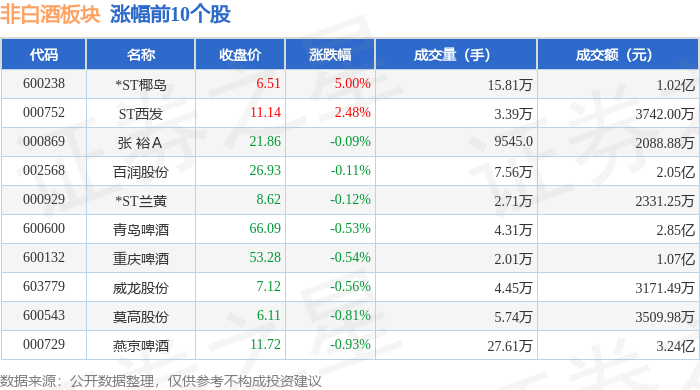
非白酒板块10月24日跌1.11%,珠江啤酒领跌,主力资金净流出6533.89万元
Zheng Xing Xing Ye Ri Bao· 2025-10-24 08:29
Market Overview - The non-liquor sector experienced a decline of 1.11% on the trading day, with Zhujiang Beer leading the drop [1] - The Shanghai Composite Index closed at 3950.31, up 0.71%, while the Shenzhen Component Index closed at 13289.18, up 2.02% [1] Stock Performance - Key stocks in the non-liquor sector showed varied performance, with *ST Yedao rising by 5.00% to a closing price of 6.51, while Zhujiang Beer fell by 5.23% to 9.61 [2] - Other notable movements included ST Xifa increasing by 2.48% and Zhangyu A slightly declining by 0.09% [2] Trading Volume and Value - The trading volume for *ST Yedao reached 158,100 shares, with a transaction value of 102 million yuan [2] - Zhujiang Beer had a trading volume of 236,000 shares and a transaction value of 228 million yuan [2] Capital Flow Analysis - The non-liquor sector saw a net outflow of 65.34 million yuan from main funds, while retail funds experienced a net outflow of 13.25 million yuan [2] - Speculative funds, however, recorded a net inflow of 78.59 million yuan [2] Individual Stock Capital Flow - *ST Yedao had a main fund net outflow of 21.99 million yuan, while speculative funds saw a net inflow of 8.97 million yuan [3] - Zhujiang Beer experienced a significant main fund net outflow of 21.99 million yuan, with retail funds also showing a net outflow [3]

国泰海通晨报-20251024
GUOTAI HAITONG SECURITIES· 2025-10-24 06:21
Group 1: OSL Group - OSL Group is currently the only publicly listed licensed virtual asset exchange in Asia, benefiting from a rare licensing barrier and diversified product expansion, which provides a first-mover advantage [1][3] - The company is expected to achieve profitability for the first time in 2024 since its strategic shift to the digital asset industry in 2018, with net profits projected to be -0.66/-0.12/0.20 million HKD for 2025-2027 [2][24] - OSL has obtained dual licenses from the Hong Kong Securities and Futures Commission (SFC) and Anti-Money Laundering Ordinance (AMLO), ensuring compliance and regulatory framework for its operations [3][25] - The company is accelerating global expansion through acquisitions in Japan and Europe, which is expected to drive significant revenue growth [3][25] - A strategic investment of up to 30 million USD in the PayFi ecosystem is planned to enhance payment services, which will be a key focus area for the company in the coming years [4][26] Group 2: Chengde Lululemon - Chengde Lululemon reported a significant revenue recovery in Q3, with a year-on-year growth of 8.91%, although the increase in sales expenses offset the gross margin expansion [5][6] - The company is focusing on the launch of new products, particularly the Lululemon plant-based health water series, which is expected to enhance brand competitiveness and capture market demand [7] - The market for traditional health water is projected to grow significantly, with an expected market size of 30 billion RMB in 2024, indicating a favorable environment for the company's new product line [7] Group 3: GCL Technology - GCL Technology's photovoltaic materials business turned profitable in Q3 2025, with an estimated profit of approximately 9.6 billion RMB, marking a significant recovery [8][34] - The company is expected to achieve net profits of -13.81/13.17/20.55 billion RMB for 2025-2027, reflecting a positive outlook for future profitability [8][34] - The company is benefiting from a reduction in competition and a focus on core business areas, which is expected to enhance its operational efficiency [8][34]




利好频出,吃喝板块却盘中跳水,“倒车接人”信号出现?机构坚定看好
Xin Lang Ji Jin· 2025-10-24 02:49
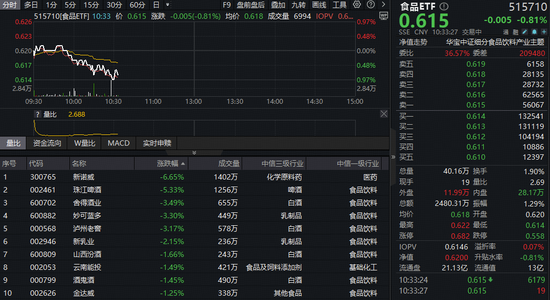
Group 1 - The food and beverage sector is experiencing a downturn, with the Food ETF (515710) down by 0.81% as of the latest report [1][2] - Key stocks in the sector, including Zhujiang Beer and Shede Liquor, have seen significant declines, with Zhujiang Beer dropping over 5% and several others falling more than 3% [1][3] - The overall market sentiment indicates a cautious outlook, with a focus on improving domestic consumption and investment as part of a broader economic strategy [1][3] Group 2 - Recent data shows a strong performance in the liquor industry, with Douyin's liquor sales up 58% month-on-month and JD's sales during the holiday period increasing by 109% year-on-year [3] - The white liquor sector is currently at a low valuation, with the Shennan White Liquor Index PE-TTM at a near 10-year low, suggesting potential for recovery [3][4] - The food and beverage sector is viewed as a good investment opportunity due to its low valuation, with the Food ETF's underlying index PE at 20.4 times, placing it in the lower 6.85% percentile over the past decade [3][4] Group 3 - Future outlook suggests that the white liquor sector is at a valuation bottom, with a recommendation to monitor Q3 earnings reports [4][5] - The food and beverage industry is expected to gradually improve, supported by macroeconomic policies and a recovering supply chain [5] - The Food ETF (515710) is highlighted as a core asset for investment, with a significant portion of its holdings in leading high-end liquor stocks and other beverage segments [5][6]


珠江啤酒股价跌5.03%,建信基金旗下1只基金重仓,持有1.19万股浮亏损失6069元
Xin Lang Cai Jing· 2025-10-24 02:21
10月24日,珠江啤酒跌5.03%,截至发稿,报9.63元/股,成交8212.40万元,换手率0.38%,总市值 213.14亿元。 资料显示,广州珠江啤酒股份有限公司位于广东省广州市海珠区新港东路磨碟沙大街118号,成立日期 2002年12月25日,上市日期2010年8月18日,公司主营业务涉及啤酒生产销售以及啤酒文化业务。主营 业务收入构成为:啤酒销售96.94%,其他1.15%,租赁餐饮服务等1.14%,酵母饲料销售0.64%,包装材 料0.13%。 从基金十大重仓股角度 数据显示,建信基金旗下1只基金重仓珠江啤酒。建信民丰回报定期开放混合(004413)二季度持有股 数1.19万股,占基金净值比例为0.25%,位居第九大重仓股。根据测算,今日浮亏损失约6069元。 张溢麟累计任职时间2年295天,现任基金资产总规模9.9亿元,任职期间最佳基金回报26.8%, 任职期 间最差基金回报-0.01%。 建信民丰回报定期开放混合(004413)成立日期2017年4月18日,最新规模5364.81万。今年以来收益 3.32%,同类排名7179/8154;近一年收益3.84%,同类排名7018/8025;成立以来 ...
珠江啤酒10月23日获融资买入108.10万元,融资余额1.99亿元
Xin Lang Cai Jing· 2025-10-24 01:41
Core Insights - On October 23, Zhujiang Beer experienced a 0.40% increase in stock price, with a trading volume of 50.01 million yuan [1] - As of September 30, Zhujiang Beer reported a revenue of 5.073 billion yuan for the first nine months of 2025, marking a year-on-year growth of 3.81%, and a net profit attributable to shareholders of 944 million yuan, reflecting a 17.05% increase [2] - The company has distributed a total of 2.164 billion yuan in dividends since its A-share listing, with 919 million yuan distributed over the past three years [3] Financing and Trading Activity - On October 23, Zhujiang Beer had a net financing outflow of 651.28 million yuan, with a total financing balance of 199 million yuan, representing 0.89% of its market capitalization [1] - The stock's financing balance is above the 80th percentile of the past year, indicating a high level of financing activity [1] - The short selling activity on the same day included the repayment of 400 shares and the sale of 500 shares, with a short selling balance of 4.45 million shares, which is below the 50th percentile of the past year [1] Shareholder Structure - As of September 30, the number of shareholders for Zhujiang Beer increased by 12.37% to 27,500, while the average number of circulating shares per shareholder decreased by 11.01% to 80,394 shares [2] - The top ten circulating shareholders include Hong Kong Central Clearing Limited and various ETFs, with notable increases in holdings from some institutional investors [3]