
光伏

Search documents
天合光能股份有限公司关于“天23转债”付息的公告
Shang Hai Zheng Quan Bao· 2026-02-05 18:38
Core Viewpoint - The announcement details the interest payment schedule for the convertible bonds issued by Trina Solar Limited, indicating the bond's interest rates and payment dates [2][4][9]. Group 1: Convertible Bond Issuance - Trina Solar issued 88,647,510 convertible bonds with a total fundraising amount of RMB 886,475,100, with a maturity period from February 13, 2023, to February 12, 2029 [2][3]. - The bond has a tiered interest rate structure: 0.30% for the first year, 0.50% for the second year, 1.00% for the third year, 1.50% for the fourth year, 1.80% for the fifth year, and 2.00% for the sixth year [2][3]. Group 2: Interest Payment Details - The interest payment for the third year will be calculated based on a rate of 1.00%, resulting in a payment of RMB 1.00 per bond (including tax) [9][10]. - The interest payment dates are set as follows: the bondholder registration date is February 12, 2026, the ex-dividend date is February 13, 2026, and the payment date is also February 13, 2026 [5][10]. Group 3: Tax Implications - Individual investors are subject to a 20% tax on interest income, resulting in a net payment of RMB 0.80 per bond after tax [13]. - Non-resident enterprises will be exempt from corporate income tax on the bond interest income from January 1, 2026, to December 31, 2027, allowing them to receive the full RMB 1.00 per bond [14].

国恩股份(002768.SZ):签署《光伏增产及海水资源提取集成项目》合作协议
Ge Long Hui· 2026-02-05 17:26
Core Viewpoint - The collaboration between Guoen Co., Ltd. and Hong Kong City University aims to enhance photovoltaic output and develop integrated seawater resource extraction technologies, indicating a strategic move towards innovation and resource optimization in the renewable energy sector [1][2]. Group 1: Project Overview - The partnership focuses on two main areas: "photovoltaic cooling enhancement" and "low-energy lithium extraction from seawater," both of which hold significant commercial potential [2]. - The photovoltaic cooling enhancement technology addresses the cooling challenges faced by solar panels in outdoor environments, particularly in coastal and arid regions, enabling synergistic benefits of "power generation + freshwater" [2]. - The project has progressed to the pilot testing stage after successful laboratory validation, showcasing the readiness for further development and commercialization [1]. Group 2: Technological Innovations - The innovative approach in lithium extraction involves the design of new composite adsorption materials that combine efficient photothermal conversion with selective ion recognition, addressing the technical bottlenecks in current photothermal materials [2]. - The development of a low-energy "photothermal-driven lithium extraction system" aims to provide a sustainable solution for the global supply of critical scarce resources, aligning with the growing demand in the new energy sector [2]. - The project emphasizes resource sharing and mutual benefits among the collaborating parties, fostering a collaborative environment for technological advancement [1].

中美一通关键电话,茅台暴涨,光伏涨停,热门科技赛道却凉了
Sou Hu Cai Jing· 2026-02-05 17:13
Market Overview - A significant phone call between US and Chinese leaders and a domestic industry association's urgent statement led to a notable market reaction on February 4, 2026, with the Shanghai Composite Index fluctuating but ultimately surpassing 4100 points [1] - Over 3200 stocks rose, with a median price increase of 0.44%, although the overall market capitalization did not reflect this rise for many investors [1] - Total trading volume in the Shanghai and Shenzhen markets was 2.48 trillion yuan, a decrease of 633 billion yuan from the previous trading day, indicating a decline in market activity [1] Sector Performance - The market showed a clear split in sector performance, with coal, photovoltaic, real estate, liquor, and high-dividend assets rising, while AI computing, commercial aerospace, consumer electronics, and robotics faced significant sell-offs [3] - The shift in funds was primarily driven by internal market dynamics rather than external interventions, with major ETFs like the SSE 50 and CSI 300 seeing trading volumes drop to levels seen in early January 2026 [3] Specific Stock Movements - Notable stocks such as Guizhou Moutai saw a 15% increase over five trading days, driven by strong sales data from its digital marketing platform [4][8] - The photovoltaic sector experienced a surge, with stocks like Zhonglai Co., JinkoSolar, and Runze New Energy hitting the daily limit of 20% increase, spurred by speculation about potential large-scale purchases by Elon Musk's team [6] - Conversely, AI application stocks faced declines following the cessation of a popular AI assistant's promotional activities on WeChat, leading to a reevaluation of the commercialization pace in this sector [8] Policy and International Context - The People's Bank of China emphasized support for expanding domestic demand and technological innovation, indicating a prioritization of consumer spending in the current phase [9] - Internationally, the Nasdaq is planning to introduce new rules to expedite the inclusion of major IPOs like SpaceX, reflecting competitive dynamics in the commercial aerospace sector [11] Investment Sentiment - The market's style shift revealed long-standing biases, such as the dismissal of the liquor industry as outdated, which may lead investors to miss out on recovery opportunities [13] - The significant outflow of funds from previously high-flying tech stocks indicates a decisive shift in investor sentiment as these stocks began to show signs of technical breakdown [13]


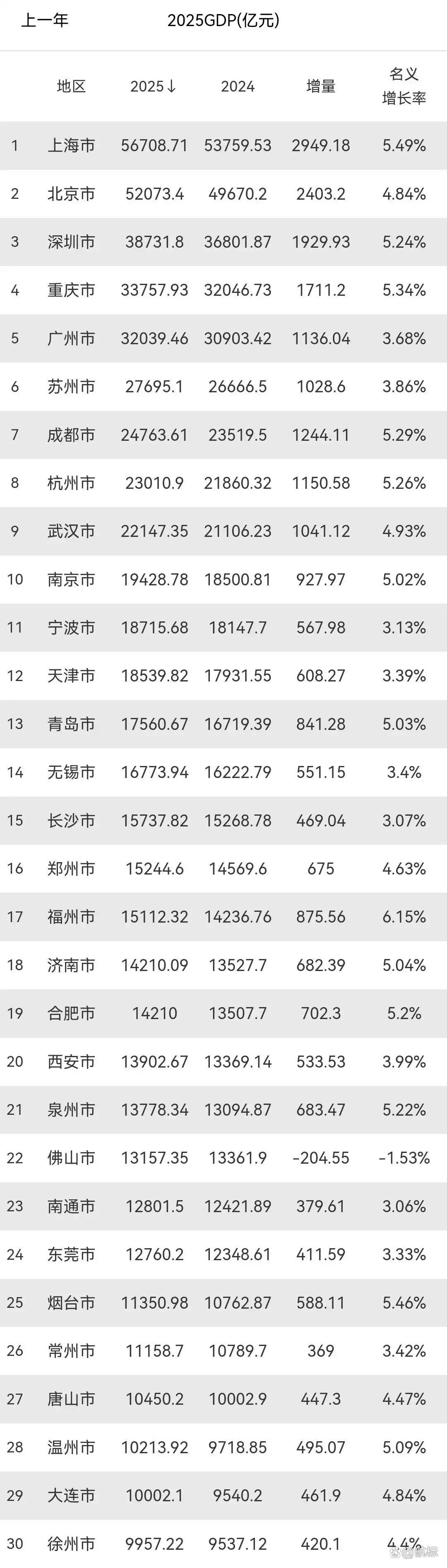
2025年GDP30强城市洗牌,成都远超杭州,郑州突破1.5万亿,泉州逆袭佛山,徐州入围!
Sou Hu Cai Jing· 2026-02-05 17:11
Core Insights - The annual city GDP rankings reflect a competitive landscape, showcasing both expected leaders and surprising "dark horses" in 2025, illustrating the distribution of economic vitality across different cities in China [1] Group 1: GDP Rankings and Growth Rates - Shanghai leads with a GDP of 56,708.71 billion yuan, showing a growth rate of 5.49% from the previous year [2] - Beijing follows with a GDP of 52,073.4 billion yuan and a growth rate of 4.84% [2] - Shenzhen ranks third with a GDP of 38,731.8 billion yuan, growing by 5.24% [2] - Chongqing and Guangzhou round out the top five, with GDPs of 33,757.93 billion yuan (5.34% growth) and 32,039.46 billion yuan (3.68% growth) respectively [2][3] Group 2: Economic Drivers and Trends - Shanghai's economic leadership is attributed to its strong focus on technology innovation, particularly in integrated circuits, biomedicine, and artificial intelligence, which together exceed 20 trillion yuan and account for nearly half of the city's industrial output [5] - Chengdu's GDP surpasses 24.7 trillion yuan, driven by a dual focus on consumption and industry, with retail sales exceeding 1.14 trillion yuan, contributing over half to its economic growth [7][8] - The transformation of traditional cities like Xuzhou into modern economic hubs, exemplified by its solar energy production, highlights successful industrial transitions [5] Group 3: Competitive Dynamics - The competition between Chengdu and Hangzhou illustrates different growth strategies, with Chengdu focusing on comprehensive development and Hangzhou emphasizing service industries, which constitute 73.8% of its GDP [7][8] - Zhengzhou's GDP surpassing 1.5 trillion yuan showcases its strategic advantage as a national central city, leveraging its transportation network to boost manufacturing and electronic information sectors [8] - The notable shift in rankings between Quanzhou and Foshan, with Quanzhou's diverse industrial base leading to a GDP of 13,778.34 billion yuan, emphasizes the importance of economic resilience and adaptability [8]
多家上市公司回应太空光伏相关业务布局
Zheng Quan Ri Bao· 2026-02-05 16:41
Core Viewpoint - The concept of "space photovoltaic" has gained significant attention in the capital market, leading to active performance of related stocks, although companies clarify their current lack of involvement in this area [1][2]. Group 1: Company Announcements - JinkoSolar announced that it experienced a stock price fluctuation with a cumulative increase of 30% over three trading days, but clarified that it has not engaged in any cooperation with Elon Musk's team or signed any agreements related to space photovoltaic [1][2]. - Guosheng Technology, Shuangliang Energy, and Gaoce Technology also issued announcements stating they do not currently engage in space photovoltaic business and have not signed any relevant agreements or generated related revenue [2]. Group 2: Technical Insights - Space photovoltaic technology is not merely an extension of ground photovoltaic systems; it involves significant differences in technology, cost, and application environments, with higher efficiency but also greater complexity and cost [3]. - The development of space photovoltaic technology is driven by the needs of commercial space development and artificial intelligence computing power, making it essential for low Earth orbit satellites and potential future space data centers [3]. Group 3: Future Outlook - The development of space photovoltaic technology is still in its early stages, with a conservative estimate of at least 10 years needed for large-scale application [4]. - With decreasing launch costs in commercial space and breakthroughs in battery technology, space photovoltaic is expected to gradually commercialize over the next 10 to 15 years [4].



“马斯克团队考察光伏产业链”,多家巨头回应
Nan Fang Du Shi Bao· 2026-02-05 16:21
Core Viewpoint - Recent market rumors indicate that Elon Musk's team has visited several Chinese photovoltaic companies to explore projects related to equipment, silicon wafers, and battery components, with a focus on heterojunction and perovskite technology routes. However, companies emphasize that no substantial cooperation has been established yet, and the concept of "space photovoltaics" remains in its early stages [1][2]. Industry and Company Responses - Multiple photovoltaic companies, including JinkoSolar, GCL-Poly, and TCL Zhonghuan, have confirmed meetings with Musk's team but clarified that no formal agreements or orders have been made. They stress that "space photovoltaics" is still in the exploratory phase and that their main business continues to focus on ground-based photovoltaic products [2][4]. - JinkoSolar specifically noted that the technology for "space photovoltaics" is still under preliminary exploration, and the industrialization process is influenced by various factors, including technological development and market conditions. The company has not seen any impact on its operational performance from this concept [2][4]. Market Performance - As of February 5, the photovoltaic sector in the A-share market showed weakness, with most stocks, including JinkoSolar and Jinglong Technology, experiencing significant declines after previous gains [3]. - Companies have issued warnings regarding performance risks due to the ongoing adjustment period in the photovoltaic industry. JinkoSolar anticipates a net loss of between 59 billion to 69 billion yuan for 2025, while other companies like Longi Green Energy and Tongwei Co. are also projecting substantial losses [5][6]. Future Outlook - Elon Musk has expressed optimism about space photovoltaics, citing its advantages in providing stable and lightweight power for large-scale satellite operations. He mentioned plans for SpaceX and Tesla to enhance solar energy production, aiming for an annual capacity of 100 GW within three years [8].



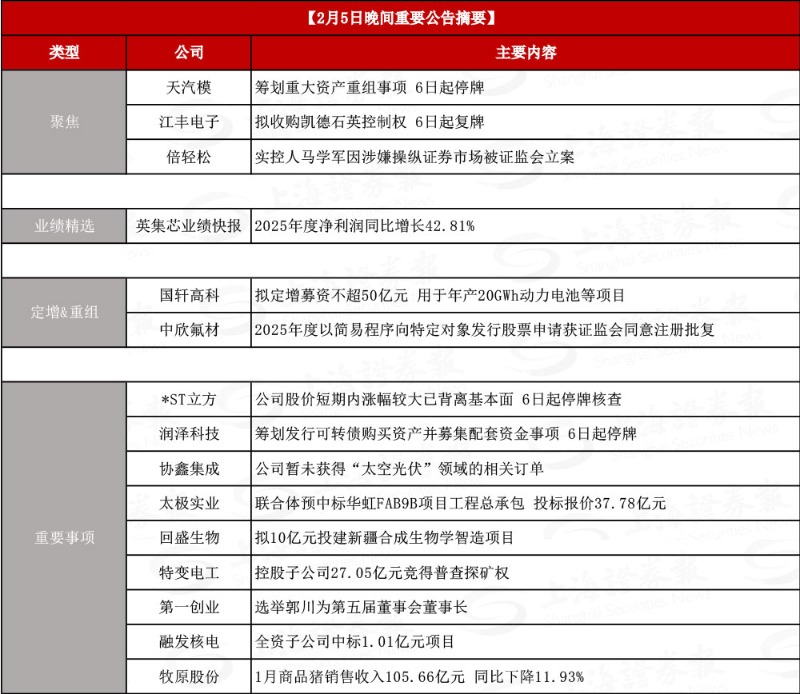
2月5日晚间重要公告 | 江丰电子:拟收购凯德石英控制权 6日起复牌
Shang Hai Zheng Quan Bao· 2026-02-05 15:57
Company Announcements - Tianqi Mould is planning a major asset restructuring and will be suspended from trading starting February 6 [1] - Jiangfeng Electronics intends to acquire control of Kaide Quartz for 591 million yuan, with trading resuming on February 6 [2][3] - Beikong Leisure's actual controller, Ma Xuejun, is under investigation by the China Securities Regulatory Commission for alleged market manipulation [4][5] Performance Highlights - In 2025, Yingjixin reported a total revenue of 1.611 billion yuan, a year-on-year increase of 12.65%, and a net profit of 177.44 million yuan, up 42.81% from the previous year [6] Capital Increase & Restructuring - Guoxuan High-Tech plans to raise no more than 5 billion yuan through a private placement to fund a 20GWh power battery project and other initiatives [7] - Zhongxin Fluorine Materials received approval from the CSRC for a simplified procedure to issue shares to specific investors in 2025 [7] Important Matters - Runze Technology is planning to issue convertible bonds to purchase assets and raise supporting funds, with trading suspended from February 6 [8] - ST Cube's stock price increased by 314.93% from January 20 to February 5, leading to a suspension for verification due to a significant deviation from its fundamentals [8] - Muyuan Foods reported a January sales revenue of 10.566 billion yuan from commodity pigs, a year-on-year decrease of 11.93% [8] Other Developments - GCL-Poly has not yet received any orders in the "space photovoltaic" sector, which remains in the exploratory stage [9] - Huizhou Energy achieved a power generation of 4.264 billion kWh in January, a year-on-year increase of 26.38% [10] - Taiji Industry's subsidiary is part of a consortium that has pre-qualified for a semiconductor project with a bid of 3.778 billion yuan [10][11]



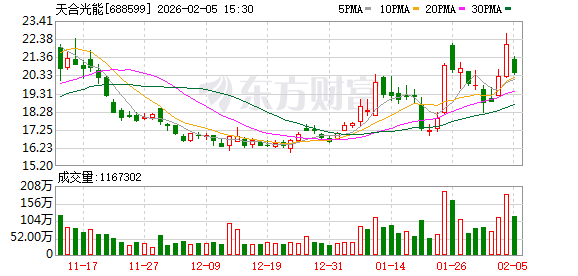
事关“太空光伏” 天合光能、协鑫集成回应
2 1 Shi Ji Jing Ji Bao Dao· 2026-02-05 15:41
Core Viewpoint - The recent visit of SpaceX to several Chinese photovoltaic companies led to a surge in the space photovoltaic concept stocks on February 4, but the momentum could not be sustained, resulting in a significant decline in the space photovoltaic index on February 5 [2][3]. Group 1: Market Performance - On February 5, the space photovoltaic index (8841929) dropped by 4.86%, closing at 3837.43, with notable declines in stocks such as JunDa Co., JinCheng Co., and Shuangliang Energy, which hit the daily limit down [2][3]. - Other companies like GaoCe Co., JieJia WeiChuang, MaiWei Co., JingSheng JiDian, and HaiYou New Materials saw declines exceeding 9%, while Trina Solar fell over 7% and JinkoSolar dropped over 6% [2][4]. Group 2: Company Announcements - Trina Solar announced that it has not engaged in any cooperation with SpaceX and has no related orders in the "space photovoltaic" sector, clarifying that its main products are focused on ground photovoltaic applications [5][6]. - GCL-Poly Energy stated that it has not received any orders in the "space photovoltaic" field and emphasized that the technology is still in the exploratory phase, with uncertain commercial prospects [8]. - JinkoSolar confirmed it has not collaborated with SpaceX and highlighted that the "space photovoltaic" concept remains in the early exploration stage [10]. - Other companies like Guosheng Technology, Shuangliang Energy, and JingSheng JiDian also reported no involvement in "space photovoltaic" business, reiterating the uncertainty surrounding the commercialization of this technology [11][12][13]. Group 3: Financial Forecasts - Trina Solar projected a net loss of between 6.5 billion to 7.5 billion yuan for the year 2025 [7]. - GCL-Poly Energy expects a net loss of between 890 million to 1.29 billion yuan for the same year [8].



王勃华:预计2026年中国光伏新增装机180GW—240GW
Xin Lang Cai Jing· 2026-02-05 15:06
Core Viewpoint - The Chinese photovoltaic industry is experiencing significant growth during the "14th Five-Year Plan" period, with cumulative new installed capacity being 4.5 times that of the "13th Five-Year Plan" period [1] Group 1: Market Growth Projections - The global average annual new photovoltaic installed capacity is projected to be between 725GW and 870GW during the "15th Five-Year Plan" period, while China's average annual new installed capacity is expected to be between 238GW and 287GW [1] - In 2026, global new photovoltaic installed capacity is forecasted to be between 500GW and 667GW, with China's new installed capacity expected to range from 180GW to 240GW [1] Group 2: Market Challenges - A decline in global new photovoltaic installed capacity is anticipated for the first time in 2026, primarily due to policy shifts and market saturation effects that are reducing investment activity [1] - Emerging markets are not expected to compensate for the decline in mature markets, leading to a slowdown in growth [1] - Global installed capacity is projected to recover growth no earlier than 2027, but the rate of increase is expected to slow down [1]
报告预计2026年中国光伏总发电能力将提高约25%
Zhong Guo Xin Wen Wang· 2026-02-05 14:42
Core Insights - The report predicts that by 2026, China's total photovoltaic (PV) generation capacity will increase by approximately 25% [1] - The global average annual operating hours for wind power is expected to be around 2310 hours in 2026, a slight decrease from 2025, while wind power capacity will increase by 6% [1] - The average annual operating hours for photovoltaic power globally is projected to be about 1340 hours in 2026, with a 25% increase in capacity due to installed growth [1] Summary by Category Renewable Energy Capacity - By the end of 2025, renewable energy installed capacity in China is expected to exceed 60% of the total energy mix [2] - Global renewable energy installations are anticipated to reach approximately 700 million kilowatts in 2025, representing a 20% increase from 2024 [2] Climate and Energy Integration - The integration of meteorological and energy systems is deemed crucial for energy security, especially in the context of climate change and the restructuring of energy systems [2] - The report highlights the urgent need for climate resource assessment and extreme disaster warning within the new energy landscape [2] Regional Insights - In China, the average annual operating hours for wind power is projected to be 2100 hours in 2026, slightly down from 2025, with a total generation capacity increase of about 2% [1] - The average annual operating hours for photovoltaic power in China is expected to remain stable at 1320 hours, with a projected capacity increase of 25% [1]