
医药生物

Search documents
11月投资策略及金股组合
Donghai Securities· 2025-10-31 14:00
Investment Strategy and Key Stock Portfolio - The "14th Five-Year Plan" is positioned as a critical phase for achieving socialist modernization, with an implied growth rate requirement of approximately 4.7% during this period. The focus is on high-quality development, emphasizing total factor productivity, resident consumption rates, and domestic demand [3][9] - The improvement in China-US relations is noted, with a meeting between the leaders on October 30 discussing economic cooperation and resulting in a consensus that includes the suspension of certain tariffs and export controls. This is expected to enhance risk appetite in the market [3][9] - There is a continued demand for stabilizing domestic demand in the fourth quarter, with a reported GDP growth rate of 5.2% in the first three quarters, making it feasible to meet the annual target of 5%. However, there are signs of slowing retail sales growth and negative fixed asset investment growth [10][11] - The Federal Reserve has continued its gradual interest rate cuts, with a clear end to quantitative tightening (QT) by December 1. This is seen as a move to maintain the Fed's independence and data-driven decision-making [10][11] Key Stock Recommendations - The report includes a selection of stocks across various industries, highlighting their potential based on current market conditions and company fundamentals. The recommended stocks include: - Hengli Petrochemical (600346.SH) in the petrochemical sector, with a focus on its resilience and dividend policy [12][13] - Satellite Chemical (002648.SZ) in basic chemicals, benefiting from its integrated supply chain and expected recovery in market demand [12][13] - Zhongsheng Pharmaceutical (002317.SZ) in the pharmaceutical sector, with a strong pipeline and expected revenue growth [12][13] - Kaili Medical (300633.SZ) in the medical sector, focusing on high-end product launches and market expansion [12][13] - Lihua Co., Ltd. (300761.SZ) in agriculture, benefiting from stable growth in poultry production [12][13] - Top Group (601689.SH) in the automotive sector, expected to benefit from its position as a key supplier to Tesla [12][13] - Zhaoyi Innovation (603986.SH) in electronics, with strong demand for semiconductor products [12][13] - Northern Huachuang (002371.SZ) in electronics, benefiting from the acceleration of domestic semiconductor production [12][13] - Anhui Heli (600761.SH) in machinery, focusing on global expansion and smart logistics [12][13] - Hengli Hydraulic (601100.SH) in machinery, benefiting from the recovery in the excavator industry [12][13] ETF Recommendations - The report also recommends several ETFs, including: - Huaxia SSE Sci-Tech Innovation Board 50 ETF (588000.OF) with a year-to-date growth rate of 47.13% [15] - E Fund CSI Artificial Intelligence Theme ETF (159819.OF) with a year-to-date growth rate of 69.58% [15] - Chemical ETF (159870.OF) with a year-to-date growth rate of 25.97% [15] - GF CSI Infrastructure Engineering ETF (516970.OF) with a year-to-date growth rate of 9.09% [15] - Southern CSI Nonferrous Metals ETF (512400.OF) with a year-to-date growth rate of 85.37% [15]





科技创新政策预期进一步提升,关注科创100ETF易方达(588210)、科创板50ETF(588080)等后续表现
Sou Hu Cai Jing· 2025-10-31 12:17
Group 1 - The technology sector showed mixed performance this week, with CPO, PCB, and memory chips experiencing a pullback, while batteries and software sectors performed strongly [1] - The STAR 100 Index increased by 0.7%, while the STAR Growth Index and STAR Composite Index both decreased by 0.7%, and the STAR 50 Index fell by 3.2% [2] - The "14th Five-Year Plan" emphasizes strengthening original innovation and tackling key core technologies, aiming for decisive breakthroughs in critical areas such as integrated circuits, high-end equipment, and advanced materials [1] Group 2 - According to Cinda Securities, the policy content of the "14th Five-Year Plan" highlights the priority of building a modern industrial system, with a focus on technological innovation and new productivity as key development directions [1] - The expectations for domestic substitution, expanding domestic demand, and national defense security are likely to increase, potentially catalyzing the end of market fluctuations and leading to an upward trend in indices [1]

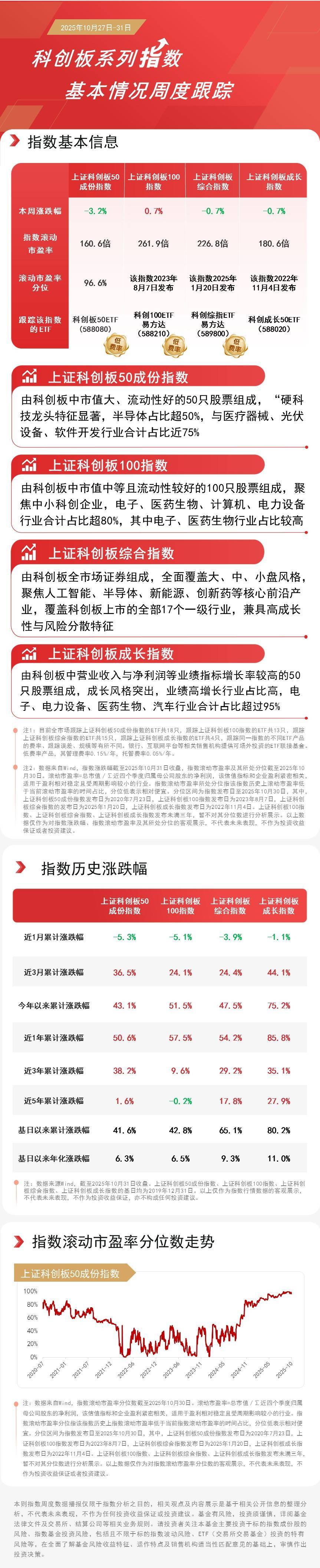
【31日资金路线图】医药生物板块净流入155亿元居首 龙虎榜机构抢筹多股
Zheng Quan Shi Bao· 2025-10-31 11:53
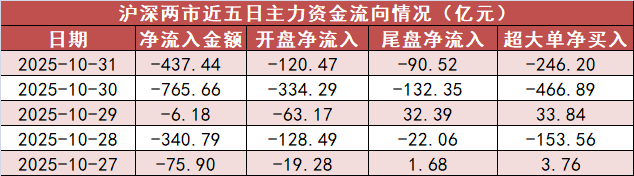
Market Overview - The A-share market experienced an overall decline on October 31, with the Shanghai Composite Index closing at 3954.79 points, down 0.81%, the Shenzhen Component Index at 13378.21 points, down 1.14%, and the ChiNext Index at 3187.53 points, down 2.31%. The North Star 50 Index increased by 1.89% [1] - Total trading volume in the A-share market was 23501.16 billion, a decrease of 1144.6 billion compared to the previous trading day [1] Capital Flow - The main capital outflow from the A-share market was 437.44 billion, with an opening net outflow of 120.47 billion and a closing net outflow of 90.52 billion [2] - The CSI 300 index saw a net outflow of 255.4 billion, while the ChiNext and STAR Market experienced net outflows of 162.56 billion and 57.19 billion, respectively [4] Sector Performance - The pharmaceutical and biotechnology sector led with a net inflow of 155.42 billion, marking a 2.72% increase [6][7] - Other sectors with significant inflows included media (96.02 billion, up 2.98%), computer (92.13 billion, up 1.81%), food and beverage (38.11 billion, up 1.49%), and retail (25.35 billion, up 1.55%) [7] - Conversely, the electronics sector faced the largest outflow at 278.68 billion, down 0.73%, followed by non-ferrous metals at 128.48 billion, down 1.03% [7] Institutional Activity - Oriental Precision Engineering saw the highest net inflow of 12.45 billion [8] - Institutions were active in several stocks, with notable net purchases in Zejing Pharmaceutical (206.78 million) and Shutai Shen (198.10 million) [10][11] Stock Recommendations - Recent institutional focus includes China Life Insurance with a target price of 10.40, indicating a potential upside of 23.22% from the latest closing price [12] - Other stocks with buy ratings include Shanghai Bank (target price 12.02, upside 26.66%) and Yuyue Medical (target price 45.47, upside 26.20%) [12]
【中国银河固收】转债策略更新 | 权益市场震荡冲高,风格切回稳健低波
Xin Lang Cai Jing· 2025-10-31 11:37
Core Insights - The report highlights the performance of three investment strategies: Low Price Enhancement, Improved Dual Low, and High Price High Elasticity, which recorded returns of 1.3%, 0.5%, and 0.7% respectively during the last period, outperforming the benchmark return of 0.3% [1] - Year-to-date, these strategies have achieved returns of 17.4%, 28.2%, and 52.2%, with cumulative excess returns of 0.3%, 11.2%, and 35.2% compared to the benchmark return of 17.0% [1] - The equity market experienced fluctuations, with the Wind All A and CSI Convertible Bonds rising by 1.5% and 0.3% respectively, indicating a resurgence of low volatility strategies [1] Low Price Enhancement Strategy - The latest holdings include new entries such as Jinggong Convertible Bond (Construction Decoration), Shangyin Convertible Bond (Bank), and Yangfeng Convertible Bond (Basic Chemicals) among others [2] - The adjustment rationale is based on the strong performance of the low price index (1.4%) and the resurgence of low volatility strategies, with a focus on stable or improving performance and reasonable premium rates [3] Improved Dual Low Strategy - The latest holdings feature new entries like Shangyin Convertible Bond (Bank) and Zhonghuan Convertible Bond (Environmental Protection) [4] - Adjustments were made due to the upward movement of the dual low index (0.4%), with a focus on stocks with improved performance or stable operations while avoiding those with high redemption progress [5] High Price High Elasticity Strategy - The latest holdings include new entries such as Wankai Convertible Bond (Basic Chemicals) and Shuiyang Convertible Bond (Beauty Care) [6] - The strategy's adjustments were influenced by the decline in high price index returns (-1.5%) and the need to manage redemption risks while maintaining a balanced industry allocation [7]

主力资金动向 44.94亿元潜入医药生物业
Zheng Quan Shi Bao Wang· 2025-10-31 11:20
证券时报·数据宝统计,今日有13个行业主力资金净流入,18个行业主力资金净流出。资金净流入金额 最大的行业为医药生物,涨跌幅2.42%,整体换手率2.59%,成交量较前一个交易日变动22.51%,主力 资金净流量44.94亿元;今日资金净流出最大的行业为电子,涨跌幅-3.06%,整体换手率3.22%,成交量 较前一个交易日变动-12.46%,主力资金净流量-287.62亿元。(数据宝) 今日各行业主力资金流向一览 | 行业名 | 成交量(亿 | 成交量较昨日增减 | 换手率 | 涨跌幅 | 今日主力资金净流入(亿 | | --- | --- | --- | --- | --- | --- | | 称 | 股) | (%) | (%) | (%) | 元) | | 医药生 物 | 70.89 | 22.51 | 2.59 | 2.42 | 44.94 | | 传媒 | 62.49 | 43.96 | 4.25 | 2.39 | 40.29 | | 食品饮 料 | 14.22 | 4.56 | 1.54 | 0.81 | 13.64 | | 商贸零 售 | 28.61 | 16.93 | 2.37 | 2.08 ...
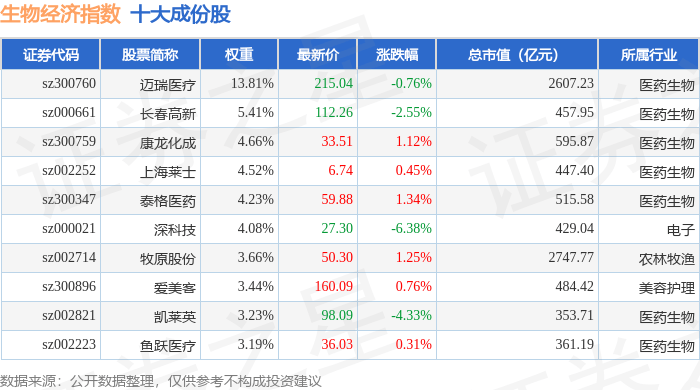
10月31日生物经济(970038)指数涨0.77%,成份股华兰疫苗(301207)领涨
Sou Hu Cai Jing· 2025-10-31 10:51
Core Insights - The Biotech Index (970038) closed at 2279.35 points, up 0.77%, with a trading volume of 28.709 billion yuan and a turnover rate of 1.85% [1] - Among the index constituents, 41 stocks rose, with Hualan Vaccine leading at a 17.88% increase, while 8 stocks fell, with Deep Technology leading the decline at 6.38% [1] Index Performance - The Biotech Index saw a net inflow of 140 million yuan from institutional investors, while retail investors contributed a net inflow of 210 million yuan, and there was a net outflow of 350 million yuan from speculative funds [1] Top Constituents - The top ten constituents of the Biotech Index include: - Mindray Medical (sz300760) with a weight of 13.81%, latest price at 215.04, and a decrease of 0.76% [1] - Changchun High-tech (sz000661) with a weight of 5.41%, latest price at 112.26, and a decrease of 2.55% [1] - Kanglong Chemical (sz300759) with a weight of 4.66%, latest price at 33.51, and an increase of 1.12% [1] - Other notable constituents include Muyuans (sz002714) and Aimeike (sz300896) with respective weights of 3.66% and 3.44% [1] Capital Flow Details - Detailed capital flow for key stocks includes: - Mindray Medical saw a net inflow of 26.2 million yuan from institutional investors [2] - Muyuans had a net inflow of 203 million yuan from institutional investors [2] - Hualan Vaccine experienced a net inflow of 74.8 million yuan from institutional investors [2]





10月31日深证国企ESG(970055)指数跌1.17%,成份股中钨高新(000657)领跌
Sou Hu Cai Jing· 2025-10-31 10:51
Core Points - The Shenzhen State-owned Enterprise ESG Index (970055) closed at 1397.41 points, down 1.17%, with a trading volume of 45.284 billion yuan and a turnover rate of 1.32% [1] - Among the index constituents, 19 stocks rose while 30 stocks fell, with Mango Excellent Media leading the gainers at 3.67% and China Tungsten High-tech leading the decliners at 10.0% [1] Index Constituents Summary - The top ten constituents of the Shenzhen State-owned Enterprise ESG Index include Hikvision, BOE Technology Group, Wuliangye Yibin, Inspur Information, Weichai Power, AVIC Optoelectronics, Shenwan Hongyuan, Yun Aluminum, Changchun High-tech, and China Merchants Shekou [1] - Hikvision holds a weight of 9.64% with a latest price of 32.87 yuan, down 1.05% [1] - BOE Technology Group has a weight of 9.31% with a latest price of 4.06 yuan, down 0.73% [1] - Wuliangye Yibin has a weight of 8.62% with a latest price of 66.81 yuan, up 0.44% [1] - Inspur Information has a weight of 7.30% with a latest price of 65.23 yuan, down 5.97% [1] - Weichai Power has a weight of 6.78% with a latest price of 14.96 yuan, up 3.60% [1] - AVIC Optoelectronics has a weight of 4.48% with a latest price of 35.10 yuan, down 0.23% [1] - Shenwan Hongyuan has a weight of 4.14% with a latest price of 5.47 yuan, up 0.37% [1] - Yun Aluminum has a weight of 4.08% with a latest price of 22.99 yuan, down 2.50% [1] - Changchun High-tech has a weight of 3.73% with a latest price of 112.26 yuan, down 2.55% [1] - China Merchants Shekou has a weight of 3.31% with a latest price of 9.45 yuan, up 1.61% [1] Capital Flow Analysis - The index constituents experienced a net outflow of 3.372 billion yuan from institutional investors, while retail investors saw a net inflow of 2.508 billion yuan [1] - Notable net inflows from retail investors were observed in Wuliangye Yibin, Weichai Power, and Mango Excellent Media, while significant outflows were noted in Hikvision and China Merchants Shekou [2]






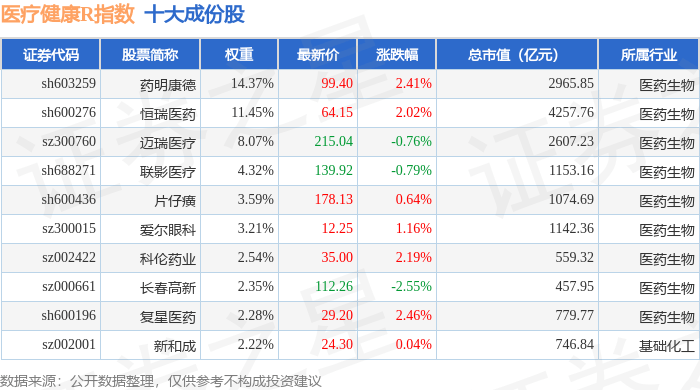
10月31日医疗健康R(480016)指数涨1.68%,成份股泽璟制药(688266)领涨
Sou Hu Cai Jing· 2025-10-31 10:51
Core Points - The Medical Health R Index (480016) closed at 7755.61 points, up 1.68%, with a total transaction volume of 40.103 billion yuan and a turnover rate of 1.25% [1] - Among the index constituents, 43 stocks rose, with Zai Jian Pharmaceutical leading with a 16.14% increase, while 6 stocks fell, with Kailai Ying leading the decline at 4.33% [1] Index Constituents Summary - The top ten constituents of the Medical Health R Index include: - WuXi AppTec (603259) with a weight of 14.37%, latest price at 99.40 yuan, and a 2.41% increase, total market value of 296.585 billion yuan [1] - Hengrui Medicine (600276) with a weight of 11.45%, latest price at 64.15 yuan, and a 2.02% increase, total market value of 425.776 billion yuan [1] - Mindray Medical (300760) with a weight of 8.07%, latest price at 215.04 yuan, and a 0.76% decrease, total market value of 260.723 billion yuan [1] - United Imaging Healthcare (688271) with a weight of 4.32%, latest price at 139.92 yuan, and a 0.79% decrease, total market value of 115.316 billion yuan [1] - Pianzai Shou (600436) with a weight of 3.59%, latest price at 178.13 yuan, and a 0.64% increase, total market value of 107.469 billion yuan [1] - Aier Eye Hospital (300015) with a weight of 3.21%, latest price at 12.25 yuan, and a 1.16% increase, total market value of 114.236 billion yuan [1] - Kelun Pharmaceutical (002422) with a weight of 2.54%, latest price at 35.00 yuan, and a 2.19% increase, total market value of 55.932 billion yuan [1] - Changchun High-tech (000661) with a weight of 2.35%, latest price at 112.26 yuan, and a 2.55% decrease, total market value of 45.795 billion yuan [1] - Fosun Pharma (600196) with a weight of 2.28%, latest price at 29.20 yuan, and a 2.46% increase, total market value of 77.977 billion yuan [1] - New Hope Liuhe (002001) with a weight of 2.22%, latest price at 24.30 yuan, and a 0.04% increase, total market value of 74.684 billion yuan [1] Capital Flow Summary - The net inflow of main funds into the Medical Health R Index constituents totaled 406 million yuan, while speculative funds saw a net outflow of 644 million yuan, and retail investors had a net inflow of 237 million yuan [1] - Specific capital flow details for key stocks include: - Mindray Medical (300760) with a main fund net inflow of 262 million yuan and a speculative fund net outflow of 127 million yuan [2] - BeiGene (688235) with a main fund net inflow of 233 million yuan and a speculative fund net outflow of 225 million yuan [2] - Haizhi Pharmaceutical (002653) with a main fund net inflow of 92.778 million yuan and a retail net outflow of 95.916 million yuan [2] - New Hope Liuhe (002001) with a main fund net inflow of 90.378 million yuan and a speculative fund net outflow of 43.538 million yuan [2] - Renfu Pharmaceutical (600079) with a main fund net inflow of 71.683 million yuan and a speculative fund net outflow of 41.302 million yuan [2]





特宝生物(688278):营收高增,派格宾渗透率有望加速提升
Orient Securities· 2025-10-31 10:34
Investment Rating - The report maintains a "Buy" rating for the company with a target price of 92.05 CNY, based on a 35x PE valuation for 2025 [3][6]. Core Insights - The company's revenue continues to grow significantly, with a 26.9% year-on-year increase in the first three quarters of 2025, reaching 2.48 billion CNY, while the net profit attributable to the parent company increased by 20.2% to 670 million CNY [9]. - The approval of a new indication for the core product, Paigebin, is expected to enhance its market penetration, as it is now recognized as a key drug for achieving functional cure in chronic hepatitis B patients [9]. - The consolidation of Jiutian Cayman into the company's financials has led to a slight increase in R&D and sales expenses, impacting profitability in the short term [9]. Financial Performance Summary - Revenue projections for 2025-2027 are 3.63 billion CNY, 4.88 billion CNY, and 6.23 billion CNY, respectively, with year-on-year growth rates of 29.0%, 34.3%, and 27.7% [5]. - The net profit attributable to the parent company is forecasted to be 1.07 billion CNY in 2025, with a growth rate of 29.6% [5]. - The company’s gross margin is expected to remain stable around 93.3% to 93.7% over the forecast period [5].

两市主力资金净流出629.03亿元,电子行业净流出居首
Zheng Quan Shi Bao Wang· 2025-10-31 10:08
10月31日,沪指下跌0.81%,深成指下跌1.14%,创业板指下跌2.31%,沪深300指数下跌1.47%。可交易 A股中,上涨的有3760只,占比69.22%,下跌的1553只。 今日各行业资金流向 | 行业 | 日涨跌幅(%) | 资金流向(亿元) | 行业 | 日涨跌幅(%) | 资金流向(亿元) | | --- | --- | --- | --- | --- | --- | | 医药生物 | 2.42 | 44.94 | 轻工制造 | 1.00 | -2.83 | | 传媒 | 2.39 | 40.29 | 煤炭 | -0.93 | -5.31 | | 食品饮料 | 0.81 | 13.64 | 汽车 | 0.56 | -6.59 | | 商贸零售 | 2.08 | 8.01 | 公用事业 | -1.22 | -7.31 | | 建筑材料 | 0.70 | 5.70 | 交通运输 | -0.48 | -8.42 | | 农林牧渔 | 0.97 | 4.58 | 钢铁 | -0.16 | -10.77 | | 社会服务 | 1.74 | 2.55 | 机械设备 | -0.32 | -12.77 | | ...