
软件

Search documents
中国“学历”最高的省会,史诗级出圈
3 6 Ke· 2025-12-11 03:07
Core Viewpoint - The recent popularity of the "Su Chao" event in Nanjing has transformed the city's image from a historically quiet capital to a vibrant and engaging urban center, showcasing its unique spirit and marketing potential [1][11][17]. Group 1: City Marketing and Image Transformation - The "Su Chao" event serves as an unprecedented form of city marketing, reflecting a collective and playful spirit that resonates with both locals and visitors [1][11]. - Nanjing's transformation is characterized by a shift from a "quiet and reserved" image to one that is "relaxed and interesting," enhancing its appeal as a modern urban center [1][17]. - The event has allowed for the desensitization of previously sensitive local terms, fostering a sense of community and connection among residents [10][11]. Group 2: Talent and Economic Potential - Nanjing is recognized as a major educational hub, ranking third in China for scientific research capabilities, which is crucial in the knowledge economy [12][17]. - The city has a strong talent pool, particularly in the software and AI sectors, with over 4,000 software companies located in the Rain Flower Terrace area, contributing to significant economic growth [14][15][16]. - The establishment of a research center by cross-border e-commerce giant Shein in Nanjing highlights the city's ongoing appeal to major corporations due to its talent cultivation capabilities [16].


博时基金唐屹兵:科创板震荡加剧!如何捕捉布局良机?
Zhong Guo Jing Ji Wang· 2025-12-11 02:27
Group 1 - The overall performance of the Sci-Tech Innovation Board (STAR Market) in 2025 is impressive, with major indices like the Sci-Tech 200, Sci-Tech 100, and Sci-Tech Composite Index showing gains exceeding 40%, while the Sci-Tech 50 Index has risen over 30% [1] - Key sectors leading the gains include hard technology areas such as Sci-Tech chips and Sci-Tech AI, reflecting a structural market driven by technological innovation [1] - Recent volatility in the STAR Market is attributed to three main factors: profit-taking by investors as year-end approaches, limited new changes in the industry, and debates in overseas markets regarding AI bubbles affecting investor sentiment [2] Group 2 - The long-term investment logic for the STAR Market remains unchanged, as the technology industry is crucial for national competitiveness, and the emergence of AI technology has initiated a new global tech cycle [2] - Key macro factors influencing the STAR Market include liquidity conditions, geopolitical factors accelerating domestic semiconductor and software sectors, global AI demand driving various industry chains, and comprehensive policy support from the government [2] - The "1+6" reform policy for the STAR Market aims to energize companies by creating a full lifecycle financing ecosystem, optimizing funding structures, and enhancing financing efficiency while protecting innovation [2] Group 3 - The Sci-Tech 100 Index represents "new quality productivity" in the capital market, focusing on mid-cap companies in critical phases of technology maturity and commercialization [3] - The index has a high concentration in sectors like electronics, biomedicine, and power equipment, which are driven by technological innovation and high added value [3] - The Sci-Tech 100 Index ETF and linked funds offer significant advantages, including risk diversification, low management fees, and real-time trading capabilities, making them attractive tools for investing in mid-cap growth companies on the STAR Market [4] Group 4 - The Sci-Tech AI Index differs from broader indices like Sci-Tech 50 and Sci-Tech 100 by focusing on approximately 30 companies directly related to AI, emphasizing a more aggressive and flexible investment approach [5] - Investors are advised to balance risk and return in a volatile environment by employing asset allocation strategies and utilizing systematic investment methods like dollar-cost averaging [6] - Common investment misconceptions include neglecting short-term volatility in favor of long-term prospects and blindly following market trends, highlighting the need for independent decision-making based on individual risk tolerance [7]
24小时环球政经要闻全览 | 12月11日
Sou Hu Cai Jing· 2025-12-11 00:28
Group 1: Federal Reserve and Interest Rates - The Federal Reserve lowered interest rates by 25 basis points, bringing the rate range to 3.50%-3.75%, marking the third consecutive rate cut [1] - Fed Chairman Powell indicated that the current interest rate is at the upper end of the neutral range, with inflation risks skewed to the upside and employment market facing downside risks [1] Group 2: Economic Growth and Trump’s Criticism - President Trump criticized Fed Chairman Powell, stating that the rate cut could have been doubled and emphasized the need for the U.S. to achieve 3%-4% GDP growth [2] - Trump questioned why the U.S. could not reach a GDP growth of 20%-25% and insisted that the next Fed chair should support significant rate cuts [2] Group 3: Canadian Central Bank Policy - The Bank of Canada maintained its benchmark interest rate at 2.25%, signaling a long-term pause in policy adjustments [3] - The central bank noted that the current rate supports stabilizing inflation at the 2% target and stimulating the economy, with a third-quarter GDP growth of 2.6% and 181,000 new jobs created [3] Group 4: Oracle's Financial Performance - Oracle reported a 14% year-over-year revenue increase to $16.1 billion for Q2, slightly below expectations, with cloud infrastructure revenue rising by 68% [7] - However, the remaining performance obligations (RPO) surged by 438% to $523 billion, raising concerns about the need for substantial capital expenditures to fulfill orders [7] Group 5: Nvidia's Chip Technology - Nvidia developed a chip location verification technology to prevent high-end AI chip smuggling, which will be available as an optional software update [9] - This technology will initially be applied to the more secure Blackwell chip, with plans to adapt it for previous chip generations [9] Group 6: ASML's Export Controversy - ASML faced accusations from Dutch media regarding the sale of DUV lithography machines to China, which could potentially be used for military technology development [10] - ASML responded by stating that the technology sold to China is outdated and not capable of producing advanced chips, emphasizing that the responsibility for national security lies with individual governments [10] Group 7: Innovation in AI by Moore Threads - Moore Threads announced a new patent focused on performance analysis methods for AI model training, which significantly enhances efficiency in training large models [11] - This innovation is expected to optimize the domestic computing power system and reduce costs for training trillion-parameter models, strengthening the competitiveness of domestic GPU technology [11]
重庆竞超科技有限公司成立 注册资本3000万人民币
Sou Hu Cai Jing· 2025-12-10 20:53
Core Viewpoint - Chongqing Jingchao Technology Co., Ltd. has been established with a registered capital of 30 million RMB, focusing on integrated circuit manufacturing and related services [1] Company Overview - The legal representative of the company is Dai Yongjin [1] - The registered capital of the company is 30 million RMB [1] Business Scope - The company operates in various areas including integrated circuit manufacturing, sales, design, and chip production [1] - Additional services include power electronic components sales, electronic components wholesale and manufacturing, and research and development of electronic materials [1] - The company also engages in software development, non-residential real estate leasing, and information technology consulting services [1] - It is authorized to conduct business activities independently based on its business license, except for projects that require legal approval [1]
连跨3个万亿元台阶,江苏地区生产总值今年有望突破14万亿元
Yang Zi Wan Bao Wang· 2025-12-10 13:42
Economic Growth - Jiangsu's GDP has increased from 10.5 trillion yuan in 2020 to 13.7 trillion yuan in 2024, with expectations to surpass 14 trillion yuan this year, marking the crossing of the fourth trillion yuan milestone during the "14th Five-Year Plan" [1][3] - All 13 cities in Jiangsu have entered the national top 100, reflecting significant economic progress [3] Consumer Market - The retail sales of consumer goods in Jiangsu remain among the highest in the country, with a projected consumption boost of over 351 billion yuan from the "old-for-new" consumption initiative in 2024-2025 [3] - The integration of events and consumption has led to the emergence of new business models, stimulating consumer potential [3] Manufacturing and Innovation - Jiangsu's regional innovation capability has risen to second in the nation, with over 70% growth in high-tech enterprises and significant contributions to patent creation and technological platforms [4] - The province leads the nation in advanced manufacturing clusters and strategic emerging industries, including power batteries, integrated circuits, and biomedicine [4] Environmental Initiatives - Jiangsu is actively promoting carbon neutrality and has launched a provincial carbon footprint public service platform to track emissions across various stages of production [5] - The province has achieved significant environmental quality improvements, with PM2.5 levels meeting national standards for four consecutive years [5] Employment and Social Welfare - Jiangsu has maintained urban employment growth above 10% nationally, with a reduction in the urban-rural income gap to 2.04:1 [6] - The province has established a comprehensive elderly care service system and achieved high rates of basic health insurance coverage [6] Consumer Engagement and Events - The province has issued approximately 2.54 billion yuan in consumption vouchers and digital currency red packets, with over 500,000 businesses participating in the "Su New Consumption + Su Super League" initiative [7] - Various promotional activities, including food festivals and local delicacies, have attracted significant public engagement, enhancing the integration of commerce, culture, and sports [7]

美股盘前丨美股指期货小幅走低 美联储利率决议公布在即
Xin Lang Cai Jing· 2025-12-10 13:37
Company News - Alibaba's Qianwen reached over 30 million monthly active users within 23 days of public testing [1] - Amazon plans to invest over $35 billion in India by 2030 [1] - Adobe integrates features of Adobe Photoshop, Adobe Express, and Adobe Acrobat with ChatGPT [1] - Eli Lilly plans to invest $6 billion to build a new factory in Alabama, USA, for the production of upcoming weight loss drugs and other medications [1] - TSMC reported sales of NT$343.61 billion in November, a year-on-year increase of 24.5% [1] - GameStop's stock fell over 5% in pre-market trading as the company's Q3 revenue did not meet expectations [1]
世界第二富豪也告御状
Xin Lang Cai Jing· 2025-12-10 10:11
Core Viewpoint - The article discusses the potential acquisition of Warner Bros. Discovery by Netflix and the subsequent counteroffer from Paramount Skydance, led by Larry Ellison's son, David Ellison, highlighting the competitive dynamics and implications for market competition and content ownership in the streaming industry [3][22][30]. Group 1: Acquisition Details - Netflix announced an $82.7 billion acquisition of Warner Bros. Discovery's core assets, including HBO and HBO Max, with a stock and cash component of $72 billion and assumption of $10.7 billion in debt [3][22]. - Paramount Skydance made a counteroffer of $108.4 billion in cash, proposing $30 per share for Warner Bros. Discovery's entire asset package, which includes additional channels like CNN [22][23]. Group 2: Market Competition and Antitrust Concerns - The merger would result in Netflix and HBO Max controlling 33% of the U.S. streaming market, raising antitrust concerns as it exceeds the 30% threshold set by U.S. regulatory guidelines [6][24][25]. - The acquisition of Warner Bros. would consolidate significant content assets, including popular franchises like Harry Potter and Game of Thrones, which are crucial for attracting subscribers and maintaining competitive advantage [6][25]. Group 3: Strategic Implications for Paramount Skydance - Paramount Skydance aims to enhance its market position by acquiring Warner Bros. Discovery, as its current streaming service, Paramount+, holds less than 10% market share [9][27]. - The acquisition would allow Paramount Skydance to surpass 20% market share, positioning it competitively alongside Netflix and Amazon Prime Video, while also enriching its content library [27][30]. Group 4: Background on Larry Ellison and Industry Dynamics - Larry Ellison, founder of Oracle, has been a significant player in the tech industry and has leveraged his influence to impact media acquisitions, including his involvement in the Paramount Skydance bid [10][28]. - The article notes a trend of Silicon Valley companies entering Hollywood, with previous acquisitions like MGM by Amazon, indicating a shift in the media landscape towards tech-driven content strategies [18][34].

普元信息:刘亚东累计减持公司股份约232万股,减持计划时间区间已届满
Mei Ri Jing Ji Xin Wen· 2025-12-10 09:58
Group 1 - Core viewpoint: Puyuan Information (SH 688118) announced a share reduction plan by Liu Yadong, who will reduce approximately 2.32 million shares, accounting for about 2.49% of the company's total share capital by December 10, 2025 [1] - The company's revenue composition for 2024 is entirely from the software industry, with a 100.0% share [1] - As of the report, Puyuan Information has a market capitalization of 2.2 billion yuan [2]

美联储议息决议公布在即,资金借道人气产品恒生科技ETF(513130)逆势布局
Xin Lang Cai Jing· 2025-12-10 03:58
Core Viewpoint - The market is anticipating the last interest rate decision from the Federal Reserve this year, with a consensus leaning towards a rate cut. The potential new chair has indicated that the negative impact of a government shutdown on the economy is greater than expected, but a stronger economic rebound is anticipated in Q1 next year, suggesting that a "cautious rate cut" is appropriate, with a prediction of a 25 basis point cut in December [1][6]. Group 1: Market Overview - The overall Hong Kong stock market has experienced a pullback, but there is a noticeable trend of capital inflow, particularly into the Hang Seng Tech ETF (513130), which has seen a net inflow of 2.478 billion yuan over the past month, bringing its total size to 42.862 billion yuan and shares to 5.8522 billion, with a year-to-date increase of 25.5 billion shares [1][6]. - The current price-to-earnings (P/E) ratio of the Hang Seng Tech Index is 23.29 times, which is at the lower end of the past five years' range, making it more attractive compared to the Nasdaq's 42.21 times and the STAR Market's 152.29 times [1][6]. Group 2: Future Outlook for Hong Kong Tech Sector - The external environment suggests that maintaining monetary easing is crucial, especially with a weak job market, and a high probability of a Federal Reserve rate cut could alleviate global liquidity pressures, benefiting interest-sensitive Hong Kong tech assets [2][7]. - Internally, continuous inflow of southbound funds, improving profitability of leading companies, and low valuation levels are expected to provide resilience for the Hong Kong tech sector [2][7]. - Huatai Securities recommends focusing on liquidity turning points and sectors that have undergone significant adjustments, such as technology and pharmaceuticals, while also considering alpha opportunities in consumer goods [2][7]. Group 3: Hang Seng Tech ETF Characteristics - The Hang Seng Tech ETF (513130) closely tracks the Hang Seng Tech Index, which includes 30 strong R&D internet platforms and tech manufacturing companies, covering various sectors such as internet, media, software, automotive, and semiconductors, making it a comprehensive and representative index [3][7]. - The ETF offers advantages such as large scale, superior liquidity, and support for T+0 trading, with a management fee of only 0.2% per year, positioning it as a key tool for investors looking to invest in core Hong Kong tech assets [3][7].
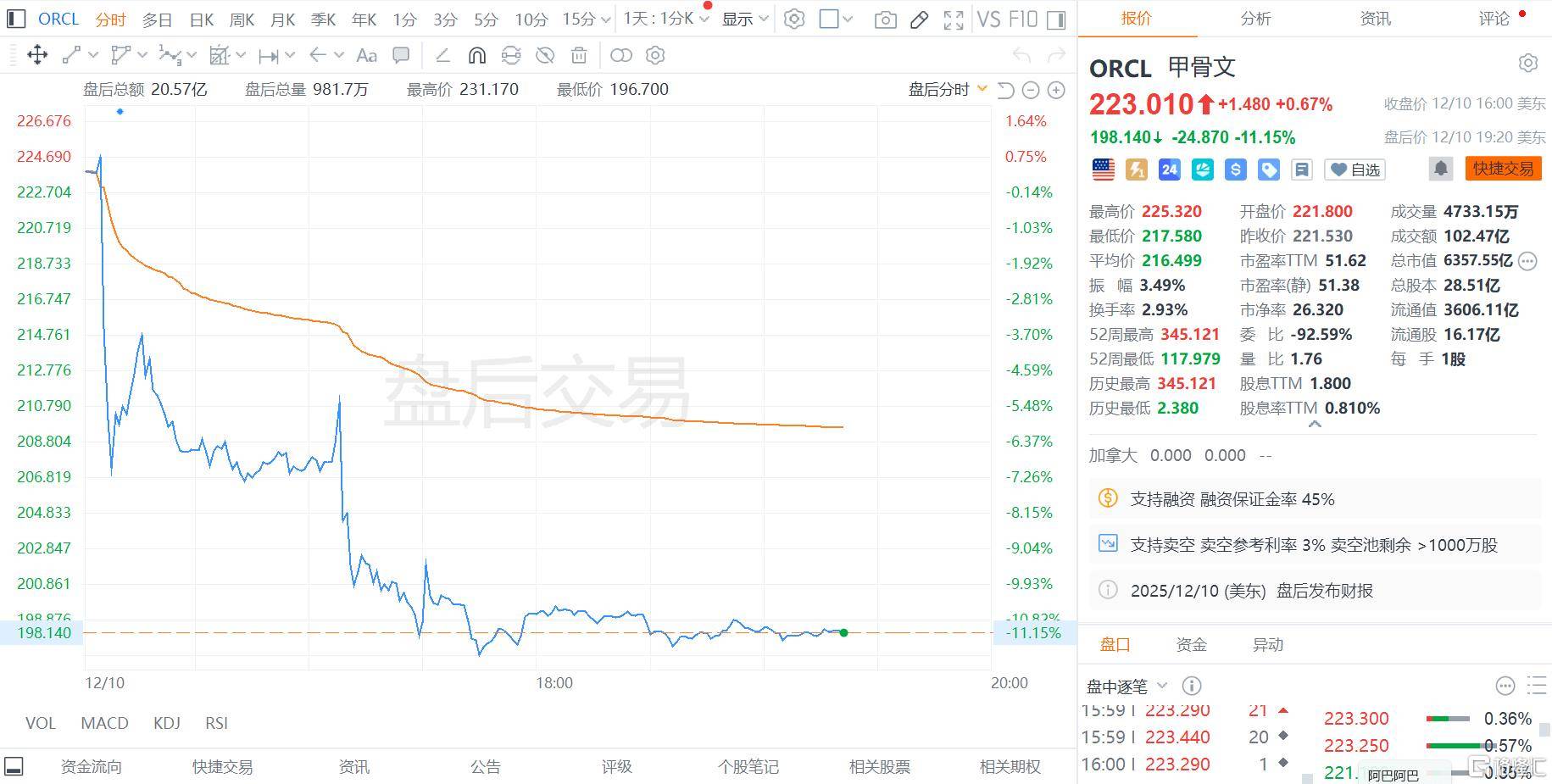
千亿债务堆算力,甲骨文(ORCL.US)的“AI豪赌”今夜迎来裁决时刻
Zhi Tong Cai Jing· 2025-12-10 01:44
Core Viewpoint - Oracle has experienced a tumultuous year, with a significant stock price drop in October, yet it has seen an overall increase of over 30% year-to-date, indicating investor interest in its position within the AI sector [1] Group 1: Financial Performance and Debt - Oracle's stock fell 23% in October, marking its worst monthly performance since 2001, but has rebounded with a nearly 10% increase in December [1] - The company raised $18 billion through a massive bond issuance, the largest in tech history, to fund its infrastructure plans [1] - As of August, Oracle's total debt reached $111.6 billion, up from $84.5 billion the previous year, while cash and equivalents decreased from $10.6 billion to $10.45 billion [2] - Analysts estimate Oracle will need to raise $20 billion to $30 billion in debt annually over the next three years to meet its growing capacity needs [2] Group 2: AI and Market Position - Oracle has become a key player in the AI sector, largely due to a $300 billion deal with OpenAI for computing power over the next five years [1] - The company is exploring various funding options, including off-balance-sheet financing and potential foreign investments, to support its AI initiatives [2] - Concerns have arisen regarding Oracle's ability to manage its debt while meeting the demands of clients like OpenAI [2] Group 3: Market Sentiment and Credit Risk - The rise in credit default swaps (CDS) for Oracle indicates growing investor anxiety about the company's financial stability amid its AI investments [4] - Analysts from Barclays and Morgan Stanley have recommended purchasing Oracle's five-year CDS as a hedge against risks associated with AI transactions [4] - Investors are advised to focus on companies actively adopting AI technologies rather than those merely spending on related technologies, as credit spreads are constraining capital expenditures [5] Group 4: Revenue and Growth Expectations - Analysts expect Oracle's revenue for the latest quarter to grow by 15% to $16.2 billion, with remaining performance obligations projected to exceed $500 billion, a fivefold increase from the previous year [5] - Oracle's remaining performance obligations surged by 359% to $455 billion in September, leading to a 36% stock price increase, although this gain has since been erased [5] - The core database business, which has higher profit margins, will be closely monitored to assess Oracle's flexibility in capital markets [6]
