
高技术制造业

Search documents
国内生产总值同比增长5.4% 一季度中国经济实现“开门红”
Bei Jing Shang Bao· 2025-04-16 07:37
另外,一季度,服务业增加值同比增长5.3%,比上年全年加快0.3个百分点。其中,信息传输、软件和信息技术服务业,租赁和商务服务业,交通 运输、仓储和邮政业,批发和零售业,住宿和餐饮业增加值分别增长10.3%、10.2%、7.2%、5.8%、5.1%5.3%的增速,在全球主要经济体中名列 前茅,。 盛来运表示:"增长稳中有升是一季度国民经济的特点。一季度GDP同比增长5.4%,高于去年全国5%的增速,也高于去年一季度延续了去年以来 持续稳中向好、稳中回升的态势。" 高质量发展向新向好 据国家统计局公布数据,一季度,高技术产业投资同比增长6.5%,其中信息服务业、航空航天器及设备制造业、计算机及办公设备制造业、专业 技术服务业投资分别增长34.4%、30.3%、28.5%、26.1%。 4月16日,国新办举行新闻发布会,介绍2025年一季度国民经济运行情况。据国家统计局发布的数据,经初步核算,一季度国内生产总值318758 亿元,按不变价格计算,同比增长5.4%,比上年四季度环比增长1.2%。"过去五年,由内需推动对经济增长的平均贡献率超过80%。2024年,'三 新'产业增加值占GDP比重已经超过18%,数字产 ...


3月PMI数据点评:新动能持续蓄势,价格仍是PMI的主要拖累
Zhong Cheng Xin Guo Ji· 2025-04-14 08:53
Group 1: PMI Data Insights - The manufacturing PMI for March 2025 is reported at 50.5%, an increase of 0.3 percentage points from the previous month[2] - The new orders index rose to 51.8%, up 0.7 percentage points, indicating improved demand[12] - The service sector PMI increased to 50.3%, reflecting a 0.3 percentage point rise, while the construction PMI reached 53.4%, the highest since June of the previous year[9] Group 2: Economic Trends and Challenges - Despite the positive PMI trends, the overall economic recovery remains weak, with manufacturing PMI still below seasonal averages[2] - The manufacturing sector is experiencing passive destocking, with finished goods inventory index dropping to 48.0%, indicating a supply-demand gap[4] - Price indices for both factory and raw material purchases fell by 0.6 and 1.0 percentage points, respectively, suggesting ongoing price pressures on profitability[4] Group 3: Sector Performance - High-tech manufacturing and equipment manufacturing sectors are showing significant recovery, with PMIs of 52.3% and 52.0%, respectively[4] - Small and medium-sized enterprises (SMEs) saw a notable rebound in PMI, with small enterprises reaching 49.6%, the highest level since June of the previous year[4] - The construction sector is facing challenges due to funding pressures and low new order indices, which fell to 43.5%[9]
3月制造业PMI回升至50.5%,需求回暖提振企业生产意愿
2 1 Shi Ji Jing Ji Bao Dao· 2025-03-31 12:09
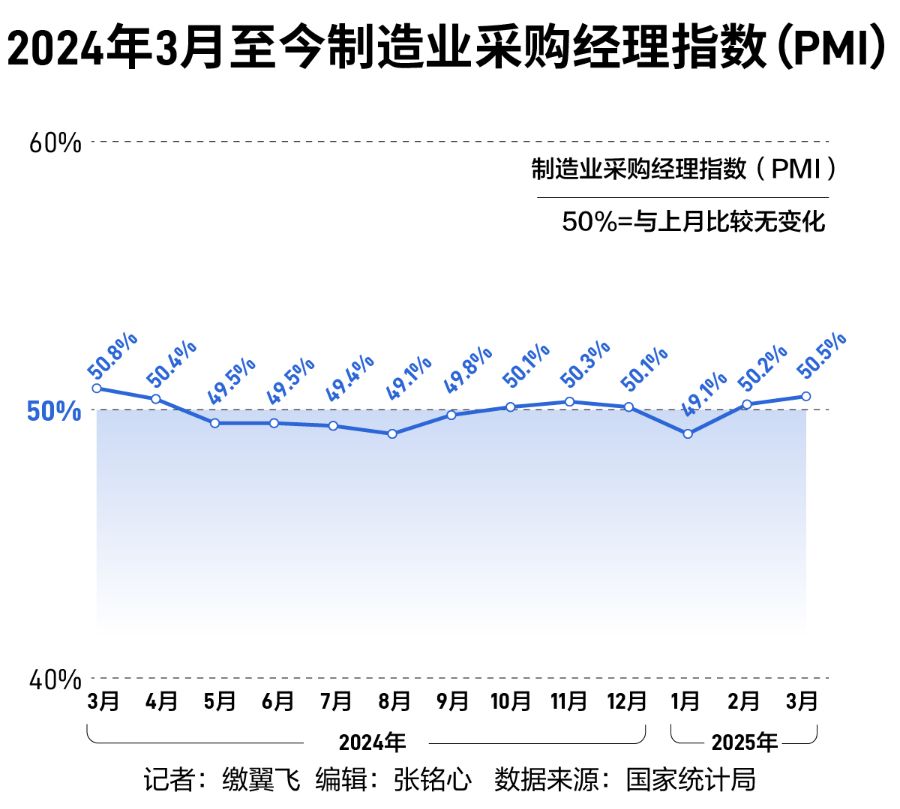
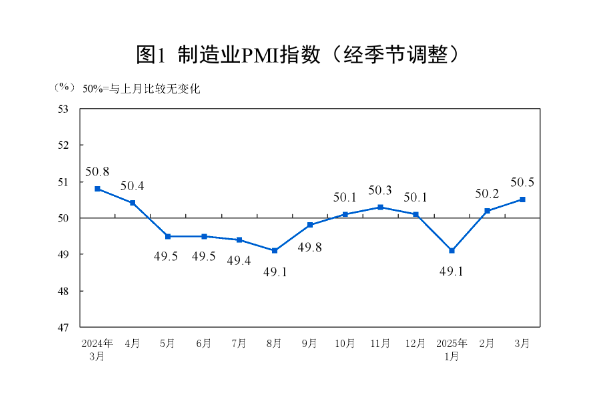
Core Viewpoint - The manufacturing Purchasing Managers' Index (PMI) in March rose to 50.5%, indicating a slight improvement in manufacturing activity compared to February, driven by seasonal factors, policy support, and technological innovations [1][4]. Manufacturing PMI Analysis - The production index, new orders index, new export orders index, and raw materials inventory index all increased, with rises between 0.1 to 0.7 percentage points [1]. - The new orders index reached 51.8%, up 0.7 percentage points from February, indicating sustained demand [4]. - The production index was at 52.6%, reflecting a continuous upward trend for two months [4]. Sector Performance - High-tech manufacturing sectors, such as railway, aerospace, and electronics, showed strong performance with production and new orders indices above 55.0% [6]. - Conversely, industries like wood processing and coal showed indices below the critical point, indicating supply-demand imbalances [6]. - The consumer goods manufacturing PMI rose to 50.0%, driven by policies promoting consumption [6]. Price Indices and Market Dynamics - The main raw materials purchase price index fell to 49.8%, while the factory price index dropped to 47.9%, indicating a supply surplus [7][8]. - The decline in prices is attributed to weak demand and increased production, particularly in the basic raw materials sector [7][8]. Future Outlook - The manufacturing sector is expected to continue its stable recovery in the second quarter, supported by government policies aimed at expanding domestic demand and promoting new urbanization [9]. - The manufacturing production and business activity expectation index was at 53.8%, indicating optimism among enterprises [9]. - However, potential challenges include the impact of increased tariffs on exports and the need for further stabilization in the real estate market [9].
【广发宏观郭磊】3月PMI的几个特征
郭磊宏观茶座· 2025-03-31 11:01
Core Viewpoint - The economy is continuing to improve, with March manufacturing PMI at 50.5, service PMI at 50.3, and construction PMI at 53.4, all showing month-on-month increases [1][4]. Group 1: Economic Indicators - The manufacturing PMI increased by 0.3 points from the previous month, while service PMI also rose by 0.3 points, and construction PMI saw a 0.7 point increase [1][4]. - The export order index has shown resilience, rising slightly, indicating external demand remains stable despite tariff pressures [1][5]. - Small enterprise PMI improved significantly by 3.3 points in March, reflecting better financial conditions [1][5]. - High-tech manufacturing PMI was reported at 52.3, indicating relative strength compared to previous periods [5]. Group 2: Recovery Characteristics - Despite some positive indicators, the overall data reflects a weak recovery, with manufacturing PMI lower than the previous year's value of 50.8 and below the historical average of 0.7 points for March [2][5]. - Service sector performance is also lagging, with March values lower than seasonal expectations, showing a cumulative decline compared to similar periods in previous years [5][6]. - The construction sector's performance is being hindered by insufficient support from infrastructure investments, as indicated by the lower demand from this sector [2][7]. Group 3: Price Indices and Employment - Both price indices showed a month-on-month decline, with expectations for March PPI indicating slight negative growth [10][12]. - Employment indicators in manufacturing, services, and construction sectors showed a decline in March, although the overall trend since September has been upward [12][13]. - The BCI enterprise hiring index also decreased, suggesting a cautious approach to hiring amid structural changes in labor demand [12][13]. Group 4: Future Outlook - The report suggests that the economic trajectory in 2025 may resemble that of 2016, with gradual improvements expected in consumer spending, local investment, and price indices [12][13]. - The overall economic growth is anticipated to experience fluctuations throughout the year, with a focus on validating the effectiveness of policy measures aimed at stabilizing growth [14].

制造业PMI连续两月回升,中小企业回稳运行
Di Yi Cai Jing· 2025-03-31 03:15
3月制造业生产经营活动预期指数为53.8%,连续6个月运行在54%左右的较好水平。 3月份,春节因素影响逐步消退,企业生产经营活动加快,制造业景气水平持续回升。 国家统计局3月31日发布的3月份制造业采购经理指数(PMI)为50.5%,比上月上升0.3个百分点,连续 两个月位于荣枯线之上。 中国物流与采购联合会特约分析师张立群认为,3月份PMI指数在荣枯线上继续小幅回升,表明经济回 升苗头更为明显。同时要注意到,采购量指数回落,购进价格指数和出厂价格指数均有回落,表明供大 于求的问题仍然突出;反映需求不足为主要困难的企业占比仍在60%之上,生产经营活动预期指数也有 所回落,企业恢复生产的信心仍然不足。 张立群表示,综合看,受政策推动经济初显回升态势,但基础还不稳定。要持续加大宏观政策逆周期调 节力度,特别要显著加强政府公共产品投资在扩大内需中的关键作用,坚持不懈地尽快改变市场引导的 需求收缩趋势。 供需两端协同增长 分企业规模来看,3月份大型企业PMI为51.2%,虽较上月下降1.3个百分点,仍保持在扩张区间,表明 大型企业增速虽有所放缓,但仍保持上升势头。大型企业生产指数保持在54%,新订单指数保持在接近 ...
700字!极简版政府工作报告来了
证券时报· 2025-03-05 02:10
Group 1 - The core viewpoint of the article emphasizes the government's economic goals for 2024 and 2025, focusing on growth, stability, and social development [1][2] - The GDP target for 2024 is set at 134.9 trillion yuan, with a growth rate of 5%, contributing approximately 30% to global economic growth [1] - The expected growth rate for GDP in 2025 is around 5%, with a focus on maintaining a stable urban unemployment rate of about 5.5% and creating over 12 million new urban jobs [1][2] Group 2 - The government plans to implement a more proactive fiscal policy with a deficit rate of around 4%, aiming for a deficit scale of 5.66 trillion yuan and issuing long-term special government bonds of 1.3 trillion yuan [2] - A moderately loose monetary policy will be adopted, including potential interest rate cuts to promote healthy development in the real estate and stock markets [2] - Key tasks for 2025 include boosting consumption, enhancing investment efficiency, and expanding domestic demand comprehensively [2]
2024年全国统计公报解读:稳中求进逐新而上
国新证券股份· 2025-03-03 12:31
Economic Performance - In 2024, China's GDP growth reached 5.0%, with the total economic output surpassing 130 trillion yuan for the first time[3] - The GDP growth in Q4 was 5.4%, accelerating by 0.8 percentage points compared to Q3[3] - Industrial added value increased by 5.7%, contributing 34.1% to economic growth, an increase of 12.7 percentage points[3] Sector Contributions - The service sector's added value grew by 5.0%, contributing 56.2% to economic growth, serving as a stabilizing force[3] - Domestic demand accounted for 69.7% of economic growth, highlighting its role as the main driver[3] - Net exports contributed 30.3% to economic growth, showing a significant improvement from the previous year[3] Emerging Industries - The share of high-tech manufacturing and equipment manufacturing in total industrial added value rose to 16.3% and 34.6%, respectively[4] - Notable growth in specific high-tech sectors included smart vehicle equipment (25.1%) and drones (53.5%)[4] Social Indicators - The urban unemployment rate averaged 5.1%, a decrease of 0.1 percentage points from the previous year[4] - Urban employment increased by 12.56 million, maintaining above 12 million for four consecutive years[4] - Per capita disposable income rose by 5.1%, with consumption expenditure also increasing by 5.1%[8] Food and Energy Security - In 2024, total grain production reached 1.413 trillion jin, marking the first time it exceeded 1.4 trillion jin[8] - Energy self-sufficiency remained above 80%, with coal production hitting a record 4.78 billion tons[8] Future Outlook - The economic growth forecast for 2025 is around 5%, with a stable foundation and strong potential for high-quality development[10] - The report highlights both opportunities and challenges for the upcoming year, emphasizing a favorable environment for growth[10]
东北第一座万亿城市,可能是它
创业邦· 2025-03-03 02:50
Core Viewpoint - The article discusses the potential for Dalian to become the first city in Northeast China to surpass a GDP of 1 trillion yuan by 2025, driven by strong economic growth and industrial development [1][3]. Economic Performance - Dalian's GDP reached 8752.9 billion yuan in 2023, with a growth rate of 6%, and is projected to grow to 9516.9 billion yuan in 2024, reflecting a year-on-year increase of 5.2% [3]. - The second industry in Dalian contributed significantly, with an added value of 3715.2 billion yuan in 2023, growing by 9% [3]. - In 2024, the second industry's growth rate is expected to be the highest among all sectors at 6.6% [3]. Industrial Development - Traditional industries such as petrochemicals and equipment manufacturing are performing well, with the Longxing Island Economic Zone's industrial output surpassing 2525.5 billion yuan in 2024, accounting for 29.7% of Dalian's industrial output [3][4]. - The high-tech manufacturing sector in Dalian saw an increase of 11.0% in added value in 2024, maintaining double-digit growth for 21 consecutive months [4]. Consumer Market - Dalian's total retail sales of consumer goods reached 2085.9 billion yuan in 2024, with a year-on-year growth of 3.9%, driven by significant increases in the sales of upgraded consumer goods [4]. Challenges and Opportunities - To achieve the 1 trillion yuan GDP target by 2025, Dalian needs to address gaps in its service industry, particularly in high-end services like financial innovation and technology research [5][6]. - Talent retention remains a challenge, as Dalian's competitive edge in salary and career opportunities lags behind first-tier cities, leading to talent outflow [6]. Regional Dynamics - Other cities in Northeast China, such as Shenyang and Changchun, are also targeting the 1 trillion yuan GDP milestone, with Shenyang projected to reach 9027.1 billion yuan in GDP in 2024 [8][9]. - Shenyang's government aims for a GDP growth of over 5.5% in 2025, which could position it to join the "trillion club" by 2026 [9]. Strategic Importance - The rise of Dalian and Shenyang is crucial not only for Liaoning Province but also for the overall economic revitalization of Northeast China, although geographical limitations may affect Dalian's regional influence [10].

重在政策落地——11月经济数据全面解读
泽平宏观· 2024-12-16 13:22
文:任泽平团队 12月16日,国家统计局发布11月主要经济数据。 11月规模以上工业增加值同比5.4%,10月同比5.3%; 11月社会固定资产投资当月同比2.3%,10月同比3.4%; 11月社会消费品零售总额同比3%,10月同比4.8%; 11月基建投资(不含电力)当月同比3.3%,10月同比5.8%; 11月房地产开发投资当月同比-11.6%,10月同比-12.3%; 11月房地产销售面积同比3.2%,10月同比-1.6%; 11月房地产销售金额同比1.0%,10月同比-1.0%; 11月制造业投资当月同比9.3%,10月同比10.0%; 11月出口(以美元计)同比6.7%,10月同比12.7%;11月进口(以美元计)同比-3.9%,10 月同比-2.3%; 11月M2同比7.1%,10月同比7.5%; 11月社融同比7.8%,10月同比7.8%; 11月CPI同比0.2%,10月同比0.3%; 11月PPI同比-2.5%,10月同比-2.9%。 1 扩大内需,提振信心, 重在政策落地 11 月部分经济指标回暖,政策效果显现,主要是工业生产、汽车消费、商品房销售和M1。 以旧换新、置换、报废补贴等政策对 ...