虚拟现实设备

Search documents
宇瞳光学成立科技新公司,含集成电路芯片业务
Qi Cha Cha· 2026-02-11 06:36
Core Viewpoint - Dongguan Yutong Optical has established a new technology company, Yutong Optical Intelligent Micro-Nano Technology Co., Ltd., focusing on integrated circuit chip manufacturing and related products [1] Group 1 - The new company has a registered capital of 20 million yuan [1] - The business scope includes manufacturing of integrated circuit chips, virtual reality devices, and smart vehicle-mounted equipment [1] - Yutong Optical holds 100% ownership of the new company [1]
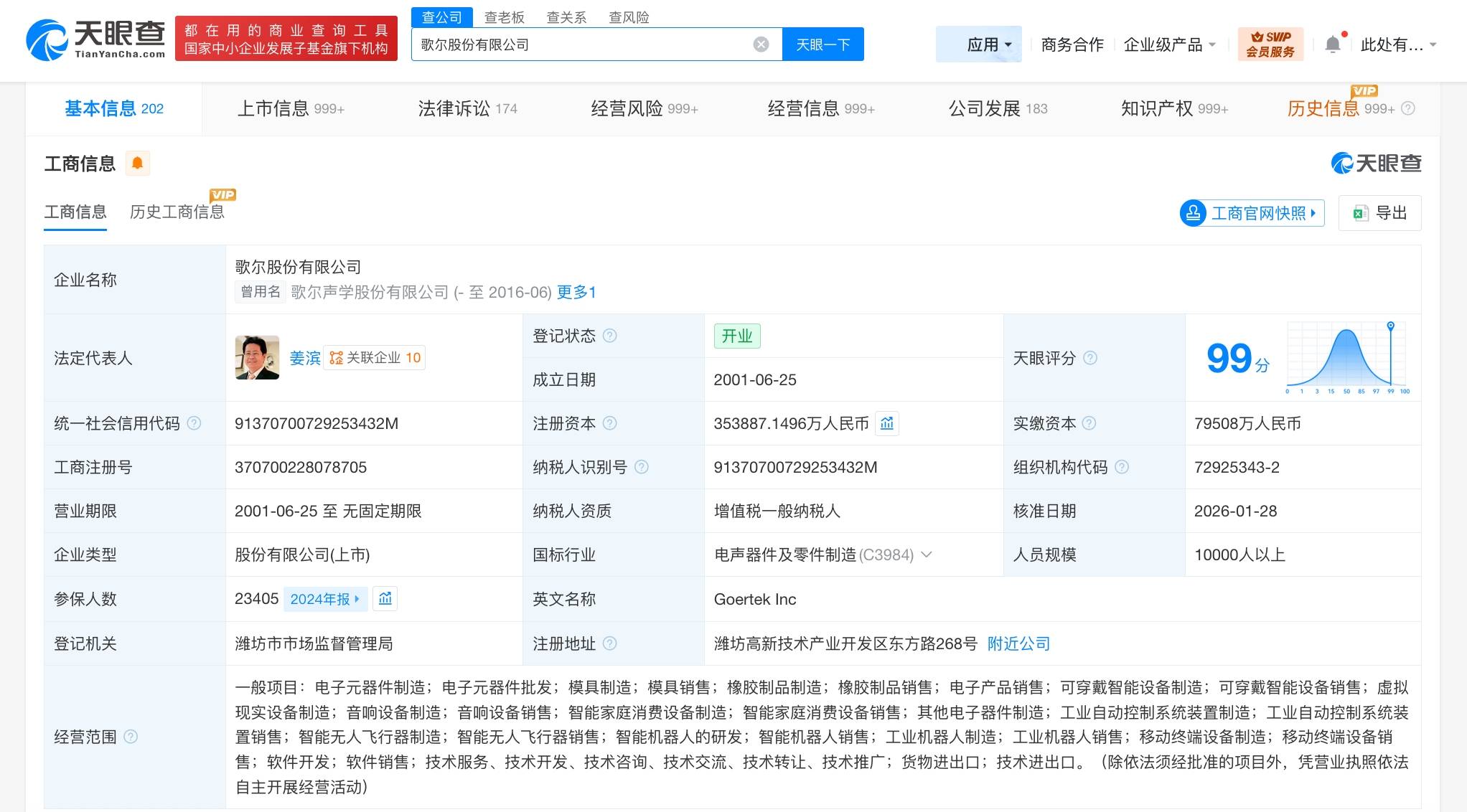
歌尔股份增资至35.4亿元
Sou Hu Cai Jing· 2026-02-10 04:23
Core Viewpoint - Goertek Co., Ltd. has recently increased its registered capital from approximately 3.42 billion RMB to about 3.54 billion RMB, representing an increase of approximately 3.6% [1]. Company Information - Goertek was established in June 2001 and is led by legal representative Jiang Bin. The company's business scope includes manufacturing and wholesale of electronic components, sales of electronic products, manufacturing and sales of wearable smart devices, manufacturing of virtual reality devices, sales of intelligent unmanned aerial vehicles, and research and development of intelligent robots [1][2]. - The company is jointly held by Goertek Group Co., Ltd., Jiang Bin, and Hong Kong Central Clearing Limited among others [1][3]. Shareholder Information - The major shareholders include Goertek Group Co., Ltd. as the largest shareholder, Jiang Long, and Hong Kong Central Clearing Limited [3].


国燕凌鹰(深圳)技术有限公司成立,注册资本5000万人民币
Sou Hu Cai Jing· 2026-02-03 19:16
Core Viewpoint - The establishment of Guoyan Lingying (Shenzhen) Technology Co., Ltd. signifies a strategic move into the intelligent unmanned aerial vehicle (UAV) market, with a registered capital of 50 million RMB and diverse shareholder participation [1] Company Summary - Guoyan Lingying (Shenzhen) Technology Co., Ltd. was recently founded with a legal representative named Wang Lingzhu and a registered capital of 50 million RMB [1] - The company is co-owned by three entities: Hainan Lingying Diko Technology Center (Limited Partnership) and Hainan Guoyan Diko Technology Center (Limited Partnership) each holding 30%, and both Sanqianchi (Shenzhen) Energy Co., Ltd. and Zhuhai Ziyan Unmanned Aerial Vehicle Co., Ltd. each holding 20% [1] Business Scope - The company's business scope includes the sale of intelligent unmanned aerial vehicles, mechanical equipment research and development, IoT technology research and development, software development, 5G communication technology services, electronic product sales, and various aviation support services [1] - Additional services include technology services, development, consulting, and transfer, domestic and international freight forwarding, virtual reality equipment manufacturing, cloud computing technology services, energy management contracts, emerging energy technology research and development, biomass energy technology services, unconventional water source utilization technology research and development, and investment activities using self-owned funds [1] Company Information - The company is classified under the scientific research and technical service industry, specifically in technology promotion and application services [1] - The registered address is located at Nanshan Cloud Valley Innovation Industrial Park, Shenzhen [1] - The company is structured as a limited liability company with an indefinite business duration starting from February 3, 2026 [1]
城记 | 长三角交出“十四五”亮丽答卷:5年超7万亿元增长显“引擎”担当
Xin Hua Cai Jing· 2026-01-30 07:16
Core Viewpoint - The Yangtze River Delta region (Shanghai, Jiangsu, Zhejiang, Anhui) has demonstrated strong economic resilience and growth potential, achieving significant GDP increases and maintaining its strategic position as a key driver of China's economic development [1][2]. Economic Performance - In 2025, the Yangtze River Delta achieved a GDP of 34.66 trillion yuan, an increase of 7.06 trillion yuan from 2021, with its share of national GDP rising from 24.1% to 24.7% [2]. - Jiangsu's GDP reached 14.24 trillion yuan in 2025, growing by 5.3%, marking it as the second province to surpass 14 trillion yuan after Guangdong [2]. - Zhejiang's GDP was 9.45 trillion yuan, with a growth rate of 5.5%, positioning it as the fourth largest economy in China [3]. - Shanghai's GDP was 5.67 trillion yuan, growing by 5.4%, maintaining its status as the leading city in the country [3]. - Anhui's GDP reached 5.30 trillion yuan, with a growth rate of 5.5%, showcasing its rapid economic development [3]. Foreign Trade and Consumption - The Yangtze River Delta has excelled in foreign trade, with Jiangsu, Zhejiang, and Shanghai ranking second, third, and fourth in national import and export totals, respectively [4]. - In 2025, Jiangsu's foreign trade reached 5.95 trillion yuan, while Zhejiang and Shanghai reported 5.55 trillion yuan and 4.51 trillion yuan, respectively [4]. - The region's foreign trade resilience is highlighted by a significant increase in exports of high-tech products, including electric vehicles and industrial robots [4][6]. - Shanghai's retail sales of consumer goods surpassed 1.6 trillion yuan in 2025, growing by 4.6%, reflecting a strong consumer market [7]. - Jiangsu's retail sales reached 4.6 trillion yuan, with a growth of 3.3%, making it the largest in the country [7]. Structural Optimization and New Drivers - The Yangtze River Delta is transitioning towards innovation-driven growth, with Shanghai's leading industries showing significant production value increases [8]. - In 2025, Shanghai's manufacturing output grew by 9.6%, with the integrated circuit and artificial intelligence sectors seeing substantial growth [8][10]. - Jiangsu's high-tech industry accounted for 52.1% of its industrial output, with significant increases in the production of optical devices and lithium batteries [10]. - Anhui's high-tech manufacturing output grew by 30.4%, indicating a strong industrial growth trajectory [11]. - The digital economy is also accelerating, with Jiangsu's core digital manufacturing output increasing by 10.2% [10].
地区经济迎难而上向新向优
Jing Ji Ri Bao· 2026-01-29 01:53
Core Viewpoint - The economic growth data for 31 provinces in 2025 indicates that despite external challenges and domestic difficulties, local governments are effectively implementing macro policies, leading to stable economic performance and a shift towards high-quality development [2] Economic Performance - In 2025, the top ten provinces by GDP are Guangdong, Jiangsu, Shandong, Zhejiang, Sichuan, Henan, Hubei, Fujian, Shanghai, and Hunan, with a combined GDP of approximately 85.5 trillion yuan, contributing over 60% to the national GDP [3] - Guangdong's GDP reached 14.58 trillion yuan, growing by 3.9%, maintaining its position as the largest economy in China for 37 consecutive years [3] - Jiangsu's GDP surpassed 14 trillion yuan for the first time, reaching 14.23515 trillion yuan [3] - Shandong's GDP crossed the 10 trillion yuan mark, reaching 10.3197 trillion yuan, becoming the third province to achieve this milestone [3] - Zhejiang's GDP reached 9.4545 trillion yuan, marking significant growth [3] Growth Rates - 20 provinces achieved growth rates equal to or above the national average, with Tibet leading at 7.0% growth [5] - Gansu and Henan both recorded a growth rate of 5.6%, with Henan being the top-performing economic province in central China [5] - Other provinces such as Hebei, Shandong, and Zhejiang reported growth rates of 5.5% [5] New Economic Drivers - The development of new productive forces is emphasized as a key requirement for high-quality growth, with a focus on integrating technological and industrial innovation [6] - Traditional industries are undergoing significant upgrades, with Shandong's investment in equipment and tools rising by 22.6% in 2025 [6] - Emerging industries are also thriving, with Beijing's strategic emerging industries and high-tech manufacturing increasing by 15.5% and 7.5%, respectively [6] New Product Output - In 2025, Guangdong's drone production increased by 39%, while industrial robot production rose by 31.2% [7] - Zhejiang saw substantial growth in the production of virtual reality devices and lithium-ion batteries, with increases of 96.8% and 65.2%, respectively [7] Consumption Trends - Jiangsu's retail sales of consumer goods reached 4.6 trillion yuan, becoming the highest in the country [8] - In Henan, the establishment of popular live-streaming e-commerce bases has contributed to the growth of new consumption patterns [8] Future Development Plans - The focus for 2026 includes expanding domestic demand, developing new productive forces, and optimizing the business environment [9] - Local governments are prioritizing support for education, health, and service consumption, alongside promoting major projects to attract private investment [9] - Guangdong and Zhejiang are pushing for the integration of smart and green development across industries, aiming to enhance competitiveness [10]
三省份地区生产总值超十万亿元 地区经济迎难而上向新向优
Jing Ji Ri Bao· 2026-01-28 23:29
Economic Growth Overview - In 2025, 31 provinces have released their economic growth data, showing a steady improvement in economic operations despite external challenges and domestic difficulties [1] - 20 provinces achieved growth rates that met or exceeded the national average, with several provinces reaching new economic milestones [1] Key Economic Contributors - The top ten provinces by GDP in 2025 are Guangdong, Jiangsu, Shandong, Zhejiang, Sichuan, Henan, Hubei, Fujian, Shanghai, and Hunan, collectively contributing over 60% of the national GDP with a total of approximately 85.5 trillion yuan [2] - Guangdong's GDP reached 14.58 trillion yuan, growing by 3.9%, maintaining its position as the largest economy in the country for 37 consecutive years [2] - Jiangsu's GDP surpassed 14 trillion yuan for the first time, achieving 14.23515 trillion yuan [2] - Shandong's GDP crossed the 10 trillion yuan mark, reaching 10.3197 trillion yuan, making it the third province to do so [2] - Zhejiang's GDP reached 9.4545 trillion yuan, marking significant growth [2] Growth Rates - Tibet led the growth with a 7.0% increase, while Gansu and Henan both grew by 5.8% and 5.6%, respectively [4] - Other provinces with notable growth rates include Hebei, Shandong, Zhejiang, Sichuan, Hubei, and others, all showing growth rates around 5.5% [4] New Economic Drivers - The development of new productive forces is emphasized as a key requirement for high-quality growth, with a focus on integrating technological and industrial innovation [5] - Traditional industries are undergoing significant upgrades, with Shandong's investment in equipment and tools increasing by 22.6% in 2025 [5] - Emerging industries are also thriving, with Beijing's strategic emerging industries and high-tech manufacturing sectors growing by 15.5% and 7.5%, respectively [5] Product Output Growth - Guangdong's production of drones increased by 39%, while industrial robot production grew by 31.2% [6] - Zhejiang saw substantial growth in the production of virtual reality devices, lithium-ion batteries, and new energy vehicles, with increases of 96.8%, 65.2%, and 49.8%, respectively [7] Investment and Consumption Trends - In Hunan, private investment accounted for 65.2% of total investment, reflecting economic vitality [7] - Jiangsu's retail sales of consumer goods reached 4.6 trillion yuan, leading the nation [7] Future Economic Planning - As 2026 marks the beginning of the "14th Five-Year Plan," provinces are focusing on expanding domestic demand, developing new productive forces, and optimizing the business environment [8] - Key areas of focus include enhancing support for service consumption and promoting major projects to attract private capital [8] - The emphasis on technological innovation and improving the business environment is evident in various provincial government reports [9]
三省份地区生产总值超十万亿元——地区经济迎难而上向新向优
Jing Ji Ri Bao· 2026-01-28 21:56
Economic Growth Overview - In 2025, 31 provinces in China have released their economic growth data, showing a steady improvement in economic operations despite external challenges and domestic difficulties [1] - 20 provinces achieved growth rates that met or exceeded the national average, with several provinces reaching new economic milestones [1] Key Economic Contributors - The top ten provinces by GDP in 2025 are Guangdong, Jiangsu, Shandong, Zhejiang, Sichuan, Henan, Hubei, Fujian, Shanghai, and Hunan, collectively contributing over 60% of the national GDP with a total of approximately 85.5 trillion yuan [2] - Guangdong's GDP reached 14.58 trillion yuan, growing by 3.9%, maintaining its position as the largest economy in China for 37 consecutive years [2] - Jiangsu's GDP surpassed 14 trillion yuan for the first time, achieving 14.23515 trillion yuan [2] - Shandong's GDP crossed the 10 trillion yuan mark, reaching 10.3197 trillion yuan, making it the third province to do so [2] - Zhejiang's GDP reached 9.4545 trillion yuan, marking significant growth [2] Economic Performance by Province - Four provinces are in the "6 trillion" yuan range: Sichuan (6.7665 trillion yuan), Henan (6.6632 trillion yuan), Hubei (6.2661 trillion yuan), and Fujian (6.0199 trillion yuan) [3] - Four provinces are in the "5 trillion" yuan range: Shanghai (5.6709 trillion yuan), Hunan (5.5309 trillion yuan), Anhui (5.2989 trillion yuan), and Beijing (5.2073 trillion yuan) [3] Growth Rates - 20 provinces achieved growth rates that met or exceeded the national average, with Tibet leading at 7.0% growth [4] - Gansu and Henan both recorded a growth rate of 5.6%, with Henan being the top-performing economic province in central China [4] - Other provinces with notable growth rates include Hebei (5.6%), Shandong, Zhejiang, Sichuan, Hubei, Anhui, and Xinjiang (all at 5.5%) [4] Innovation and New Industries - There is a strong emphasis on developing new productive forces as part of high-quality development, with a focus on integrating technological and industrial innovation [5] - Traditional industries are undergoing significant upgrades, with Shandong's investment in equipment and tools increasing by 22.6% in 2025 [5] - Emerging industries are also thriving, with Beijing's strategic emerging industries and high-tech manufacturing sectors growing by 15.5% and 7.5%, respectively [5] New Product Production - In 2025, Guangdong's production of drones increased by 39%, accounting for 90% of the national total, while industrial robot production grew by 31.2% [6] - Zhejiang saw significant growth in the production of virtual reality devices (96.8%), lithium-ion batteries (65.2%), and new energy vehicles (49.8%) [7] Investment and Consumption Trends - Investment structures are improving, with private investment in Hunan accounting for 65.2% of total investment, reflecting a 1.3 percentage point increase [7] - New consumption patterns are emerging, with Jiangsu's retail sales reaching 4.6 trillion yuan, making it the top province in this regard [7] Future Economic Planning - As 2026 marks the beginning of the "15th Five-Year Plan," provinces are focusing on expanding domestic demand, developing new productive forces, and optimizing the business environment [8] - Key areas of focus include enhancing support for education, health, and service consumption, as well as promoting innovation in various sectors [9]
2025年浙江GDP达94545亿元 新质产品供给增势强劲
Zhong Guo Xin Wen Wang· 2026-01-23 01:55
Economic Performance - In 2025, Zhejiang's GDP reached 94,545 billion yuan, growing by 5.5% year-on-year at constant prices [1] - The primary industry added value was 2,657 billion yuan (3.9% growth), the secondary industry 35,682 billion yuan (5.1% growth), and the tertiary industry 56,206 billion yuan (5.8% growth) [1] Artificial Intelligence Sector - From January to November 2025, the core AI industry in Zhejiang generated revenue of 6,294 billion yuan, marking a 21.6% year-on-year increase [2] - Key areas of growth included data services (35.4%), computing power services (31.8%), smart terminals (10.8%), and algorithm models (9.9%) [2] Emerging Industries - In 2025, high-tech manufacturing, digital economy core industries, equipment manufacturing, and strategic emerging industries in Zhejiang saw value-added growth rates of 12.4%, 11.3%, 10.5%, and 10.0% respectively [2] - Rapid production increases were noted in new products such as virtual reality devices (96.8%), lithium-ion batteries (65.2%), new energy vehicles (49.8%), industrial robots (36.4%), laptops (27.5%), and service robots (27.0%) [2] Private Economy - In 2025, the added value of private enterprises in Zhejiang's industrial sector grew by 7.2%, contributing 77.7% to the growth of the industrial sector [4] - The province had 123,000 private enterprises with export performance, an increase of 11.8%, with total import and export volume reaching 4.56 trillion yuan, up 7.1% [4] Income Distribution - The per capita disposable income for all residents in Zhejiang reached 70,240 yuan, a nominal increase of 4.8% year-on-year [4] - Urban and rural per capita disposable incomes were 81,649 yuan and 45,154 yuan, growing by 4.3% and 5.5% respectively, with the urban-rural income gap narrowing to 1.81 [4]

“北方第二城”险易主?青岛未能反超天津
Sou Hu Cai Jing· 2026-01-22 10:44
Core Insights - Qingdao's GDP is projected to exceed 1.7 trillion yuan, while Tianjin's GDP stands at 1.85 trillion yuan, indicating a gap of approximately 100 billion yuan between the two cities [1] - In the first three quarters of 2025, Tianjin's GDP reached 1.3416 trillion yuan with a growth rate of 4.7%, while Qingdao's GDP was 1.3373 trillion yuan, growing at 5.4%, narrowing the gap to 42.61 billion yuan [2][4] - The competition for the title of "Northern Second City" is intensifying, with Qingdao's growth trajectory suggesting a potential overtaking of Tianjin [2] Economic Performance - In the first three quarters of 2025, Qingdao's GDP was 1.3373 trillion yuan, with quarterly contributions of 407.13 billion yuan, 451.60 billion yuan, and 478.61 billion yuan [3] - Tianjin's GDP for the same period was 1.3416 trillion yuan, with quarterly contributions of 419.43 billion yuan, 451.23 billion yuan, and 470.95 billion yuan, resulting in a total gap of 42.61 billion yuan [3] Historical Context - Historical data shows that in 2000, Qingdao surpassed Dalian and Shenyang to become the "Third City in the North" after Beijing and Tianjin [3] - In 2015, Tianjin's GDP was 17.2 trillion yuan compared to Qingdao's 9.4 trillion yuan, marking a significant gap of 7.8 trillion yuan [4] Industrial Growth - Qingdao's industrial output value increased by 7.7% in the first three quarters of 2025, driven by significant growth in emerging industries such as optical electronics and integrated circuits [5] - Tianjin's industrial output value growth was 4.5%, with key industries like biomedicine and vehicle networking showing strong performance [5] Future Prospects - Qingdao aims to reach a GDP of 2 trillion yuan by 2027, focusing on advanced manufacturing, marine economy, modern services, and technological innovation [6][9] - The service sector has become a crucial support for Qingdao's economy, contributing 64.3% to GDP in the first three quarters of 2025 [9]

浙江2025年GDP达94545亿元,同比增长5.5%
Guo Ji Jin Rong Bao· 2026-01-22 10:37
Economic Performance - Zhejiang's GDP reached 94,545 billion yuan in 2025, with a year-on-year growth of 5.5%, surpassing the national average by 0.5 percentage points [1] - The province has established a robust economic foundation with three cities—Hangzhou, Ningbo, and Wenzhou—each exceeding a GDP of 1 trillion yuan [1] Industry Development - The three major industries in Zhejiang have shown coordinated development, with the tertiary sector being the main driver of economic growth, achieving a value-added of 56,206 billion yuan and a growth rate of 5.8% [2] - The industrial sector's value-added increased by 6.2%, with significant contributions from high-tech manufacturing and emerging industries, which saw growth rates of 12.4%, 11.3%, 10.5%, and 10.0% respectively [2] Trade and Export - Zhejiang's total import and export volume reached 5.55 trillion yuan in 2025, growing by 5.4%, with exports at 4.19 trillion yuan (up 7.2%) and imports at 1.36 trillion yuan (up 0.3%) [3] - The province's exports of green products, such as "new three samples" and wind turbine generators, increased by 28.1% and 98.2% respectively, highlighting a shift towards sustainable trade [3] Wenzhou's Economic Growth - Wenzhou's GDP surpassed 1 trillion yuan, marking a significant milestone and joining the ranks of China's trillion-yuan cities [3] - The city has seen a population increase from 9.573 million in 2020 to 9.852 million in 2024, indicating a strong demographic trend [4] Infrastructure Development - Zhejiang is focusing on infrastructure improvements to address existing gaps, with significant projects like the opening of Jiaxing Nanhu Airport and the completion of Hangzhou-Qiuhai High-speed Railway [5][6] - The province aims to enhance its infrastructure to support high-quality development, with a modernized transportation and energy system being a priority [6][7] Innovation and Technology - The artificial intelligence sector in Zhejiang has shown remarkable growth, with core industry revenue reaching 629.4 billion yuan in 2025, a year-on-year increase of 21.6% [7][8] - The province is actively promoting the "Artificial Intelligence +" initiative, integrating new technologies into traditional industries to drive economic transformation [8]